“Stones,” rolling slowly and backwards

Nine days ago I started this Halloween Series with my sung adaptation of a graveyard poem by Robert Frost. Now we’re nearing the end of the series, and today I’m going to present another graveyard poem that sits with my sense of Halloween, Ethna McKiernan’s “Stones.”

I also promised in the beginning of the series that I would say why I’ve decided to make an extra effort to note Halloween. Decades ago, I met a young man (we were both young then) who had many interests, John Brower. The immediate bond: we both loved unusual music, not just strange or adventurous Rock that one could find in many a large record store back then, but harder to find Modernist orchestral music, and the even harder to find musics from other cultures around the globe. John also had a strong interest, much stronger than mine, in fantasy and horror genre fiction and film. What links those two groupings? For one thing, they were outsider-ish things then. If you want direct evidence of this mysterious connection you only need to investigate the trope of using the musics of the first of John’s interests with the movies and TV shows within his second one. The first signals the second: dread, tension, and the unknown. Scary movie, unknown planet, unsettled minds, eldritch times and places, it was a good chance that the less tonal string sections, the theremins and early electronica, the gongs or tuned percussion, the swooping vibratos and strange timbres of otherwise unheard avant-garde or exotic musics would emerge in the soundtrack. In the obverse, can anyone think of a well-known happy or loving scene similarly soundtracked with odd music? I can’t.*

But that doesn’t explain John. He gathered about him an eclectic mix of folks interested in these things, many of whom would be loners by inclination or classification. And every Halloween he would take them into the dark autumn north woods to his family’s cabin for a celebration of the holiday of the things less -heard than feared, we all in this group lit by the light of frightening movies until deep into the night.**

John grew up, continued to be engaged in many things, keeping those core interests and working to foster them. Then he died suddenly, while still young by the way I’d measure lifetimes from my current age.

There so much more to his story, and I’m sure parts I don’t really know, but within the briefness I prefer for these posts I want to say that I learned things from John and his enthusiasms, and in the scattered pre-Internet age he was a rare ear interested in some of the things that I spent my time thinking about and seeking out. Two decades after his death, I still will hear a piece of music, see a movie referred to, or encounter a piece of dark fantasy, and I’ll think of John, remembering some of what he thought of it, or I’ll be occasioned to consider what he might say about it today,

John had this spirit of Halloween, the old spirit of the things we repress and shush-up the rest of the year. Now, long after his death, and the death of others who so graciously tolerated and helped inform my interests in music and poetry, I have this personal graveyard in my head that I’m tending. As the Blues Poet Bo Diddley sang, I find “I’ve got a tombstone hand and a graveyard mind…”
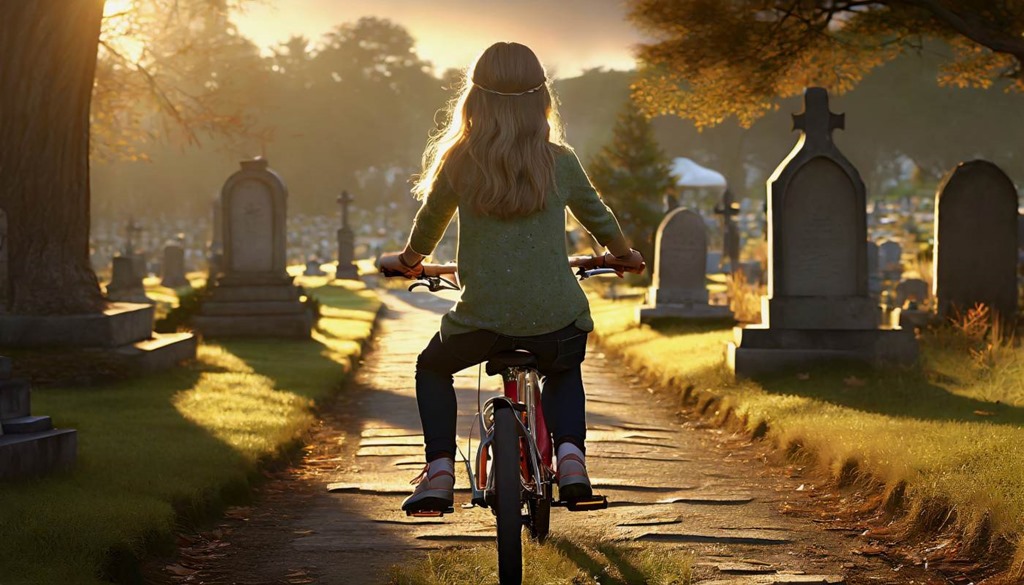
Stones Illustration 800

One of the most striking and effecting poems in my Halloween Series, Ethna McKiernan’s Stones. If you want more, and I’m thinking some of you will, buy her book, linked below.

..

Which brings me to today’s poem I set to music. Regular readers may recall Ethna McKiernan from earlier posts. She was part of a small poet’s group alternate Parlando voice Dave Moore and I were part of — and unlike Dave or I, she published her poetry regularly both locally and via her connection with Ireland.***  She died nearly two years ago now, but in my head she has a mind’s gravestone like my late wife, like John Brower, like Ethna’s friend and poet compatriot Kevin FitzPatrick.

Poets, musicians — we play in our heads all the time. We look back at inscribed dates inside there, and compose in that dark using beats and sounds strung over time. Those beats come to rests, those sounds fade to silence. When I set Ethna’s poem “Stones”  to music I chose to refrain a line from her beautiful poem so that it won’t end before you pay attention to it: “I am watching over all of you.” In Ethna’s poem that line is hauntingly unclear by design. We the living are charged with watching over our personal graveyards. We hope, transparently and by wisps of sight, that their residents are also watching over us.

Happy, yes, Happy Halloween that we knew them. The audio player to hear me trying to do justice to Ethna McKiernan’s poem “Stones”  with my own music and performance is below. No player on your screen? This highlighted link will open a new tab which will supply you with an audio player.

.

*While the avant-garde or the exotic was only used for terror and unrest, for some reason the foundational composer of western classical music, Johan Sebastian Bach was the other go-to music for frightening undercurrents. Why? As young children, did filmmakers sit under towering pipe organ tubes fearing that wolves would appear out of that forest, or that teetering from low notes, that they would fall over and crush them?

**John was one of the first folks I knew with a home VCR, and even as video rental stores started to emerge he proudly purchased movies he admired, just has he collected esoteric avant-garde records, and small-press books. Neither of these things were inexpensive to his income level then, but he considered this his form of patronage of artists and their art.

***As she was dying, Ethna finished her final new and collected book, and it’s very very good. You can order Light Rolling Slowly Backwards  from your local bookstore or from the publisher at this link.

Arthur Hoehn: A Radio Romance

I hear that today is something called National Radio Day. I read that on social media, which I suspect in turn will be a strange artifact to be explained to unformed young people of some yet undisclosed future. After all, as I write tonight I have doubts I’ll be able to convince any current young people of the romance of radio.

I grew up midcentury in what was supposed to be the TV age, but TV was a very constrained and arid thing then. TV was usually one set in the living room with maybe 3 or so channels receivable. It signed off in the evening, came back on with the dawn, and presented one thing at a time under the control of a schedule that could be memorized by its viewers. Radio may have been the old tech, but it was richer, stranger, more able to surprise with chance. Kids had their own radios, cars had radios, and the talking/singing boxes continued all night — and radio was never stranger than at night. Small local stations were required to dim their watts and disappear at sundown, and then certain stations would appear like the night stars, receivable across the countryside with varying reception. In my tiny Iowa town I ran an antenna wire out my window to an apple tree branch outside. The radio’s tubes glowed and Chicago and WLS were certain. KOMA in Oklahoma too. Detroit and Tennessee sometimes.

To be honest, I don’t recall hearing the famous super high-powered mid-century Mexican X stations. Maybe I did for moments — listening to the radio at night meant that stations would sometimes drift in and out, so I might not have heard every call sign. One of those stations, XERB, had a DJ and program director who was too unremarkable as his given name Bob Smith, and so became Wolfman Jack. At XERB he had an on-air compatriot named Fat Daddy Washington.*  But today’s piece isn’t about the Wolfman. It’s about Fat Daddy Washington.

You see it’s not just those night-time radio signals that jumped around and changed with the stars. Just as Wolfman Jack had been Bob Smith, and “Daddy Jules,” and “Roger Gordon and the Music of good Taste” as he bounced around formats and jobs; Fat Daddy Washington was not some longtime hepcat, but a kid just a few years out of St. John’s University, a Roman Catholic affiliated college tautologically located in Collegeville Minnesota. “Washington” had worked at the college’s radio station under his real name Arthur Hoehn.

Now let’s zoom in on the “Summer of Love” in 1967. For some reason Hoehn headed back to his old school in north central America from its southwest corner, driving in a sharp new Thunderbird. There’s a story there I’m not privy too. Was he going to impress old schoolmates with his newfound flash — a not uncommon move? That doesn’t sound like the unassuming Arthur I later knew a bit. Was he possibly out of a job at the X? Plausible. When he arrived back in Collegeville, he ran into one of those schoolmates, a guy named Bill Kling who wanted to expand and professionalize the college radio station.** Kling later told the story that Hoehn unilaterally offered to help out. Kling joked years later that he wasn’t even sure he paid him at first. However, Hoehn was also recalled as what became Minnesota Public Radio and American Public Media’s “first professional DJ hire.” Since the Collegeville station played classical music with news breaks, I’m not sure that Hoehn’s Fat Daddy Washington mic-time at the heavily R&B oriented X was much featured in their early pitches for funds.

unknown-barone-hoehn-unk-eichten-unk

Earlier in this century, MPR/APM employees tried to ID all the people in this early staff picture posted at our headquarters. The only ones I knew from my time were Michael Barone (2nd from left), Arthur Hoehn (3rd from l) and Gary Eichten (5th from l)

.

By the time I worked alongside Hoehn his regular gig under his given name was working the overnight shift as the host of a classical music program “Music through the Night.”***  If nighttime is the right time to maximize that romance, I’ll still tell you that when I’d actually run into Hoehn it wasn’t romantic. Radio in the flesh rarely is, and nighttime shifts are no place to dress for success or to put on a show of supercilious professionalism. Hoehn would likely be wearing comfy wild-print Zubaz lounging pants and a nondescript open collar shirt. We’d likely nod at each other knowing we each had a job to do.

When broadcasting live (as Hoehn did) the radio host is near alone even in larger stations and networks, and they can expect that most of their listeners are also sameways singular. There might be someone in the next room asleep or another driver in some light-pool car transiting the passing lane, but the listeners are each alone with the host and his record’s vinyl voices, like-black pianos, and sleep-breathing strings. They may be listening to you to try to fall asleep, they may be listening to you because they just don’t want to go to sleep right now, they could be in love full of bright energy, or just out of love and wanting company, they may be working a night shift like you, they could even be — as I watched my father-in-law one night — in a hospital bed awaiting death with the radio murmuring the needle-dancing angels of this side of life.****

Though some old folks reading this will remember this with me on Radio Day — young people, you likely didn’t/don’t live this. Yet I’m writing this more for you. I’ll allow that this is likely as imaginary as any fantasy world for you. But this went on once upon a time. The feeling of the romance of radio, intensified by nighttime, was as real as any current or future fantasy is, and so this has the value of any fantasy tale, as an exercise for imagination, and as a demonstration that shared fantasies can dissolve into air like dew after dawn.

When my coworker Arthur Hoehn died in 2011, I thought: there are a number of songs about DJs, but the music these song-celebrated DJs play is inevitably jazz, r&b, or rock. What about the man alone playing orchestral instrument music, likely in recall/remembrance of those classical “dead guys” compositions, while most of the world sleeps for a few hours in the little analog of death. Is that goth or what?

A performance of the song “Arthur Hoehn”  I wrote is below, recorded soon after Arthur’s death. You can play it with the graphical player if you see that, or with this alternative highlighted link.

.

*Wolfman Jack the nighttime DJ was featured as a romantic mentor to the kids in the movie American Graffiti, and parlayed that role into a larger TV and radio broadcasting career in the 1970s. It’s a point too large to deal with in a footnote, but some white DJs in this time-frame took on portions of Afro-American argot and signifying. Given that American popular music in general has done likewise before and after Wolfman Jack and Fat Daddy Washington, I’ll leave this as a footnote.

Here’s a link to blog post about XERB, with a contemporary flyer saying of Hoehn show  “’Fat Daddy; Washington, one of the heaviest swingers in the world, presents 9 tons of soul and is a real “mama’s’ man.”

**Several other Collegeville student-station alums were part of the early MPR/APM core. Longtime news program host Gary Eichten was another. Pipe organ enthusiast Michael Barone too. And another who cut his teeth hosting classical music only to break from that into a unique combination of oral story-telling mixed with musical variety: Garrison Keillor.

Coincidentally, I’ve just realized that I believe my High School English teacher Terry Brennan who introduced me to Keats, Frost, Donne et al in my tiny Iowa town was just out of St. John’s too. If so, it’s highly likely that he was an overlapping classmate of some of those folks. Odd to put that together decades later!

***Eventually this program with Hoehn hosting was syndicated live around the country via satellite (yes, they used satellites, not the still nascent Internet, to do that then). One of the national listeners who sent a fan letter: Joan Baez. Baez also worked in the Sixties with Peter Schickele, who I met in my first month at the network headquarters.

****Other famous overnight DJs? Alison Steele “The Nightbird” was the overnight FM rock DJ in the late 60s-early 70s on NYC’s WNEW-FM and had no-less than Jimi Hendrix as her recorded praise-singer. A British guy in the American southwest conned his way onto the air as an experienced DJ (he wasn’t) during the early days of the British invasion in the early 60s. He broadcast on “KOMA in Oklahoma” one of those “clear channel” stations that I could reliably get in Iowa at night, though he had the early morning shift there. His air name was John Peel, and he went back to the UK and worked for pirate Radio London with the “London After Midnight”  show which in 1967 became “The Perfumed Garden”  launching many an underground rock group in England with his eclectic playlists before a subsequent long and influential broadcasting career. I’ve never even heard air-checks, but musician/writer Tony Glover had an overnight “underground” rock show on KDWB in Minneapolis during the Sixties that some recall with fondness.