Beautiful Justice

This poem by the French Surrealist poet Paul Éluard wandered into my view earlier this month, and it seems like it, and my work translating it into English, slots right in between my late wife’s poem I performed last time and this Saturday’s planned #NoKings protests planned around America.

I’ve mentioned earlier this year that in my youth I became interested in the French Modernists because I had gotten the impression that they were a key force in English-language Modernism. Later, from my work for the Parlando Project, I came to learn that this is only partially so. I wasn’t far into the Project when I realized that there was in London before WWI (at that time still the center of English-language literature) a “reverse British Invasion” going on as crucial as the 1960’s British Invasion that helped revitalized rock’n’roll music. Americans: Pound, Eliot, H.D., Frost, and even the important British Imagist theorist T. E. Hulme who had spent some expanded-sky time in Canada, were all there shaping up a make-it-new freshness. Now it’s also true that Eliot and Pound were fond of some French poets,* but as I later traced those French poets with the greater resources I could obtain this century, I found that some of those French writers were taken with Whitman and Poe.

Still, the French Symbolists, and the more internationally-sourced but eventually Paris-centered Dada and Surrealist poets were  important. Having only High School French it was hard for me to absorb a great deal of French Modernist poetry, but what I was able to find in translation, or painstakingly translate myself in the 1970s was an important influence on me.

It was soon enough that I came upon Paul Éluard then, who as far as the French were concerned, was a big deal, often rated as the greatest Surrealist poet. Well, ratings are silly – ought to remain so – but his poetry had striking imagery and was often concerned with some combination of erotic love and anti-fascist politics. In the 1970s, the first attracted me primarily, while the latter seemed a noble history lesson.

Ha ha! History, it seems, has jumped out of the past, and the anti-fascist Éluard is due for a revival – and so I welcomed seeing his poem “Bonne Justice”  appear on BlueSky in its original French. I could make out enough of it (my French is even more scant than it was in my 20s) to want to do a translation and possible performance.

bonne-justice-paul-eluard-manuscrit

I don’t know why his handwritten manuscript uses a circular format. Éluard may be trying to convey the eternal in natural law. Cynics might read “circling the drain.”  Young moderns seeing this would need to start with the translation task of reading cursive.

.

Translation moved quickly. Vocabulary issues are easily handled by computer these days, and online sources help to drill down on a word’s flavors.**   Éluard’s language here is not fancy, there are no obscure or archaic words, and he seems to me to be speaking to a general audience, not artistic theorists or avant-garde cadres. I proceeded as I normally do when translating from a literal gloss: first finding the images and what word choices will most clearly illuminate them, while giving care in preserving the “music of thought” in how the poem introduces the images and sets them off in the context of each other – though then I will take a hand at using a modern English word order and sentence structure that has some new music of sound in its new language. I rarely try to make rhyming translations. This poem’s word-music retains Éluard’s original repetitions, which I think are sufficient.

Beautiful Justice

A chord sheet presented so that others can sing this fresh song created in English from Éluard’s poem.

.

So, my “Beautiful Justice”  keeps all of Éluard’s parallels, though I made one set of considered changes, both for the benefit of myself as the performer of the result, and from my reading of Éluard’s intent. This poem seems to be speaking of qualities and situations of mankind as a whole, but he uses “hommes” (men) for this, and in another case a masculine noun for brothers (“frères”) which I rendered as “family.” I decided these gendered words were outdated conventions that would benefit from translation. Yes, I was thinking too of my late wife’s poem, “In Another Language,”  performed here last time, who in those same 1970’s was dreaming a genderless language.

It’s just a single acoustic guitar and my rough-hewn voice for this performance. If one wanted to remember this poem, now song, when marching on October 18th, it could be portable that way, though I don’t think my own performance is a stirring march – it’s more a reminiscent prayer. Prayer is focused speech. Song adds intensity of breath and music to speech. Marching and standing together, as simple as that is, adds action from our bodies (even this old man’s body). There may be more going forward that we will be called to do – who can tell with accuracy – but I think it’s not a bad start to be praying in song for those laws old/yet new, those always perfecting laws that protect us, the laws that aren’t capricious decrees to persecute and sever us.

You can hear my song in English made from Paul Éluard’s French poem with the graphical audio player below. No player? This law says you’re permitted to click on the highlighted link and it will open a new tab that will have its own audio player.

.

*Core Imagist F. S. Flint, working-class-born, but a native Londoner, worked hard to promote modern French poetry in this pre-WWI era for one.

**Though an online French dictionary I use for that had a service outage while I was working, and I began to dismay that I’d given away to charity my large old French-English dictionary volume.

Young People Scream

Today’s post will combine a few things: there will be a link to a video of a new odd cover version of a song “Young People Scream,” written by someone who’s not Bob Dylan, and I’ll continue the behind-the-scenes story of how I’m making new musical pieces, but first I’ll explain why posts and interactivity from me has been low since the last part of June.

I’ve been sick for over a week with some kind of respiratory bug, and for a big chunk in the middle of it I was about as sick as I recall being for decades. At the worst, I was feverish and my stamina was very low — walking to the bathroom was a chore. I slept off on through a few days, and when awake I was foggy, unable to deal with any complexity.* Things have been improving over the past couple of days, though I still have a cough and tire easily. My wife preceded me with the same crud, and she’s still got her cough, so I’ll likely be dealing with that for a while yet.

I’ve been exploring some changes in how I record with my long-time friend, poet, songwriter, keyboard player, and alternative Parlando vocalist Dave Moore. A combination of things is suggesting those changes, part of which is that Dave’s playing skill-set has become constrained with age’s infirmities. I wrote last time that MIDI will give us new options to ground the pieces’ chordal cadences within modern computer recording software. Will this work, or do I even know exactly how I’m predicting it will work? Don’t know yet. I’m getting some more cabling next week that I’m thinking will offer some additional audio routing in my studio space for Dave, but today’s cover song recorded in June is an example of a way MIDI was used to shape a recording.

Super-quick intro: MIDI is a way to record things, but it doesn’t record audio. Typically, it records what actions happen when someone plays a controller — in Dave’s case, a piano-style keyboard. If Dave presses the C, E, and G keys on that keyboard, MIDI records when he pressed each of them, how hard he struck them, and how long they were depressed. The sound of that C Major chord we hear when those notes are playing together is created as a separate step. As he plays, a sound is heard, just as if he was playing an organ or conventional electric piano, but this sound is generated by software with only a small fraction of a second delay. An entirely conceptual composer could even play MIDI with no sound, but aside from Conlon Nancarrow humans naturally want to hear sounds when they use the controller keyboard.

As Dave played today’s piece live with me a few weeks ago, he heard a combo organ sound as he played and sang his part. There was a drum loop going to give us a time reference, and I played the electric guitar part you will eventually hear live with Dave and the placeholder drums.

Afterward I listened analytically to what had been played live. His without-a-net, one-pass vocal worked — and as I’ll talk about in the next segment, I discovered that I loved the song he chose to sing. My guitar part was meh, not good enough to feature, but not totally dire. That organ part? It had a few stumbles, but the greater problem was that the vocal had a nice laid-back groove, but the organ’s characteristic timing, attack, and timbre didn’t mesh with that feel. How to fix?

I extracted the MIDI from what Dave played, stripping things back to the chordal structure divorced from the sound. I used that chordal structure laid bare to guide an upright bass part, and using acoustic drum sample patterns I created a Jazzy-sounding drum set track. Having the drums, bass, and guitar grooving together, I used the program that extracted Dave’s chords for me to play that chord information derived from the live performance with a grand piano sound instead of the small combo organ Dave was hearing as he played them live.**

The resulting piece is here in this video.

.

Now what about the song that all this work was done to present? I suspect “Young People Scream” speaks to something some young people are feeling. Hell, I’m not young people, and I’m feeling this! Given that it was first released in 1982 by a still in his Twenties singer-songwriter Robyn Hitchcock, there’s a lot of ambiguity and context shifting when we experience the same song today — probably was so from the beginning too, because Robyn Hitchcock has a long career that I’ve admired of writing songs that are attractively elusive. He may do this using surrealism’s tactic, the remixing normal to seem strange, but in this one I sense asides to irony and satire.

Hitchcock’s own version on his Groovy Decay album was performed with a rock-a-billy arrangement. This would have been then a 30-year-old musical style, but one that had been revived by young musicians spinning off from the Punk and New Wave musical rebellion — and so, “Rock This Town” by the Stray Cats was a 1982 hit. Conscious or not, I suspect a certain slyness on Hitchcock’s observation and choice there: young people in 1982 using their parents’ youthful rebellion’s mode — a mode they’d largely abandoned with embarrassment as those thirty-something Boomers moved on to the modern Rock and pop sounds or the “Greatest Hits of the Sixties, Seventies, and the Eighties.” As the first verse has it, tweaking those younger rock revivalists by telling them “It all been done before” could get a “don’t care” reply.

Despite the upright bass in this current LYL Band version, it’s not hot-tempo rock-a-billy. Instead, I wanted to let the tension-releasing satiric vitriol delivered with a dry “just the facts” attitude by the singer come through. Even if he’s not literally screaming, I think the singer, to a degree of undercurrent, has to appear driven around the bend with their disgust at the older generation — and while I don’t know the author’s intent, I think Hitchcock’s words convey that indignation. The video ends with the on-screen statement it does because I’m “older people” and I’m disgusted, though my throat is still too sore to scream aloud today.

*It was difficult to read when awake, though I had some intense fever dreams while sleeping for entertainment. I did catch up on some episodes of A History of Rock Music in 500 Songs, which are outstandingly detailed and interwoven. If you like the surprising stories and unlikely connections I do here, and would like that sort of thing done at greater length and intelligent confidence within the world of Rock and popular music, you will like this too.

**The program I used for this, Toontrack’s EZKeys, does a pretty good job of automatic transcription. I’ve also used the Capo transcription app for this, but I think Toontrack’s chord detection may use some musical context information that Capo doesn’t in order to get closer to a useful chord sequence right off. Something that EZKeys clearly does: it allows one to apply music grooves or feels to the chord cadence it extracts, which saves considerable time. Those with good harmonic ears could of course do this by hand (with one’s ear? Musicians, we poets will dock you for mixed metaphor!)

Meru

Poet William Butler Yeats had interests and a life that spanned times and poetic styles. His earliest poems whole-heartedly exhibit 19th century romanticism and prosody, but like the English Pre-Raphaelites he sought to vividly revive elements of the deeper past while doing so. His interests beyond poetry ranged as well. Last time I performed Yeats, I mentioned he had deep interests in esoteric magic, and yet the same man had a firm grounding in civic poetry while supporting an Irish cultural revival and independence from England. A poet with an already established style, he crossed paths with the American and British Modernists early in their revolution, and his later poetry shows that rather than getting his back up about their changes, he adapted some of their make-it-new approaches. Yeats employed influential American Modernist critic Ezra Pound during Modernism’s rise, and while he dipped his toes into fascist movements,* unlike Pound he seems to have drawn back from that.

Today’s piece, “Meru,”  is a late poem in Yeats’ career. I find it balancing the worldly and spiritual, and on no more authority than my own necessary to come to grips to perform it, I see it as commenting on the rise of rapacious authoritarians contemporary with its composition in the 1930s.**   Here’s a link to the poem as Yeats published it.

“Meru”  is a sonnet, a rather regular one structurally. Though the word we use for this lyric poetry form literally means “little song,” many sonnets are hard for me to perform with music. Their length is good, and lyric poetry in this context means that they focus on a compressed scope of time and experience — but the form rarely uses refrains, a powerful, almost indispensable, tactic for song attractiveness. Seeking a good musical structure, I divided Yeats one-stanza poem into four verses, with refrains after verses two and four.

Meru

The song form I reformed Yeats’ sonnet into. Note the chords shown are what I fretted on guitar, but I used a capo on fret 3, so the piano, bass, and the song song sound in Eb.

.

What do I think, as I chose to perform this, the poem conveys?

I like Yeats opening here, with its circular word-choice of “hooped,” for describing civilization’s shared beliefs. I’m unaware that this is any kind of established British Isles idiom, and the choice of this scene-setting word seems to invoke something like a key-ring or perhaps a wooden barrel or cask — and in the last image, that’s a construction that can fall apart. The opening statement continues to say civilization’s order is only an illusion, but the first three lines end by reminding us that such creations of the human mind are none-the-less great movers of reality and life. I’ll come back to that at the end today.

The second, four-line, group is remarkable in its ferocity, and I think it’s a description of mankind’s often perverse desire to gather more power, more wealth, and perhaps something they vaingloriously ascribe as rough justice while doing so. The ending line of this section serves as my first refrain: “The desolation of reality” that results from this.

Third segment, as I read it, brings in a distinct element of Yeats’ occult beliefs, starting by reminding us that the “desolation of reality” is a repeating motif of history and the fall of empires. But what’s with the two mountains introduced? Everest is Earth’s highest mountain, but it’s remoteness and location in Tibet links it with a late 19th century form of occultism: Theosophy. Theosophy is too large a subject to go into here,*** but its founder posited that certain Ascended Masters located in Tibet held onto ancient secret wisdom becoming super-human in the process. Mount Meru is more obscure to most readers I suspect: it’s a symbolic mountain, and like other symbols such as Mount Ararat, the Garden of Eden, or the entrance to the underworld, it is not an actual fixed map point, but is often referred to as being in some part of the Himalayan region. Some read the poem’s plural hermits as two hermits, one-per-mountain, and Theosophy holds to two current Ascended Masters.

I suspect these Theosophical details were in Yeats’ mind as he wrote his poem, but I don’t know if he ever wrote about the genesis of this sonnet. And luckily for most readers (and listeners today) you don’t need to know any of that. After a description of desolation of nations, I think the image of two or more hermits, ascetics living naked in snow and ice shelters in famously remote places stands as an image of the other-worldly mystic surviving with nothing but belief and the knowledge that the world’s disasters are part of some reoccurring process driven by human greed for power and wealth. Is this removed survival our fall-back in today’s world of raging authoritarians, blinded in their ravening?

And once more, I suspect the aged Yeats was thinking of his own age, of the rising of fascist authoritarians then, not just specifics of Theosophy — as a poet, one uses the images in one’s cupboard. This aged singer certainly thinks of those men and the desolation they cause as I sing Yeats poem this month. The poem ends — and I refrain on this — with a twist on the old saw: “it’s always darkest before the dawn.” Chillingly, naked in the snow, Yeats has as his dawn consolations that all tyrants (and alas, all mankind’s) glory and monuments are gone.****

Is this fate? Is this prophecy? Is this inevitable? I’m no Ascended Master — if you are, you tell me. I’m just a composer drafted by words and asked to sing them. But I promised I’d come back to the “manifold illusion” of peace, of some sustainable rule without unleashed tyranny. “Man’s life is thought” the poem said. A diverted American poet turned President once spoke of a conception, a particular manifold illusion, imagined on: “Liberty, and dedicated to the proposition that all men are created equal.” If enough believe, the mage’s trick works. I’d rather it be a kind trick.

You can hear my musical performance of Yeats’ “Meru”  with the audio player gadget below. Has the audio player become subject to the desolation of reality? No, just some ways of reading this blog suppress it. This highlighted link will conjure up a new tab with it’s own audio player so you can hear it.

.

*I’m not a Yeats scholar, and there are surely many who know more about the man and these political matters. While disappointing, I was not surprised to see he found some connections in fascistic groups, as trappings of cultural nationalism and nostalgia for some mythic past were widespread then, just as they remain in the fascistic nationalists now crowding under the aged wings of my country’s self-fancied mad king.

**Because of the later date of publication, this poem may not be in the Public Domain in the US, and this entirely non-commercial project almost always uses work in that class out of respect for author’s rights. I’m making an exception here out of a renewed commitment to civic poetry in the current world.

***Here’s more info on Theosophy if you want to wade in deeper. Having had some interest in esoteric beliefs as a young person, I carried some knowledge of it as I encountered this poem. As the Wiki article points out, Theosophy continues to influence various “New Age” ideas, but I’m not a believer.

****Some readers of the poem hold the “His” in the last line to be a godhead. I’m not sure why that would be. Could it be the then traditional capitol letter at the beginning of the poetic line leads to that reading? Or is it some element of Theosophical mythology? There’s another, non-cap, “his” in the poem, and I read that pronoun, along with its partner, to refer to elements of mankind.

Blake’s Other Holy Thursday, from Songs of Experience

Unlike its Songs of Innocence partner, William Blake’s other “Holy Thursday”  poem has no plausible ambiguity in its view of childhood poverty. One reader wrote to remind me that the Songs of Innocence “Holy Thursday”  poem shows a peaceful, happy scene that I misread. They could be right! Allen Ginsberg famously thought Blake appeared to him and instructed the later poet by reading “Ah, Sunflower”  to him, but what instructs me to see undercurrents in the first Holy Thursday poem is reading more about what we believe we know about Blake’s beliefs. Reader Alan also reminds us the two poems’ connections should be examined — and that’s what I’ll do today, along with sharing a performance of Blake’s second song about Ascension Day.

Both Holy Thursday plates

As Blake illuminated and printed these two poems. One of the things I always admired about him: he was a self-contained, DIY, artist who learned what he needed to do to manifest his art.

.

Let’s jump to the second poem, the one from Songs of Experience.*   Childhood poverty is an undercurrent in the first — would Blake even expect his readers to know that the children in the first poem are charity cases (many modern readers do not) — but poverty is foreground in the second. Blake takes on the mode of a Biblical prophet in this second poem and charges against the civic and/or religious state pour down from the start of it. Holy Thursday happens in springtime, but it’s “eternal winter” here. Its final stanza is preaching that this is not the natural order, and that in a polity of mankind’s natural state, the Earth’s fecundity would provide food for all.

I’m not sure we invariably think of Blake, for whom a spiritual element is clearly present, as a writer of civic poetry, as a political creature — yet modern scholars have subsequently delved into that element of the poet. Ginsberg, a civic poet of my youth, recognized a fellow civic poet in the prophetic Blake, and to deal with that is not to deny the spiritual element. I myself am no more a fine scholar than I’m a fine musician. In both professions, I’m simply and old man who does what he can in those fields haphazardly because he cannot wait longer at this point in my life to perfect those arts.

How do I currently think the two “Holy Thursday”  poems connect? I don’t want to put words into Alan’s mouth, he’s likely sharper than I can draw him, but he or others may believe that first poem is happy, innocent children in safe, supportive clerical care, uttering praise to their religious saviors/supervisors and that institution’s godhead and nation. And the second poem? Perhaps either a progression or another facet degraded from that? I’d say there’s no reason not to think that the two poems are happening at the same time in the same Britain — so, the two situations simultaneously comment on each other. The wards in the first poem may live better than the utter misery of the poor in the second, but they are part of the same civic system, the same “land of poverty.”  The thunder within the ward’s song that ascends briefly to heaven in the first, is the fecund rain that feeds all in the yet to be manifested world of the second. I’d summarize that Blake thinks that poverty and its partial charitable mitigations aren’t in opposition, but rather that poverty is a civic construction like the imperfect charity schools were. What Blake sees as opposition (in both poems) would be some Rosseauian natural state as the proper order of society. Yes! I realize that’s idealistic, that’s there’s no actual political party or plan ready to implement such an Eden. You can call it a fantasy. You’ll have good arguments to do so.

In my country, in my time, we’re at one of those political moments where forces in power wish to remind us that the poor are a disreputable burden, feeding off the productive citizens, wasting our resources of freedom and pleasure. You can call that a fantasy too. You’ll have good arguments to do so. But unlike the former view, this one’s on offer, even in the process of being implemented.

I’ve “progressed” from acoustic guitar to electric guitar in today’s “Holy Thursday,”  along with piano and percussion. You can hear it with the audio player below, or if that player is obscured in a field of thorns, you can get a rain check with this alternative highlighted link that will open a new tab with its own audio player.

.

*Text linked here in case the picture of Blake’s original illuminated plate is too hard to make out.

Yeats’ The Second Coming

I will not write much about the Yeats poem I present today. Unlike some others I’ve performed here, it’s quite well-known. Phrases in the poem like “things fall apart; the centre cannot hold,” “the ceremony of innocence,” “the best lack all conviction, while the worst are full of passionate intensity,” and “what rough beast…slouches towards Bethlehem to be born” have been quoted, reused, and brought out as touchstones and summaries alongside distressing events. Still, if you’d like to see the entire poem “The Second Coming”  as it appears on the page, here’s a link.

Where folks do explainers for this 1919 poem, it’s usually pointed out that the Irish poet William Butler Yeats studied mysticism and magic, and alongside this short poem, he wrote other texts explaining his esoteric theories of the rise and fall of epochs. This was more than colorful stuff for poetry for him, he believed it, and believed that the 20th Century was some kind of end-times. Now that we’re a quarter of the way into the 21st Century, we seem to be running a little late — but Yeats was writing of millennia, so being off a hundred years or so might be a rounding error. And as he starts off writing of the cycles, the widening gyres of history, his sonorous phrases of dread keep coming back to us.

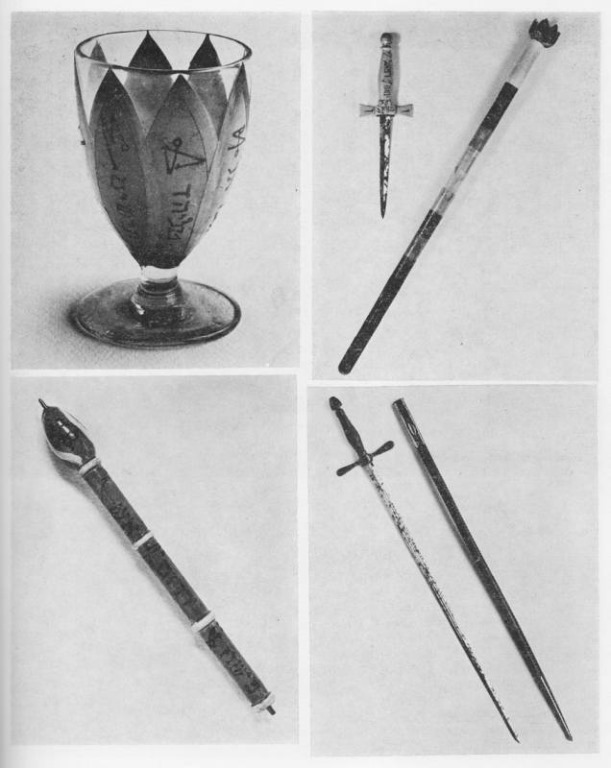
W B Yeats Magical Weapons

Yeats as wizard. Here are some of Yeats magical weapons. Photos from “Yeats, The Tarot and the Golden Dawn by Kathleen Raine” which I found at this web page.

.

Even ignoring all the mystical back-story, this is a poem about the breaking of nations. Therefore,“The Second Coming”  fits with the theme of civic poetry, and I put this poem down on a short list of poems to consider combining with music for this April’s National Poetry Month, but we’re nearly half-way into the month before I could complete a version that I felt was presentable.*  Given its grand scope it called for some big music, and my orchestral scoring skills have atrophied from where they had developed earlier in this project. Another way to make a large noise is to perform it with a full rock band, and I have been trying to recover my skills in that kind of ensemble playing this Spring. But there was another obstacle: I found that, unlike other Yeats’ poems, this one isn’t easy to fall into singing. The blank verse here tends stentorian, and I’m not a big-voiced powerful singer. For one stubborn section of the poem, I felt I needed to break into chant rather than try to keep the lyrical lift of singing. This sort of thing is a consequence of a composer needing to rely on a limited singer to realize the work.

The raw tracks I recorded for today’s song were somewhat messy due to the number of instruments: three guitars, organ, piano, bass, and drums, It was quite the operation to mix them even to my “good enough” level. You can hear that musical performance of W. B. Yeats’ “The Second Coming”  with the audio player you should see below. What, has that rough beast not slouched onto your screen? It’s not the end of the world — some ways of reading this blog suppress showing the player gadget. Here’s an alternative, a highlighted link that will open a new tab with its own audio player.

.

*As I write this sentence, I take stock and consider that since this Project began 9 years ago, I’ve been composing and recording the more than 800 pieces presented here at a rapid pace. To create a single album’s worth of music in a month is considered a challenge — since 2006 there has been an “RPM challenge” to write and record an album of songs during the month of February. I’ve been doing something like that, nearly every month, for nearly 9 years!

Has that been good for the quality of the work? I don’t think the answer is a straightforward “Of course not.” While there are times when I wonder about some months-long work focused on a single composition, at my age I figure anything I want to explore or express needs to be a matter of getting down to it and getting it done as well as my current skills allow.