From my Parlando outlook, this is a fine choice to start off a look at our twin girls and boys 1920’s poetry anthologies for National Poetry Month. Today it’s a poem by William Blake, a poet still known and rated today, and a poem that includes a child and praise for music inside of it. It’ll make a natural beginning I figured.
After I made that decision, I started to notice a couple of things. The poem began to seem stranger than it somewhat straightforward first reading might suggest. The odd thing I noticed first was the amount of insistent repetition in it. Lyric poetry, and even more so poetry meant to be sung. will often refrain lines, repeat entire verses or sections — look at many a modern charting pop song and you’ll see hooks as repetitious as today’s poem — but it still struck me as odd. The child continues to ask for song. The piper plays it. Immediately, the child asks for the song again. Parents experienced with young children may relate here — insert your own bête noire kids-song ear worm and insatiable toddler — those requests can be cute and dulling at the same time. Blake’s child is laughing at the time of the first request, weeping at the second, Why? Best guess: because the song is over, and they must hear it again. But then the child asks for a third song — perhaps the same one, perhaps not — and they are asking for it without the piper playing the pipe. Since most pipes are wind instruments it’s likely the piper in the poem hasn’t been singing the first two times.*
Combining the child’s responses after the first two requests which the piper has immediately fulfilled (laughing, weeping) the child “wept with joy” after the third go-round.
The picture I get here is joy in repetition, and woe at ending. The child makes one more request: the piper should cease the singing and write this music down. The piper MacGyvers up a pen and ink and gets to scoring.

Simple guitar chords on the chord sheet this time.
.
Then we’re told the child vanishes. This shouldn’t surprise us. If we were paying attention, this child appeared to the piper “on a cloud.” This child wasn’t a flesh and blood child — wasn’t one of the potential readers or listeners to the anthology’s contents — it’s a spiritual emanation of childhood.
OK, that’s a little weird, but Blake was a self-confessed visionary, and literary inspiration stories can be peculiar. Just another day at the poetic office for Blake. And as the piper makes his own pen and ink, I thought of one of the things that I found most inspirational in Blake’s life: that despite literary poverty he mastered the means of creating his own poetry, art, and engraved books.
Just after completing my musical version of this, another area of concern came to me. Just how strange did this seem to the children in the 1920s or to their parents who might read this to them if they were younger children?
I was a young child in post-WWII America, and in my time and place, I would have been puzzled. About the only piper I’d have any reference to was The Pied Piper, a page-bound storybook character. Yes, various kinds of musical pipes were extant then, as there would have been in the 1920s, but nothing I would expect in my time to see being played in wild valleys. Blake’s poem was over a century old when the 1920s anthology was made— maybe late 18th century England had itinerant rural pipers?
As they grew up, the child reader, then or now, would likely understand this is fantasy, even if exactly what Blake was getting at with his fable might be missed. Its value would remain as a set of word-music that speaks to the joy found in music and the arts.
Is anyone trying to guess if this was in the girls’ or boys’ anthology? Male author. The cloud/child is male, the piper is not gendered. Is joy in music a gender role thing? Not really.
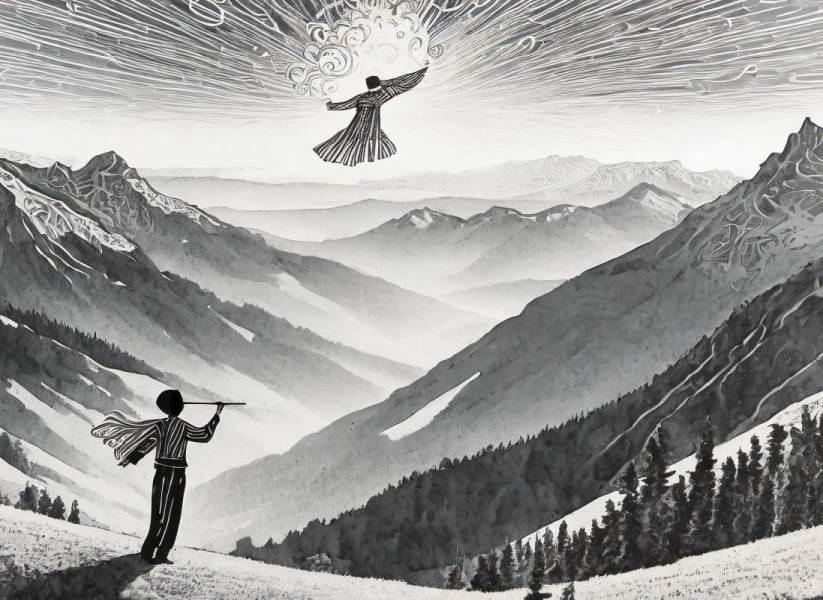
Wilderness cumulous-carried spirit children are not a reliable compositional prompt.
.
It’s from the introductory section of the “for girls” book. My music is a simple folk music setting: acoustic guitar and bass, and eventually an Irish tin-whistle for piping. The tin-whistle is a played VI.** Two other instruments make a subtle entry in this recording. There’s a quiet electric piano in the piece, played and mixed so low it almost sounds like an overtone of the guitar, and another VI of a small obscure 1940s keyboard instrument, the Solovox that comes in for the next-to-last verse.
The Solovox was an FDR-era monophonic analog keyboard synthesizer, with glowing tubes and a wood-veneer case like a large table radio of the time. I used it for two reasons. If this song floats in fairy-tale time with children appearing and disappearing out of clouds, I thought the piper’s sound could change from the tin whistle to something more mid-20th century as a marker of how the children the anthologies were written for grew and changed. But also, I’ve seen, even briefly played, a particular real Solovox. The mother of alternative voice and keyboard player in this Project Dave Moore had one, and when he was young his mother would play piano and deftly slip one hand over to play melody lines on a Solovox. Dave now has his mother’s example of this old instrument, and has had it fixed so it plays, though with some glitches.
To hear “Piping Down the Valley’s Wild” you can use the graphical audio player you should see below. Player vanished? This highlighted link will open a new tab with an audio player. I plan more poems, adapted musical pieces, and observations from The Girls/The Boys Book of Verse coming up soon.
.
*There are methods to do that, where a singer alternates using their breath to sound the instrument and to sing lines of song. And there are bagpipes and the like where the wind comes from a bellows. But the child has asked the piper to drop their pipe and sing, so it stands to reason this is a request for the piper to sing a song with words after playing instrumentally for two renditions. The song then progresses from melody, to sung words, to finally written words — a plausible metaphor for the writing of a poem.
**I explained VI/Virtual Instrument technology last time, but in short it’s playable software that tries to contain all the sounds an actual instrument makes, often by capturing all conceivable notes and many articulations of those notes with a microphone it makers placed on the real instrument.




 Frank Hudson