Holy Thursday (from Blake’s Songs of Innocence)

My parents had a small library, which was on a set of bookshelves in their bedroom in the house I grew up in in a little Iowa town. I’m not sure which books came from which parent, or even if some of them were passed down from their seniors, for I recall a couple of books on 19th century figures: William McKinley and Frances Willard. I think my mother’s people were Republicans, and both sides were teetotalers as far as I know. Some of the books were college textbooks. There were books relating to the Protestant ministry, which my father aimed to practice as his father had, and others connected to journalism and high school teaching, which was my mother’s line of work before marriage. I loved looking through them while laying on the chenille bedspread of their double bed.

I bring this up today because I believe I first encountered William Blake in one of those books of theirs. It wasn’t a poem of his, but rather a small note in the back of the volume dealing with other minor figures. The note reported that Blake wrote some quite fine short lyrics before descending into longer mystical tracts that might be seen as evidence of madness.

Having already gone through a short but intense Edgar Allen Poe phase when my teenage-self read that, my interest was piqued. A year or so later I learned that The Doors, a rock band headed by someone who was said to be a poet, had used a line from a Blake poem in one of their songs. Now I really was intrigued.

And yet it was maybe another year before I found and bought a small paperback containing selections from Blake’s writing. My initial reaction? The longer prophetic books puzzled me, many (but not all) of the shorter poems could come across as twee little nursery rhymes, but some of his poems that fell between those two became favorites, particularly his satiric and scathing “Proverbs of Hell.”   No teenager ever since deciphering metal-band lyrics or any rapper’s flow was more happy than I was to read that rebellious page poem.

Those short lyrics? I liked more of the poems Blake printed in Songs of Experience  than those in his companion volume Songs of Innocence.  Simplicity can be harder to value, and Songs of Innocence  is a case in point. Today’s piece is one of a pair of poems in Blake’s non-identical twin volumes using the title “Holy Thursday.”   Here’s a link to the text of this one.

First off, what’s Holy Thursday, at least as it relates to Blake’s poem? I didn’t know as a kid, and I didn’t know as an adult either until this year, so late in my life. I thought it was the Thursday before Good Friday, the date commemorating the Last Supper of Jesus and his disciples before his arrest, trial, and execution. And as far as some Christian denominations go, that would be correct — but not so fast! Holy Thursday is also another date,* one at the very end of the Lenten calendar: the date commemorating the resurrected Jesus ascending into heaven after being seen on earth for 40 days by the disciples. That one falls on May 29th this year — or on the following Sunday, just to make things even more confusing.

We know that Blake is referring to the later Holy Thursday because the poem of his that I perform today is reportage on an annual British Holy Thursday (Ascension Day Edition) event: a marching of a batch of orphans from charity institutions up to London’s St. Paul’s Cathedral for a special mass where they sang hymns they’d been taught.
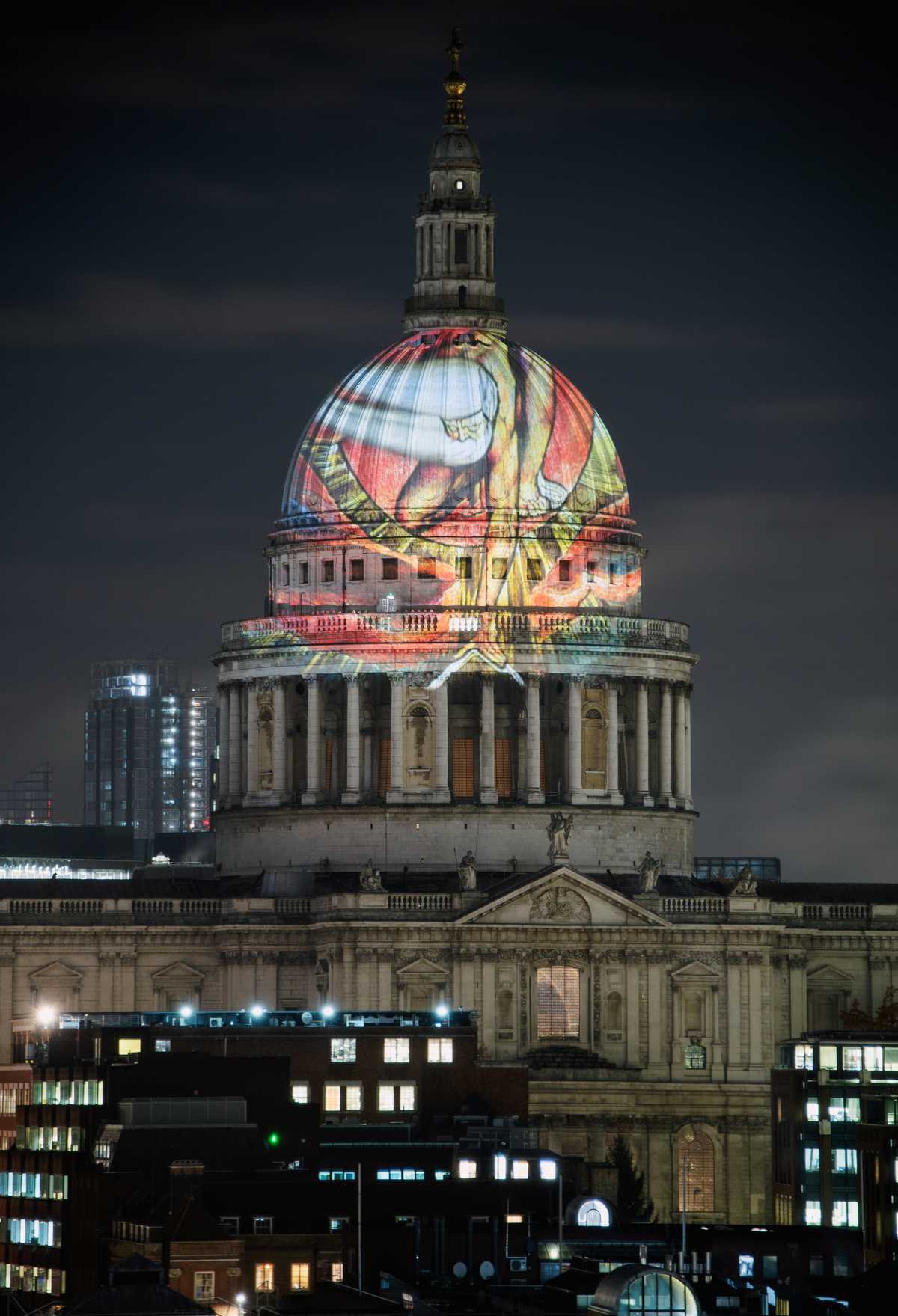
A few years ago the Tate Museum had a big Blake celebration and had one of Blakes most famous paintings projected onto the dome of St. Paul’s Cathedral. I wonder what Anglican dissenter Blake would have thought of that? (photo by Alex Wojcik for the Tate)

.

Blake’s tone is ambiguous in his account. One could read this poem and assume this is an act of charity being celebrated — but in the context of Blake’s beliefs one could see otherwise, as he was an ardent dissenter from the state-sanctioned Church of England. Elsewhere in Songs of Innocence,  the children are free (at least at times) in some Edenic state — but these Holy Thursday children are regimented into ranks by schoolmasters (beadles) caring disciplinary canes. The song they sing is given to them by those that control their lives. What happens when they sing the song they are directed to sing? Heaven, the seat of the godhead that Jesus has risen to merge with, harmonizes in thunder that descends on the “wise guardians of the poor**” seated below the heaven and the children in this rich and mighty cathedral. In summary, I think Blake is pointing out the self-satisfied “virtue signaling” in this pomp and ceremony.

Perhaps I should have tried to create a choir or used a pipe organ for this one, but simple music today, which you can hear with the audio player gadget below. Has your audio player ascended into the Internet to sit as the right side of Jeff Bezos or Elon Musk? No, it’s just that some ways of reading this blog suppress showing it.  This highlighted link will launch a new tab trailing heavenly glory — or at least its own audio player to carry forth my acoustic guitar and voice of subjective quality.

.

*The Last Supper Thursday is also called Maundy Thursday — the other, Ascension Thursday or Day. Separate names would of course make things clearer. I grew up a Methodist, and they bungled the fix: they use all three (or is it four?) names.

**I sing this phrase as a question, which I divine is Blake’s intent.

Poem in Your Pocket: Counting Out Rhyme

I’ve been dealing out the civic poetry so far this American National Poetry Month, but for today’s Poem in Your Pocket Day here’s a charming poem by Edna St. Vincent Millay. If I understand Poem In Your Pocket correctly, its idea (as distinct from the entire Poetry Month) is to put emphasis on publicly sharing other people’s poetry. The rest of Poetry Month has a lot of examples of encouraging the writing of poetry oneself: poetry prompts, daily haiku writing pledges, poets putting forward their own work, and so on. That’s all fine—but this Project from its beginning has sought to go beyond the supply side to encourage the consumption of poetry. With the recorded musical versions we make here, there’s a modest hope of community in singing or speaking the poetry aloud. A song not heard is one of those trees-falling-in-an-uninhabited-forest things—whatever the result, it means to be a sound.  Now onto today’s poem, situated in a forest.

Counting-Out Rhyme

.

“Counting-Out Rhyme”  indicates with its title that it should be considered as that children’s game or process. As a game, a counting-out rhyme is a delineated incantation, each beat accompanied by a pointed indication around a group until the ending beat arrives and the final pointed-to individual is chosen. The most common folk poem in this manner in my childhood was “Eenie, Meanie, Miney, Moe.”*

I, having emigrated from the republic of childhood so long ago, have no idea if kids still use this process on playgrounds. From my more recent experience as a parent, modern younger children who would use it seem more supervised more often than my cohort, and responsible adults might be likely to select without rhymes. In my day, when the 20th century still had decades to run, kids just knew how this worked via the folk process.

Despite its title, as I worked with Millay’s poem I couldn’t really think she authored it for playground uses. Though not a long poem, it’s longer than it needs to be for selection, and the poem seems utterly beholden to its own, internal, incantatory powers. It picked up from the Imagists the flagrant naming of colors, decoration not needed for utility. I suspect Millay is remembering her own New England childhood here, much as E. E. Cumming was recalling his in his Spring poem, and the poem is rather more a magical spell, one meant to bring on Spring or bring one back to when the woodland sights of it were unprecedented and wonderous. It’s lovely word-music, and I heard it from off the page — and then played it in the musical version below — as a languid song, not the hurried rota of trying to make a quick, randomized choice.

In a week when chronological adults (whatever their maturity) are playing counting-out games with numbers that will empty or fill pockets and prisons, I share this poem from my pocket — not legal tender, but Spring tender. With the audio player below you can hear me perform this with 12-string guitar and sparse contributions from an ensemble of viola, violins, flute, clarinet, English horn, and silence. No player? You won’t need to find a wood-nymph to cast a spell, I provide this highlighted backup link that will open a new tab with its own audio player.

.

*In my experience from my times and place, the following line always included that dammed ethnic slur that makes the opening line of nonsense words almost offensive in anticipation. I noted in the Wikipedia article on that verse that the ethnic slur was an American variation, and there are multiple theories of the rhyme’s origin without it. I have no full accounting of the harm the slur brought by its childhood ubiquitousness — but I was somehow pleased to read as an aged adult that it was something the folk process added in America, and in order to form a more perfect playground republic, the same process can remove it.

The other similar selection process I recall from childhood was deciding which side would bat first in kids-run baseball games by alternating two kid’s hand-grasp up the length of the barrel of a bat until the final grasp topping the length was up first. Wouldn’t flipping a coin be faster? I’m not sure we had coins in our pockets back then.

In Just Spring

It’s the first day of Spring.

This E. E. Cummings poem is often read as delightful. And it is. It’s also a poem some encounter in childhood. At least in my youth, it was an anthology favorite that vied with Carl Sandburg’s “Fog”  as an introductory example of free verse. And no verse is ever more free than this: the letters smattered like mudprints all over the page, capital letters not yet grown, stuff smushed together. No colonnaded sonnet, no astringent exhale of meditative breath like a haiku. On your poetic menu, this is a mudpie for Spring.

Is it just this?

I set it to music. That’s what this Project does in Spring, and Fall, and Winter too. Every chord in the music I made today is a minor chord. Is this a sad poem, did I want to force it to be one? Not that simple. Just lowering the 3rd note in a scale a half-step to form a chord from it, is that really determinative? These are just sounds playing together.

But this is a considered song about Spring and the distance in half-steps from childhood, not just some neutral exhalation of it. The poem itself grew up, or blew up, over a few years. It was first submitted for a class assignment by a Harvard college student in 1916, and that version, while free verse, lined up this way.

In Just Spring 1916

I found this excerpt of the original version of the poem in a section on Cummings written by Michael Webster included in A Companion to Modernist Poetry published in 2014.

.

That college student would soon go overseas into a world war as an ambulance driver, and Cummings and his cohorts there took exception to simplistic war piety. I’d guess the logistics of suffering didn’t firm up the young man’s patriotism. In something I see echoed in this week’s American news, his talk was deemed an imprisonable thing to say, and Cummings was imprisoned in France. It’s one thing to write free verse, it’s another to convert the currency of one’s free thought into loss of freedom. I wonder if at this point the blood-soaked mud of WWI’s trenches were known to the young man. Anything but mud-luscious.

Cummings had enough luck or privilege to be released. In 1920 The Dial  publishes a new version of that college poem. In a few years more this magazine would publish an expatriate American’s poem that indicted Spring, starting “April is the cruelest month…” But this is Cummings’ poem, and this is how it looked on The Dial’s  pages.

in Just-spring dial 1920

On first publication it’s largely the poem we now know, but it doesn’t have a title. And curiously, the second instance of balloonman is “balloonMan.” Did a proofreader just get exhausted editing Cumming’s manuscript?

.

In 1923 Cummings published a poetry collection, Tulips and Chimneys. He put the still untitled poem in a section “Chansons Innocentes” (Innocent Songs). By innocent did he mean from childhood’s sensibility, or a plea of not guilty? And this is how that version went.

In Just Spring Tulips and Chimneys 1923

Nope, the balloonman to balloonMan thing must have been Cumming’s intent.

.

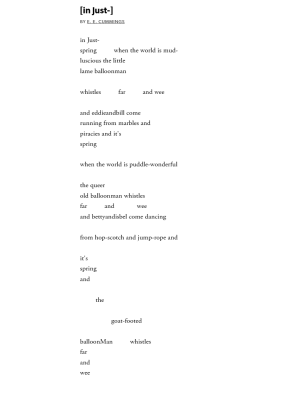
We’re near the final version, but at some later date (I’d assume a selected or collected poems publication) it converted its first line (strictly constructed) into a title with some typographical marks to make it look like Cummings was establishing Bon Iver’s song titling methods a few decades before the bard of Eau Claire. In the end, the poem that a lot of folks informally recall as “In Just Spring”  is [in Just-].   I can’t help but read that title as a pun.

In Just Spring final 400

Here’s how the poem in it’s final form appears collected on the PoetryFoundation.org web site. “Just” is the only capitalization and man stays lowercase.

.

And now decades have past — and I, an old man, have gone to perform this poem for this year’s Spring, and I pick minor chords. Much has past us, dancing toward or running from: another world war, and current cruel wars happening somewhere further than the far distance whistle of the balloonman. Cummings’ childhood was close enough to me that I can actually recall playing marbles in the dry dirt finger-writ circle of a schoolhouse playground.*  I know how a hopscotch chalk field is laid out. Do children still jump rope with rapping rhymes, and if not, what has poetry and hip-hop lost? If there’s a balloonman, his creatures are mylar and determinedly decorated no doubt. All this 20th century stuff is now as archaic as the arcadian goatfoot-god Pan who whistles like escaping air. I, and once-girls with names like Betty and Isbel, know this. Now, as I experience the poem this year there’s more distance there than there was for a twenty-something poet who wrote it. I put a distance far and wee in the music — for Cummings was of an age that he knew he was to be an adult now, while still young enough in years to know within his body’s memory the lost experience of the playing children delighted at the balloons. Balloons that would either fly away or deflate — escape/ascent vs. air loss or a pop as sharp as a bullet.

It’s the first day of spring. My chords have a third a half-step deflated. Disordered self-important dolts are running things, and I think better to have an old halt body with a bouquet of floating hearts. If the world can still seem puddle-wonderful — to be aghast is not to wonder. So, I must recall how to wonder, far and wee.

You can hear my performance of E. E. Cummings “In [Just] spring”  with the graphical audio player below. Did someone let go of the string and a player is blown away? Don’t whistle, just use this highlighted link alternative that will open a new tab with its own audio player.

.

*And playing pirates without extra-faceted dice, is a lost quattro too — but I wonder if Cummings was thinking of Barrie’s Peter Pan  in choosing that manner of play. I’ve just finished watching an absorbing 2022 TV documentary series called Wonderland on BBC Select that often asks over its episodes how much childhood trauma, WWI, and social injustice informed English children’s literature a hundred years ago.

Records In Childhood

As December begins, I’m going to be taking some time to celebrate and elaborate the roots and concepts of this long-running Parlando Project as we reach our 800th-released audio piece milestone.

For those who are new here, let me restate again what we do: we take various words, mostly literary poetry that was never intended by its authors to be performed, and combine them with music in differing styles. Sometimes the page-words are sung, sometimes they’re spoken or chanted. Sometimes the music will patently match the text, sometimes not. The latter class are some of my favorite pieces: Emily Dickinson as blues singer or psychedelic ranger, Robert Frost with EDM, Longfellow at a beatnik coffee-house, Li Bai with western orchestral instruments, Jean Toomer or John Keats as performed by an indie-folk combo. I expect long-term listeners to scratch their heads at times, though I also fear that some will sample a piece that they don’t much care for and leave off from future listening here.

No one idea or artist inspired this all, but today’s piece is about the farthest back I can recall anything that might have inspired the Parlando Project. I think this happened when I was around age 10.

I grew up in a mid-century Iowa town of 700 folks, and it wasn’t a particularly musical place. There was a small high-school marching band, a handful of children probably had piano lessons of some kind, if only in hopes there’d be someone to play piano in the three Protestant churches in town. The two best musicians in my childhood cohort played trumpet and accordion. The former was surprised to admire Louis Armstrong despite having personally absorbed dismissive racial stereotypes, the other might aspire to Myron Floren level of showpieces on the stomach-Steinway. The same little town might have over-achieved in literature though. It was named by its 19th century town-platter “Stratford,” and its streets were named for British poets and Longfellow — main street being Shakespeare Avenue. If you grew up on a street that was merely numbered, or an avenue named for some animal or geographic feature, such things never had a chance of shaping your worldview. I grew up thinking of Milton or Shakespeare as being a local possibility.

My father sang, mostly in church. My mother thought he had a good voice (“better than Perry Como” she once said) and I recall it having a very nice timbre when I was a child, but there was no piano or other instrument in the house, and he didn’t sing a cappella that I recall. We didn’t have a TV until I was 7 or 8 (and even then it was a chancy fringe-reception, rabbit-eared, used set that would send its display to snow or tumbling whenever it felt like it). There was some kind of radio, for which I’d hurry home from school to listen to the Lone Ranger on, though I can’t recall what the radio looked like. And at least some of the time there was a phonograph. I recall it was one of those that looked a bit like a portable typewriter with a luggage-finished case that could be clasped-closed. It may have been one of my parent’s from their college years. It sat in a little side room off the kitchen at home that we called “the breakfast nook.” And with it was a small cache of records. And here it gets odd — specifically odd — but applicable to the Parlando Project.

I clearly recall four 78-rpm disks, an unexpected set for a Fifties, small, rural-town-in-Iowa record collection. Two were commercial spoken word recordings, the sort of thing that was a viable genre then.** Record one: Robert Frost reading his poetry. My recollection that the featured poem was his “Two Tramps in Mud Time,” but so far I’ve found no Frost recording of that poem to refresh my memory or share here.*** The second was Vachel Lindsay reading from his “The Congo,”  which has an insistent, chanting, rhythmic flow. The fact that I can remember them would be clearly meaningful, but to be honest I have to say that I didn’t like either of them. I’m not sure what I expected from poetry that came from poets more recent than those whose names were on my streets, but Lindsay seemed overwrought to me, and even at a young age I might have been put off by the whole white-guy-doing-primitive-African vibe of his poem. And Frost? I’ve often written here that I didn’t care for him until I started to explore things musically that became this Project in the 21st century. Only then did I discover that he was a supple lyric poet — and furthermore, a much more subtle observer of humanity than I had appreciated in my youth.

The fact that I didn’t really dig these two poets didn’t keep me from playing the records. Experiencing them felt exotic then, and I liked that even if I didn’t admire what was engendering that feeling.

The third record didn’t match suit. It was a recording from the 1940s of a song called “Open the Door Richard.”   I didn’t know then, but this was an unusual “Novelty Record” piece, charting in versions by as many as five different musicians within one year, 1947. All those musicians were Black, and before it was one of their recordings it apparently was a Black Vaudeville comic number that the musicians spruced up with swinging jive-cat musical settings and choruses. The musical versions all differ in detail while sharing the chorus. Some of them are largely drunk-act comedy,**** while others are more at down-on-one’s luck frustration and focus on the riffing, musical, chorus-hook. From listens today I suspect the recording I listened to back them could have been the Count Basie Orchestra version or (best guess) this one by the Three Flames. I liked that record, though I thought it a little odd, and I probably didn’t fully understand it. If these first three records have a link, that’s it, isn’t it? I enjoyed the strangeness, the difference.

Open_the_Door_Richard_sheet_music_cover

Tortured Poets Department, but my childhood: disks containing a psalm of comfort, a song of misapprehension,. and two early 20th century Modernist American poets.

.

The final record was the one I listened to the most. It was not a commercial 78, but a recording, perhaps from a record-yourself booth (or offers like that) which provided the earliest Elvis Presley recordings. It was my father reading “Psalm 23,”  the famous psalm of David. The voice was someone in my life, no exotic stranger, but I was totally mesmerized. If no one is more mundane than one’s own parents, this everyday, ordinary person had their voice on a record!   And the text, in familiar English translation, is one of the most comforting pieces of poetry in the canon. When I’ve revisited the Psalms periodically as an adult I’m sometimes shocked at violent and authoritarian themes I find weaving in and out of Psalms’ religious rapture — but if “Psalm 23”  implies frightful things, it does so to say that they pale in comparison to a connection with a godhead.

Parents sometimes comfort their children, do so by saying “it will be all right, we’re here to protect and care for you.” My parents weren’t much like that in expression however, though by action in life they were being that with much effort. This object, this record, did that, using someone else’s words translated from a Bronze-Age king, poet, and musician.

I think I asked about the “Open the Door Richard”  record and the “Psalm 23”  record. I can’t recall what my dad said about the Psalm recording, though I wish I did. I have a vague memory that he said the “Open the Door Richard”  song was something of an in-joke between his brothers. I didn’t get, or can’t remember the full story, but one of my father’s brothers went by the name Richard (one that became a successful Protestant minister). Another brother was named David, though he never talked to Leonard Cohen about secret chords or sling trajectories.

So there you go, in summary: I had formative exposure to poetry on recordings. One case with my own father’s voice offering comfort; and another, an Afro-American tale of misapprehension. It would be years before I had any idea to do likewise, and decades before I could do something from this early experience regularly in ways that you could hear.

Longish post, but here’s a short musical piece called “Records in Childhood”  using a sonnet I wrote this year casting some of that remembering my early experience with recorded words. You can hear it with the audio player below. No player?  This highlighted link will open a new page with its own audio player

.

*There may have been other records, though it was not any kind of large stack. The fact of memory that these four are the ones I recall testifies to their impact.

**Besides poetry recitations, sermons, and even some secular speeches were released on disk — and spoken-word comedy records were often big general-interest sellers. In a previous post I talked about how vividly I experienced Hal Holbrook’s one-man stage show of Mark Twain Tonight on an LP record in a library in Iowa.

***I did find this professional recording of Frost reading some of his “greatest hits,” and was surprised to hear quiet piano backing was used in a way that could be compared with some Parlando pieces.

It’s possible that my home’s Frost recording was a separated part of a set. 78 RPM records were sometime sold in a bookbinder of page-sleeves holding multiple disks, which is the reason we still call a longer form vinyl LP, CD, or issued-together set of digital files “an album”

****Drunk act comedy goes back to at least Shakespeare’s Falstaff, and in an earlier personal history Parlando piece I found out how my teetotal great-grandfather might have perceived the sometimes brutal alcoholic folk-song “Rye Whiskey”  as stoner comedy.

One benefit of having an acquaintance with this largely forgotten song was that when I first heard the Bob Dylan Basement Tapes song “Open the Door, Homer”  I knew the reference.

For Father’s Day: Kevin FitzPatrick’s “Bicycle Spring”

It’s been an eventful June so far for me, and I plan to be writing like a real blogger about what I’ve experienced in the last couple of weeks shortly. Then too, just this week I started working on a few further Parlando audio pieces. At least one may make the cut to appear here in the next few days.

This weekend is Father’s Day, and a new musical piece that I thought I’d present for that turned out too rough, even for my tastes. So, here’s a well-loved poem by Kevin FitzPatrick that alternate Parlando Project voice Dave Moore performed with The LYL Band a couple of years ago. It seems apropos. Kevin’s books of poetry are available from this website: kevinfitzpatrickpoetry.com Today’s poem appears in his 1987 collection Down on the Corner.

“Bicycle Spring”  was first presented here in 2022, but for today’s post I remastered it and made this little video for it. Here it is:

.

Wishing my versatile readers and listeners a happy Summer.

That Summer Feeling

I could, maybe should, write about a number of things this weekend. The end of May brings Memorial Day, one of the United States’ two holidays celebrating those who served in the armed forces, the spring version being more focused on those who died in wartime duty. It also brings to mind the anniversary of the drawn-out, agonizing death of George Floyd a few blocks from where I’m writing this. I think of that little group of South Minneapolis people, ordinary citizens of my neighborhood, who witnessed it, who pleaded with the police officers to cease their officiousness. I think of the new policemen in that squad, earnestly following the lead of their trainer who’d arrived, the man with his knee on Floyd’s neck. Duty.

Duty is a small word, but one that we have two holidays to honor. We generally respect it, and in small and large ways we carry duties through our days. My wife does in her workdays what I did for a couple of decades, taking on the duty of helping the sick. In between workdays she takes on the obligations to her mother suffering from increasing Alzheimer’s in a care home.

I’ve written about all those things here. I could write at length about them here tonight. In doing so I could say I am following my obligations to humanity, to those who suffer, to those who’ve lost. We use poetry often to decorate those tasks, more often perhaps than we use the more capricious song to do so. Thus I could write, and you might view it as your duty to read that.

Instead, I’ve been filled this month with the realization that this is my teenager’s last summer as a teenager. They’ve concluded an indifferent year of post-secondary education, and now have taken their first job. As to next Fall plans: they are thinking of stopping with school, saving money from the job, and moving out. Studying seems like a duty — their work-a-day job does too, but maybe it’s a more novel duty, or at least one that has a biweekly award of a paycheck.

Music is a key to memory, particularly emotional memory to me. During these feelings this May, I came upon a performance of a song by Jonathan Richman. Richman has an utterly strange career. He’s one of those you might see called a cult artist, which means those who “get” him sometimes puzzle those who don’t, but also it means that many who read this won’t know his work at all. As a teenager Richman became something of a Velvet Underground* superfan, and his early work shows direct influence of Lou Reed’s songwriting. In the early 70s he and his band The Modern Lovers recorded more than a dozen tunes that prefigured a lot of what was to come in Punk and Indie rock a few years later, but the recordings were not issued when they were made. Then in 1976, when the first stirrings of Punk were drawing attention, they came out along with newer recordings.

Here’s complexity to that odd: the old, early 70s songs and recordings were unvarnished, and they followed Reed’s model of being emotionally honest, but their timbres and approach would be in tune with some of the vanguard of what was called Punk at that time. The newer songs were even more childlike, though no longer being written by a teenager or recent teenage time-emigrant, and the sonics were quieter, even more stripped back. As his career continued, Richman generally proceeded down that path, writing ever more childlike songs focused on everyday wonderment. If his early singing called on some of Lou Reed’s snarl and assertion, the later work took on elements of 50s Do-Wop teenage innocent sweetness.**  Richman in a sense started out before his time, had a recording career launch when his early work seemed of the moment, and then continued until the present day as a singer-songwriter presenting the impression of coming from a place that was younger and younger.

The song I heard while thinking of my teenager at the borderline, “That Summer Feeling,”  was sung by a 40 something Richman a couple of decades into that career. On Richman’s record the Do-Wop influence is apparent, backing harmonies and call and response from additional voices. Compared to the version you can hear below, there are more verses, more detail of youthful specifics. Blind to the career history I’ve summed up above, you might easily think someone about 19 or 20 recorded it, fresh with passing through that borderland.

Here’s the intuitive choice I made when I decided to quickly work up a cover of “That Summer Feeling:”  to record it more in the style of the early 70s The Modern Lovers recordings than the “mature” Jonathan Richman. If I had more time, I would have overdubbed a garage rock guitar solo at the end or maybe some combo rock’n’roll organ as those records sometimes had. Following my taste, I preferred the songs less specific but most summer-set verses.***  This musical change and the way I sang the lyrics also brings out more of the undercurrent in this song, a complexity that a casual listen to a more smoothly produced recording might let one overlook. The singer isn’t just doing a let’s remember our youth story here. He warns in slightly mutating refrains that that youth will haunt you, and then he pleads with the (presumably teenage) listener to not wait until they’re older to, what — it’s not entirely clear — somehow integrate that duty-free time’s outlook fully into oneself or it won’t just haunt you, it’ll taunt  you, and finally it will hurt  you “the rest of your life.”

Would any kid ever listen to that message? Doubtful. My fatherhood duty knows limits, even counterproductive effects, of advice. Still, I wanted to sing it anyway.

After the jumps of this Memorial Day post, I won’t make the proforma Memorial Day holiday wishes. Some will be decorating graves. Some will be thinking of how life was disregarded. Some are caring for the sick and infirm. Some will be having cookouts or taking a little vacation trip away from work. Black joy, worker’s rest, flopping down in the grass without any duty, playing or listening to music. We honor duty. Let us also honor some respite from it.


Here’s my performance of Richman’s song.

.

*As many writers do, I must reiterate the Eno quote about how only a few thousand bought the first Velvet Underground record — but that everyone who did went out and started a band. Historians have determined that the record actually had decent sales, but Richman is one of the early examples of direct VU influence. The early Modern Lovers band included folks who would go on to being in The Talking Heads and The Cars.

**The small vocal ensemble 1950 style of urban teenage music that got called Do-Wop was often written by teenagers or near teenagers — and like the Punk, Rap or Indie music that followed later, it was inexpensive and approachable to create for the kids who made it. Arch cultural critics and satirists-in-song Lou Reed and Frank Zappa both appreciated it, thought it honest in its innocence. Punk founders Patti Smith and Lenny Kaye met because Smith loved an appreciation of Do-Wop that Kaye had published. I on the other hand have vocal limitations that keep me from indulging in the style.

***I am struck by the specific the song takes in one verse where it goes from singing swimming ponds and cool lawns to a traffic stop. I don’t think Richman meant to make that an existential moment, even if our modern gun-soaked life might make it seem so now.

Pippa Passes

One never knows where strangeness will arise in this Project. Take today’s piece, which I thought was the most routine little poem in a pair of 1920s anthologies of children’s verse I’ve been exploring this National Poetry Month. I wrote down Robert Browning’s “Song from Pippa Passes”  as a candidate early in this process. It’s short. It claims in its title to be singable. It contains a well-known line that’s so often repeated we may have forgotten it came from a poem. Those are all good things for a Parlando Project piece. In the context of my planned series, I figured this innocuous poem could stand for the elements of the innocence of childhood portrayed in The Girls  andThe Boys Book of Verse.

Here’s the childhood context known and unknown for the editors of these books in 1922. There was much change afoot:

  • The United States had emerged from a pair of overseas wars — the second, WWI, broader and more deadly.
  • World maps had been redrawn. Kings deposed and monarchies ended.
  • American women had just gained the right to vote.
  • In the arts Modernism was breaking through, music and poetry took on forms that seemed formless.

Children are born into a world they know is new only by definition, but their parents, the ones who’d purchase such books must have sensed these changes. Is this poem a way to rest from all that change?

And then there’s what we know, but the editors would need to be prophets to foretell to those children starting to read or be read to:

  • The world would soon be plunged into a widespread economic depression.
  • Totalitarian dictators as cruel as any evil historical monarch would arise with popular backing.
  • A greater and more widespread world war was to come as these children reached young adulthood.
  • That great war would end with a fearsome weapon’s deployment and a cold war standoff between two global alliances.

Could they repeat this poem later in a breadline, bomb shelter, or landing craft?

So far this month we’ve learned that the editors would include poems of blood, murder, war, and strife. These weren’t considered off-limits for children. They would almost completely ignore Modernist poetry however (save for our special child prodigy exception). There would be some poems of adventure in the girls volume, but more poems in the realm of imagination, and no notice of women at work (though there’s little about men at work in the boys volume either). The boys volume would have sections of poems on war and battles, and another section devoted to “words to live by” poems of virtue. The girls were not given a similar section of poetic instruction. *

Pippa Passes

A thorough introduction? It does show that the editors had knowledge there was a context to this short poem. Now read the rest of this post.

.

And Browning’s little poem? Well at least I won’t have to do any research for it. It’s just a poem of Springtime childhood safety and innocence. I think I ran into the poem in schoolbooks in my youth, and it was never explained as anything other than that. Well, I have to write something about it now. Let me check.

OMG, in heaven or otherwise.

Turns out the verse drama the song comes from is a nasty little piece of work. Smutty adultery, political assassination, trickery, dirty deeds done with wills and waifs. I read the first act, the part that includes this well-known poem. It portrays a scene between two adulterous lovers fondling each other and panting about their ardor. We learn this bodice-ripping ceremony celebrates that they’ve just killed off the third-wheel husband. The Pippa in “Pippa Passes”  wanders by singing our 8-line ditty, and without an ounce of explanation on the part of Browning, the adulterous man kills the new widow and himself out of guilt for — well, it’s complicated — guilt for being seduced by the hot wife, not thanking the dead husband enough, and maybe a little for the murdering part, though obviously the song has occasioned him being up for some more murdering.

TL:DNR summary: more “Double Indemnity”  than “Mr. Rogers.”

My reading? Browning’s intent, however ham-handed, was to draw bitter contrast between humankind’s fallen state and Pippa — a poor, innocent, factory girl, who’s passing by these scenes of mayhem on the only day-off she gets in a year. To give Browning the best I can give him: the total incongruity of this tiny song that ends “God’s in his heaven — all’s right with the world” moving the plot to some new if not exactly benign resolution is Brechtian a century before Brecht.

Now here’s what’s strangest. How the hell did this become a popular short poem all on its own as just a piece about Springtime happiness? What’s the path here? Was there a shortage of happy short spring poems? Did someone misunderstand it and promote it as such? My musical performance is left with just trying to make this set of happiness words seem vaguely strange. I’m writing this in a world with manifest suffering and dutiful cruelty explained by “You don’t understand, we have reasons and rules that prescribe that suffering.” We are slow as snails on that thorn. So, I had help.

The audio player to play my performance of Robert Browning’s “Song from Pippa Passes”  is below. No player? This highlighted link will open a tab with its own audio player.

.

*My wife galsplained this: “Girls were supposed to be just naturally good and virtuous.” If you’re wondering why I didn’t prompt you to guess if the poem was from the girls or the boys volume of these poetry anthologies today, this is another one that was in both books.

The Wind

Today’s piece from the two volumes of The Girls  and The Boys Book of Verse  pair is by a poet I’ve begun to revisit during the past year, Robert Louis Stevenson. Taken just as verse, Stevenson will impress the ears of adults and children alike as charming, but as I revisit his children’s poetry I’m finding additional resonances. So, let’s look very briefly at his “The Wind”  today.

The Wind

A chord sheet so you can sing this one yourself if you’d like. As you look at Stevenson’s poem here you can also participate by guessing if it was placed in the boys or the girls volume of the pair of 1920’s poetry anthologies I’ve been looking at all month. Answer below.

.

The two things the poem wants to establish about its title subject is the wind’s presence and its mysteriousness. It’s felt as a body pushing force, heard as gentle sound of fabric on grass. But its first-mover, its purpose, the meaning we are to derive from it, is expressed as unknown. The wind here is a symbol of motion. Those easily teleological or mythological might reduce this to a matter of God or gods. That might be Stevenson’s intent, and is likely some reader’s experience.

I prefer to find the poem restricted to what I see on the page, and there I find it as a poem of the growth and going  of childhood. Stevenson chimes on that elsewhere in his children’s verse.

Do children feel that, that wind of their growth, or is it so merely there  as to be unthought of? I, an old man on a bicycle this Spring, certainly think of it, wind in its expression of gusts. I huff and puff in it, mine a much weaker blowing back!

I’ve said this before but let me reiterate in this month when I’m examining a sample of the literature my parents might have experienced in childhood: a lot of good children’s literature speaks to the adult and the child with the same words, the same images — words heard, images seen, from two sides. I think that’s what Stevenson is doing here. The child will find the familiar feeling reflected on the page sensuously. The adult gets the mystery, the passingness.

In the final five days of this National Poetry Month, I’m going to try to move to completion a number of audio pieces I’ve got in various stages. The posts may come — will have to come if I do this — in rapid succession. I’m grateful for your attention, and I apologize if I will press or exceed it. The music for today’s piece is back to electric folk-rock combo mode: Telecaster guitar, drums and electric bass. You can hear my performance of Robert Louis Stevenson’s “The Wind”  with the graphical audio player gadget below. Has that gadget blown away? No, you’re just reading this blog in one of the ways that suppresses showing that. This highlighted link will open a new tab with its own audio player so that you can hear my performance. And your answer to which of the two gendered poetry anthologies this poem appeared in: girls.

.

Hills: children’s poetry, but written by a child

It’s 1914. A single mother is listening to her 4-year-old talk to her imaginary playmate. Has this always happened? Did children in pharaonic Egypt or ancient Ur exercise their fresh language skills and nascent social skills with such fancies while being buckled into their camel child-seats? There was no Mesopotamian Facebook — the only way we’d know this would be if someone wrote it down. No such accounts survive.

This mother was a professor of English at Smith College, associated with artists: visual artists, writers, musicians. She wrote poetry, and I’ve read she knew Robert Frost and Walter De La Mare. She chose, as an artist might do, as a mother might do, to write down some of the things that her child was saying.

At some later point, the daughter was asked if she knew what her mother was doing. “No, she was always scribbling” the daughter replied, she made nothing of it. Eventually, her mother revealed that she was writing down what the child was saying as poetry. What the child invented and spoke — at first to her imaginary friend, and now to her mother — was transcribed by the mother into lines and stanzas. The mother’s name was Grace Conkling, her child/poet was Hilda Conkling.

Short, compressed, Modernist free-verse was becoming a thing in America. Ezra Pound’s first Imagist anthology and Carl Sandburg’s Chicago Poems  were published in 1914. Edgar Lee Masters’ The Spoon River Anthology was released on New Years Day in 1915. The child’s mother was savvy enough to know that a few lines with fresh, direct imagery could be a poem even without strict meter or rhyme.

Over the next few years the mother and child produced poetry this way: the child speaking it, the mother writing it down. Some of the poems were sent to magazines by the mother, and they were published.*  In 1920, a book-length volume of the poetry, Poems of a Little Girl,  was published. It was successful enough that two other Hilda Conkling collections soon followed. Amy Lowell wrote a preface to the first Conkling book. I read this week that Louis Untermeyer called Hilda “the most gifted of all” child geniuses. Rimbaud, dead for 30 years, couldn’t complain. When the editors of our pair of 1922/1923 poetry anthologies for kids made their choices, they included four of Hilda Conkling’s poems, an unusually high number. Only Wordsworth and De La Mare had five selections in the volume that included Conkling — Shakespeare or Robert Louis Stevenson only warranted 3 each.

As I revealed earlier this month, Conkling’s poems are the only Modernist poetry in the Girls and Boys Book of Verse.**   That may somewhat account for that level of representation. The first two sentences in that book’s foreword say:

“Because real lovers of poetry know that time and place are of little importance, the poems in this book are brought together with no sense of the period in which they were written. From “The Song of Solomon” to Hilda Conkling’s “Spring Song” they are here because they are beautiful, with a beauty that neither years nor events can change.”

So, Conkling is there to represent the here and now, a representative not only for being the most recently published, but because she still hadn’t reached the age of 12 when those words were written — she wasn’t just content for an audience of boys or girls, she was still a young girl, plausibly a future as much as a present.

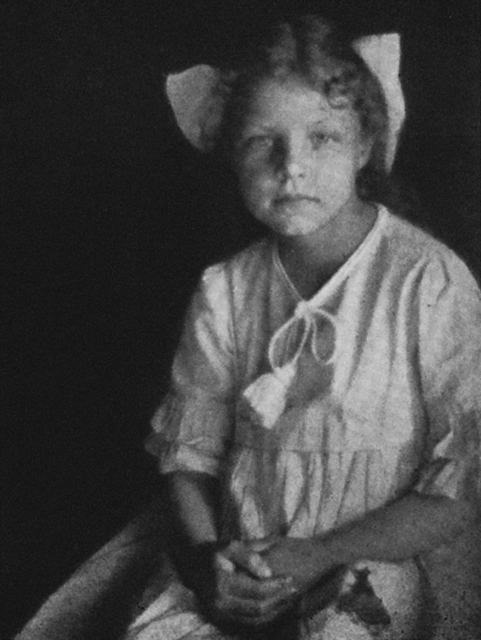
HildaConkling

Verse for children? I’m children, and a Modernist too!

.

Those who’ve been reading along this month know that since our anthologists decided to produce a gendered pair of books, The Girls Book of Verse  and The Boys Book of Verse,  I’m asking readers here this National Poetry Month to guess which book included the poem of this little girl. Answer below.

Hilda Conkling is now largely forgotten. When one looks at the published poems today, they still have their charms. When I’ve tired of reading so much derivative and rote late 19th century poetry and those 20th century poets who didn’t even try to “make it new” Conkling’s poems can be refreshingly free of the dead hand of influence or fears of being scored on exacting verse-craft. There are still effective lines in many of them. Unpretentious but striking images pop out. Professor/mother Grace Conkling was adamant that she didn’t edit the poems, that as their process developed she would read the transcribed poems to Hilda and that she would always obey Hilda’s corrections of anything she got wrong. What’s unsaid is how much selection or excision Grace did, what poems never were transcribed as unremarkable or if any lines were never transferred from scribbled notes to manuscript. Young Hilda Conkling wouldn’t be the first artist whose work was magnified by a sharp blue pencil and a shortening scissor wielded by a skilled editor.

Somewhere around the time the Hilda Conkling books were published, mother Grace, perhaps wanting Hilda to try her wings as a now literate adolescent, suggested that Hilda start writing down her poems herself. This seemed to break the spell. Some of Hilda’s published poems show a clear desire to not only emulate her mother, but to please her in doing so, so a motivation might have been stilled. Another factor: Grace may not have realized that like a “cold reader” charlatan can fake mind reading by picking up subtle clues from someone as they try to construct a convincing tale of reading the thoughts of a mark, that the very act of being the transcriptionist and first audience for Hilda’s poems might be part of their authorship.***

As far as anyone knows, Hilda stopped creating poems just as she became a teenager. If there were any later-life discarded drafts from adult revisiting of her childhood inspirations, they are unknown. She lived with her mother Grace until Grace died, and made her living working in bookstores in Boston, two things indicating that Hilda could have continued to connect with literary culture if she’d wanted to. Hilda’s story, her poetry, once held as so remarkable, became a literary curiosity that only attracts folks like me who want to think about art and Modernism thoroughly.****

Hills poem

.

I haven’t read anyone claiming that Hilda wrote her poems because she remembered past lives, because she was an “old soul” — but then or now, that sort of woo thing might have come up. Today, as I was finishing this post, days after completing the musical arrangement I used for her poem “Hills”  that you can hear below, I wondered how to explain the musical choices I made for that original music. The music is sorta-kinda South Asian, based slightly on my appreciation for those World Pacific Ravi Shankar LPs that entranced me as a young man and the Indian physicians I worked with in New York in the 70s. Specifically though, it’s more at the cod-raga experiments that many Western folk/rock musicians took to in the 60s. I always liked that stuff, and it’s more approachable with my musicianship than the real thing. Was something  asking me to musically express a reincarnation theory?

To hear my musical performance of the 8-year-old Hilda Conkling’s poem “Hills”  use the graphical audio player below. No player manifesting? The skepticism of your way of reading this post may be blocking the ectoplasm! Knocking on this highlighted spirit-table link will open a new tab with its own audio player.

.

*Poetry Magazine  published Conkling’s poems alongside a great many of the formative Modernist poets. But she also appeared in Good Housekeeping.

**As a fan of early Modernist poetry, I tell myself that I could have easily found a dozen or more suitable Modernist poems published before 1922 to include in their books.

***I’m also reminded of the curious case of acclaimed poet James Merrill and his partner David Jackson using a Ouija board in the creation of poems in the 1970s.

****I think of the work of New York School poet Kenneth Koch, who in the 1970’s started teaching poetry and creative writing to grade school children by reading them Modernist poetry (including poems that our 1920s anthologist overlooked) and then prompting them to create their own poems. A short web search revealed nothing so far, but the brief phenomenon of Hilda Conkling might easily have come up alongside Koch’s teaching ideas.

I have some hopes of finding the energy and audacity to write about a new attempt this year by a contemporary poet to inspire children to write poetry, but only time will tell on that one. Girls or boys book of verse for this poem of genderless camel-hills bearing the world on their backs? Girls.

The World Is Too Much With Us

This sonnet is one of William Wordsworth’s most well-known short poems. As can be the case with commonly known poems, I can’t remember when I first read or heard it, and so it might seem like it’s always existed, that it’s just there, ordinary in its presence. I’ve been thinking today that the poem’s familiarity hides some strangeness. Let’s look at some of that.

For National Poetry Month this year I’ve been examining poems included in a pair of 1920’s anthologies for children: The Girls and The Boys Book of Verse.  Let’s start by examining context for this poem appearing there. This is not a poem of childhood experience.*  “The World Is Too Much With Us” starts off speaking in an adult’s voice of the weariness of “getting and spending.”  I’d say that inside the pair of anthologies I’ve been looking at this month, this is more intended as a poem a parent would read to their child. Other poems in these books live and report from the world of imagination, a splendid world, which though it may also not be physically “with us” as children, exists in the same way as the thoughts and emotions of the actual world do.

The World Is Too Much With Us

Chords in case you’d like to sing this poem yourself. Another form of participation: As the two 1920s poetry anthologies were gendered, I’m asking my audience to guess if each poem I present this month was in the boys or girls volume. Answer below.

.

Do we ever think of Wordsworth’s opening phrase as odd: “The world is too much with us?” Volumes and volumes of poetry are filled with nature poetry telling, seeing, hearing, approaching tasting or smelling, the world. We expect poetry to give us that world-muchness. We’ll get to nature eventually in the second quatrain — though it may not be the nature we’d expect — but this is an example of a leading phrase that should shock or intrigue us: “What do you mean WW? I’m so busy with my adulthood I hardly see the world beyond nearsighted bills and paycheck!” Perhaps familiarity keeps us from feeling any shock at the opening.

There’s an odd idiom to finish off that first line: “late and soon.” Was this a common phrase in Wordsworth’s time, or is it just a make-rhyme? While its variation “sooner or later” is something that everyone still says, in this exact saying it seems to be making the present moment a wider aperture: saying that recently and in my next future this is the way things are — though it’s also expressing the deadlines that press our getting and spending, all that ASAP and overdue.

In reading poetry I’m immediately attracted by the musical impetus prosody brings to the words, but another part of my mind should (eventually, after the word-music has struck me first) trace the actuality of the images. The poem’s second quatrain brings the nature images, one almost conventional, the following one, extraordinary. This poem is so commonplace with us that we think little of this quatrain. “This sea that bares her bosom to the moon” may be an all-to-conventional readymade now, but Wordsworth wants us to see there an offer of vulnerability; and with the other well-worn trope of the moon’s tides, a sense that we will, even if we are “out of tune,” resonate with the pulls of nature. And then the unusual image: this nature is not a slow, predictable rising of a consonant chord. If we think we remember this poem, do we forget the “winds that will be howling at all hours” that are now enclosed inside the petals of “sleeping flowers.” This is Wordsworth’s Blakean heaven in a wildflower. I cannot say what the poem’s composer’s conscious intent was — but as a deep image, the flowers containing the plant’s reproductive features could illuminate that desire and sexuality are a riveting but unreined nature.**

And within the later specific context of this poem appearing in an anthology that might be bought by parents to read to young children, this remarkable — yet little remarked on — image may speak to the howling winds of parenthood.

So, the world of human commerce is too much with us — but nature too may be too much with us — it may rack us beyond our control. Do we overlook that Wordsworth says for everything  we are out of tune, something he writes after a quatrain on the commercial world of work and a quatrain on nature.

The sestet that concludes Wordsworth’s sonnet to my reading is not a grand summation or synthesis, some glorious wish. I read it as saying some rickety, obsolete, altogether false mythology might seem a preferable refuge from this world — its nature and  its business. Proteus and Triton there are not the speaker exalting in neo-paganism. They are “outworn,” and a thing that the poem can only see as plausibly not as bad as the elongated moment the poem has presented. In such a fancy — if bound between covers, the imagination of a childhood book of Greek myths that our anthologists might also offer — we could have powers and a way to shape the world that elude the poem. Over on a bookshelf near me is such a book from my wife’s childhood. In childhood, our imaginations, our fancies, are our superpowers. Us obsolete children, outworn, cannot call on those powers and inveigh them with this world.

I hope I brought out some of those inferences with my musical performance in a poem that is perhaps too well-known to be known today. It was rewarding to take out my nylon-string guitar to record it, the kind of guitar I started on in my 20s. You can hear my performance of “The World Is Too Much With Us”  with the audio player below. No audio player? Is it inside a sleeping flower? No, some ways of reading this blog hide it.  This highlighted link will open a new tab with its own audio player.

.

* One of Wordsworth’s best long poems, Intimations of Immortality from Recollections of Early Childhood,  is the author’s own brief supporting this division.

**Wordsworth’s romantic life and parenthood has complexities that early biographers excised, including a second family in France, a country England was at war with. One can also summarize that women helped make the poetry his name alone is on, including another famous short Wordsworth poem “I Wandered Lonely as a Cloud.”  Here’s one condensed account of Wordsworth and those matters. If you’d like to hear this Project perform his famous April daffodils poem, and read what I wrote about it, that’s linked here.

The answers to your gender quiz game today. “The World Is Too Much With Us”  appears in both the girls and the boys 1920s anthologies. Relax busy adults, no one loses points today. “I Wandered Lonely as a Cloud”  is also in both books.