The Wraithie’s Message

Is there anyone reading this far in these posts today mumbling to themselves “It’s Black History Month — and instead of the eclectic variety I expect from the Parlando Project, Frank is giving us this little-known early-20th century Black Chicago poet, this Fenton Johnson guy (who, huh)?”

Let’s keep you here, because Johnson is bringing the variety again today, with a piece that could pass for early William Butler Yeats, or someone else from the Celtic Revival that was happening contemporarily with Johnson’s first poetry collection A Little Dreaming  of 1913. And if our last piece of Johnson’s that had the Roman underworld didn’t warn you, this one is further into the dark fantasy/horror poetry genre as well.

Wraiths and wights, two names given to the wicked messenger in today’s poem have been popularized by later, fantasy books — Tolkien and Rowling et al. But Yeats and others in the Celtic Revival touched on various kinds of supernatural spirits around the time of Fenton Johnson. The non-human beings in these dealings were often at least chaotic or untrustworthy — and as a class, wraiths tended to be even more so. Though named as fairies, not wraiths, I’ve recently presented two linked fairy poems by Yeats and Robert Frost for example where the fairy is seeking to trick a human couple so that they can abduct one of them to fairyland.

Fiery Mask 800

Don’t stay up late reading blogs, for a wraithie might visit you

.

In Johnson’s “The Wraithie’s Message”  the poem’s initial speaker beholds a marvelous creature made of “living flame” at his window. The creature tells our mortal, who the wraith addresses as “dreamer” that there is a lovely sea-side woman, the dreamer’s soul’s desire, who he has beguiled with “burning song” so that this woman is now dreaming of, desirous of, our dreamer.

The dreamer at the window is all in on this. He sees not an untrustworthy wraith in this apparition of living flame, but a “good elf” who might be of service to humans. And besides, as the poem ends, he explains that this dreamer is tired of his  dreams — ones that have not been realized. What really awaits? In my understanding of this poem, the wraithie is a siren by proxy. The promised maiden may be by “the deathless sea,” but that may be in the sense that the enthralled or the dead have no more dying to do.

Should it surprise us that a young Black Chicagoan is writing this poem? Perhaps a little, but it shouldn’t be a lot. I come from the Midwestern city of Prince Rogers Nelson after all. Versatility with many styles has been demonstrated by Black Americans over and over. In regard to Afro-American musicians, I lost my constrained surprise decades ago when I learned that Fenton Johnson’s early 20th century contemporaries, Blues musicians —who I prized for their distinctive “authentic” recorded music — had a wider repertoire and spread of influences than I had guessed, and that they were often capable of essaying a variety of white ethnic styles with aplomb.*

But the choice of this Celtic Revival flavor by Johnson may not have been entirely random. Remember that last time Johnson was trying on the title of “bard,” and a bard for a generation of Black Americans who were trying to propagate an Afro-American culture of achievement and distinction — not just out of some parochial ethnic pride, but out of a very serious need to establish their humanity in a country that still retained nearly its full measure of white supremacy. The Celtic Revival of Johnson’s time was similarly seeking to present themselves as full human beings by displaying a rich culture, and it’s not unlikely that Johnson was seeing what he could appreciate and adopt from that.

With a Celtic myth via an Afro-American, there is after all a story here of a despairing dreamer and an untrustworthy power willing to trick them to their doom.

The Wraithe's Message

Simple guitar chords, but my recorded version will sound different because I used a CGDGBE tuning

.

I had planned to do this Fenton Johnson piece this month, but as I’ve mentioned before, I’m nearly always unsure of what time and focus I will have to do these pieces now. I had written a sketch of the music already (that helps) and in the middle of the day today I was able to try it out. It came together so quickly I was able to complete a basic track before attending a Canadian Zoom salon featuring friend of this blog Robert Okaji reading new poems. Then later tonight I finished mixing it, leaving it simple enough, though I hope it’s effective. This is another piece that may depend a great deal on my vocal abilities “of a subjective quality” — but that’s up to you the listener. You can hear my musical setting of “The Wraithie’s Message”  with the audio gadget below. No player? A substitute can be summoned with this highlighted link which will open a new tab with its own audio player.

.

*Some might be wondering if Fenton Johnson utilized or valued Afro-American music and modes. Yes indeed — he was early and effective in that, a decade before those in the Harlem Renaissance did similar things. I’ve got a couple of pieces planned demonstrating that yet this month.
Love and a Question

While looking for material to combine with music and perform for the Project this week I came upon a specific but little-known connection between two great early 20th century poets. I’ll go into the details of that in a bit, but before I write about that, let me set the scene by mentioning something about one of those poets, Robert Frost.

In the past mid-century, when I was growing up, Robert Frost was a poetic institution. He’d won four Pulitzer prizes, his work was as well known as any living American poet, ordinary readers might have familiarity with some of his best-known poems, and a few phrases from those poems had entered general usage. It was not uncommon for the schoolbook poetry anthologies that I’d encounter back then to end with Robert Frost. If he wasn’t the end of poetry, he was as good a symbol as any of the end of poetry as it was consumed up until that mid-century time, where literary poets wrote verse that was assumed to have a chance at general readership and could have evident value to them. He wasn’t Tennyson or Longfellow exactly (Frost’s sound was more like common American speech) but you could see him as a proprietor in the same trade as the 19th century giants.

He was enough of an institution that schoolboy-me was having as little to do with him as I could. Sure, he was living, but that was no help, because he was old.  Many dead poets left young corpses, paintings, engravings, or photographs of dashing writers, heads cocked with their thumbs and index fingers up against their visionary brains. Keats or William Blake, now there  were my comrades, not Frost. I plead youthful ignorance and concerns, and Frost’s poetry stuck around to eventually inform me in my foolishness.

So, it surprised me to eventually learn that for nearly half his life Robert Frost couldn’t get arrested as a poet in America, and he wasn’t doing all that well in finishing college or finding a steady day gig. Frost may have been trying, but he wasn’t trying very long in any one place — inevitably either they or he wasn’t for having him stick around. Nearing 40 years old, Robert Frost did something next in his unstable life: he went to England. What was this guy, that by my time was the quintessential American-scene poet, thinking?

I’m not enough of a scholar to know for sure, though reading a few Frost bios would probably inform me. One good theory: nature poetry and poetry about rural subjects was having something of a bloomlet in England. If England had led the way in industrialization and empire building, an in-reaction interest for literature about the countryside and country living was arising.

Within a couple of years of arrival Frost connected in England as he’d never been able to do in New  England. He published his first two collections of poetry. He formed a close friendship with British critic Edward Thomas (and in return convinced Thomas to write poetry). He ran into another American ex-pat, Ezra Pound, and the younger Pound trumpeted the now 40-year-old Frost’s poetry back to America as part of the coming new thing.

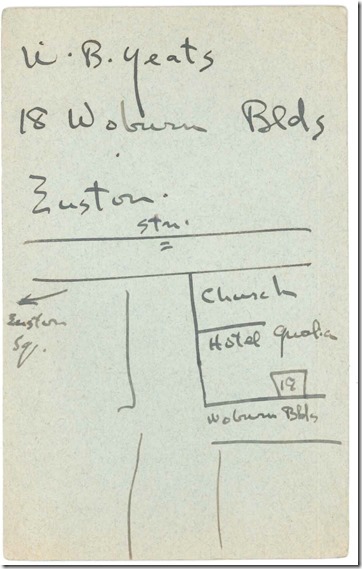
Imagism in action Ezra Pound, acting as a Georgian-era GPS, drew this map to show Frost how to get to Yeats place in London.

.

And there may have been another factor, a hoped-for connection with another poet: William Butler Yeats. Yeats wrote of the rural Irish  countryside of course, and I had never associated Frost with the Celtic revival at all. Just in preparing for this post today, I took note for the first time that Frost’s mother was a Scottish immigrant. Why did I start to look into that kind of connection?

I started re-reading Frosts first English-published collection, A Boy’s Will,  where I came upon this poem with a generalized title: “Love and a Question.”   That poem stood out at first glance because I could easily see how it could be fit to a folk-ballad style musical accompaniment. It even included a close variation of a floating verse line used in several folk songs “Her heart in a case of gold/and pinned with a silver pin.” But then there’s a second line too: the woman by a country hearth with thoughts of “the heart’s desire.” Here’s a link to the full text of Frost’s poem.

That second line would have been unremarkable except for the accident of performing a Yeats poem from an early verse play of his The Land of Heart’s Desire  this past winter. I link to my post on this if you are new or have forgotten, but this play sets up a nearly identical situation to Frost’s “Love and a Question.” A newly married couple are in a remote cottage on a stormy night. A knock at the door, and we are introduced to a stranger who asks for some comfort — but who is, it’s inferred, a fairy who wishes to enchant the new bride.

How well did Frost know this piece by Yeats? In research this week I found out that while in one of his short-lived teaching jobs before leaving for England he’d directed Yeats play with a company of his students. Cites I can find online mention him putting on this play,*  but nothing I found mentions that he also wrote this poem rather directly dealing with the play’s same story.

What does Frost bring to Yeats’ material? While his poem is understandably more condensed than even a one-act play, Frost obscured the situation considerably over Yeats well-told fantasy tale. The few attempts to write about Frost’s poem I found online catch nothing of the fantasy element because Frost makes that so unclear. Yeats’ stranger at the door is portrayed as odd and troubling soon after the character’s arrival, yet other than the continued borrowings from Yeats plot, the only thing in Frost’s text that suggests that the stranger is not a mortal is the peculiar detail of the stranger carrying a ”green-white stick” which if read in the context of Yeats’ tale may be interpreted as a wand or wizard’s staff. The stranger in Yeats is an active character, throwing themselves into the newlyweds’ relationship rapidly. Frost’s stranger is but spoken to and doesn’t act or speak other than the knocking entrance. The bride in Yeats has some action and agency in her own thoughts. The bride in Frost is a single tableau by the fire. The fears of the bridegroom are expressed in both the verse play and the poem, but in Frost’s poem he seems to be talking almost to himself. Endings? Spoiler alert: in Yeats’ play the bride dies, and it may be guessed that her soul-spirit has been taken by the fairy-stranger. Frost’s ending is vaguer. The bridegroom seems to say he understands the protocols of regular alms-seeking, but he can’t understand why someone would be so rude as to interrupt a new wedded couple on their honeymoon. Yeats’ bridegroom is anxious, but wary as he tries to win the occult battle, even though he fails. Frost’s bridegroom seems, well, puzzled.**  Is Frost satirizing Yeats tragic Irish tale, suggesting that a real rural bridegroom wouldn’t figure out what was going on? I might be missing something, but does the poem feel like a satire? For the bridegroom to be a fool wouldn’t surprise a Frost reader. Many kinds of human foolishness, misunderstandings and limitations are portrayed in Frost poems.

This brings up another factor. This early Frost poem isn’t very Frostian. The story, such as it is, isn’t clearly laid out, and the language and prosody — this seems impolite to say about this master — is awkward. I thought this poem would be easy to sing. It wasn’t, and I think that goes beyond my limitations and the brief time I could obtain to work on recording this. The poem strains natural, clear syntax and order at times to make the rhyme, and it doesn’t show well Frost’s famed use of metered verse that sounds like natural 20th century American speech. I don’t know if being so confusing adds to the weird tale, though as an aficionado of handed-down folk music there are times when the stuff that falls out through worm-holes or is forgotten in the folk process does add power by mystery. No one really knows for sure what “Smokestack lightning” is, or what it has to do with the rest of what Howlin’ Wolf sang about, and most don’t know what the hell a cambric shirt is either. We know only that something strange is going on. The listener here may be like Frost’s bridegroom: with some passion though puzzled.

So now you know that Robert Frost wrote a poem after a verse-play by Yeats, and you can hear me work to bring that Frost poem to music with the graphic player below. If that player doesn’t show up at your door, wave your magic pointer and strike this highlighted link to open an alternative audio player.

.

*Introduction to a Frost anthology The Road Not Taken by L. U. (I’m thinking, Louis Untermeyer), Yeats and American Poetry  by Terence Diggory, and Robert Frost: A Life  by Jay Parini. The latter quotes Frost writing that Yeats was able to “make the sense of beauty ache.”

**The ballad tradition includes tales of ordinary folks who by luck, pluck, or guile beat the occult challenger. I don’t know how well Frost knew his Child ballads, but he did know the golden heart box with a silver pin. Still, I can’t think of one offhand where the mortal wins just by being a bit dense about what is going on.