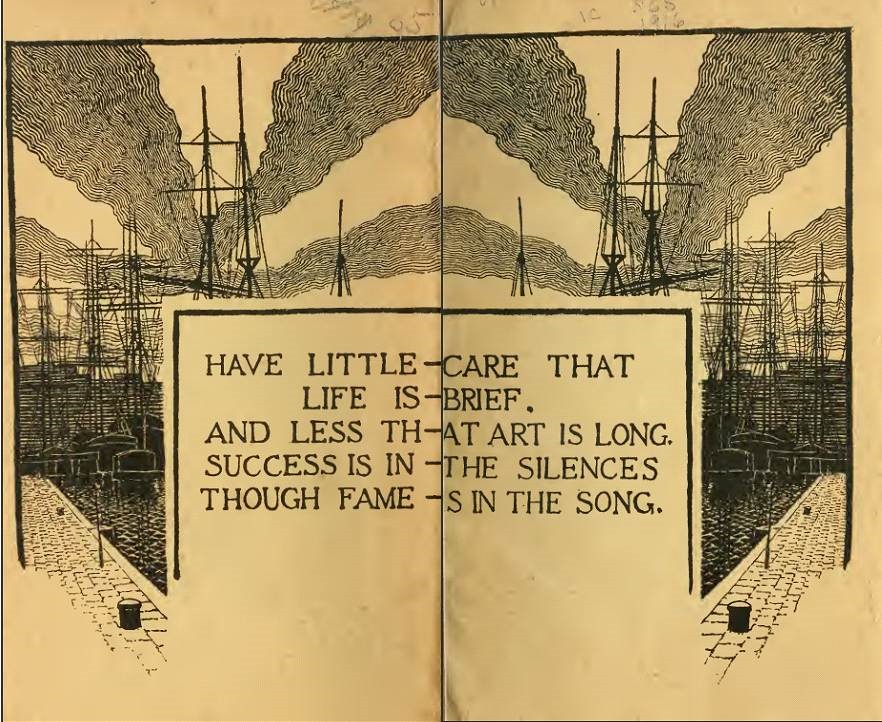
So, what else did our two young late-19th century North Americans Bliss Carman and Richard Hovey put in their 1894 Songs from Vagabondia book? How about this one: a SF prose poem adrift in wine and the universe?
I’ve already mentioned that Hovey’s poetry is easy to link to the French language poets* that were a strong influence on English language Modernism that was just over the horizon in 1894, but perhaps pioneering Canadian poet Carman had obtained a copy of Rimbaud’s Illuminations when it was issued just a few years before the pair’s Vagabondia book. The form of the prose poem was still fairly novel, but this experiment in that form adds another, fantastic, element too.
The first time I read “The Mote” I thought it the story of a short slightly tipsy conversation between two young men in a bar. For young men with loosened tongues to talk of the universe, its unfathomable scope and mysterious connections, is a comic commonplace after all.
As the mote flies into the wine cup of one of the young tavern drinkers and the conversation starts, it’s easy to overlook the way Carman set the scene: the pair entering the tavern are of “august bearing, seraph tall.” Are Rudy Gobert and Karl Anthony-Towns having a post-game libation? “Seraph” isn’t the most common form of an esoteric word, “seraphim,” but it’s a name for the highest order of angels.
If one reads it again, taking that seraph literally rather than figuratively, then the mote which is called “Earth” isn’t a parable, but the plaything of two indolent angels! This ambiguity seems cleverly designed-in by Carman.
You can hear me perform Bliss Carman’s “The Mote” with the audio player below. The guitar part was played with my Squier Jazzmaster, an affordable rendition of a once unsuccessful Fender electric guitar design. One of the knocks against the Jazzmaster was that it had too much open string-length between the tailpiece and the bridge, a fault that could generate extraneous noises when one uses the vibrato bar. Some modern players see this and figure: “Feature, not a bug!” So, in that manner, some of what I recorded here has me intentionally playing the outside noises that a Jazzmaster can make.
If you don’t see the audio player gadget, I provide this highlighted link that will open a new tab with its own audio player.
.
*Here’s an odd thing: the 19th century French poets that were stretching the subject matter, outlook, and prosody in advance of their contemporaries in England took influences from American poets like Whitman and Poe. Carman and Hovey wouldn’t have needed to go across the ocean to France to read those Americans — but still, there’s a field of echoes going on in this pre-Modernist era. There’s another cosmic joke here too: Brits may have needed to hear some American-originated poetic ideas spoken in French before they could recognize their value!
When we last left off pioneering Canadian poet Bliss Carman he was audaciously publishing a collection of 100 lyrics by Sappho. If you read that post you find that such a substantial book of Sappho required Carman to largely imagine what the ancient Greek poet wrote, since much of what survives of her poetry are fragments, often but a line or two.
One could shelve that effort next to Ouija board transcriptions, among literary frauds, or within the loose bounds of historical fiction. Still, the “Sappho” poems he published have their attractions. And there’s a greater reason to look at Carman’s work: he was writing these things in the generation between 1890 to 1915 before English language poetic Modernism fully emerged with new models and freedoms for poetry. Some younger poets then suspected that Victorian 19th century poetry was overdue to be superseded. In England, William Morris and the Pre-Raphaelites had done what segments of young poets, musicians, and artists sometimes choose to do: they rejected their current and parent’s generation and looked to older models of their arts for different forms of expression.
Imitating the ancient Greeks in English was one such idea. Carman went further by treating his recreations as translations, but he may have gotten away with it when English translations of Sappho were still a bit thin on the ground. Other early Modernist poets writing in English like H. D. and Edgar Lee Masters produced original works that echoed the tone and methods of Greek lyric poetry.
Those Sappho lyrics weren’t Carman’s breakthrough however. That happened in 1894 when he and American poet Richard Hovey* published Songs of Vagabondia, the first of a series of co-written poetry collections that sought to break the Victorian mold. For a mid-20th century person like me, I sensed a rhyme in the appeal of these books as I read through them. Is it too easy for me to see them as the late 19th century equivalents to On The Road and beatnik bohemia?
How so? Though the Vagabondia poems have variety in subject and tone, they extol carpe diem, wine, women, and song, along with non-itinerary wandering. Sensuality and beauty are self-rewarding. Respectability, career, and money are for others.
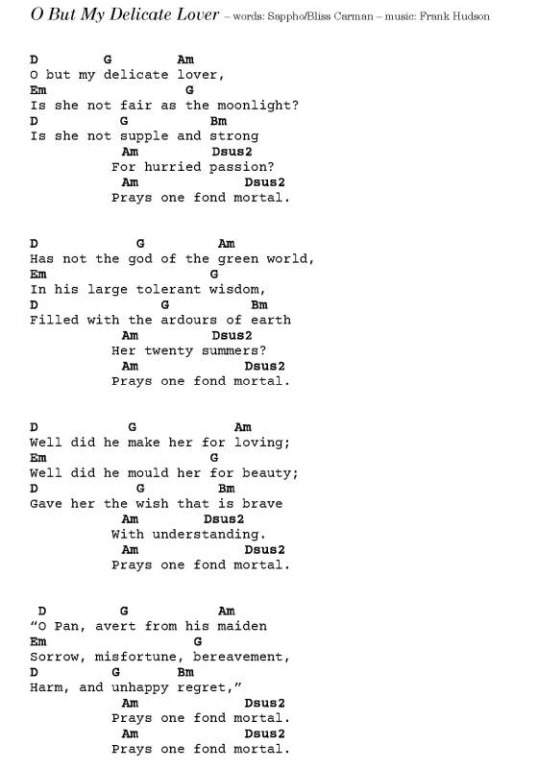
This song is fun to sing, so let me share the fun with a simple chord-sheet to encourage you to try it.
.
Carman’s “The Two Bobbies” speaks to this literary and cultural moment. He jauntily compares the English Victorian worthy Robert Browning with the 18th century Scottish poet Robert Burns. Silent on its now age-beiged page, Carman’s poem was just begging to be made into a song, so this week I came up with a simple setting for acoustic guitar and my voice of subjective quality. You can hear me hold forth with it using the audio player gadget below. No audio player? This link is a backup that will open a new tab with its own audio player.
.
*And what of Vagabondia’s co-author Richard Hovey? I have plans to present some of his work here soon. Rather than looking to the ancient Greeks or to 18th century British poets, Hovey was steeped in another motherload of Modernist-influential poetry: certain French poets of the second-half of the 19th century.
I regularly read and take part in a daily poetry thread on X/Twitter. Its host, Joseph Fasano, posts a theme word and an example poem reflecting a topic most mornings, and other poetry readers respond with poems that relate to that. Early this week the theme was “Longing.”
One of the responding poems was this one:
The X/Twitter poster here happens to be a relative of mine, though I’m not sure which one
.
This is an English translation of a poem by the ancient Greek poet Sappho rendered by famed Canadian poet and translator Anne Carson. If we didn’t know it was a translation, if we thought of it as a poem by a modern poet, here’s one thing we might notice on the photographed page: those short lines, those white spaces, those fenced-off blanks kept apart by square brackets. Looking at the text this way, the poem on the page has a striking effect. Its incompleteness — its, well, longing — is amplified in those spaces.
In Carson’s presentation that’s an inescapable part of Sappho’s work. We have only fragments of Sappho after all, only a handful of her poems are even comprehensively within sight of being complete. Some Sappho fragments are but single words, and many, a phrase or a few lines. And we know so little of the poems’ context. What details recorded about Sappho’s life date at best from centuries after she is thought to have lived, and are inconsistent. That she was a woman in a male dominated world, and lived in an outlying area away from the centers of classical Greek culture that we most know from later surviving works adds to the mystery. That the Greeks of the Athenian Golden Age, or the later Hellenistic Greeks, misread is some way the larger corpus of Sappho still available to them as they supplied us with Sappho quotes, commentary, and biography is plausible.
As readers of modern poetry, we likely assume when reading a Sappho poem that it’s a more-or-less authentic voice of someone describing a moment in her own life. I can’t say that as being a sure thing (any more than it is for, say, Shakespeare’s sonnets). But maybe that makes little difference, especially in the absence of well-attested facts — the words have the effect they have on us, based on our own lives, our own culture, our own time.
Carson’s translations are well-regarded, but she’s not the first to translate Sappho into English — she’s not even the first Canadian to do so. The first attempts there I know of, likely the first in fact as it’s by such an early Canadian poet, were by Bliss Carman.* In 1904 Carman published Sappho: 100 Lyrics. Unlike Carson, who is a scholar, I don’t know if Carman was all that knowledgeable in ancient Greek, and from what I can find he’s less open in sharing translator’s notes on his methods. The preface to his book, written by a friend, says only he more-or-less imagined the poems as complete and wrote then from that imagination.
From a scholars’ standpoint this is an outrageous act. On the other hand, there’s a current in poetry of writers finding something in assumed characters, some for anonymity, some for fraudulent reasons, some to burlesque writing styles they wish to make fun of. Carman’s life was not straightforward. There were a lot of bumps and setbacks in his career — all as one might imagine at a time where the idea of a Canadian literary poet was yet to be established. So, to take a vacation from all that to the isle of Lesbos and imagine Sappho strumming her lyre within his earshot? Maybe understandable.
Another green world. Here a chord sheet for today’s musical performance.
.
Published in the era just before the outbreak of English-language Modernism, Carman’s version of Sappho found some readers. Ezra Pound apparently read them, and in his loose Chinese translations and elsewhere he seems to have adopted a no-hurt, no foul practice of translation as a personal recasting of the original work. Carman’s Sappho is sensual without overelaborate decoration or any “I’m so naughty” stance. I can imagine some of those Not-Yet-Modernists who kept a well-thumbed copy of Swinburne in their back pockets circa 1900 appreciating these poems. If the tropes in these love poems are often common ones, he’s portraying Sappho who would have predated those tropes becoming commonplace, and he’s asking us to believe our moments are repetitions with a long heritage.
Many modern readers of Sappho have adapted Sappho as a pioneering Lesbian poet. In the many centuries between Sappho’s 600 B.C. E. and the present there have been a variety of renderings of Sappho’s sexuality. The text, fragmentary as it is, often shows attraction and praise for women and female gods. If we assume Sappho herself is the voice in her poems (and why not, we know so little, and nothing for sure, and Occam’s razor) this would follow. In this poem of Carman’s Sappho, the lover and object of longing is certainly female. Bliss Carman was an apparently hetero male, but his poem’s assigned author is a woman. Parsing….
Those that object to drag-time story hour at the library will have a hard time with all that. If for only that alone, I’m going to give voice to this poem from Carman’s collection of imagined Sappho translations. You can hear my musical performance of “O But My Delicate Lover,” with the audio player below. Has the important fragment that includes an audio player disappeared for you? This highlighted link will open a real, not imaginary, tab with its own audio player.
.
*Carman’s 1904 work may also be the first American translation of Sappho, as it predates the top hit in a web search that shows Mary Barnard’s 1958 volume as the first from the U.S.A. Coincidently, Ezra Pound is attributed as someone who encouraged Barnard to do her book of Sappho translations.
Carman studied in the U.S. and was distantly related to Ralph Waldo Emerson. His ancestors emigrated to Canada as Tories escaping after the U.S. Revolutionary War.
I first encountered Leonard Cohen in one of those so serious Sunday arts, religion, and culture shows that broadcast TV felt required to provide around the past mid-century. As he was consistently able to do throughout his life, Cohen was able to articulately weave a good deal of provocative thought into an interview. I was struck, and took to reading and listening to Cohen from that point on.
I was young then, and Cohen’s eloquence was novel to me. In the many decades since, I have heard others work the provocative angle in interviews, but never with the same level of quality as in Cohen’s spiel. Poetry, religion, music, politics, and more could enter into his answers — and often when the question didn’t determine which of those things would be in his response.
I cannot find any online video of that exact Sunday TV show from The Sixties, but his 1966 CBC interview is an example of what a Cohen interview would be like.
.
To some that could seem pretentious. And that is a risk: a lot of provocative interviewees when challenged are bluffing. Asked to show their cards, they will throw the cards and the table in the air, or will fold into muffled defensiveness. Cohen seems to have never done that. He always had, seeming at hand, another answer, deeper or funnier, or more provocative. And those Sixties interviews are even more remarkable in that many current televised interviews are prepared: a demi-scripted performance where the interviewer is tasked to ask questions prepared beforehand, so that the interviewee can be setup to tell their clever story or give a canned pitch for their current work, cause, or situation. My sense is that Cohen wouldn’t have followed such a scheme even if it was expected of him then.
Did you “huh?” at that “funnier” in the above litany? Maybe it’s the baritone voice or the unrestrained gothic concerns; to many superficial observers Cohen has always seemed the uncut expression of despair and sorrow — but with a little sex in it. Yet absurdity and satire were always part of his expression. Those looking for the correct and proper level of seriousness, those with the least sense of humor and the highest expectations for consonant entertainment, are the most likely to miss that element in Cohen.
This a longer-form documentary on Cohen from the mid-60s. Watch the first 3 minutes and ask yourself if songwriting might have lost a talent to stand-up comedy if Cohen had emerged a couple of decades later.
.
Today’s piece is a short passage from Cohen’s first novel, The Favorite Game, though the words (and I) perform it much like a poem in the Parlando Project manner with The LYL Band. I thought of this older performance today because I recently had a restless dream which had a jukebox in it, and that caused me to think of the disappearance of this phonebooth appliance that directly connected one to the sound of a voice for a coin in public places. How strange that seems now, with our earbuds and all-you-can-bear-to listen-to streaming. Cohen calls out the mechanism’s comic mystery in this passage, and you can hear it without a dime or quarter with the player gadget below — or if you don’t see that player, with this highlighted link.
For not the first time here, I need to travel in a roundabout way in time and place to get to today’s piece. Last post, I discussed how little survives of the work of the ancient Greek poet Sappho: only a small handful of more-or-less complete poems, the rest fragments (some as small as a single word).
What caused us to then remember her at all, to collect and care about these fragments? I think it’s largely because the legends that grew up about her combined with the short verses that survive are intriguing. Yes, the ancient Greeks praised her formal poetic achievements highly, but what survives of her writing and biographic legends testify to a poet who lived and writes about love and desire. The compression of the lyric form mixes with the intensity of the erotic themes and the peak-a-boo of their historic fragmentation — the poems flirt with us.
And now for the time-jump. We move to the beginning of the 20th century, from an exotic 7th century BCE Aegean island dweller to a Canadian, a poet with the name of Bliss Carman.* In 1894, Carman and a college friend published a collection of poems extolling the romantic carefree life: Songs of Vagabondia. Not quite as ecstatic as Whitman or Jack Kerouac, it none-the-less found a public and launched two sequels. Carmen followed this series up in 1907 with what became his most highly praised poetry collection, the audacious Sappho: One Hundred Lyrics. How’s that? We’ve established there’s only a handful of somewhat complete poems.
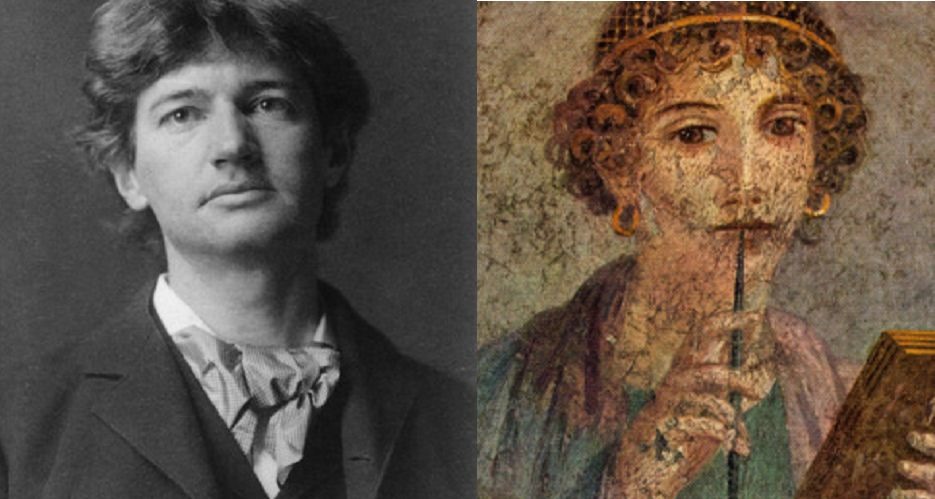
Bliss Carman audaciously invented his own extension of Sappho. Sappho is here depicted as being the first poet to chew on the cap of her pen while thinking.
.
Carman’s cousin, and fellow worker to establish a Canadian poetry, Charles G. D. Roberts, explained what Carmen did altogether briefly in an introduction to the book:
Mr. Carman’s method, apparently, has been to imagine each lost lyric as discovered, and then to translate it; for the indefinable flavour of the translation is maintained throughout, though accompanied by the fluidity and freedom of purely original work.”
One wishes for more explanation. Roberts’ account reads to me like one of those occultists who receive texts through spirit guides or translate ancient inscriptions by telepathic laying on of hands. However, in reading the entire book I get a sense of a different tactic with the same strategic goal that I’ve admitted in some of my translations and presentations with music: an attempt to make the old text in an old language uniquely accessible to some contemporary readers.
Yes, yes there are dangers in inauthenticity and willful anachronism. “Um, Actually” historical scholarship illuminates things too, but last time I said I understand and find value in those current readers of Sappho who wish to encounter her as if she was a modern gay woman. Carmen wanted his readers back then to get some sense of Sappho’s expression of unboundaried love that the fragments hint at if assembled just so.
His re-animated Sappho is more of a circa 1900 Pre-Raphaelite to Pre-Modernist** one. He eschews rhyme and doesn’t go all out for florid poetic diction. Most of the lines are his, not Sappho’s by any actual sense of translation, and perhaps they are best appreciated in the same way that dialog is in a historical novel. In research this week I understand there were some notes where Carman at least connected a portion of the poems with the corresponding cataloged Sappho fragments, but nothing like this was contained in the published book.
At it’s best, like today’s piece, you get a poem that wears its intent of patinaed timelessness lightly. Here’s a link to the poem’s text if you want to read along. I particularly like the image of the coupled lovers watching from the bedroom window unknowable ships whose ventures are now safe in port.***
For music today, I’ve turned not to the ancient lyre and flutes of Sappho’s time, but perversely to try for that timeless illusion using synthesizers along with my fretless electric bass. The player gadget may appear below to hear my performance of Bliss Carman’s “LXXXII Over the roofs the honey-coloured moon” poem. Some blog viewers will not show the player gadget, but then this highlighted hyperlink will play the audio piece if you click on it.
.
*I’ll admit it: the moment I read this name, I smiled. I couldn’t tell what gender. To modern ears “Bliss Carman” sounds like a florid pen name on a romance novel, or even a drag queen’s persona, but some reading and research staunched my snickering. In Real Life, he helped establish Canadian literary poetry and his career stretched from the establishment of the Canadian Confederation to the Modernism of the 1920s.
***Reminds me of Emily Dickinson’s “Wild Nights” poem with lovers “Futile — the winds — To a Heart in port — Done with the Compass — Done with the Chart!” Dickinson’s poem would have been somewhat freshly published when Carmen was working, and I wonder if he knew it?
We’re entering a month in which Veterans Day will be celebrated with additional ceremony, because the 11th will be the 100th anniversary of the ending of the first world war. Earlier in the blog I remarked that World War 1 was the last war which was substantially narrated to us by poets.
That’s so for a complex set of reasons. Modernism, arising before the outbreak of the war, sought to revive a fresh poetry shorn of worn-out imagery and obligatory practices. The war brought both the old poetry and the new Modernist ideas into a great deadly laboratory to test their efficacy. The comfort of the old poetic music survived this test, but it was gravely wounded. The new practices were not exactly proved either, such was the horror and absurdity of the war. Indeed, the post war Modernism that came out the other end of the war’s meat grinder was oddly often much more obscure and seeking after esoteric tactics.
To a large degree, the post-WWI era marks an off-ramp for poetry. 20th century poetry emphasized the language of aesthetics and philosophy that might employ music to sweeten its sound, rather than the music of words that might employ philosophy as one of its harmonies. Eventually, by our current century, it turned again, and it is now largely about memoir and the establishment and explanation of personal identity.
World War 1 broke poetry, and in it’s wake, the Modernists ascendant decided the shards better reflected reality than some dusty Grecian Urn.
Any of these schemes can work (and not work) artistically, but there is a sort of hierarchy of needs and audience here. The old poetry was more universal, the post WWI High-Modernism the most exclusionary, and our current poetry can result in a multitude of voices crying “I’m here!” to the exclusion of “I see you!”
If one sets aside modern literary poetry, the old poetry still survives. One place you might find it is in the library that some carry about in their heads: memorized poetry. How rare is that today? I cannot say, but I can recall late in the last century, observing Garrison Keillor offering some prize (an autographed book? a T-shirt? I can’t recall the exact prize) to anyone in an admiring crowd who could recite a poem of more than 8 lines. I recall no one taking him up on that offer. Poetry started with those libraries in our heads, and we have the Iliad, the Odyssey and other ancient poetic epics because of prodigious memorization before writing. It isn’t just the noise from our glowing palm screens, or giant TVs that numbed this out of us, it started with the silent racket of all those printed books that call us to read them. Memorization seems a mooted point.
Can you pick out the veteran in this picture?
But returning to that portable library in our heads, and returning da capo to where we started. Somewhere near the middle of the 20th Century, a U.S. Navy pilot was captured and imprisoned by the forces of the country they were bombing. Their captors were none-too-restrained in their treatment of their prisoners, torture and physical abuse was part of that; but in-between that and the constant lack of control that all prisoners face, the prison was made up of small solitary cells with deliberate and extraordinary limits on communication between the prisoners. The design was to break their will, not just their bodies.
The captured pilot was John McCain, who survived this and later went on to a long political career, but one thing that he said helped him persevere in his prison was another captured pilot teaching him a poem by Robert W. Service, essentially loaning out a book from the library of one prisoner’s head to the other. And the method of doing this was painstaking: a pseudo-Morse-code of taps on the wall of the cell that the prisoners devised.
Robert W. Service poems would fit well into taps, as his marching poetic feet can make one tap involuntarily—and the rhymes and narratives give a good structure to assist memorization too. Of course, this was a war prison, it wasn’t a graduate class in Modernist poetry, and if any of the prisoners might have known T. S. Eliot’s “The Wasteland” they might have skipped it if they couldn’t add the famous published edition’s footnotes in tap codes.
Other than Service’s poetic aids to memorization that let his poetry be present in these solitary cells without possessions, another reason that it should be a poem of his that helped these prisoners endure is that some of Service’s best-known poems are about fatalistic endurance leavened by dark humor. Service’s poetry wasn’t just available without paper, it shared an outlook that helped sustain the prisoners.
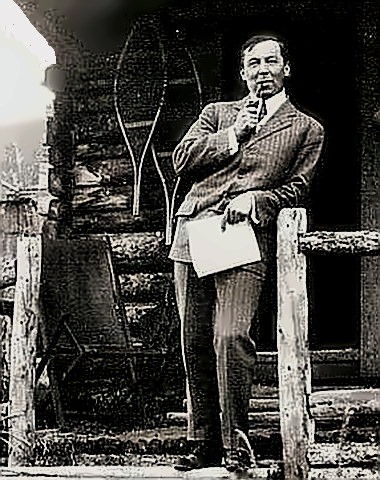
Canadian poet Robert W. Service, not essaying a look that Leonard Cohen would own up to.
So that’s one veteran’s story from a war, decades after WWI. Here’s another.
While McCain was imprisoned, another Navy veteran went into a studio in New York City and recorded an LP of Robert W. Service poems set to music.* While Service’s pre-war “Canadian Kipling” poetic style hadn’t changed, the outlook of the poems used in this record included Service’s rage at the horror and lies of WWI. Robert W. Service didn’t become a Modernist poet, but he showed in these poems the same WWI impact that broke other pre-war poetic outlooks.
The veteran in this case was “Country Joe” McDonald, and even if these Service poems talked distinctly of WWI and the British, French and Canadian experience of it, McDonald no doubt intended it to reflect on the then ongoing war in Vietnam. Of course, there were poems written after the WWI era about war, and McDonald had already tossed off one of the most famous Vietnam war songs himself: “I Feel Like I’m Fixin’ To Die Rag.**” And yet, here he was, drawn to these poems about World War I to express something decades later.
For our audio piece today, here’s a Robert W. Service poem, “The Lone Trail,” more from the endurance side of the poet, performed by Dave Moore with the LYL Band. Here’s the player to listen to it:
*The record War, War, War largely draws on Service’s Rhymes of a Red-Cross Man which was published in 1916. McDonald’s record is a true solo record, just acoustic 12-string guitar, vocals, a bit of harmonica, and some foot-stomping; a straightforward, earnest, and harrowing collection. Parlando Project voice Dave Moore owned that LP, part of the reason he performed today’s Robert W. Service piece.
**McDonald later tells the story of hearing that not only did the North Vietnamese appropriate his song for propaganda broadcasts meant for the U.S. troops, but they even piped it into that POW camp in Hanoi. In the story McDonald heard, the soldiers, and even the prisoners, would laugh. His analysis: the French-educated Vietnamese “Never understood…an American sense of humor.”



 Frank Hudson