The Two Bobbies: compare & contrast Robert Burns and Robert Browning. Make your answer in the form of a song.

When we last left off pioneering Canadian poet Bliss Carman he was audaciously publishing a collection of 100 lyrics by Sappho.  If you read that post you find that such a substantial book of Sappho required Carman to largely imagine what the ancient Greek poet wrote, since much of what survives of her poetry are fragments, often but a line or two.

One could shelve that effort next to Ouija board transcriptions, among literary frauds, or within the loose bounds of historical fiction. Still, the “Sappho” poems he published have their attractions. And there’s a greater reason to look at Carman’s work: he was writing these things in the generation between 1890 to 1915 before English language poetic Modernism fully emerged with new models and freedoms for poetry. Some younger poets then suspected that Victorian 19th century poetry was overdue to be superseded. In England, William Morris and the Pre-Raphaelites had done what segments of young poets, musicians, and artists sometimes choose to do: they rejected their current and parent’s generation and looked to older models of their arts for different forms of expression.

Imitating the ancient Greeks in English was one such idea. Carman went further by treating his recreations as translations, but he may have gotten away with it when English translations of Sappho were still a bit thin on the ground. Other early Modernist poets writing in English like H. D. and Edgar Lee Masters produced original works that echoed the tone and methods of Greek lyric poetry.

Those Sappho lyrics weren’t Carman’s breakthrough however. That happened in 1894 when he and American poet Richard Hovey* published Songs of Vagabondia, the first of a series of co-written poetry collections that sought to break the Victorian mold. For a mid-20th century person like me, I sensed a rhyme in the appeal of these books as I read through them. Is it too easy for me to see them as the late 19th century equivalents to On The Road  and beatnik bohemia?

How so? Though the Vagabondia  poems have variety in subject and tone, they extol carpe diem, wine, women, and song, along with non-itinerary wandering. Sensuality and beauty are self-rewarding. Respectability, career, and money are for others.

Two Bobbies

This song is fun to sing, so let me share the fun with a simple chord-sheet to encourage you to try it.

.

Carman’s “The Two Bobbies”  speaks to this literary and cultural moment. He jauntily compares the English Victorian worthy Robert Browning with the 18th century Scottish poet Robert Burns. Silent on its now age-beiged page, Carman’s poem was just begging to be made into a song, so this week I came up with a simple setting for acoustic guitar and my voice of subjective quality. You can hear me hold forth with it using the audio player gadget below. No audio player?  This link is a backup that will open a new tab with its own audio player.

.

*And what of Vagabondia’s  co-author Richard Hovey? I have plans to present some of his work here soon. Rather than looking to the ancient Greeks or to 18th century British poets, Hovey was steeped in another motherload of Modernist-influential poetry: certain French poets of the second-half of the 19th century.
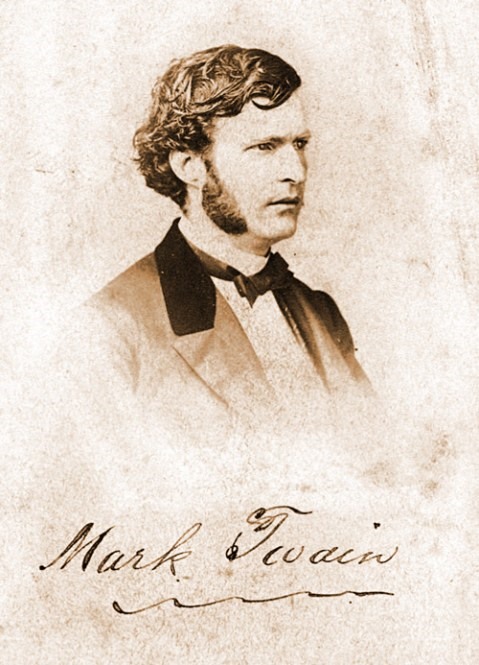
Genius by Mark Twain

Last time, American satirist Mark Twain took aim at the pretensions of half-hearted sentimental memorial verse. Today’s barbs for bards are from a younger Twain. The text is taken from what was apparently a journal entry written on shipboard in 1866, before Twain was established in his literary career. Elsewhere on the web “Genius”  is identified as a poem, and perhaps in manuscript that intent is clear—but when I first read it, I suspected it could be notes for something not yet finished, or even cue-phrases for a humorous lecture.

150 years and the mystery of what it is hardly obscure the points Twain makes. The alienated, self-pitying, and intoxicated artist, damaged by a feeble market that is itself a claim to their originality, is a type we can still recognize—even for some of us, in the mirror. In my performance I chose to bring forward what I think is some ambiguity in the piece. Twain never quite shows the work itself is a worthless affectation, while indicting the affectations around the artist specifically and wholeheartedly. Yes, the poet’s rhymes are said to be “sickly” and “incomprehensible,” heavy charges laid on them by those “with sense” who are not hip enough to appreciate the “genius.” Every single poète maudit* since would take those charges as badges of honor. I sense some mixed admiration for this stubborn guy who sensibly should take available steady work as a sawyer, but instead sticks to writing.

Mark Twain 1863

The pen name was still fairly new, and the ‘stache hadn’t yet leapt to his upper lip, but here’s the twenty-something Twain.


After all, Twain himself was not far from that state. He was not yet a successful writer. He hung out with a group of self-described Bohemians in San Francisco. He lived in his Twenties a fairly reckless and feckless life, fleeing to the west from Missouri to escape the Civil War and the draft, fleeing Virginia City for San Francisco to escape a duel occasioned by a slanderous article he had published, and this particular journal entry had him on a ship heading to Hawaii, leaving San Francisco. “No direction home, like a complete unknown…”

And all his life, Twain was two, a man who clearly wanted success and recognition, but whose writing and outlook was distrustful of established norms, propriety, and shibboleths.

If “Genius”  is notes for a talk and not an intended page-piece, it points out that Twain’s eventual career included substantial work as a speaker who told humorous stories. We have a name for that sort of work today: stand-up comedian. During his time out west Twain met and befriended Artemus Ward, a man who has since been called the first stand-up comedian. They met in the mining boomtown of Virginia City, and the story goes that after Ward’s performance, Twain took Ward on a drunken tour of the rooftops of the town. Given their state, the risk to American culture of such an intoxicated lark was in retrospect considerable, so perhaps we should thank the town constable who along with a shotgun filled with rock-salt, ended that escapade.

So, Twain lived to write his books and to skewer poetry. The player gadget to hear my performance of Mark Twain’s “Genius”  (whatever it is, or was intended to be) is below. Here’s the full text of “Genius” as is appears elsewhere on the web.


*Was Twain skewering a particular poet, or a type? Edgar Allen Poe, the American poet of his time who lived and sang the “songs of a poet who died in an alley” would be one candidate. And it could be in some part a reflection of persons in the West Coast bohemian scene he was sailing from.