Paying the Piper: Epilog

Those following my June series on my trip to investigate the life of a largely forgotten poet, folk-song collector, and teacher Edwin Ford Piper may wonder why I titled it “Paying the Piper.”  There were a couple of reasons I knew as I started writing the series after returning home after the trip.

The first: I’d be paying attention to Piper when nearly no one else was. That may be a strange choice, though it’s one I’m largely comfortable with. I enjoy looking at places others aren’t, and I love stories that connect seemingly unlike things. So, Piper’s settler family moving to the frontier of Nebraska just after The Civil War, raising a poet-son who educated himself on the plains amid those who stayed, and those who passed through. I being a guitarist who grew up in the folk song revival, I appreciated that he collected the songs that entertained those people, songs that I could run into decades later because of the work of collectors like Piper. Even my search on that elusive question I couldn’t solve had it’s rewards: what of the pervasive Workshop and MFA culture of poetry of the last 70 years arose, perhaps unwittingly, from Piper’s own methods.*

The reason we call it paying  attention implies it has a cost. I could have done more new musical pieces here, ones featuring poets there is more general interest in. The longer posts in June took a lot of work for a small audience. I chose to pay that cost. If you come here for the more known poets and for the musical performances, some of those are already in progress this week.

My wife and I returned home in the evening after my sojourn to the University library in Iowa City. I had a lot of notes, and pages captured but not yet analyzed, and I had ordered a couple of books to help that would arrive in the upcoming week. It was good to have gone on this trip. It was good to be home. Now the second paying.

What was the one thing I was most looking forward to at dawn the next day? Getting on one of my bicycles and moving my old body briskly through the cool morning air. I would ride to a café and have a frittata and a big glass of iced tea, read the newspaper, and think about poetry or music tasks for the upcoming day.

I walked out that next morning to the garage access door, and I found it slightly ajar, unlocked. I opened it. Sometime during my Iowa trip, my family’s bicycles had been stolen.**

I could write a thousand words here on the stolen bikes if I thought there was a readership for that. I lost my old original generation mountain bike. It was the first bike I bought to ride through Minnesota winters back in the early 1980s instead of buying a car. I rode it in snow as planned, and over rough trails in woods — and in a couple of returning trips, in the river valley hills and gravel roads of Iowa where I grew up, With less knobby-tires it worked well to ride around the city too. Over a decade ago it was the bike I attached a trailer bike to, to take my young child for rides. In the last few years it had become my rain bike since it had full length fenders, and it was the one I rode when the place I’d need to lock up was a little more risky. I’d figured, scratched up and faded, outdated in every regard, it didn’t look like anything to steal. But, it was gone, though I tell myself the memories aren’t stolen.

Diamondback Ridge Runner Spring 2013 600

Picture of the OG mountain bike taken a bit over 10 years ago, when it still had the trailer-bike hitch on it.

.

20 years ago I decided to replace it, and bought what was then a modern “Hybrid Bike.” It was an aluminum Trek, not the fanciest in their line then, but it had indexed gear shifting and the ability to run thin high-pressure tires that I thought would make the bike nimbler. However, the bike and I just didn’t bond. It never was a joy to ride, even with the 28mm narrow tires that were expected to make it faster and easier rolling. Aluminum frame bikes, particularly the ones from that generation, are known for having a harsh ride, maybe that was it I told myself — but whatever, it just wasn’t any fun. Then a couple of years ago I obtained a set of new wide 50mm tires that didn’t fit the bike they were bought for. I’m not sure why, but I mounted them on the aluminum Trek along with a Brooks Flyer leather saddle (that’s the one with springs). The bike was transformed. The extra tire air volume and the saddle not only made the bike more pleasant to ride, those tires made the bike feel more nimble (and more tolerant of bad street surfaces). In the past year it had become the bike I rode more than any other. It had been some mice and a pumpkin, then a splendid carriage and horses — and now, poof, it was gone.

The bike I was looking forward to ride that morning? A purple REI Randonnee that my wife and I had bought used with the idea that she might want to try longer bike rides at some point. It too was probably 20 years old like the Trek, but it had a smooth riding double-butted steel frame. That touring idea never worked out, but I had modified it over the years with a better set of handlebars, a tweaked stem height, some used “brifters” for indexed shifting (my wife never cared for the bar-end shifters it came with). I ended up riding it on longer rides. It was comfortable, responsive, and I miss it.

Also lost, both my wife’s and my winter “Fat Tire” bikes.

Just inanimate things, but I ride my bikes almost every day for joy and utility, the loss was something like loosing a pet.

All lost as I was in a library studying the life and times of a largely forgotten poet and singer of songs people kept.***

.

*I might write more on that Workshop/MFA issue for poets and writers later this summer, but one of the folks who helped guide me on my search S. L. Huang wrote a thoughtful article on the dangers of this paradigm for many writers which I’ll link here.

**I won’t go into the details of how/why the garage was unlocked, though I likely know.

***Besides the thing-grief of these oft-used tools for joy being gone, and the work of trying to nail down details with the Edwin and Janet Piper stories, a large part of my June was taken up replacing the stolen bikes. You’ll meet the replacement bikes later, likely in use.
Bicycle Spring

Let’s celebrate our arrived spring with this LYL Band performance of another Kevin FitzPatrick poem. Here’s a link to the full text of Kevin’s poem that we used — a link which also serves as a reminder that Garrison Keillor’s old Writer’s Almanac program used this poem once too.

Green vs Snow - photo by Heidi Randen

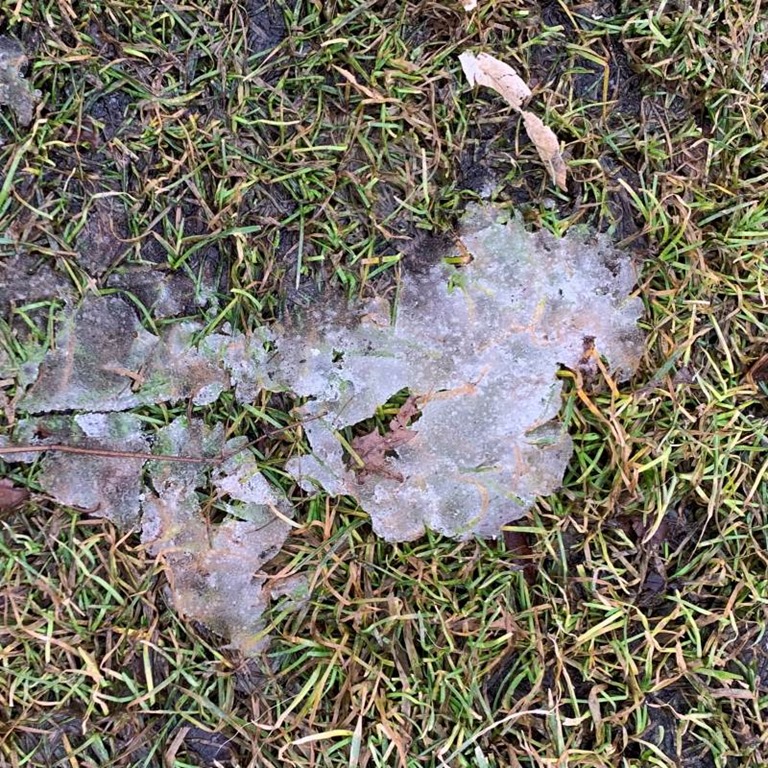
Not a satellite image of Antarctica, but a representation of how ice is fading and green emerging in Minnesota.

.

Like most all of Kevin’s poems this one yields a straightforward meaning to many readers or listeners without need of study or re-reading. As I mentioned last time, that was one of Kevin’s aims. You may also notice the care he takes with the word-music in this piece. In our little poet’s group, Kevin’s suggestions would often be metrical improvements, and isn’t the sound of this poem’s opening line: “Windy, sunny, and Sunday” a fine springboard into this spring poem!

If one expects, requires, or prefers a more allusive and elusive poetry, you could shrug at this poem on the page. The poem’s overall metaphor — that learning to ride a bicycle in childhood is representative of a parent and child’s task of independence and departure — is likely apparent before you complete the poem. Myself? I found the poem charming. I can come to like a poem that doesn’t charm me at first — but how many poems survive to be understood when we initially stand coldly next to them? Oh, some poems taunt you with mystery. Some ask you to be impressed with verbal richness. Some present unknown worlds you may choose to explore. “Bicycle Spring”  seems simple. So, is it less good, or good only for lesser pleasures and less respect?

I’ve been writing, reading, and performing poetry for decades. I suppose I should have a valuable opinion on that matter. Sorry to disappoint, but I do not. Readers often tell me that my own poems and lyrics are too obscure and mannered. I personally prize originality in outlook and images highly, even at the risk of asking my readers/listeners to drop expectations and habitual/familiar ways of understanding a piece. Is that the best way, or do I even execute that way very well?

Way back in the 20th century I was taking a seminar class with poet Michael Dennis Browne, and in talking to the group he suggested that most of us students were writing poems that were more obscure than the ones he was writing. He asked, or at least strongly implied, that we should ask if that obscurity was necessary. I now ask you — as I continue to ask myself — to ask that. One thing should be key to your analysis: obscurity may be a way to cover up bad writing, insufficient intention, and fear — yes fear — of being understood.

Kevin FitzPatrick’s poetry was one poet’s answer to those questions. He truly wanted to speak to a broad audience, and yet at his death had achieved only a small (if appreciative) one. Dave and I are trying to enlarge that audience a little bit with this series,* as well as to memorialize our feelings after the death of our colleague.

Before I leave you with Dave Moore’s performance of Kevin FitzPatrick’s poem “Bicycle Spring,”  let me point out that there are often little figures on the horizon or in the background that can add depth to the first hearing or reading of one of Kevin’s poems. In our first example this month “Blackberries,”  I should have given you a link to the Seamus Heaney poem “Blackberry Picking”  that serves as the distant core of FitzPatrick’s poem.  FitzPatrick’s “Blackberries”  is homey, humorous, even practical. Heaney’s “Blackberry Picking”  is fatalistic, mildly tragic, haunted by waste. Kevin admired one poem, wrote another, and says so in “Blackberries.”   To know the tragic and to choose the comic is a complex choice isn’t it? And in “Bicycle Spring”  the background is there too, those concluding “blocks where he/has forbidden you to walk.” The father’s job is in part to help himself disappear.

The graphical player to hear the LYL Band’s performance of FitzPatrick’s “Bicycle Spring”  is below for many. If you don’t see that, here’s a highlighted hyperlink to hear it too.

.

*Kevin’s poetry collections were published by Midwest Villages & Voices, and are not available through easily linked online booksellers or AFAIK, even directly from the publisher. “Bicycle Spring”  is in his 1987 collection Down on the Corner  which is ISBN 978-0935697025 and this information may help you get a copy via your library or local bookseller.

UPDATE: Kevin’s literary executors have now made his work more easily available for those who need to order it online. See this link to order his books that way.

Snow Storm on a Blank Page

Longtime readers will know that one of the principles for the Parlando Project is “Other People’s Stories.” I partly do this out of a contrarian streak, as the Internet is full of folks telling their own stories. Yet, obviously, I do not take my path due to a condemnation of personal stories. After all, without other’s stories, I would not have the ones I present and react to here.

I believe something additional happens in my process of presenting my encounters with other people’s stories. You, the valued readers and listeners here, add a third part to this. Do you see, what I see, as I am looking at, speaking someone else’s silent words; while you remain off to the side, with your ears at each side of your own mind and memory, your eyes parallel to your own mouth? No, you will see something slightly different.

Yet, this morning, let me violate my self-imposed principle, and write, as if this were a conventional blog, about myself.

I awoke today after a week that finally found promised 50 degree Fahrenheit temperatures to an utter snowstorm that had itself awakened from a night sky that fitfully dreamed rain, sleet, hail, and freezing rain. The wind outside had someplace to go in a hurry.

I am an Amateur of Velocipeaes by Leonara Carrington

Leonara Carrington dreams of bicycles with oversize tires

As a contrarian, I dressed and took to my marvelous Minnesota invention, the fat bike fitted with 4 inch wide studded and knobbed tires. A morning with few moving, yet full of noise. Snow crunching under the tires, wind restating its case more insistently over again, the typewriter of snow against my goggles.

Parked at the curbs, even the most fearsome cars were growing a white carapace, their windshield wipers stretched out, insect arms, quivering in the wind.

Windsheld wipers stretched out insect arms

“Insect arms, quivering in the wind”  wipers left out to keep them from being encased in ice

To be an old man on a bicycle is to know gratitude. Does a fierce April snowstorm tell a story? Perhaps it does. Is it beautiful, or a false and comfortable frightening that leaves others inside, deciding that internal pleasures are best this morning. But I wished to hear its story today, to see it. As I rode, the wind said yes and no in its one direction. The snow said music is frozen yet moving. The whiteness says color can only exist if you make it.

In the middle of the week I had driven two friends to the airport. They saw this sign “If you see something, say something.” I thought, isn’t that the fourth Imagist rule, one unstated by F. S. Flint and Ezra Pound? Yes, you must honor the thing and your reaction to it, using no word just because you believe you must use that word, and remember you are making music, not marching. But the first rule, which I understand now in the multitude of a blizzard: if you see something, say something.

A Summers Night

A couple of posts back we had a piece with words by Roy G. Dandridge who got called the “Paul Laurence Dunbar of Cincinnati.” Today’s episode’s words are by the Paul Laurence Dunbar of Paul Laurence Dunbar.

paul-laurence-dunbar

Paul Laurence Dunbar. Young, Gifted, and Black.

Dunbar grew up in Dayton Ohio, the Afro-American son of former slaves. In his town’s high school class of 1890, he was friends with another guy, a white guy, one who had varied enthusiasms. This other guy was a snappy dresser for his time, wearing newfangled wing-tip shoes, bowler hats, and a sporting a dashing waxed handlebar moustache. When the mandolin had a popularity boom, Dunbar’s classmate dude had to learn to play it, and he apparently drove his family around the bend as he practiced. Then later, the dude became interested in printing, and so designed and built his own printing press. He got so attached to printing and publishing that he dropped out of high school to start his own print shop with his brother. Then a couple of years later, the modern bicycle was invented, and his mechanical ability branched out to building, selling, and repairing bikes.

Dayton HS class of 1880 labeled

Dunbar with his high school class. Dunbar is in the upper left, our mystery dude in the shadows in the back.
And what’s with the guy on the left in the front row, shouldn’t he be in a band or something?

But let’s step back to that printing business. Paul Laurence Dunbar was already writing poetry as a high school student. After graduation, his family’s lack of funds and racial discrimination kept him from going to college, but he hungered to get into print. Our dandy, mandolin playing, designed-and-made-his-own-press print shop guy went into business with Dunbar and printed a newspaper that Dunbar edited and wrote for, even while Dunbar was still in high school–and then he used his connections in the business to get his classmate’s poems collected and published two years after Dunbar graduated from high school.

Dunbar’s books gathered attention. James Witcomb Riley, Frederick Douglass and William Dean Howells reviewed him favorably. By the end of the 19th century he had toured England, gotten a job with the Library of Congress, and written the lyrics for a Broadway musical and collaborated on an operetta, becoming the first widely known modern Afro-American poet before he was 30 years old. The 20th Century awaited him.

Then he contracted tuberculosis. His health declined, and though he tried to continue to build on his career, he died in 1906 at the age of 33.

He should have been one the older generation of the Harlem Renaissance of the 1920s. He could have taken his mastery of the lyrical 19th century style, and like Yeats in Ireland, transitioned seamlessly into the forms and topics of modernist poetry.  Alas, none of that was to be.
 

Dunbar’s “A Summer’s Night”  is a lovely, sensuous lyric. If one goes beyond the Victorian-drenched term “maiden” used almost as a refrain in the opening lines, and the slightly precious “perfumed bosom” of the southern breeze that closes the first half of the poem, the flitting last half that closes with carousing fireflies staggering home in the dark is just gorgeous It’s my hope that using our Parlando Project tactic of performing these words with music lets one more easily accept the sentiment of the more archaic words.
 
So, what happened to our mechanical aptitude dude, the guy who’s printing press began printing Paul Laurence Dunbar while they were High School classmates, helping launch the career of America’s first widely known modern black poet?

Wright Bike

This bike looks pretty sweet even today. Dig the mono-tube rear stay, the tri-plane front fork, and the flipped moustache bars.

Turns out bicycles were one of the seed technologies of the 20th century. Our dude knew how fabricate his own stuff, and make it strong and light. The dude was named Orville Wright and he and his brother Wilbur took the modest profits from their printing and bike businesses, and three years before Dunbar died, they designed, built and flew the first airplane. There was a lot of disbelief that a high-school dropout from a hick town could do any such thing. Pioneers like Paul Laurence Dunbar and Orville Wright had to do it,  otherwise no one would believe it.

To hear my performance of Paul Laurence Dunbar’s “A Summer’s Night”  with music, use the player below. And thanks again for liking, following, and sharing.