The spider holds a Silver Ball

Welcome back to our regular fare after a spate of summer diversions. And what is it that you’d expect to see here? We take various words, mostly literary poetry, and combine them with original music in differing styles. I’ve done this Project for over nine years, and within the archives here you can wander through nearly 850 of these combinations. Since poetry can be described as words that want to burst into song, such combinations might seem an obvious task – sometimes they are – but I enjoy looking for unusual connections, conversations between tendrils and mycelium deeper in the soil, not just the majestic and visible branches everyone sees.

One frequent supplier of words to be recast in sound here is the seminal American 19th century poet Emily Dickinson. Dickinson’s mind is Shakespearean in its scope, and while her modes of expression vary to meet those needs, much of her poetry sits in a rich intersection between short epigramic verse that superficially seems like it could be stitched as some crewel homily, and unconventional, rebellious, independence of thought.

For example, this lesser-known Dickinson poem: “The spider holds a Silver Ball.”   I’ll link the full text of it here. The opening four lines are praise to a spider’s industriousness, with the arachnid – unusually for this poet – standing in here for the highly common Dickinson totem, the bee. Dickinson, the avid gardener with a science-focused education, knows well the necessity of pollinating and honey-keeping bees. In this rarer appearance in her work, the spider is no such creature, for their work is occult or predatory. She praises its web-work none-the-less, that work’s imperial provisioning for prey goes unmentioned. This praise continues in the next stanza. The web is anchored or arises from “Nought” she says. The spider makes its spider silk from a secreted process, its attachment points may be a dimly lit corner unespied, its constructions do not exist until the spider’s efforts create them. But “Nought to Nought” is an omen too for all this effort as the final stanza will tell. Note too, Dickinson genders the spider: “His.” Spiders of either sex spin webs, but this action is male.

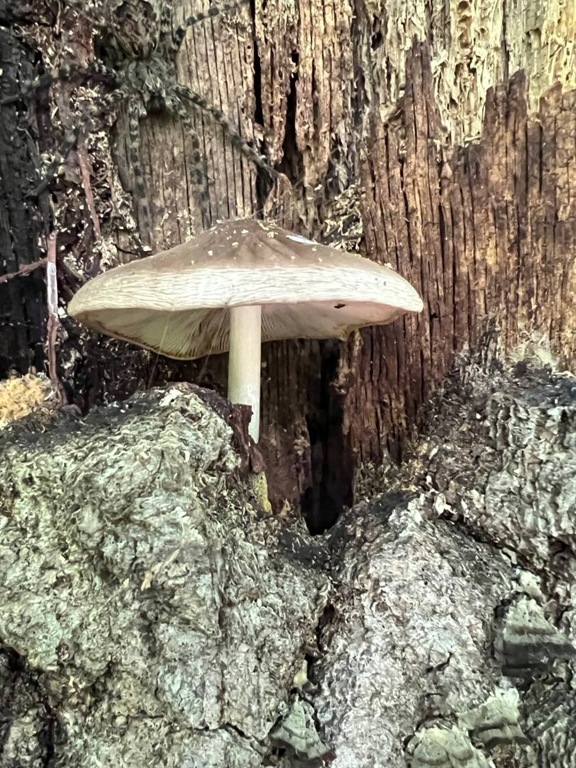
spider and mushroom by Heidi Randen 1080

A mélange of moss and mushroom. Can you spot the spider’s unperceived hands in the picture? (click to enlarge)

.

I’ll make a leap here: Dickinson, the prolific weaver of 1,789 poems, identifies with this spider. One accounting has this as poem 513, so there are hundreds of poems behind her as she makes this one, and more than a thousand yet to go. The bees in Dickinson’s poems are usually cast as joyfully playing, the spider here is more obsessive. Even the dourest Puritan in her era would know the worth of the bee’s work: flowers, food, unspoiled sweetness. In the final stanza, the spider’s work is destroyed by what Dickinson genders as woman’s work, by housework – as endless as this spider’s spinning. Another leap: I wondered if Dickinson might have composed this poem while busy with housework, secretly engaged in the (gendered by her) masculine work of inessential gossamer creation – no matter if “Nought to Nought” is that work’s fate.

As I read this poem I thought of another poet working in this mode, the William Blake of Songs of Innocence and Experience,  who wrote of “The Fly”  and likened his own intellectual and creative drive to the bothersome insect.

I combined Dickinson’s words with music that partakes of the sound of the 1960s psychedelic genre.*  The joy of that kind of expression is the freedom granted to instruments to take novel roles and reconstituted timbres. To a loping 6/8 time, the bass is allowed to rise to sing, the electric piano has been having an episode, the guitars wander onto new paths, an organ breathes, the drums fibrillate. Over this I sing wildly, unconcerned to be overheard. You can hear this performance with the audio player gadget below. What, has that audio player seemingly come to nought? Some ways of viewing this post will suppress the gadget, so I offer this highlighted link which will spin a new tab that has its own audio player so you can listen.

.

*I don’t find this a strained pairing at all. The 19th century American New Thought and Transcendentalist strain was still alive in the Beat and later counter-culture outlooks that arose a century later. Dickinson’s recasting of language and syntax in many of her poems is like to the sonic experiments of psychedelic music, which I’m attracted to for their adventuresomeness rather than their drugs. What is novel about my application of this to Dickinson is that this element of her poetry is under-observed, while it’s more common to view William Blake as “A ‘head’ before his time.”

Like trains of cars on tracks of plush

Later this month I’m hoping to attend remote online sessions of the Tell It Slant Poetry Festival run by the Emily Dickinson Museum in Amherst, perhaps as many as I did last year. Something they do that I enjoyed was listening to all the sessions where a range of readers read all of Dickinson’s 1789 poems.

Now was I sitting in rapt, solitary devotion for every hour of that multi-day marathon? No, though I was paying some attention throughout. I restrung some guitars, reduced the clutter in my office and studio space, put away laundry, and tended to the dishes. If I gardened or cooked, I could pretend I was work-a-day Emily herself.

What makes the marathon meaningful, even if one does it only in part? The multiple voices for one thing. A group of several people read the poems in rotation each session, so there was no careful preparation from foreknowledge of which poems exactly each reader would read. A prepared reading might be powerful — having trained actors or voice artists read the whole corpus would bring something to it. This is not that, yet worthwhile.

I’ve heard a lot of folks read poetry over the years. Several of the readers struck me as better than most, even given that they might be reading the poems that came up in rotation for their turn essentially cold.*  Of course, every so often one of the readers in their turn would get one of ED’s greatest hits, and all of us: the reader, the other readers, and the attendant listeners would perk up. If one pays attention to this, that happenstance, it “dazzles gradually.”

But then too the ordinary readers, the times when someone stumbled on a word, the lesser-known poems, the small ones that might be no more than a quatrain or two — they two are part of the fullness of Emily Dickinson. She may have been a genius, but she produced these hundreds of poems among a more-or-less ordinary life, infusing them with worthwhile attention. With this many poems it’s unlikely anyone (certainly not I) can really hold all of Emily Dickinson’s work in memory. And so it is, in such a complete reading, that some poems will spark with my attention as if they were just written and never before read or heard. With the smaller poems especially, it may be not much more than a glimpse we share in real-time with Dickinson’s ability to see and think differently. Yet, those small visions add up over the hours, grander from their numbers of unique takes.

Which are the poems she drafted while baking, head full of the hymnal meter, hands dusted with flour? Which while in the garden? Which while caring for her sick mother?

Virtual attendance is planned for many of the Tell It Slant sessions that run from September 25th through October 1st. You can sign up for them at no cost at this link. No one’s taking attendance — see or not see any of the sessions as they fit into your life or level of interest. Given the uncertainties in my life, I’m not sure how many I will be able to fit in.

One game I played during the readings — where I eventually jumped into the chat window with exclamations — was whenever the poem cycle came upon a bee. Dickinson closely observes many plants and animals, but she seems to have had a particular affinity for the bee. Is it a symbol of the Puritan work ethic? A chunkier, easier to observe bug? A symbol of fertility? A flying rose with sweetness and a sting? A coworker the knowledgeable horticulturalist knows is essential to pollination?

like trains of cars on tracks of plush illustration

Billy Strayhorn and Duke Ellington aside, sometimes the muse takes the bee train,

.

Here’s one of her short bee poems, particularly extravagant in its imagination. And here’s a link to what I believe to be the authoritative text.**  That opening image alone should astound. Bees as a railroad train, with the plush flowers as directive as train-tracks —yet soft, not iron.***  “A jar” in the second line is ambiguous. A jar as in a container for the pollen it collects? Possibly, but I’m suspecting more at ajar’s meaning as apart or out of harmony. Bees as locomotives and their train of cars makes them outsized from reality’s proportions. They may move the petals on close examination, their industry is harder and heavier than the plants.

In the second stanza, the metaphor shifts. Now the bee is a knight, the flower a fortress or castle they assault. The bee-knight seems a strangely chivalrous marauder, if inconstant and ready to move off to the next bloom.

As an Imagist poem, this then can be apprehended as simply a picture, an observation of a charged moment of attention. How strange to see the tiny bee as a train or even a knight — but yes, it must travel in appointed commerce on its compelled track, and yes, like a wandering knight-errant it must move on.

But this bee could be a muse too, couldn’t it? It knows its schedule, even if we don’t. It arrives, shakes us like a passing train, assails our walls, then bids a courtly adieu and passes on to another artist, writer, musician.

You can hear my musical performance of this short Emily Dickinson poem “Like trains of cars on tracks of plush”  below with the audio player gadget you should see there. No player? This highlighted link is another way to hear it, as it will open a new tab with its own audio player.

.

*I once worked for a radio network. Watching the on-air folks, I was reminded that the ability to cold read text is a skill. It sounds easy to do — when it’s done right.

**There’s a twice as long version out there which I think is derived from the 19th century Mabel Loomis Todd and Thomas W. Higginson posthumous collections. These were straightened up for easier public assimilation and were given, by the editors, their ideas of meaningful titles. Did they append two fragments thinking them connected? My apologies for not researching this issue further.

***As striking as Dickinson’s image is here, railroads were as essential to 19th century American commerce as bees are. Towns grew and shrunk based on their routes. Another plausible reason for the train image: one of Dickinson’s father’s commercial achievements for Amherst was assuring that it’d get a railroad line.