The Drunken Singer

Even though the Parlando Project is about presenting other people’s words,* I sometimes remind myself that I still write poetry and lyrics. Every so often I’ll think of a song, sometimes one I wrote years ago, maybe one that never got a presentable recorded version, and I’ll wonder if I could record it like a regular Parlando Project piece.

“The Drunken Singer”  is one of those songs. It’s well over a decade old, predating the Parlando Project altogether. A couple of coincidental things made it come to mind. At another place online that I participate in, there was a recent thread on another older song, one by the extraordinary singer-songwriter Richard Thompson called “God Loves a Drunk.”   I love Richard Thompson’s work, but his fans sometimes feel called to warn potential listeners that he can be very dark. Like the British Isles folk music that influenced him, he can produce songs of death and misadventure — but he’ll also go another step further and produce songs of even greater bleakness. “God Loves a Drunk”  is one of those.

Early in this Project I told the story of my misapprehension of a folk song of alcoholic abandon “Rye Whiskey.”   I had wondered how my teetotaler great-grandfather could have been fond of it. In the process of working with this Project I discovered it was an oft-performed set-piece for the popular “Cowboy Singer” Tex Ritter, who played the song for laughter by imitating a drunken fool while he sang it. Thompson’s drunk song has no plausible laughter, though it does point out something ironic: that inside their degradation, the alcoholic touches on elemental things about the limits of the human condition.

Thompson’s song, and his performance of it, are skilled and intricate as are the many details he uses in it. None-the-less, it reminded me of this song of mine. “The Drunken Singer”  uses only three sketchily presented incidents, a less-is-more approach that I often favor when writing lyrics or other poetry.**
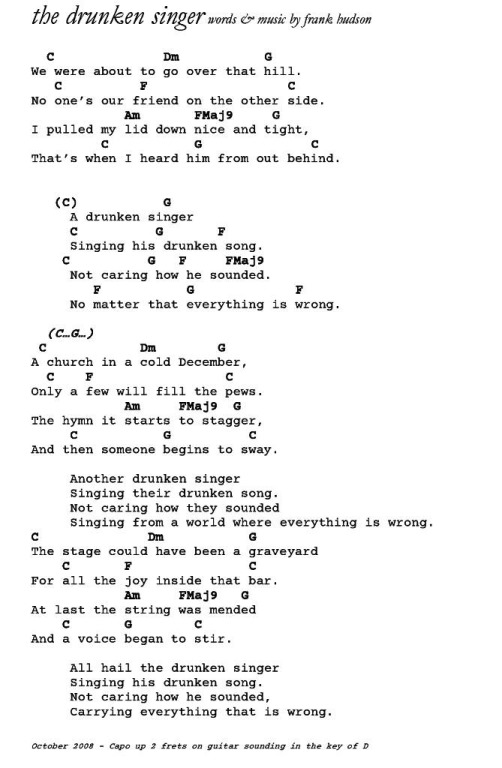
The Drunken Singer

A part of the inspiration for writing this song: despite my being in the cold-water army, my voice often produces sounds that too are not proper or correct.

.

The second reason “The Drunken Singer”  came to mind was that I found myself working this month on a handful of possible songs I could set from poems that referenced singers, and you just heard one of them last post: “The Late Singer”  by William Carlos Williams.

So, these are my reasons for inserting this, my own song, into the Project today. You can hear my new recording of “The Drunken Singer”  with the player gadget you should see below. If there’s no gadget (some ways of viewing this blog suppress it) you can use this highlighted link that will open its own tab with an audio player.

.

*New here? The Parlando Project takes those words, usually literary poetry intended for the page, and combines them with music we compose and perform. Because I almost always use poetry in the public domain, I often use poems from the most recent period that has clearly moved into that status: the early 20th century, the era when Modernism emerged. But I don’t keep to the early Modernists only, as an examination of the more than 700 audio pieces available here since we started eight years ago will demonstrate.

**As to the “Are song lyrics poetry?” question, my summary answer is “They are a kind  of poetry.” Do lyricists and literary poets focus on, or stress different things, or work with different expectations? Yes — but the range of what is canonically literary poetry shows those things vary widely within literary poetry too.

This Project knows there’s a tension there between page poetry and songs. I just think it’s fun to work within that tension, to push: to pull, to refer and to connect.

Do the Dead Know What Time It Is?

Here’s a poem by 20th Century American poet and artist Kenneth Patchen performed with music which manually realizes some ideas often produced by machinery.

Patchen is one of the original poetry accompanied by jazz guys, an idea that is one of the tributaries to the Parlando Project, but the poem of his I use today isn’t one that sings off the page when you first look at it. The speech in it seems casual, as if one is overhearing someone talking.

“Do the Dead Know What Time It Is?”  has a very unusual structure. It’s one part a Robert-Browning-like dramatic monolog and another part seeming snippets of a bar-room conversation. But Patchen doesn’t separate these out into differentiated sections of a multipart poem, rather the two modes seem to be occurring at once, the louder monolog spoken by “the old guy” to the younger man and then the often whispered and interrupted conversation between the younger man and a woman who is trying to pick him up.

Here’s Patchen reading this poem with a jazz combo. I also just discovered that The Blue Aeroplanes did a version of it with a rock band decades ago.


I first thought: oh, what a great thing for a recording! I’ll put one in one stereo channel and the other on the other side—but then I thought better. The claustrophobic nature of these two conversations is part of the effect Patchen has designed.

As barroom stories go, the old guy’s story is a good one, even if the younger man is only half-listening—but the second, whispered one, is all about what isn’t exactly said. I could go on at length about how the two stories connect, what they say to each other in the structure of the poem Patchen made, even though the two conversations in the bar never actually join each other. I found the poem quite moving, but I’ll leave it to you to connect them.

Instead, let me dance about the architecture of the music today. I’ve been on a loud electric guitar kick lately, which may frustrate those of you that prefer the acoustic music, which will return in good time. Music structured like this piece is often constructed by loops stored and manipulated by computer software or by small solid-state devices that can capture a phrase and repeat it. Similarly, the original rappers’ DJs used turntable manipulation to repeat a section of a grooved record, a task that can now also be emulated digitally at the press of a button. There’s nothing wrong with these methods or machines.

Still, I most often try to play the repetitive parts you hear here. It’s not something I’m naturally good at, and I allow some imperfections to occur. Perhaps I do this because I became enamored of the hand-played repetitions that made up the composed music emerging in New York near the time I left for the Midwest—but it’s not Steve Reich or Phillip Glass* that today’s piece sounds most like. The proximal influence is a record album that came out in the early 1970’s called No Pussyfooting  by Eno and Robert Fripp. That record’s guitar textures were produced by mechanical means too, two tape recorders set several feet apart from each other so that the “looping” was really a long loop of tape between them that allowed measures played by the guitar to repeat and get gradually added to in approximately real time. This seemed magical then, but a tidy little box that sits on the floor and costs about $100 can do all that these days.

No Pussyfooting

It was hard to find a barber shop with a fresh tarot deck in the ‘70s


There are two guitars in my music here, but the one that sounds throughout most of the piece I’m playing with loud sustaining notes that I (unconsciously) made sound as if they are a repeating loop with variations even though it’s real-time, straight through playing emulating Robert Fripp’s sound on that record which made such an impression on me at the time. One never knows what ghosts will visit when I plug in a guitar.

You can hear that music combined with Patchen’s words with the player below. The full text of “Do the Dead Know What Time It Is?”  is available here.


*Reich did use tape loops as well as live through-played instruments. Seeing the small ensemble Phillip Glass toured with in the ‘70s: electric combo organs that sounded like “96 Tears”  and “Light My Fire”  along with a handful of wind instruments was amazing in a small space.