However similar if amorphous shapes, everyone’s ghosts are private spirits, and I have a new musical piece with words by Emily Dickinson testifying to that — but let me slide over to a couple of personal things first, as if I was a regular blogger externalizing their internal story.
I’ve had a couple of weeks when I’ve needed to come back to the Parlando Project stuff from other things. I had a colonoscopy with unremarkable results. Huzzah. That’s some prime blogger internal dialog! But before that, I searched around my crowded little bedroom/office to find old cassette tapes. The oldest are from The Sixties when I had one of those small battery powered monaural cassette recorders with a slide-out chrome handle, a single speaker on the top, and a chorded plastic microphone with a start-stop slider button on its side. Others were from the 1970’s-2000 era when I recorded musical things, first on the stereo tape decks of the late 20th century home hi-fi era until I was able to afford one of the legendary Portastudio models designed for musicians, using the same humble cassette tapes, but able to record 4 distinct tracks. My task: to make digital copies that I can store in no appreciable physical space and are independent of an obsolete format.* More than 30 years of this stuff, much of it of only private interest, though you may hear some of it eventually.
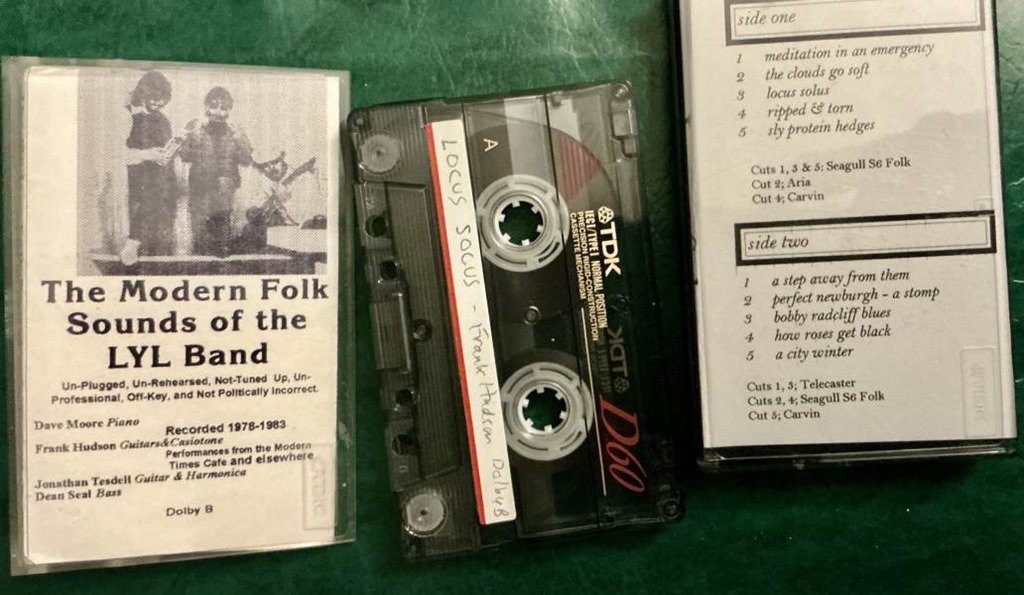
Some of the cassette tapes.
.
The ubiquitousness of inexpensive video is fairly recent, but assuming no catastrophic events, many born in the past 15-20 years will likely have color video with sound of their childhoods and young adulthood that could follow them the rest of their lives.** Is that a good thing, something they welcome? I don’t know. Before this some folks had diaries and journals, or kept letters, so some level of self-documentation is not entirely novel. Still, for me, a person whose Project lives in music and sound, whose favored form of literature began in sound before writing was invented — retaining an element of the sound of the words, and their sequence, and echoes — my particular audio time-capsules have a special tang. And fears.
Most of the tapes are not just me, in a few I’m just the man holding the microphone, though I’m there as the shadow that chose to start the recorder. They hold our imperfections: things before we knew, before we learned — and then too the persistent faux pas that we still commit: there, and committed to a recording. Given that most can record now anytime with the tap of screen, how many will simply erase to save future embarrassment?
So back to Emily Dickinson and this poem about ourselves and what we think we fear — which may not be what we actually fear, or should fear. “One need not be a chamber — to be haunted” is a poem about that self we either can’t lose or can’t consider. In five stanzas Dickinson lays out some conventional gothic scenery (some of which she herself will erect in other poems) haunted houses, undead ghosts, church graveyards, and finally an assassin laying in wait for us.*** Dickinson points out that the self may be making or amplifying those fears, and perhaps that self, making scary movies in our imaginations, may be doing it to displace us from seeing the real fear source, our mind’s-self. “Ourself — behind Ourself — Concealed — Should startle — most” Dickinson’s poem concludes. You can read the text of Dickinson’s poem at this link. And yes, you might note I sang “alley” by mistake instead of “abbey” messing up Dickinson’s graveyard implication.
So, is that our choice? To ignore ourselves, out of fear of what we’ll find, or to disappear into a copious kingdom of solitary solipsistic self, many of us with the digital equivalent of Krapp’s Last Tape clanking and dangling from them like Marley’s ghost? Socrates decried the unexamined life. Memoir can be an honorable genre. Despite my taking the time this month with the old tapes, I think of this Scylla and Charybdis, and in the end there’s ultimately no keeping of this life and self, though sometimes there is sharing.
Today’s musical ensemble is a Rock-band of some kind: drums, bass, piano, 12-string acoustic guitar, and two electric guitars, one of which is run through enough effects to mask its guitaristic nature. No need to rewind, you can hear it with the audio player below. No player? No need to untangle that with a pencil in the reel-hole — this highlighted link will open a new tab with its own audio player.
.
*Many years ago, I was on a committee working on the technical design for a radio network’s archives (most of which were still on audio tape then) which involved long-term storage and public accessibility elements. The online “New Media” folks had their ideas about what formats to use for listeners to stream over the Internet, the audio engineers had concerns about what would give the longest life and best fidelity, and the computer IT folks had thoughts about what media would have the capacity to hold something that might climb into the then hard to imagine “terabytes” of digital storage. The three groups weren’t always in agreement, and a grizzled consultant from some outside large, already in existence, archive was brought in to meet with us. Should we use digital tape, hard drives, optical disks? What file-system format on which? What audio file format should be used on that media? Is some of this going to die from “bit rot” on the media in how many years? We had lots of questions and wanted the wizard to arbitrate our concerns. He listened for a while as we cross-talked.
Then he answered. “It doesn’t make much difference what you choose. You’re going to have to convert to other media, file-systems, and audio formats in the future, and every few years going forward. Plan for that.”
**Many of my mid-century generation have photos from their youth. I had a “baby book” that lasts into my grade-school years in black and white. A few families had movie cameras (though no one I knew did) but many of those shot silent film. The cost of film and developing that film constrained the amount of pictures and home movies made. Lots of birthday parties, weddings, holidays. Parts of life yes, but selected shorts.
***I was working on this in the wake of the news of a planned, lay-in-wait killing of an insurance company CEO, which will be followed in the American drama by the killing of a teacher and a teenage student in a school reported by a 2nd grader who called 911. The first was caught on ubiquitous digital video, and the emergency call of the second perhaps made on one of those smaller than a fat postal-letter things we call phones even when we aren’t making phone calls. More than social embarrassment may haunt our digital archives as we live going forward.
I also note that final stanza of this poem’s “revolver” is another example to go with “My life has stood — a loaded gun” of Dickinson poetry citing a firearm being held as the high card in some kind of deadly personal dispute.
 Frank Hudson