Last time I was musically blasting your ears with twin electric guitars, bass, drums, and keyboards as I commemorated the snark of the early Internet’s “flame wars.” Today’s piece combines – just in time for American Thanksgiving – a quiet nylon string “classical” guitar, and a 19th century poetic ode to pumpkin pie.
The words I sang were written by John Greenleaf Whittier, one of a circle of New England worthies who were grouped as the Fireside Poets. Back in my parents or grandparent’s time the Fireside Poets were as celebrated as pumpkin pie. As a group they took on the job of creating an American poetry written by Americans with American subjects.* Alas, that’s a job that once done, doesn’t inherently demand continued interest, particularly in a country like America that has become a cultural superpower. American poems written by Americans about American subjects are a commonplace thing now.
But to do this was a piece of work in the first part of the 19th century – and in furtherance of this Whittier chose an indigenous American plant for his poem. The pumpkin represents American autumn is so many ways, starteing with jack-o-lanterns in October, as a decorative harvest tote, and for its curtain call, the fruit for pumpkin pie at Thanksgiving. Whittier wrote his ode mentioning all these things, and here’s a link to his entire poem. I read Whittier’s tone as “mock heroic” in his poem, but I chose to make a small song using only his ending, the pumpkin pie part, since I was racing to complete it before American Thanksgiving. Friends of our officially young-adult kid are gathering downstairs tonight to do whatever they will, as I hole up under the slanting roof typing this.
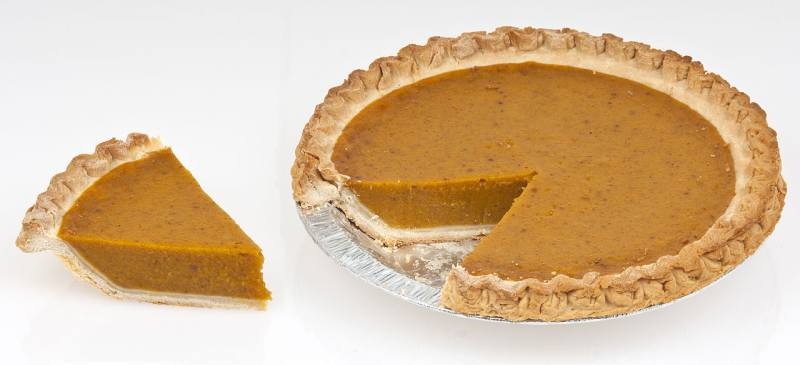
“Fairer hands never wrought at a pastry more fine.” Pumpkin pie picture by Evan-Amos
.
Is it just me, or is there a touch of what my wife calls “comfy gothic” in this passage at the end of Whittier’s poem? The poem starts out addressing the pumpkin plant itself, but as it continues we see it speak to the humans associated with it from childhood to grey-hair-dom. When I have Thanksgiving tomorrow with my little family I’ll have thoughts of everyone distant or dead that made or attended Thanksgiving meals over my life. In the poems final stanza Whittier speaks of, praises, the hands that make the wonderful pumpkin pie, and then as the poem ends, he sings them away with a wish that their final sunset is as orange and lovely as a pumpkin.
There’s an audio player gadget, or should be, below that will let you hear me sing that last stanza of Whittier’s poem. I focused on the simplest and most modest of musical settings for this one, purposeful contrast to the previous musical piece here. If you don’t see the audio player that’s likely because some ways of reading blogs suppress it, so I provide this highlighted link that will open a new tab with its own audio player. Consider that the apple or blueberry pie option to hear this song about pumpkin pie.
.
*Earlier this year when I asked AI to create some protest songs, it defaulted to a musical style stuck somewhere between Bro-Country and Indie Americana. When I needed to make up names for the faux acts I chose Fireside Poets’ names like “Greenleaf Whittier” for them – because though writing for the page, those Fireside poets were the poetic roots of Americana.
A funny thing happened on my way to winding-up my Summer diversion series of thoughts on Artificial Intelligence. I’d concluded last time: since current AI was capable of producing musical pieces in popular styles that could pass for human works in casual listening – or plausibly even more exacting listening – those who’d prefer music expressed by humans might need to change the things they look for and value in music. What kind of things? Accept more imperfections in the music, cultivate an appreciation for the humanness inherent in live performance, and increase their consideration of the intent and motivations of the musical organizations they support.
That last point, about more significantly honoring intent, had hardly inscribed itself as a blog post here when a mischievous thought came over me: while AI is created by businesses with commercial intent, human-made music doesn’t have to be. As difficult as it is to refine authentic intent from music made by strangers distributed in a marketplace, could we be fooled about intent by entirely software-generated music? So, what if I asked AI music generating software to produce a protest song? What if I went further and presented it in a misleading context?
Disregarding my environmental footprint for the duration of the experiment, I created a free account on an AI music generating site, and I set about creating a new protest song. Out of the many outrages of 2025 so far, I picked the authoritarian assaults on academic independence which have sought fines/bribes/tribute from some of the U.S.’s most prestigious universities (known in America as “the Ivy League”) while demanding oversight into their operations and academic programs on flimsy pretexts.
Like a lot of AI, the one I used for this works on a “freemium” structure, with limited features for non-paying users. To make a song I only needed to enter in a text prompt (length-limited for free users) describing it. I asked another AI engine to suggest a prompt and asked it to create lyrics for a song (though the song-creating AI site would be glad to generate its own lyrics). The more general AI answer-bot suggested including artists whose style the music generating AI site should seek to emulate. I picked Phil Ochs and the Fugs. I wanted something with real anger and satiric bite.*
I created around six songs. None of them gave me that, even when I tweaked my prompt. What came out was sweet-voiced singers with an attitude of pop-music yearning, or acceptably sorrowful disappointment in their delivery. The AI lyrics did come up with a few phrases that had some charge to them, but the lyrics generally suffered from what I personally call “Horse With No Name” defects.** My prompt specified “gruff,” “angry,” rough” or even “sloppy” to describe the vocal delivery I was looking for, and out came the singers with an air of polished regret, and lyrics that groaned under their attempt at machine-constructed sincerity. The best I could say for the lyrics on the songs? They might pass as modern recording-production-style versions of the parodies created for the Spinal Tap acting company’s folk-music parody It’s a Mighty Wind.***
These results fed into the context I chose to present them in. I wrote a script for a podcast, supposedly devoted to American folk and Americana music. I decided the podcast presenter would be earnest, but a bit removed from the less-commercial segments of American folk music, and so I made her British. She would be portrayed by the machine speech that I use on my writing computer as a proofreading aid.**** As the token human in this enterprise, I’d appear as a hype-man for the Parlando Project.***** Over the next day I wrote the podcast script and recorded it folding in sections of the machine-generated protest songs. I slightly degraded the audio quality for the British host’s dialog, though after I finished I now think I should have done that for my own dialog instead, as I’d be more likely the guest relying on a remote overseas link for the imaginary podcast.
I had fun doing this, trying to gauge how many tells that this wasn’t on the up-and-up I should drop before revealing the near total AI nature of the content in the last minute. For the names of the Americana acts that were purported to be performing the AI songs, I decided to burlesque the names of U.S. 19th century Fireside Poets. I think “Greenleaf-Whittier” is a great name for a band in that genre – failing that, Jeff Tweedy if you’re reading here, you’re welcome to it for the next Wilco album title.
Featuring the exciting new song “University Surrender” you heard on the “Kit That Sounds So Real” podcast.
.
The audio player below will let you hear the 18-minute program. The program opens with a snippet of an AI generated folk instrumental whose prompt I supplied was its title: “Obey in Advance.” Though only a small selection, I think it demonstrates that AI generated music without vocals is particularly “real” sounding. The program continues with parts of three versions of a song called “University Surrender” where the AI program supplied the words, music, and fully produced recording in three slightly different Americana styles it thought appropriate. The three versions resulted as I tried tweaking my text prompt – and while distinct, on repeated listening they seem somewhat “samey” to me. More smooth than I was asking for, “Ralph Waldo Bryant’s” version rising to falsetto delivery almost works for the material despite the pitch control artifacts I can detect in the computer-generated performance – but remember, as I said earlier in this series, the same artifacts are now common with recorded human vocalists in current pop. “Greenleaf-Whittier’s” cover did add one, nice, out-of-leftfield, touch: the flagrantly computer-voiced autotuned opening refrain of the title before continuing into its bouncy two-step country groove. And then there’s “Oliver and the Rolling Homes’” version of “University Surrender” whose arrangement serves up a country-music playlist/station format sound. I was laughing hard as I heard the small-town-worshiping-my truck-my girl -I may get a little drunk sometimes-but I’m a hardworkin’ man-like my daddy sonic approach, but this time holding forth on tenure and syllabus issues. And then there’s “Ivy Towers Bow” that is said to be written and performed by “J. R. Lowell.” The lyrics here were written by an AI chatbot and then those lyrics were given to the AI music generating program to make this song. Musically this one doesn’t give me anything – so generic. I almost didn’t include it, but I decided it was an example that a generate-songs-AI was on par with a text-focused AI when writing lyrics. The final song on the fake podcast might be the one of the group that does the best emulation. If I was listening casually and “E. E. Peterbuilt and the International Harvesters ““The Emperor’s New Chains” came on, I’d think it better than many songs in its style. Oddly enough, the AI program produced it when I goofed and clicked generate when I’d only partly written the prompt “Folk or Americana protest song, gruff voice…” and by not having to lyrically add the academic details that made Oliver and the Rolling Homes version of “University Surrender” so unintentionally hilarious, its Horse-with-No-Name lyric faults are not as exposed. If I wanted to pick one AI song from the ones I generated to fool a careful listener, I’d pick this one. You know you’re in the Uncanny Valley when the guitars have faded out and the robot vocalist gives us a little aside into the still open mic. Spooky.
If you don’t see the audio player gadget to play this imaginary podcast, this highlighted link was human supplied to let you hear it, and will open a new tab with its own audio player.
If my courage and energy hold out, I still want to write one more post about what I call “the guild issues” that concern some artists engendered by plausible AI results.
.
*The AI program didn’t object to those two 20th century folk-rock artists of outrage and cutting satire being supplied for models – but it completely ignored trying to emulate them. When I tried “Bob Dylan” – suggested by the separate AI that’d given me a prompt I could use elsewhere – the song AI immediately refused to do so, presumably due to a specific concern about IP.
**”A Horse With No Name” was a 1971 song, recorded in England by a band led by expatriate Americans. The recording, done by humans, not AI, sounded like someone had anachronistically entered our future and asked AI to “Create a song that sounds exactly like a Neil Young record.” The lyrics went forth despite including some awkward lines like “There were plants and birds and rocks and things,” “the heat was hot,” “’Cause there ain’t no one for to give you pain,” and “Under the cities lies a heart made of ground, but the humans will give no love.” To spare us from more lyrical howlers, the song also featured a lot of repeated “la la la’s” in its chorus, well-performed in a CSN&Y style of harmony.
The song was a substantial hit in both the U.S. and Britain, indicating that it worked as a song for its audience none-the-less.
***Hey, I’m a fan of Spinal Tap. Everyone is! And rating art is a fool’s game – but “It’s a Mighty Wind” is every bit as good, maybe better.
****The “read aloud” feature in the current versions of Microsoft Word is a huge aid to my self-proofreading. With my neuro-wiring, it lets me catch a great many errors I’d otherwise miss, and using the female British voice enhances the “hearing this anew, as if I didn’t write it” factor that makes it so effective.
*****The stuff I say in the middle of the satiric podcast concerning the Parlando Project is how I actually feel about the nine-plus years of stuff I’ve put out here.
I spent much of today reading through Carl Sandburg’s landmark 1927 folk song collection American Songbag, all 500-plus-pages of it. It’s not the first time I’ve looked into the book, and indeed I’ve paged through it or jumped to songs I was interested in before. But next month I’m planning a trip to Sandburg’s boyhood home in Illinois and to Iowa City where I will be taking a look at some papers relating to early 20th century poet and professor Edwin Ford Piper who was one of the sources of folk song material used in Sanburg’s anthology.* So, looking at the book in full seemed a good grounding for this trip.
I’ve made the case before here, such as this post from a year ago, that besides being a somewhat deemphasized Modernist poet these days, Sandburg is a primary model for the American Folk Music Revival, which eventually produced in the second half of the 20th century several genres of popular and semi-popular music.** Here’s the matrix that Sandburg built in the 1920s, a hundred years ago:
American folk music can be appreciated like art music
It will be associated with literary poetry
It expresses, or can be adapted to express or accompany, progressive/left-wing causes
It’s multi-ethnic, and the contribution of Afro-Americans will be substantially acknowledged
Humor and funny stories will be part of its presentation
Sandburg was including segments of folk music performance as part of poetry readings before American Songbag. AFAIK we don’t have any transcripts or recordings from that era, but all these things are demonstrated for the record in the 1927 book. Sandburg is not the only American doing any of these things a hundred years ago, but he’s doing all of them at once, and he’s doing it with a degree of fame and cultural acclaim that was significant.
I was aided in my rapid march through American Songbag by already knowing many of the songs it contains, and as I encountered them I remembered hearing them in my half of the 20th century performed by Woody Guthrie, Pete Seeger, Bob Dylan and many of those other “folk singers” that surrounded them.*** The Sing Out magazine and Jerry Silverman folk songbooks of the Sixties that are my foundation, are successors to Sandburg’s work, right down to the touch of using vintage B&W line drawings as interspersed decorations.
Sandburg often includes little stories about the collector (Piper was one of a group who collected the songs “in the field” for Songbag) and for those he collected himself he says a few words about how, where, and with whom he first heard the song. Here’s one of the most engaging of those stories I came upon today in the book:
Once when the night was wild without and the wintry winds piled snowdrifts around the traffic signals on Cottage Grove Avenue, Chicago, we sat with Robert Frost and Padraic Colum. The Gael had favored with Irish ballads of murder, robbery, passion. And Frost offered a sailorman song he learned as a boy on the wharves of San Francisco.
The song Frost sang for Colum and Sandburg? A subtle wry ballad of farming? A nuanced lyric of nature cooly observed? No, it was this one. Some will know it from its latter association with the Assassin’s Creed video game franchise:
.
*Besides the folks songs Piper contributes, Sandburg even quotes a part of a poem from his contemporary Piper’s Barb Wire poetry collection in Songbag.
**Besides the Folk Scare of the 50s and 60s, the American “Rock Music” that extended Rock’n’Roll to FM radio, college campuses, and rock critics was generally formed from folks who had connections with the just preceding folk revival. Modern Americana and roots music links to the same strains and connections that Sandburg was personifying 100 years ago.
***Guthrie composed music for Sanburg poems later. Ruth Crawford Seeger (Pete’s step-mom, Mike and Peggy Seeger’s birth mother) was one of the composers who created harmonized music for the folk songs in Songbag, and she also set Sandburg’s page poems to music. When the young Bob Dylan started to expand the poeticism of his song lyrics, he decided to pay a visit to Sandburg, briefly meeting him unannounced in North Carolina at Sandburg’s farm. Other folk luminaries connected? At least a couple songs collected from Leadbelly by John Lomax are included in Songbag. Lomax is credited, but Leadbelly isn’t, though Leadbelly’s more general public career hadn’t yet started. Let me just say that Lomax’s relationship with Leadbelly is complicated. Just this month I was reading a recollection of a performance by Spider John Koerner (who first performed in the mid-century Minneapolis folk music scene along with Dylan) where he told a humorous story about a farmer who fed his pig by lifting him up to the branches of an apple tree. That’s a story Sandburg also told. I’ll also note that when I came upon several songs in Songbag, the rendition I recalled from the Folk Scare of the mid-century was by Dave Van Ronk, a wonderful performer and a mentor to Dylan when he arrived in New York.
Today is the 140th anniversary of Carl Sandburg’s birth. Sandburg began his long and broad career as an American Imagist poet, political activist, and journalist, and he went on to add prize-winning biographer, folk-song revivalist, and goat farmer to his resume. If one was to make a list, he would be in a small group of American cultural forces in the first half of the 20th Century who created what we today call “Americana,” and helped make sure that this label could be applied, as it can be today, to a musical genre. I won’t have time to go into this today, but in 1927 he published “The American Songbag,” which is as important a landmark in the American folk song revival as “The Wasteland” is for high-art Modernist English verse.
I’ve spoken about Sandburg here a great deal in the past couple of years because I believe he’s too-little read, too-little considered in academic circles, and too-often misunderstood from the effects of this quick (mis)understanding and dismissal. To the degree that people encounter him in school or surveys of poetry, it’s for two poems. One, sometimes effectively used as an introduction to metaphor even at the grade school level, is his short Imagist poem “Fog.”
The other, better known as the Carl Sandburg poem, is his Whitmanesque “Chicago,” with its famous opening litany of praise for Chicago that is ever quoted whenever that city is to be characterized. Some things are odd about the case of “Chicago.” First, while folks remember and re-use it’s opening stanza of praise, they forget the three lines that follow it, which though stated in century-old language, is unmistakably as stark a report as any OG rap laying out hos, gangsters, and poverty:
“They tell me you are wicked and I believe them, for I have seen your painted women under the gas lamps luring the farm boys.
And they tell me you are crooked and I answer: Yes, it is true I have seen the gunman kill and go free to kill again.
And they tell me you are brutal and my reply is: On the faces of women and children I have seen the marks of wanton hunger.”
Though “Chicago’s” Whitmanesque/expansive-litany style is one that Sandburg would continue to use at times, its prominence has overshadowed Sandburg’s sparer Imagist voice, the one that he used for the rest of the poems in his landmark “Chicago Poems” collection.
It’s easy to think that if Sandburg had spent time in Europe hobnobbing with its cosmopolitan demi-mode, if he had included more Latin and Greek in his poems, and if he’d kept his political outlook to something between Tory and crypto-Fascist, that he might have scored more academic cred in the second half of the 20th Century. And his more general popularity, like that of Edna St. Vincent Millay, is in danger of dying out after the death of the fire-starter without the hard-blowing bellows of academia keeping the embers glowing.
If that’s so, who does that leave to keep Sandburg’s poetry more broadly heard?
If anyone remembers Sandburg, particularly the spare, Imagist Sandburg, it’s musicians and composers. He gets set to music often, and his free verse often sings easily. And, it seems to me that musicians, rather than page-poetry curators, more often remember the innovative modernist in Sandburg. One of my favorite records of 2017 was Matt Wilson’s “Honey and Salt” which, like the Parlando Project, seeks to use a variety of music combined with Sandburg’s underappreciated broader pallet of literary expression in unexpected ways.
A promotional trailer for Matt Wilson’s Sandburg “Honey and Salt” recording
Today’s piece, a slightly remastered version of one I used to test streaming audio here before the official launch of the Parlando Project, is Sandburg’s tender “Winter Milk” as performed by the LYL Band a couple of years ago. You can hear it with the player below.
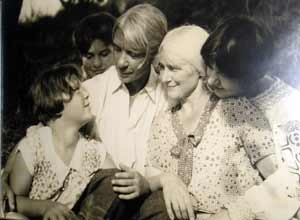
A slightly older Helga Sandburg on the left with her parents and sisters.
A gentle reminder, I encourage readers and listeners here to share the links to these pieces on social media as it helps spread the work that Parlando Project does very effectively.
Anyone remember those sentry questions that would be used in to determine if some straggler in the soldier’s darkness was an American or foreign foe? “Who plays first base for the New York Yankees?” they’d ask.
Native Iowans have a similar method to catch those from out of state. They might start right off with asking about the state capital. “Dezz Moynens.” Wrong! Not an Iowan. “Day Moyne.” Native. Poweshiek, that fine county with a Brooklyn no one knows. “Poe’s He Eck.” Nope. “Powa Sheek.” How about that nice small town founded by lost Swedes in Boone County, Madrid. “Ma Drid?” Outsider, it’s “Mad Rid!”
While overseas in France in the early 1920’s Stephen Vincent Benet wrote his own catalog of place names that I have adapted for today’s piece “I Have Fallen in Love with American Names.” In it, Benet contrasts American place names with European ones, perhaps to staunch a little homesickness on his part, but also as part of his claim to something he and Carl Sandburg helped to define in the first half of the 20th Century, something that’s now used to label a musical genre: “Americana.”
To briefly define Americana, it’s the featuring of things that are distinctive to our country, most often things that are in the past tense, things that we are asked to pay attention to as our heritage. If these things seem a little odd, old-fashioned or provincial to us, that’s the tang the artist wants us to taste.
I came upon Benet’s poem after reading a Phillip Roth memoir in the New Yorker last month, where Roth takes off from Benet’s poem to discuss how a literary sense of a greater America he did not yet know expanded his horizons westward from his childhood neighborhood in Newark New Jersey. Roth remembered how, in the 1940s, even though one of the most cosmopolitan cities in the world was a river and a marsh away from his town, New York City was a world away, perhaps as far away as America seemed to Benet in Paris.
Roth doesn’t mention it, but as I read Roth’s piece, I thought of Benet’s story “By the Rivers of Babylon,” were a future neo-indigenous youth ventures across that same river into the ruins of New York on a vision quest.
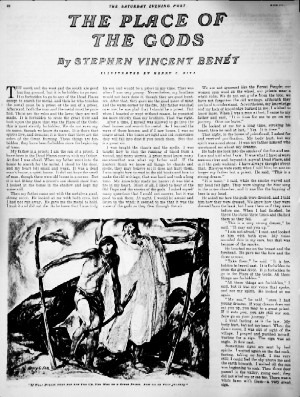
This was “By the Waters of Babylon’s” original title
In the nearly 100 years since it was written, Benet’s “I Have Fallen in Love with American Names” has not fallen to ruins, but it has gained some tarnish or patina. I’ve cut a stanza because the notables referenced are now obscure, and I modified another line in it, not out gentility, but because it frankly stuck in my craw. By chance, one of the obscure and colorfully named towns in Benet’s catalog, French Lick, now is slightly better known as the hometown of basketball great Larry Bird—but that’s the not the greatest resonance the poem has picked up over the years.
As the poem builds to its ending, Benet uses something like the thought used by Rupert Brooke in his famous war poem “The Soldier”, the idea where even if Brooke was to die and his body was buried overseas, that his Englishness would remain. Benet sets up a series of places he might be interred in England or Europe, and ends with a line that later became the title of a landmark book about the cruel and unjust treatment of indigenous Americans. Did Benet choose to end his poem with the evocative place name of Wounded Knee because of the massacre that occurred there a bit more than 30 years before he wrote his poem, or because of legends that Crazy Horse was secretly buried there, or was it only something that caught his eye on the page of an atlas? I don’t know enough about Benet to say. His litany of American places does include “a Salem tree” which sounds to me like a reference to the Massachusetts witch trials and executions. If we are to remind ourselves of the greatness in our heritage, we are likewise obligated to remind ourselves of the sins there too.
Fall in love with a Salem tree? I have a tenuous connection to the story made into this film.
In my performance, I made the choice that, author’s intention or not, modern audiences will hear it as intentional, so I should perform it that way. The American name of my home state, Iowa, comes somehow from it’s indigenous people, but over 400 years passing, we no longer know what it’s meaning is. How strange to say that I come from a place of no meaning, knowing the pass-word to tell the magic ghosts of native sentries, but knowing not what I’m saying.
To hear “I Have Fallen in Love with American Names” use the player below.


 Frank Hudson