The Sound of Sense

Today’s piece is kicking off a Summer where I’m going to be doing some different things here than what the Parlando Project usually does. Though the Project’s “usual” varies, the capsule description typically applies: “Combines various words (mostly other people’s literary poetry) with original music in differing styles.” What’s coming this Summer?

I’m not entirely sure yet. There may be more behind-the-scenes stuff, even some “inside baseball” topics about recording, composition, and musical instruments. I think, some personal memoir, a few more peculiar “cover versions” of other folk’s music — we’ll see. I’ve never emphasized those things, so I don’t know how this will work yet. Come September, I intend to return to our regular stuff: writing about my experience of other poets and their poems as the Project moves toward its 10th anniversary. I hope there will still be some things of interest to those who come here for that. For regular readers, particularly those that have followed this Project for a while, I’m hoping you’ll enjoy this Summer’s personal digressions.

I recorded music with Dave Moore last week. Dave and I have known each other since we were teenagers, and we’ve made music as the LYL Band for 45 years. For much of that time Dave was a driving two-handed keyboard player, pounding first an upright piano, then a Farfisa combo organ and electric piano. The Farfisa had grey keys for the bass register, and Dave was often effectively the bass player in the various LYL lineups. Two-handed keyboard players are a tough thing to integrate into the typical Rock band. That kind of playing can fill a lot of the harmonic space — but in some of Rock’s history, guitar voicings are expected to outline the chords. As it turns out, this was OK for me, as I was never a competent conventional rhythm guitar player. Though LYL had an additional guitar player sometimes, I worked out an unconventional role, most often playing single notes and double stops that decorated the chords that Dave laid down, or adding timbral color with guitar effects.

By the turn of the century, we fell into a regular pattern: around once a month we’d set a date. Just before the appointed time, I’d be ready in my studio space and would start to play a little melodic line or spare pattern. Dave would come by a few minutes later, let himself in, and he’d walk up to the keyboard position in the studio space as I continued to play. I’d lean over and reveal the key I was playing in, and off we’d go. I’d have some words ready, a literary poem for Parlando perhaps. Our familiarity bred musical content: I was accustomed to Dave’s keyboard moves, he likely knew mine after all this time too. We’d extemporize a weaved top line. In 2-6 minutes I’d wind it up. We’d say hi to each other. Dave would next hand me a sheet of lyrics. Sometimes with chords, sometimes just some jottings as to predominant ones or key, sometimes just the words. He’d start to play and sing and I’d find my way to play something that I hoped would fit in. That piece would end, and then I’d hand Dave a chord sheet with lyrics to something I had put together. Though sparse, my sheets would be more organized, allotting info for Dave to drive the basic harmonic content for what I would sing and play along with him.

The alteration proceeded as such from there.* After about an hour we’d take a break, talk a bit, and then we’d pick up the rotation for another hour. There would sometimes be partial takes, even (rarely) a “let’s play through it again” request. There’d be short delays as we shuffled through papers, or switched instruments or keyboard sounds, but there wasn’t much deliberation.

What did the recordings reveal afterward? Some trainwrecks certainly. Some searches for inspiration that snoozed off. Particularly in my case, a lot of poor attempts at singing. None-the-less, there’d also be some stuff I’d think worth working with. You’ve heard some of those spontaneous live-in-the-studio takes here.

As it happens, other than their being two alternating songwriters, this is close to how Bob Dylan worked in the studio throughout much of his career — though he worked with trained studio musicians for the most part — skilled folks who could bring a lot more facility that Dave or I can supply.**

Why’d Dylan do that? Well, I’ll have to ask him, though somehow, I haven’t had the chance. My guess is that when it did work, a real sense of something happening in the room among a group of people was transmitted. An exploration. An edge of the seat, this hasn’t yet been formed, a how will it turn out feeling the listener can share.***

Let me repeat myself for necessary clarity: my skillset as a musical instrument operator is such that I think that it doesn’t fulfill the job description of a musician. I won’t impose a summary on Dave, but I think he’d be unlikely to claim high-level musical skills. I do call myself a composer, and Dave has started to call me a producer. I wish I had more skills, but I work artistically with the ideas and actualities I have.

New Studio Space MIDI keyboard

One thing was different last week. For nearly 20 years Dave usually played an older non-MIDI keyboard at my studio space. I may write more about the context later, but I’m thinking it’s time to move to MIDI. Dave has no experience with MIDI and computer instruments, so this will be a journey. I was able to find a good open-box example of this affordable, semi-weighted MIDI keyboards with aftertouch.

.

So, last week, after decades of this, when Dave and I met, I was in progress, playing a guitar riff, and he, on arrival, began playing electric piano. I had set out a drum loop and had a bass track running that hung around the key center. The piece I read as I played my electric guitar was a sonnet, a recent one in my sonnet-series about Alzheimer’s disease and a care-home for those suffering from it — and how we, outside the disease, interact with those within it. “The Sound of Sense”  doesn’t lie: Robert Frost actually did think there was a basic undercurrent in how poetry works — that it’s like how we hear others speaking just out of earshot.

Dave’s not Bill Evans or McCoy Tyner. I’m not John Coltrane or Mike Bloomfield. Some people say I sing like Bob Dylan, but I think on a good day I might sound something like Bob on a bad day. Here’s something I’ve been thinking lately, as successful music gets more produced and marketed from the moment of conception on: it’s still good to have some notes made that don’t know what the note to follow will be. If that next note is unexpected, even “off,” — well that’s better than always knowing what the next note is. And that latest artistic worry: Artificial Intelligence and LLMs? They’re programmed to work-to-rule, creating statistically what you’d expect next.

Two old guys playing live in the studio together. I perform a sonnet I recently wrote that Dave hasn’t heard. He and I weave together in a loose, homespun warp and woof, and unlike a lot of poets reading to music, I spend a minute playing electric guitar at the end, trying to not play the next note that you’d expect. You can hear that performance with the audio player below. No player? You aren’t out of AI credits or something — this highlighted link will open a new tab with its own audio player.

I hope we’re going to have an interesting summer.

..

*When other musicians played with Dave and I, I tried to continue that strict arbitrary rotation — everyone got to start a piece in turn.

**A few years back a huge box-set including alternate partial and unsuitable takes from Dylan’s classic Sixties period was issued. Fascinating, listening to and hearing the outright failures or “just not it” attempts. Given what I know those musicians involved could  do, knowing those failures keep me from utter despair when I listen to a busted LYL take uttered from my limited skill-set.

***Some classic Jazz recordings of the LP era were done this way, though often with a substantial shared mental “book” of structures and cadences for the skilled musicians to rely on. It may be one of those shared illusions, as there’s no strictly technical reason that Kind of Blue  or A Love Supreme  couldn’t have been recorded as most modern pop music is recorded: many instrumental tracks played separately and laid behind featured top-line tracks constructed of many passes collaged together. Those old Jazz records feel like the musicians are breathing together in the room to me, in my mind’s eye I can see them glance at each other — but we can be fooled.

She Dreams of Sewing Machines

I wondered what I’d do for this April’s U.S. National Poetry Month. I’ve usually done something to observe it, though what I do may not be similar to other places. The audio pieces here almost always use literary poetry we combine with original music, so appreciation of poetry is business as usual there. What about writing poetry? I’m not a big fan of overt poetry prompts, instead working from a personal expectation that anything in life or art worth creating a poem over will let you know; and while I write sometimes about the process of creativity, I’m not a creative teacher. I’m also not promoting my own poetry — an honest, necessary task, just not one that I’ve chosen to do much of. Similarly, I’m by present resolution non-commercial with the music I create here. The current music business situation is difficult enough that the least troublesome and most assured way to make nothing from music is to start with, and keep to, the goal of doing exactly that!

So, what to do this April? I’d considered a close-focus theme, or the presentation of the work of a particular poet, but I’ve recently tested my appreciated readers a bit with a long series on the mystery of a musician’s scrapbook that came into my possession decades ago. Enough long- form for a while I think.

Online, I asked for requests, and got one: anti-fascist poetry. I’ve been bending somewhat away from my usual “you can get your complete diet of politics many other places” practice due to my nation’s current situation, which frankly disgusts me in the present and frightens me in its extrapolated expectations; but as a practical matter I almost always use older Public-Domain-status words for the poetry texts I combine with music here. Unlike our current Twenties, the last decade to be called The Twenties (where PD status generally ends) had yet to come upon that brand of authoritarian superiority.*

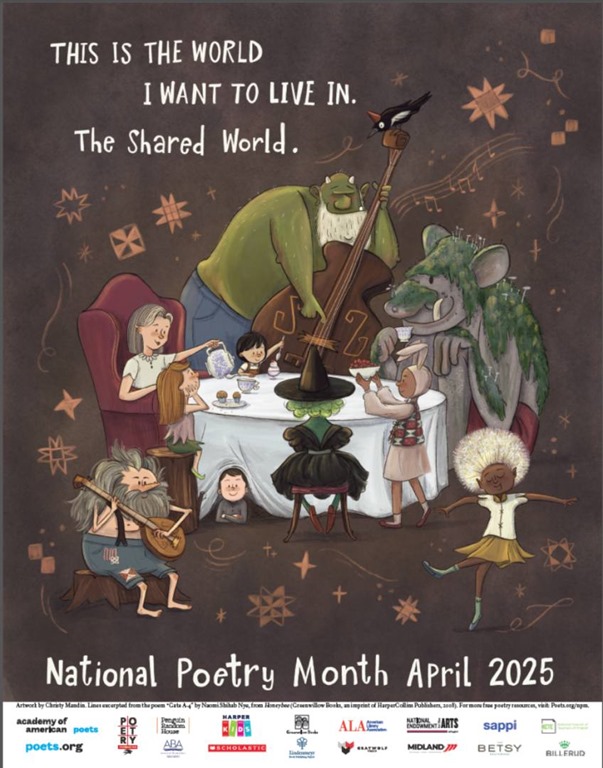
I found my solution by looking at the materials made by the organizers for this 2025 National Poetry Month. I saw that this year’s theme takes off from a line in a Naomi Shihab Nye poem “Gate A-4”  which offers me a suitable theme for the Parlando Project this April in this country in this year. That line is: “This is the world I want to live in. The shared world.” So, there will be some civic poetry on civic issues. There will also be poems of varied shared experiences. I haven’t completed any translations from other languages recently, but if I don’t get to that this month (and it’s usually a very busy month) I may feature some of my favorite not-originally-in-English poems from my past decade’s work.

2025 National Poetry Month Poster 1080

This year’s poster by Christy Mandin.

.

To start off #NPM2025 I’m going to do something that’s not representative of what this Project normally does: from the start we’ve focused here on other poets’ poetry, even though Dave or myself could’ve supplied a great number of song lyrics and poetry to be recast as such. That decade-long primary practice is not followed in today’s audio piece — instead, it’s a sonnet from the Memory Care Series I’ve been writing for several years — some of which have been performed here in draft form. Though I wrote these words, it doesn’t really violate this Project’s maxim: “Other People’s Stories,” because it’s the tale of a daughter with a mother descending deeper into dementia, and of the connections and slow-motion mourning the course of this disease assesses.

Earlier this month I performed Alice Dunbar Nelson’s “I Sit and Sew”  a civic poem about a woman who wished to help the war-distressed and injured. Sewing was a bitter consolation in that poem — but in today’s sonnet, sewing is an image of a different, though still bittersweet, connection. You can hear my performance of “She Dreams of Sewing Machines”  with the audio player gadget below. If you don’t see any such gadget, it’s likely because you’re viewing this blog through a reader that suppresses showing it, and so I offer this highlighted link as an alternative.  It will open a new tab with its own audio player.

Return here throughout April to see what other, varied poetry, music, and performance styles I can complete and add to our shared world, or just use the blog follow feature.

.

*Arrogant ignorance, prejudice, persecution, vain greed for glory and gelt — that all existed before the name fascism, and that may still provide some PD poems. The pieces that I have nearer to completion are more about the human experiences that we all share, and by telling of them we by implication speak against callous disregard.

Arcadian Ewes (Ca’ the Yowes to the Knowes)

Today is Robert Burns’ birthday, which I hear is much celebrated in Scotland. While this Project has done over 800 audio pieces over the years, none of them (before today) have used Burns words. Why not? It’s a personal limitation of mine: his poetry uses a lot of Scottish words and dialect, and I have a hard time doing that.*

But, at last, I’ve finally snuck in a bit of Burns. And while it’s not as novel, I’m also using a set of words I wrote for the bulk of today’s performance, though the Parlando Project remains overwhelmingly about experiencing other people’s words. The second part of “Arcadian Ewes”  is a draft version from a work in progress: The Memory Care Sonnets.  Drafts of other poems in the series have appeared here before, but for those new to this, they tell the story of a daughter visiting and caring for a mother with increasing dementia.

While hearing the original account of a daughter and the daughter’s friend going for a weekly singing session at the memory care facility last fall, I was somehow struck at the time with the story’s Arcadian sensibility. That’s a place I know from this Project. Poetry and folk-song is rich in Arcadia: there are shepherds, flocks, meadows, love, peril, loneliness, peace, gifts, songs, a sense of time ever-present without fences, taking place over the hills and away from our actual daily lives. Here, in the sonnet, the shepherdesses go to the place, gather their flock of singers. What songs will they sing?

Even as I was writing the poem the refrain of Burns’ song that now begins the recorded performance was in my mind. I can’t quite account for why, other than the song for some reason often brings me to tears — and I can’t fully explain that either.

Ca the Yowes status Dunfries Scotland

Today’s musical piece begins with part of a Robert Burns’ song  displayed on this monument in Dumfries Scotland
(photo by: summonedbyfells via Wikipedia)

.

“Ca’ the Yowes to the Knowes”  was collected and reshaped by Robert Burns in the late 18th century.  He published at least two versions, and the folk process has given us other variations, including differences in how much of the Scottish accent and wordage is retained. As a text though, it generally isn’t a sad song. The song’s shepherdess, taking her ewes among the hills seems happy enough in her labor, but happier yet to find a swain in her Arcadia who promises her unending devotion and care. That story isn’t sad now, is it — unless one dotes on how love’s promises aren’t always faithful, that human lives are not unending. But as I said above, poetic Arcadian time doesn’t end, and maybe that contrast with human time is the essential sadness. Perhaps it is those elemental parts of Burns’ story, of the care for the carer, is what linked it to my resulting poem of the daughter taking care of the mother.

However inexplicably, I believe it’s the music that makes me cry when I hear that song’s tune. Music, that same powerful class of thing that is the balm that restores a connection to the mother on one of her “bad days” of deeper withdrawal in the sonnet. The music for the performance you can hear below doesn’t hew exactly to the old song’s tune, for I don’t know if I could have stayed with the reading if it did. You can hear my performance with the audio player gadget below. Has your audio player strayed away over the hills? No, just some ways of reading this blog suppress displaying it, so I also offer this highlighted link which will open a new tab with its own audio player.

.

*That lack of the ability to hear and then repeat back sounds bedevils me several ways: it’s often relied on in musical endeavors, and it’s long frustrated me in my desire to speak other languages, or even pronounce some names correctly. I suspect it’s a neurological quirk of my brain.

The Fade, a Rock song about aging and loss

So here it is, our 800th officially released audio piece from the Parlando Project. Perhaps it’s not representative: it’s not by a dead poet, and unlike almost everything else we do it may not have been written for the page without thought of it being sung. “The Fade”  was written and sung by the leading alternate voice of the Project and all-around inspiration Dave Moore. Dave and I go back to when we were leaving our teenage years. I met him then when he read two pieces in a church: one was his own poem, a cheeky number that mixed eros and agape, and the other was a reading (as if it was page poetry) of Bob Dylan’s “With God on Our Side.”   A decade later we started doing music together as the LYL Band, and some of what we were doing has become melded into what became the Parlando Project.

So, as I think again — is there any way to have a representative Parlando Project piece? Maybe not, and if so, by design. Variety and seeking something unexpected are founding goals.

Dave’s writing here, and our common efforts in making it the song you can hear below, strikes me as something too little done. Rock, whether it’s Rock’n’Roll, punk-rock, Alt-Rock, Indie-Rock, has tended to speak from a youthful perspective. Even the Classic-Rock acts that are still treading the boards at Dave’s or my age hew to topics that would interest those younger than they are. “The Fade”  is far from those common tropes: it’s about the diminishment of aging and particularly about the fogging and loss of memory.

Early this morning I watched an old documentary, a British South Bank Show done in the mid-1980s about the Velvet Underground, a band that was more than a decade defunct at that point, but all the principals (several dead now) were alive then, only entering into middle-age in the 80s, and of a mind to answer questions about the band’s influential work. The topic most covered as they spoke about their former joint project was what made the songs the original lineup put out of lasting importance when the idea of 20-year-old Rock songs having currency seemed novel.

Chief songwriter Lou Reed had it that he wrote about the things he saw around him rather than using the regular subjects of pop songs. True enough, but he chose subjects decidedly less ordinary in song in the times when he wrote them. He specifically wrote about things that frightened people enough that they left them out of the songs they wished to listen to: drug dependency, gay and gender issues, less-vanilla sexuality, and mental variations. And then several others, including the band’s PhD, Sterling Morrison, took pains to note that Reed presented those stories without editorial comment or stance, without sentimentality.

I’ll note now, that later in his career, past the times of that now 40-year-old documentary, Reed wrote one of the few Rock albums about aging and its disabilities: Magic and Loss.  It still stands pretty much alone. It’s also unlikely that even the adventurous readers and listeners that this Project has have heard it.

Dave and I recorded “The Fade”  this past spring. When I talked to Dave this morning we exchanged info on folks we know, folks our age or even a bit younger, who are moving into assisted living or who are suffering from dementia. I don’t know, there are probably a few songs about how sad Alzheimer’s and the like are, probably some songs that try to mitigate it with a chorus that mixes in the memories the sufferer no longer maintains. Dave’s song isn’t like those songs — if they exist — and I’m glad I helped make his song exist, and that I get to share it with you today.

The Fade

This is the sheet Dave handed me with brief scribbled chord notes on the day we recorded this. As you listen to the performance you may see that he did a masterful job of revising his typed words. I think the song gained power from the verses he left out.

.

You can hear that recording of “The Fade”  with the audio player below. I think Dave gets a bit of the VU-ara John Cale sound with the keyboards in it. I’m using feedback in it too, but not quite as the Velvet’s did. What? No player visible? No, you didn’t forget it along with where your keys are or what you came into the room for, it’s just not shown in some ways of reading this blog.  You can use this highlighted link as an alternative.

.

Every Day Is A Moving Day

The Parlando Project has been featuring a few more self-written pieces this summer, and here’s another sonnet continuing the story from last time about a daughter who’s caring for a mother with Alzheimer’s disease.

Every Day Is A Moving Day

Each afternoon she takes the pictures down,
stacks them neatly against the wall.
Less neatly, she gathers up her clothes
And stuffs them overflowing in a small basket.
When her daughter arrives, she’s ready
to move. “I put most everything together.”

Daughter answers, “No. We moved you to
Memory Care last month. You stay here now.”
“Here? Is this where I stay until they take me
out in a wooden box?” She says between
puzzled and stern. The daughter explains again —
though it may well be what her mother says.

And then they take their walk in August flowers —
hot, colorful, bee-busied, fruitful, short-lived, flowers.

– Frank Hudson

Last time I wrote how I composed a sonnet beginning with images I collected while obliquely considering the story. In this one, the nature image comes at the end, and the process of composition was different. This sonnet was composed through a more journalistic method.

Maybe 50 years ago I once considered a career as a journalist. I had, probably still have, some traits useful for that: curiosity, some research skills that can be applied to most anything, a commitment even then to “Other People’s Stories,” and an ability to write faster than some writers.*  But then I had some weaknesses that more than outweighed those skills: shyness combined with the inability to appropriately shut up sometimes chief among them. Journalism requires a lot of meeting new people, and when I do that I’m not only shy, but self-conscious that I may just start blurting out way too much self-blather. Awkward.

The story inside this sonnet was told to me, including most of the telling details. Good story, I thought. In my experience of daily journalism, one learns the inverted pyramid, good lede writing, and what should follow, and then pours the information and events to be covered into that form.

Sonnets don’t work exactly that way, but they are (however loosely their forms are treated by American poets) structures. You know you’re going to tell your story or chapter in 14 lines. Every poet, like every writer, has to decide how much story are you going to relate and how much are you going to go on about it. It just so happens that 14 lines is somewhat of a perfect length with poetic compression. Then, though you probably want something enticing in the first line or two, you aren’t going to use the lede/inverted pyramid narrative order — you’re going to reverse that. Particularly in the English/Shakespearean sonnet, “burying the lede” with a concluding couplet is your task. Somewhere in the sonnet you will probably want to present a turn, a twist, or as Petrarch would have had it, a volta.

I myself love to play with factoring the 14 sonnet lines every which way. This one decides that instead of an eight and then six lines Italian Sonnet organization or the three quatrains and couplet English sonnet, to do it with a six then six ending with a couplet. The poem’s first turn happens at line seven as the daughter tries to reorient the mother with dementia, but then the final couplet nature image is in effect another turn, another volta, as I attempt to leave the mundane journey of Every Day and move it to another level.

Two Pages from Heidi's Calendar

My talented spouse created her own daily calendar for the year using some miscellaneous quotes and her own photography.  Here are two days from August.

.

The player to hear my musical performance of “Every Day Is A Moving Day”  is below for some of you. Not seeing it? Some ways of reading this blog won’t display that, so I’ll give you this highlighted hyperlink that can also play it.  Do you like the audio files of the musical performances and want a handy way to listen to those other than inside this blog? Did you know that the Parlando Project has been available as a podcast** since it began in 2016? You can subscribe to it by searching for our tag line “Parlando – Where Music and Words Meet” on most any podcast service, including Apple podcasts.

.

*I write faster than most “creative writers.” On the other hand, if you think my posts here contain awkward writing (I do) you wouldn’t want to see my first drafts. Good work-a-day journalists I’ve been around can produce reasonably good copy a lot faster than I can.

**No, you won’t hear me reading this post on our current podcast episodes. The existing Parlando Project podcasts are just the audio file of the performance. Which brings me to a question: would you like to listen to a podcast with the text of the entire post read and with the musical performance at the end? This might reduce the number of episodes I could issue each month, but if my voice holds out, I could offer that. What do you think?

Smells

Traffic for the blog has picked up again a bit after its summer slump, but I’m still going to be presenting a few more of my own poems before returning to our usual presentation of other authors’ words. One thing that this does is allow me direct access to the poet’s intent, so today let me pull back the curtain and discuss what choices I made and what I was trying to convey in this sonnet that is part of a series I’ve done this year about a family dealing with one of their members with Alzheimer’s disease. The main characters so far are the older woman with dementia and her middle-aged daughter. The mother has transitioned to a Memory Care Unit as her dementia has increased.

Here’s the text of today’s poem, “Smells,”  so that we can follow along line by line as I discuss what I was trying to do and how I chose to do it. For today, for length reasons, I won’t talk as much about sound-music choices. Maybe another time for that.

Smells

The August after-rain smelled of rot and growth
where it dropped drought leaves on the lawn.
And by the garage door a bug had left its
solar-boat sarcophagus molt on the door frame,
implacable as any statue. Then down the block
the young dog walker looks at their phone
while the dog sniffs longingly at the weeds
tufting a stop sign. On to the MCU.

It smells today of urine just in the door;
and the mother asks again if she can leave —
which they do only for a walk. They pass
a bee garden, which has a sign “bee safe.”

The mother laughs. The daughter smiles.
She can still recognize a pun — its
accident.

Even though the poem follows the consciousness of the daughter character, the first three images of the poem were taken from things I observed myself on August mornings this summer. It can be chancy imbuing personal thoughts on a character when the character may jump across gender, age, or other boundaries from the author — but the alternative of not making that leap and to attempt to invent outside of the body and consciousness the author lives in risks as much if not more.

The first two lines discuss a dichotomy or dialectic: in this summer’s drought, when we had a short rain, it actually stripped the just hanging-on leaves off of some trees rather than greening their canopies up. Oddly, there was an autumn/spring smell from this, that, as the poem says, included a bit of decay and a bit of fertility in the air. The poet here hopes the reader can feel this moment of loss and change from these images, and as the poem develops remember how they may reflect on the other events.

Cicada Molt 1024

It’s remarkable how the winged cicada can emerge and yet leave this detailed casing behind so intact and empty.

.

Lines 3-5 include the second image, another dichotomy, an inert and lifeless thing left from an insect’s life-cycle and change. I sort of piled on here with the Egyptian allusions in line 4, and I questioned that. First off, not everyone has any interest and knowledge of those historical myths, and I’m calling them in without deep expertise in that. My hope here is that neither does the reader need more than superficial knowledge. As an inconsistently educated American I see these leftover bug shells, so lifelike and yet empty, and marvel as they often call to mind the Egyptian use of insects in their iconography. Once more this is nature’s change, even growth, though with evidence of loss intentionally invoked. I think too that subconsciously I was referring to the Jewish tradition of mezuzah devices on doorposts. The traditional mezuzah contains verses from Deuteronomy invoking the supremacy of the godhead, meant to remind all that pass through doors that we may come and go, but that something else is eternal.

As an author I often find that images like these present themselves to me as images first, and I need to ask myself what they mean or potentially mean. I collect the image, and the poem to use them in follows. My expectation here is that such images are richer than ones simply ginned up to decorate or explain by simile something in a poem, but the risk here is that they may not seem similarly meaningful to a reader. How many notice something as odd as leaves falling in August instead of later Autumn, or intact cicada shells except empty of their insect, or recalls particulars of old Egyptian or Hebrew iconography?

A casual, quick reader will just see these things as time-wasters, dawdling until the poem says something. I’m putting some trust in my readers here.

The final image of the sonnet’s octet is perhaps more universal. I could see it as a New Yorker cartoon or cover, and it’s common enough that I suspect that someone has drawn a cartoon meant to make us smile at this combination: a dog smelling for scent markings left by other dogs’ urine while the human at the other end of the leash is checking something else for connections to others of their species. The opening two images are ambiguous, growth and loss. I’m hoping the reader smiles a bit at the third, assuming they pause a bit to consider this combination of the dog and human.

The octet ends with the information that the daughter is seeing this while getting into her car and then driving to the MCU, the Memory Care Unit. I worried that by itself the abbreviation will be puzzling but saw no way out inside the structure of this sonnet. In the series,* the MCU acronym should become familiar.

At line 9 we link from the comic scene before it to a more concerning one regarding the message that the MCU smells of incontinent folks further along in their dementia. Line 10 introduces what will be a re-occurring motif in the sonnet collection: the mother wants to leave the MCU, but her increasing confusion while still being active and mobile makes it necessary that she be in a constantly supervised, structured, place for her safety. The daughter and mother get a walk and make yet another nature observation: a garden intentionally meant to attract pollinators with a whimsical sign. When the mother laughs, the daughter is reassured that at least for now, the mother still understands the concept of a pun, and once more the tension of the situation is sweetened with humor.

Just as I was making the version of the sonnet shown above I decided to leave the poem’s final word on an indented line continuation. My intent here was to make the reader stop and consider why the poem ends with “accident.”

What does this poem mean by that or mean in its entirety? I occasionally get asked that and I’m embarrassed to find myself tongue-tied, unable to do anything more but burble something inane. I am somewhat aware and can articulate (as I did above) what each image or event in the poem is intending to convey, but the whole thing? Ah, err, well, a….

A confident artist would say that if I could convey the combined intent of a poem, even a short poem —perhaps even more so with a short poem — what the combination of words and their sounds and sequence means with a prose paragraph or three, that I wouldn’t have written it as a poem. I’m not being coy or secretive when I say that — it’s just that a poems indirection and sound music undercurrent means differently than a prose explication means. The foreshadowing nature images here should mesh with the events of the last six lines, and the juxtaposition allow each to illuminate each other and the reader.

“Accident” is the end word to make us consider that just as a pun makes us laugh at the coincidental double meaning of a word-sound, that the infliction of the indignity of Alzheimer’s and our accommodations as sufferers or caretakers to deal with it are not punishments or acts of evil.

My performance of my sonnet “Smells”   is available with a player gadget below, or if you don’t see that, with this highlighted hyperlink that will open a new tab window to play it.

.

*Another sonnet in this sequence was presented earlier this summer in this post here.

The Poem, “The Wild Iris”

One of the things this project is about is describing my experience of other people’s poetry and art, an experience which often intensifies as I inhabit some text in order to combine it with my music. Experiencing a poem in that way enforces a deeper connection, for you have to understand, in at least one way, that the author embodied something with their art. That’s my project, but ordinary readers will often find a level of experience with poetry they read too.

Does poetry exist to instruct or guide our experience of life, or does our experience of life or living with a poem vivify silent lines on a page?

Does poetry exist to instruct or guide our experience of life, or does our experience of life or living with a poem vivify silent lines on a page? Isn’t it likely a bit of both? It’s not always the poem’s fault if it doesn’t leap off the page and integrate with our selves, but then sometimes else we do connect with the poem’s experience with our own experience. When that happens, a poem — well — opens from its closed position in a book.

Heidi Randen’s own photo of the wild iris, which opens

.

Today’s piece finds me selecting for performance a part of a blog post by Heidi Randen where she describes such a bilateral interaction with a poem by Louise Glück, “The Wild Iris.”  Suffering, observing suffering, feeling loss, observing loss, are some of the matter here. This poem helps Randen, and the poem’s potential is fulfilled by her connection. I took the final lines from her blog post and performed them as a “found poem,” deciding to overlay some form on it and applying my reading of it with the music from The LYL Band in order to make my own comment on it and to bring them to you.

The Poem, “The Wild Iris”

The poem
”The Wild Iris”
that opens:
”At the end of my suffering there was a door.”
The poem
”The Wild Iris”
that opens.

There is a joy after fear.
A door opens.
There is a joy after fear.
The door opens
into a world of light
and beautiful colors,
and you can breathe again.

Here’s a link to the Glück poem, which may bring you understanding or solace, or just a shrug. Below you may see a player gadget to hear my performance of “The Poem, ‘The Wild Iris.”   However, some ways of reading this blog will not show the gadget, so here’s also a highlighted hyperlink that will open a new tab window to play the same LYL Band performance. The music today may be a little strange to some listeners since I wished to have unsettling elements mixed with reassuring ones. I also don’t  know how you will react to the repetitions that are most of the form I imposed on Randen’s words. They too are part of the focused noticing* I intended for this.

.

*”Focused noticing” is a decent short definition of art, isn’t it.

Until Memory is Only Forgotten

Just last month I was writing here about how alternate Parlando voice Dave Moore and I used to perform pieces live and unrehearsed. Infirmities, personal matters, and a little thing called the Covid-19 epidemic meant we haven’t been able to do that for 18 months — but today we did that again.

Rusty? Yes. We’ve always been rough and ready, which means we persevered today because we love our common attempts at spontaneous performance, even though your ears will be spared most of them. Personally, I’m overjoyed to hear Dave’s keyboards mixing in with my guitars again. Perfect or imperfect is another, subsidiary, matter.

Here’s the very first piece we performed today, using for a text one of the sonnets I’ve written this year about infirmities. My sonnet, “Until Memory is Only Forgotten,”  tells about an older woman with Alzheimer’s disease which has removed, and is removing, many of the layers of her memory, and who is traveling from the Memory Care Unit where she is presently living to visit siblings back in the farming community where she grew up.

Jerseys!

Pictures of the Gone World. The young woman who raised blue ribbon dairy cows.

.

Long time readers here will know this Project normally features us presenting and performing texts by other authors, but since summer tends to bring in a smaller audience, I may be using more of our own texts when I can find time to present work here this season.

I chose to tell this woman’s story without following a time-line, because as with memory (even a degraded one) the scenes aren’t linear. Dave and I repeat some motifs in our playing, just as the subject of the poem sees different crops in the fields and can only see corn and speak again to her daughter-driver of that crop; yet in unmarred memory she recalls her Jersey dairy cows like the other Memory Care Unit resident who can still tout his Holsteins. Structurally this is a free-verse sonnet, though I think the old patterns of iambic pentameter remain rustling distantly in the fields.

Until Memory 800

Here’s the sonnet used as the text for today’s audio piece.

.

The player gadget to hear The LYL Band performance of “Until Memory is Only Forgotten”  will appear below for some of you. If you don’t see it, you haven’t forgotten, you’re just reading this in a mode or reader that won’t show such things. That’s OK, this highlighted hyperlink will also play the performance.

One Summer Morning, Which Isn’t

Here’s an audio piece that begins in the midst of a common life event: when a son leaves home to go off on his own independence. While this leave-taking could be for a job, or for military or other service, in the modern world, it might well be for college.

Other than its late summertime setting, and the odd moment when the son in this story is thinking of something he’s read in a book as much as what his father is saying as he leaves, there’s nothing in it that indicates the child is leaving for school. Perhaps the son (or the reader) at the start thinks that such a leave-taking will be the story of “One Summer Morning, Which Isn’t,”  but eventually things open to a broader story.

Many who read an earlier version of this were puzzled by the title. “Why isn’t it,  that, one summer morning?” they ask. I once revised the title to answer the puzzlement, but today’s version instead revises the text of the piece to try to better convey what I wanted to get at under its original title. Even that first morning in the opening is seen from two very different perspectives, and as the story expands I try to show that leaving-takings are, strangely, always present, they are not only a moment or a single day. Am I successful in that effort? I’m not sure. It’s gone through some revisions over six years, and by now I’m not even sure it’s a poem, or if it isn’t more of a compressed short story. Well, the new draft is done, and it’s ready for you to hear it performed.

Jaguar for Surfing Sounds

Listen! Gidget, Listen! You hear the grating roar
Of pebbles which the waves draw back, and fling
At their return, up the high strand,
Begin, and cease, and then again begin,
With tremulous cadence slow, and bring
The eternal note of sadness in.
Matthew “Hodaddy” Arnold


Today’s music is fairly spare: electric guitar, bass, and drums. Yes, that bass line, close but not identical, is meant to remind you of another piece of music, back before Steely Dan. The electric guitar is an inexpensive version of the Fender Jaguar. Just before the 4 minute mark on the track, that weird high wind-chimey sound is something available from its design: notes that can be plucked on the strings between the bridge and the tailpiece. I was reminded of this trick while listening in a car ride with my son when an old Sonic Youth track came on the radio earlier this month.

To hear “One Summer Morning, Which Isn’t,”  use the player below.