Someone on social media this week suggested this conversational opener: “Remember when talking about the weather was just small talk?”
I was thinking about this as I worked to finish today’s musical piece that I’d started a week ago. Since then, American news has been filled with accounts of one major hurricane’s aftermath and the approach of another one. The kind of fun I have meshing poetry with a variety of music I compose and realize is hard to set beside disasters of this scope. I think: here I am privileged to explore unusual connections when other citizens are dealing with hardship and immense losses. In the end I saw the Dickinson poem speaking to those differing situations, and I’ll finish by talking about making this musical piece and the style of its playing which also lets two strong differences coexist.
“The Wind Began to Rock” presents as a narrative, with well observed descriptions of the storm’s arrival and then deluge, but Dickinson chooses the odd conclusion. You can read the text of her poem here. We don’t get a tale of devastation. We don’t get the following suffering. We’ve had the fury — and then what? The incongruity of that ending — if it isn’t a mistake, what is it? I think we should be convinced of Dickinson’s genius enough to make our default assumption it’s written with intent. I’m already risking insensitivity, could I add humor to this and say that with the anti-climactic ending of the narrative arc here, I could have appended a subtitle “Started early, took my shaggy dog.”
I’ll just briefly note that Dickinson could be writing from experience. During the 1861 hurricane season, her hometown of Amherst got the inland tail-end of two storms. But I’ll note another metaphoric storm too at the same time: America’s Civil War. That this huge storm occurs, and the Dickinson household damage reported at the end is only “quartering a tree” may be her point. Some are losing more, up to their lives. The question of enslavement’s onerous human property and the continued existence of the nation that her father served in the Congress of are at risk.
Even the seemingly inconsequential summary of “quartering a tree” is an odd choice that bears consideration. Is this a reference to the particularly cruel execution practice of “drawing and quartering?”
The storm has not made her house divided and not standing, but the tree may say her privileged situation has a crucifix of more complete suffering in view. Questions may arise to us, if we are privileged to not be in the direct path of hurricanes or oppression, looking out on our own storm season and the drifting path to an election this Autumn. All those thoughts arose after I’d completed the recording of today’s musical piece. My earlier performance was innocent of them, but let me present the music anyway.
As I mentioned last time, Emily Dickinson’s wide-ranging poetic spirit had possessed me with this charge: “I wanna rock!” I have no idea how rocking Dickinson’s own parlor-piano music-making was, but her poetry often indicates to me a mood of loud slyness that could front a rock band.
Rock music famously doesn’t require a lot of compositional undergirding, and the harmonic framework of the music here was minimal: two chords (B and A), their roots a full-step apart. Yet, it really doesn’t correspond with typical chordal cadences in Blues or Rock — it’s a tactic I associate with the Velvet Underground, a smart people in a rock band collective whose formative association once traded under the name “The Primitives.”
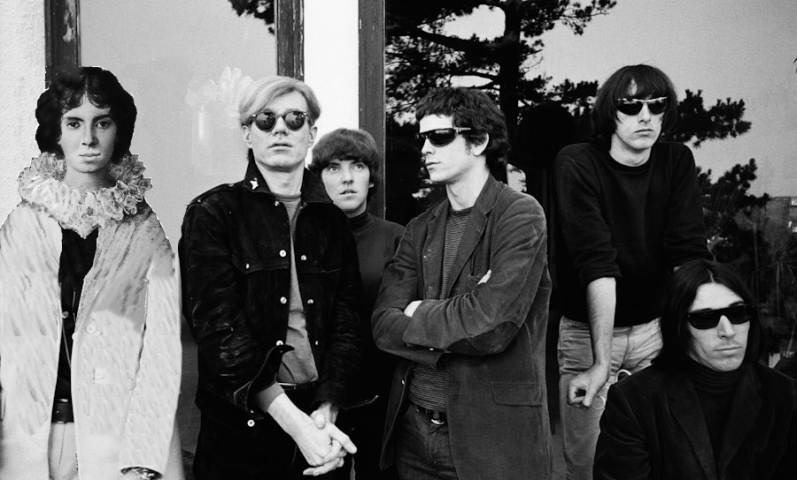
Today’s musical piece doesn’t sound much like this band, but “All Tomorrow’s Hurricanes” was a cut on the first Velvet Underground and Emily Dickinson album. Andy Warhol’s cover had a picture of a peelable ghost flower.
.
As much as I was working with piano, bowed strings, and acoustic guitar lately, I was itching to get back to loud electric guitar — but my situation in this era of my life makes two poles of music making more difficult to schedule. My quiet stuff has to be recorded when outside noise won’t scrape and bark into sensitive microphones, and the loud Rock that asks for interaction between the electric guitars and amplifiers pushing rude airwaves into a room risks disturbing others. Sometimes the situation, that I can’t whisper in an otherwise silent room, only makes me want to turn up the electric guitars all the more.
As you’ll hear if you venture to the audio player below, I was able to turn the guitar amps up for this, though I had a limited window to shatter.
The kind of guitar playing that steps out to the lead in the ensemble today is a style I worked with quite a bit back at the turn of the century. Like the chord progression, it’s not Rock-band-conventional. The framework is two lead guitars each free to explore melodic lines without strictly alternating (e.g. obligatory “call and response,” “trading fours,” or the like) or playing pre-composed harmonic intervals between their melody notes. It’s still Rock-music-like in that the two lead instruments reference the Rock beat, but this kind of simultaneous, spontaneous lead playing happens only rarely in the Rock genre. You can hear something like it in some folk musics, in early Jazz, and much later in Free Jazz — but for all its “let’s make a racket” ethos, Rock music generally avoids this.
Anyway, if you want to listen to this as it’s intended to be heard, don’t use ear buds or quiet levels. Use a set of stereo speakers and turn up the volume level. You can dance if you want to.
Audio player washed out on your way to reading this? This highlighted link is an alternative that will open a new tab with its own audio player.
.
 Frank Hudson