A Song in the Garden of Love

Today we offer a respite from my voice and the return of alternate Parlando Project presenter Dave Moore. And since it’s been a few days since the last new audio piece, today’s piece combines a lyric written by William Blake with one by Christina Rossetti. Two great poets in one piece! Ladies and gentlemen, there is no greater value you can find today in the poetic words mixed with music marketplace!

Both pieces are stated by their authors to be songs, either in the name of Blake’s collection where “The Garden of Love”  first appeared, “Songs of Experience,”  or in the title itself for Rossetti’s piece, which she called just “Song.”

So of course, both pieces have been set to music and sung before this, but it was Dave Moore’s idea to combine the two pieces; and one can immediately see once he did this, how tightly they fit, with Blake sorrowfully reporting the graves in the garden, and Rossetti musing on the grave and its landscape.

Rossetti wrote her “Song”  while still a teenager. Unlike Blake who was born in a religious dissenter family and grew increasingly distrustful of the corruptions of organized religion, Rossetti would become one of the most graceful and modest of the poets of the Victorian Christian revival. Strange, isn’t it, that the two poems mesh together.

Christina Rossette on staircase

“If you listen very hard, the tune will come to you at last”
Christina Rossetti listens for inspiration, or puzzles over her holiday gift list


Speaking from my poet/musician duality, the version of “The Garden of Love”  that I most recall is the one recorded by Allen Ginsberg in December of 1969. Ginsberg’s recording is played, followed by a 20-minute discussion of the poem and performance here. The four speakers in this discussion mull on the country music waltz feel Ginsberg performed the Blake too. If I were in that room, I could have replied from the musician side of that duality, that in 1969 there was a bloomlet of counter-cultural figures essaying country-music tropes to the puzzlement from the hippie audience as to what level of irony was intended. Two musical figures close to Allen Ginsberg had taken part in that move earlier that same year: Bob Dylan with “Nashville Skyline”  and Ed Sanders with “Sanders’ Truckstop.”
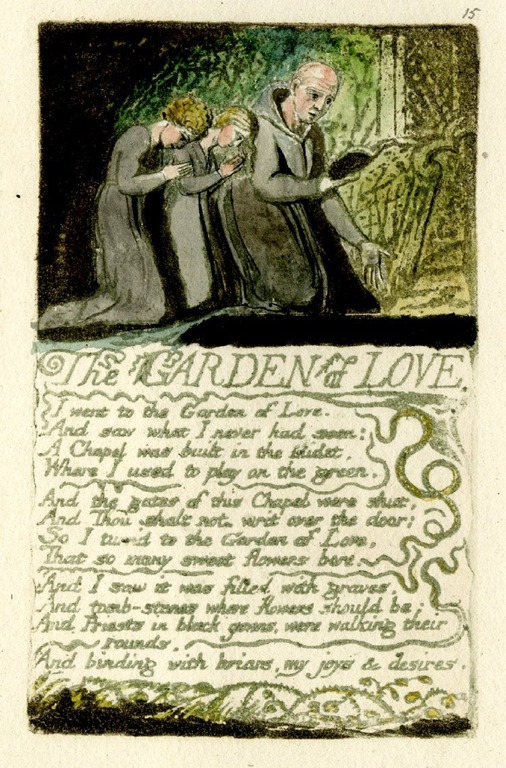
Wm Blake The Garden of Love

“A dominie in gray…led the flock away.” Blake’s self-illuminated song.


Our performance of this mixes Dave’s somewhat church-hymn organ (Ginsberg often used a hand-pumped harmonium organ in his live performances) with my country-ish Telecaster electric guitar, so perhaps Ginsberg’s country move was stuck in my memory as we performed this. Here’s what Dave Moore said about his performance:

“Wayback Machine time.

This song goes back to the early days of the Reagan years, which he ended up forgetting but we can’t.

Probably this is my first attempt to put music to classic poetry, I just thought they fit together so well & expressed both despair and hope so well. This one is my favorite vocal of all attempts at this piece. My introductory verses for each poet are new & I wish I’d separated them from the two little poems better, but that’s what you get with one-takes. Ah, sweet death, we can still sing.”

Dave points out a contrasting benefit of the pieces here performed as the LYL Band, which are not only “one-takes,” but are often pieces that only the composer-vocalist has any sense of the structure of, leaving the rest of us to follow and create parts on the fly. This leads to a certain roughness, and yes, at times, tentativeness too—but I believe there is a corresponding sense of the undiscovered and its discovery that may come across to the listener.

To listen to the LYL Band perform Dave Moore’s pairing of these two beautiful, yet sad, English lyrics, use the player below.


Under The Harvest Moon

Early in 1964 the then 22-year-old Bob Dylan and some friends decided to go on a road trip, and so they all piled into a new Ford station wagon. The group had (or developed along the way) some objectives. Some sight-seeing. Dropping off some donated clothes for mine workers. A couple of scheduled concerts (one sold-out, the other had to be re-sited to a smaller venue due to lack of ticket sales). They probably had some generalized youthful expectations of adventure, the “whatever comes our way” feeling. Bob Dylan was also expressly trying to change his songwriting.

Bob Dylan, the performer, was not yet widely known, but Bob Dylan, the songwriter, was a going concern. That summer his song “Blowin’ in the Wind” had sailed up the pop charts when sung by another group, and other performers lined up to record the song.

Bob Dylan was writing a lot of songs; in quantity alone, amazing to those in the know at the time, and yet “Blowin’ the in the Wind” seemed to be a different kind of song. What was its difference? It was clearly a song about social issues, the sort of topic that never challenges the dominance of desire and partying as popular song subjects–but also it dealt with those issues in a metaphoric way. That was not unprecedented. For example: Pete Seeger and Lee Hayes “If I Had A Hammer” was written in 1949 and had also been a hit that summer for Trini Lopez, and that song used verse by verse metaphors in a similar way—but still this poetic approach was not common for topical songs.

Around the same time Bob Dylan wrote “Blowin’ in the Wind,” he wrote another song, one with even more uniqueness: “A Hard Rain’s A-Gonna Fall.” How unique? Nearly seven minutes long for starters. Instead of the neat metaphors of “Blowin’ in the Wind” or “If I Had a Hammer” marching in ordered procession, the images come rushing out as if they are escaping for their lives rather than being marshalled for presentation. Social issues aren’t being addressed in “A Hard Rain’s A-Gonna Fall,” they’re being hit with a fragmentation bomb. It doesn’t aim to be another polemic so much as to convey the experience of the polemic forming. It doesn’t try to convince you of its opinion so much as to entice you into having a passionate opinion.

There was no song like “A Hard Rain’s A-Gonna Fall” before Bob Dylan wrote it, and afterwards you can see holes from its shrapnel everywhere. The man who could write “Blowin’ in the Wind” could be a successful songwriter. The man who could write “A Hard Rain Is A-Gonna Fall” could win the Nobel Prize for Literature, even if that would take a while.

That previous summer, poet Allen Ginsberg was at a party. Someone puts on Bob Dylan’s LP, the first side. The side begins with “Blowin’ In the Wind” and ends and “A Hard Rain’s A-Gonna Fall,” and as that last song plays Ginsberg says he wept, because “It seemed that the torch had been passed to another generation. From earlier bohemian, or Beat illumination. And self-empowerment.”

But back to our 1964 car trip. How much of this does this 22-year-old Dylan know? Who can tell. The best supposition is that he knew he was onto something and he wanted to do more of it. So in the back seat of the car he has a portable typewriter—the mechanical, steam-punk laptop of the day—and throughout the trip he’s writing songs. Principally he’s writing “Chimes of Freedom.” Again, who can tell, but I think a lot of creatives would empathically suspect he was feeling a heady mix of excited and relieved that he could do it again.

Their car trip gets to North Carolina. Dylan says they must visit a poet who lives around there somewhere. Not only does Dylan’s era and car lack laptop computers, they lack smartphone apps and GPS.  So they stop and ask a local.  This is how Dylan biographer Anthony Scaduto tells the story:

“Where’s Carl Sandburg’s place?” (Dylan) asked the tall gangling mountain man in coveralls. “You know, the poet.” The mountain man considered that for a while. “You mean Sandburg the goat farmer?” he asked.
“No, I mean Sandburg the poet.”
“Don’t know about no poet. There’s a Sandburg has a goat farm. Wrote a book on Lincoln. Little guy. Littler than you, even. If that’s the one, take this road two miles up there, turn left after the little bridge, can’t miss it.”

So here’s the 22-year-old Bob Dylan, the man who is about to take his own jangled and re-mixed reception of modernist poetry and societal criticism and collide it with guitars and transistor radios in an unprecedented way, and who does he want to see?  The 85-year-old Carl Sandburg.

Accounts of what happened next differ, and may not matter if we consider only that one thing, that Dylan wanted to see Sandburg.

I’ve talked about this before here. Everyone who influenced us had an influence. It’s a great long chain across time. Dylan was influenced by Woody Guthrie, Woody was influenced by Carl Sandburg. Sandburg was influenced by Walt Whitman. Whitman was influenced by William Cullen Bryant. Bryant was influenced by Homer.  And now going forward from 1964: Every rapper’s flow that jumps from one thought and observation to the next without catching its breath, every indie-rock song that decides to show the oblique confusion and emotion of confronting experience without boiling it down to conclusions, every self-penned ballad where the singer insists we hear how specifically she or he saw things comes (however indirectly) through Bob Dylan’s lyrical revolution.

So after all that introduction, here’s a short autumn-themed piece with words written by Carl Sandburg with music I did myself. Like Dylan’s later work, Sandburg’s “Under the Harvest Moon” unflinchingly addresses issues of love and death.

A small anecdote about the process of recording this piece.. As I set up to do the basic track for “Under the Harvest Moon” the power went out, and stayed out most of the afternoon. I so wanted to “try out” the composition, as much as I could, so I dug out and old hand-held digital recorder and a 12 string guitar and recorded the vocal and acoustic guitar track in a dimly lit room. As happens fairly often with musician’s demo tracks, I liked the demo well enough to keep it. Later when power came back on I added bass, an electric guitar part and the string –section part of the final track. To hear the resulting “Under the Harvest Moon” click on the gadget below.


Angels In the Alley

This piece tells a true story of a remarkable coincidence that I don’t think has been noted before. We’ll start with William Blake. Blake evidenced lifelong faith in his art. Near the end of that life he was still laboring to complete a set of illustrations for Dante’s “The Divine Comedy”, even though he was in even more dire poverty than was the norm for him, even while he was deathly ill with liver disease that may have been brought on by the chemicals his engraving process required.

I recently had a chance to visit England, and one of the must stops for me was the Blake room at the Tate Gallery. The room is deliberately kept in dim light to protect the fading inks and watercolors, and I needed to get very close to the small pamphlet-sized prints of Blake’s work to see the detail. This room was so filled with contrasts. A dark room to protect what had been bright colors. Small prints filled with gods, angels, cosmic events. The work of a man who lived in poverty and general disregard that now has his own room in one of the great art museums of London. Sadness, triumph.

Back to this audio piece now. The first part re-tells an account from one of Blake’s friends of his death in a tiny apartment off an alley in London. You can’t quite visit the site of Blake’s last work and death. The area was later rebuilt. Looking at what was there now, I noted that the replacement building was The Savoy Hotel. That’s when the connection light went off in my mind, something that my twin interests in music and poetry was bound to see, and that’s told in the second part of “Angels in the Alley.”

You see, the Savoy Hotel was a major setting for “Don’t’ Look Back,” the documentary film about Bob Dylan touring England in 1965. And in that film is the famous film clip of Bob Dylan flashing hand lettered cards with key words as his song “Subterranean Homesick Blues” blares out. Where was that filmed? In the alley next to the Savoy Hotel. One of Dylan’s Beat Generation older siblings, Allen Ginsberg, is standing in the background as this plays out. Just before the song winds down and everyone walks off, Ginsberg gestures grandly, raising both his hands over his head. It’s like he’s trying to show some kind of mind expansion. Or strike a ballerina pose. Or shape his arms like upraised wings, like an angel.

The gadget you should see below will let you play my audio piece, “Angels In the Alley” performed with the LYL Band.