Today’s piece is rare for the Parlando Project: a presentation of a contemporary poem by American poet Henry Gould.
Contemporary? How contemporary? “Searoads” was written only a few days ago. I read it on Halloween when the poet shared it on Blue Sky shortly after it had been written. Since I follow Gould on Blue Sky, I had read several of his poems before. He’s posted poems and poem drafts written serially as he works on a book-length opus dedicated to a topic. In recent Gould poem-series, historical time seems to take place simultaneously, and wide references to history and literary works weave through stanzas (or even within lines) of individual poems, this weave sometimes worked with the warp of wordplay.
That makes for a challenging density. Since my youth I’ve taken self-pride in being a history buff, and working on this Project has extended the poetry I’ve had contact with to a level that tests the working set of my old-guy memory. When I’ve got the energy to exercise those parts of my personality, digging into one of Gould’s poems can match up with those receptors. Gould’s work is ambitious and deals with earnest subjects, but I suspect it’s also playful. When you can catch, and hopscotch through the pattern of one of his sideways leaps to connection, there’s a pleasure in discovery – and this is so even though honest history and literature contains a great deal of conflict and pain.
I have a term I use for an effect I find in poetry – the polyphony layers of perceptions invoked with images, the melody of tracking from one thing to another like unto it, the intervals of sames separated by time – The Music of Thought. I assume this isn’t a new idea, but while study of the prosody of sound is commonplace, a prosody of the patterns when the images and what they present, composed in that order and layering, seems rarer to me. That I take any pride in writing about this is likely secondary to my ignorance of how thoroughly others have already written about this. I’m the kind of solitary, stubborn cuss that has to discover it myself to be able to integrate it into my enjoyment of poetry.
There can be a problem with the Music of Thought. While tastes in the word-sound-music may vary among readers and listeners to poetry, the effect requires nothing special in terms of shared knowledge. Children can enjoy Dr. Suess before they have much of a corpus of knowledge at all.* Poems of Yeats, Eliot, Frost, or Emily Dickinson can charm us by their sound even when – if we were tested by some exacting taskmaster to do so – we couldn’t write an internally consistent and plausible essay on what they were on about exactly. Fear of that looming taskmaster kills poetry readership, but the lure of the pleasures of sound draws us back in. The Music of Thought may still be sensuous, but it’s more abstract, it requires more knowledge and attention from a reader.
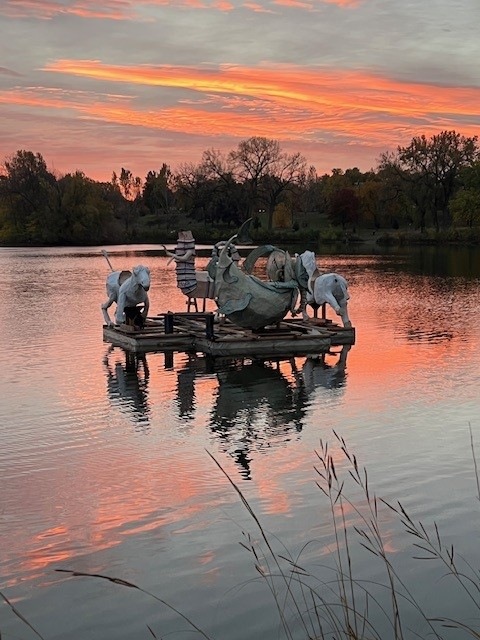
My wife shot this mysterious assemblage in Powderhorn Park at the dawn of All Souls Day 2025
.
When I came upon Gould’s “Searoads” it was late in the day. I was in the context of the short-attention-span-theater that is a modern social media feed. Tough court for the poem?
The sound caught me first and last, and I also easily fell into this poem’s Music of Thought. In both musics, “Searoads” drives forward attractively, and I was gathering meaning even on the first time through.**
How does it work? I’m bad at scansion (when creating music I’m habitually playing with offbeats and syncopations, sporting with measures, which probably demonstrates that I don’t understand the basic pattern well enough). Could “Searoads” be intended pentameter with predominant iambic stresses? I read the stresses as having variation (which good verse should have) but I scanned the lines as having a goodly amount of iambs, while I hear them as predominantly four-feet lines.***
The use of rhyme here is excellent. I heard rhymes the first time through, but not the scheme – so I didn’t know when they were coming. My own ear or taste loves off/near rhyme, and that too helps the sound work without some regular clock-coocoo chime effect. If I take apart the mechanism, it’s ABABCABCA. And there’s a lovely moment in the poem when an extra C rhyme comes strongly in the middle of the last line of the first stanza with “infants.”
The poem has a few unusual words. I knew “sarabande” was a dance form that survives in European classical music, and I even knew that there is some dispute about its origin, including a theory that it includes American musical ideas adapted by Spanish colonialists in the 16th century from native central American music. I didn’t know the word “Argive” (of the Greek city-state of Argos) – but two things referenced in the poem were part of my attraction. On Halloween I was intending to work on a piece for All Saint’s Day (November 1st) or All Souls Day (November 2nd), but despite some effort earlier in the week I hadn’t found a suitable text. As I read Gould’s poem, he may be invoking circular reincarnated or pre-existing souls in the second stanza – so in celebrating all who have died and the unity of that human experience, we may celebrate all unborn as well. What a lovely autumnal thought! And the same stanza even needle-drops a line from one of the All Souls’ texts that I wasn’t progressing on making music for: the “full-fathom five (my father lies)” speech from Shakespeare’s The Tempest.
But one word (well, hyphenated, but…) is most responsible for the piece you can hear today: “Ark-Dove.”**** I suspected the dove sent out from Noah’s Ark to confirm the time afloat in the great flood was ebbing. When I asked Gould, he confirmed to me he was thinking of that too, at least in part, as he wrote his poem. In our troubled times, a great flood of destructions, on a boat stinking of animal effluents, I think we are waiting for the dove to return with a green twig – but I had another specific thing going off in my mind too.
There’s a folk song, collected in 1906 in Texas at a temporary work camp along the Brazos river. A woman there, washing clothes on that riverbank sang this song about being abandoned; but imagining Noah’s dove anyway, singing “If I had wings, like Noah’s dove, I’d fly down the river to the one I love.” Beside the song, the folk-song collector only got the name “Dink” for the singer. He wrote that he tried to find out more later, but when he returned to ask about her, she was gone from the camp and no one knew where. We cannot know if she found wings to carry her above the river or if the river carried her, submerged, down its current.
So, as I returned to the top to read Henry Gould’s poem for a second time on Halloween, I was already humming that folk song, known as “Dink’s Song,” to myself as I read the words. The next morning, I had no Dink to ask for, but on All Saints Day I decided to work out some music to sing Gould’s poem. I did this with no expectation that anyone besides myself (and probably Gould, who I figured I’d just send it to, unbidden) would hear it.
I’ve been composing a lot in October on acoustic guitar, this meant I had some musical ideas to try with the words. I loosely based my music on the chord cadence from the verse of “Dink’s Song,” (D G5 D / Bm G5 D) with an even looser variation from the song’s chorus on the last line of each stanza (D G5 D Asus2 D). I’m not a very melodic singer, and unless one knows “Dinks Song” and reads this, one won’t hear the connection. I recorded this using my usual cross-picking technique on acoustic guitar while singing, and picked the best out of about five passes I quickly recorded that afternoon. I added a low-pitched piano part that emulates the way a tanpura is used in South Asian music and a bass part as I thought the piece needed a little more low-end activity.
Henry Gould received the recording and has graciously allowed me to share this musical performance of his fine poem “Searoads” here. You can hear it with the audio player below. Has the audio player flown down river? No, it’s just that some ways of reading this blog suppress showing an audio player gadget. This highlighted link will open a new tab with its own audio player so you can hear it.
.
*Adults could enjoy challenging Modernist poetry more if they allowed themselves to initially listen to it (even silently) as a toddler listens to board books. For that matter, I assume Dr. Suess/Theo Geisel had Lewis Carroll and Ogden Nash in his ear when he wrote, but his poetry makes me think he was reading Gertrude Stein or Marianne Moore too.
**I don’t rate myself highly in understanding poems, but a short poem that draws me in usually gets a repeated reading where often my understanding changes. One of the pleasures of doing this Project is that that the poem I start with can change to a poem I understand differently by the time I’m done with the recording.
***Today’s short discussion of prosody demonstrates why I do that sort of thing rarely here. I suspect a combination of being bad at it (not getting the correct answers in my scansion) and distrusting the classic accentual/syllabic theory that may need to be followed more loosely to produce a sophisticated effect.
****”Searoads’” unusual “Ark-Dove” with hyphen and capitalization made me think Gould must have had something else specific in mind, beyond my folk song and the Bible story. I did a quick search and found that two ships, the Arc and the Dove brought the first English settlers to Maryland – the Arc and the Dove are sort of the Catholic U.S. version of the Pilgrims and the Mayflower. What a rich reference! I asked Gould. Nope, he wasn’t thinking of that. Ah, but the muses Henry – they must have whispered in your ear.
And the poem’s title gave me thoughts too. Isn’t “Searoads” the way medieval English poetry might refer to a ships’ path?


 Frank Hudson