Bavarian Gentians

One of the things I’ve loved about doing this Project is the varied ways that poems come into consideration for performance within it. I’m not even sure after reaching 850 of them today, that I could catalog all the ways the words have come forward. Here’s an example: last week my wife was visiting a wildflower area — something she does often enough that I kid her that she’s a nature nymph with all the powers and duties thereof. She’d taken some pictures. One she showed me was of gentian flowers.

“Do you know D. H. Lawrence has a poem about blue gentians?” I asked

“The flower or the dye?”

“Mostly the flower as I recall.”

In actuality, I couldn’t recall much about Lawrence’s poem, only that it had once impressed me around the age of 19 or 20 when I had started to read poetry more widely. Now the old man-me did a quick web search before going to sleep that night and found Lawrence’s “Bavarian Gentians,”  likely the Gentian poem I’d barely remembered. I copied it and saved it for further exploration around a Parlando Project performance.

This week I began to work on that. The first thing I noted was the poem’s odd word-music. There is enormous use of repetition: words “blue,” “black”, “dark” and “darkness” reoccur constantly, and the flow of the poem seems less that of normal prose or poetry and more like a stuck-record ostinato.*  In performance I couldn’t see how to treat this as an elegant set of refrains, so I based my eventual performance on my first impression of obsession.

But there are twin narratives inside the poem’s babbling: observation of the gentian flower itself in the Imagist manner, and a retelling of the Persephone in Hades myth. What I feel links them (other than the obsessive refraining about the dark blue color of the flower and the coincident darkness of Hades’ underworld domain) is that flowers are the reproductive organs of plants, and the Hades and Persephone, daughter of Demeter, myth is about a male/female couple in the context of Demeter’s goddess of fertility.

bottle gentians by Heidi Randen

The bottle gentians that led to today’s piece. Like the Bavarian gentians in Lawrence’s poem, dark blue and autumn-blooming. This genus’ flowers stay in this closed budded shape, which hampers pollination, while the Bavarian gentians open into the vase or torch shape described in the poem.

.

And then, as I was fairly far along in my work with the musical performance you can hear below of “Bavarian Gentians,”  I made a discovery. There are two candidates for the official, presumed final text of this poem. It just so happens, the one I found in my quick bedtime search was the lesser-known one. The version that instead will be found in most cites and collections treats the Hades/Persephone/Demeter material at a more abstract level, while the one I’d been working with is much more raw and troubling. Note: I’m not a strict adherent to content warnings, but the account in the version I was performing likely deserves one: it’s an incident of sexual violence. Here are links to the two versions of the poem: the smoother one, and the rawer one I used. Keith Sagar and some other scholars question the predominance given to the smooth version and argue that the more explicit take was Lawrence’s final revision.

I can see how the more often reprinted version of this poem was chosen. It’s more graceful I think, and one could read that kind of change as the path of an author’s revision where later, more-removed, artistic judgement polishes the rough-hewn inspirations — but it could also be the kind of revision made to make something more marketable. Now knowing of the other version, I briefly thought I should redo my performance using it — it might communicate better to a listener who might only hear it once —  and another reason I considered a redo: the sexual violence depicted in the version I had first found presented problems.

I’ll briefly outline that problem. Let me summarize the Hades/Persephone/Demeter myth. Hades, the god of death and the underworld, abducts the young Persephone to be his bride against her will and she is unable to escape from this situation. Her mother, Demeter, a more senior and powerful goddess, intercedes and a compromise is reached. Persephone will be able to rejoin the above-ground world of the living, but she must return every winter back to Hades and his underworld of the dead. The myth here is transparently an explanation of the growing season in non-tropical regions. Told at an abstract PG level, and particularly in the expectations and context of classical non-equalitarian and clearly patriarchal society, it’s a “just-so-story.” We are not to experience horror with it.

But in Lawrence’s lesser-known version, this scene is portrayed: the poet’s speaker, using the gentian flower as if it could be a lamp, follows an abducted Persephone and Demeter, this child’s mother pursuing in rescue. They enter Hades, a place of complete darkness, Persephone and everything else for that matter cannot be seen, but sound remains — and this is heard: Hades (called by his Roman name, Pluto*) is raping Persephone.

Did Laurence mean for this account to make us recoil in horror, as I did when I needed to confront the text for performance? Shouldn’t the text call for that? Or was it intended as just some ancient fantastic myth given a bit of specific detail for which the author had and expected no overwhelming empathetic reaction? There are readings of this poem’ that see a metaphoric synthesis which is only on some surface level horrible, and something else on a metaphysical level.

I don’t know enough to say for sure, if there’s a “sure” in this case. Like the sexual violence and exploitation that was woven into Eliot’s “The Waste Land”  without drawing significant emotional weight from most (and mostly male-oriented) readers for decades, it could go either way in authorial intent — but I’m not the author, I have to perform this, I feel that horror, and I expect some listeners will feel the same. Frankly, this makes me a little dissatisfied with my performance of this piece, though I tried not to shirk its implications, however imperfect the result.

What could have driven Lawrence to use this myth in such a way, and in this version, to keep in the horror? He was working on this poem knowing he was facing a mortal illness. Like poets John Keats and Adelaide Crapsey, he was dying of tuberculosis. I have no knowledge of his experience of sexual violence, but Lawrence was undergoing viscerally an abduction against his will into the underworld of the dead. He might have felt that his poem, starting and ending on the consideration of the (by natural fact) bisexual flower justifies that element of considering Demeter and Persephone, and his anima will be taken away to die along with the rest of him by the disease. Make your own judgements on these issues; they may be wiser than mine.

The final line of this version has a contrasting power to what precedes it. The erect yet open gentian flower — which despite its shape was after all useless as a torch in Hades’ dark —  spreads in dark welcome at the draught of the light of a day.

If you’ve progressed this far past the trigger warning, you can hear my performance of one version of D. H. Lawrence’s “Bavarian Gentians”  with the audio player below. No audio player to be seen? Some ways of viewing this blog suppress showing it, so I offer this highlighted link that will open a new tab with its own audio player for those situations.

.

*I figure much of my audience is old enough to grasp that metaphor, but a footnote for the rest: the vinyl record with a deleterious wound to its groove which won’t let the needle progress beyond one stuttering spiral revolution.

**Lawrence’s use in the poem of the Anglicized Greek names for Persephone and Demeter, but the Roman name for Hades, Pluto, puzzles some readers. I suppose it could just be a Cortez-on-a-peak-in-Darien kind of poetic error, but I wondered if this poem, written in 1929 might have been recently soaked in the Pluto name from the discovery of the then considered 9th planet. Close, but no cigar: Pluto was discovered in February 1930 at an observatory created by the poet-related astronomer Percival Lowell in the American Southwest region that had recently been Lawrence’s home.

My remaining theory on why Pluto? Having the underworld and its god-king both using the same name Hades makes it harder to distinguish between the two.

The Cherry Blossom Wand

Here’s a poem by a poet you may not know of. I certainly didn’t until early this year when I saw a note about the later life of Anna Wickham on Bluesky, read the linked article (which I recommend), and made a note to look into her poetry.

Well, there’s life and my disorderly path – it wasn’t until this month that I did so. As a page poet Wickham may not capture you easily, depending on your expectations. I read a 1921 American collection that combined two books of hers published earlier in England: 1915’s The Contemplative Quarry  and 1916’s The Man with a Hammer.*   She wrote almost entirely in short formats, there are quite a few 8-or-fewer line poems that can remind one of Emily Dickinson poems of similar length. Short formats can be favored by those who dash off poems in an otherwise occupied life, and this may be the case here – but at least on first read through, there’s a different general attitude from the American genius. Dickinson to my reading is often playful in her poem’s argument, and even when writing of subjugation or from inside a gothic fantasia, she generally seems in control – and she was after all a member of a family that had achieved local prominence and financial stability. Wickham’s background seems less secure and more bohemian, and from 1906-1929 she was married to a man who is reported to have viewed her poetry as a sequalae of mental illness.** This horrid situation is reflected in the poetry – there’s ample counter-punching wit and protest deployed against the patriarchy in these two collections – but that also presents a certain closed-in feeling. Some of these poems take on the manner of quickly-whispered-where-he-can’t-overhear asides to friends from a woman in an abusive relationship. From extant drafts we know Dickinson had, and took, time to revise her verse, and she often strikes me as a talented structured improviser. Wickham (so far) seems to me to be more a jotter of quick poems from the first-thought-best-thought practice – biographical scraps I’ve read reinforce that conclusion*** – and some (most?) of her papers that might show more about work in progress do not survive.

older Anna Wickham in her kitchen

Anna Wickham in 1946. She made her living by turning her Hampstead home into a rooming house. Still asserting herself, she famously took umbrage with someone declaring: “You’d better retract, my good man. I may be a minor poet, but I’m a major woman.”

.

There’s a good chance my appreciation of her work will increase, but I also didn’t get a sense of compelling word-music on first reading, and that’s a quality that can attract me to a poem even before I understand it – which makes the first poem of hers that I’ll present today a bit of an anomaly. “The Cherry Blossom Wand” is  musical, and she even put a notation beside its title on the published page “To be sung.” I have no knowledge if she wrote music for it, or sang it,**** but that sort of thing is taunting the Parlando Project!

I see the poem as being a multifaceted account of beauty or love of beauty (and if we extend that, to love itself). The poem starts with its refrain stanza, telling us a branch of cherry blossoms is a “wand” that can do some kind of merciless bewitching magic. I like the refrain’s final line “a beautiful thing that can never grow wise.” Ambiguously: either we never wise up to the thrall of beauty, or that experience, time and wising up removes the beauty.

Blossoms are of course famously temporary, as the first non-refrained verse reminds us. On the page, Wickham only puts the refrain first and last, but since songs favor repetition, I put an extra refrain between the two verses.

The final verse before the ending refrain contrasts the merciless enchantment of the blossom wand with the “kind” removal of the bewitching beauty, and the verse then ends with its own internal refrain saying that the transience of beauty and time is eternal. There’s no change that can change that change, and the mercy is that we are not taunted long with its brevity.

As a whole then: bittersweet.

Cherry Blossom Wand

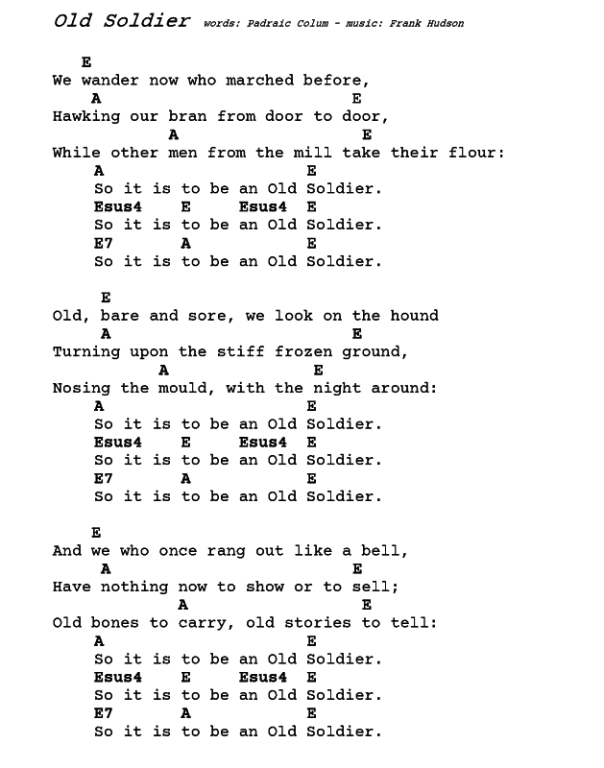
Chord sheet for the song I took as commanded by Wickham’s note on the page

.

Musically I got to play my nylon string guitar for the first time in a while. Every time I play that variety of guitar, I’m reminded of the cheap J C Penny nylon string guitar that I bought off the after-Christmas sale table in late 1974 to begin to learn how to play. Classical guitar players may be appalled, but I currently play my nylon string with a pick, which is wrong – but it’s how Willie Nelson does it.

You can hear my performance of Anna Wickham’s “The Cherry Blossom Wand”  with the audio player gadget below. Has some merciless hand removed any such player?  This highlighted link will bud a new tab with its own audio player then.

.

*Some accounts say Anna Wickham is more read and studied in the U.S., which would be the reverse of some poets I present here, most notably Welsh poet Edward Thomas who has some best-loved poems in Britain, and is hardly known in America. Influential 20th century American anthologist Louis Untermeyer thought enough of Wickham’s work to praise and include it. The Feminist-Modernist angle probably occasioned some interest too, and you can read her as a predecessor to Sylvia Plath in some of Wickham’s themes. Before she had a career as a best-selling novelist, American poet Erica Jong wrote a couple of poems dedicated in part to Wickham: this one, and this one.

**Wickham was eccentric. The linked article that sparked my interest has accounts that make that eccentricity seem charming, but depression seems to have figured in her life too. The complexities of our mental wiring and biochemicals mixed in with the stress of her life makes remote historical diagnosis chancy of course. The close publication of the two books of poetry that I read as a combined collection coincided with her husband going off to WWI, giving her some increased autonomy. Give a moment to imagine Edwin Starr singing a revised song: “War!! Uhh! What is it good for? Giving Anna Wickham a chance to see her poetry in print. Good God! Say it again!”

***The account of her reading one of her poems in public and presenting it with ““Rubbish, but there it is”” indicates this approach.

****After a childhood family sojourn to Australia, Wickham returned to England to take study in performing arts, particularly a singing career, though that doesn’t mean she composed music. The Cherry Blossom Wand”  has been set to music as Art Song before, at least this once 25 years ago.

She mentioned abandoning any search for musicality in her poetry in one of the poems I recall reading this month. This could be part of Modernist distain for frippery, or a practical act of triage for a poet without enough time. She’s a contrast to her American contemporaries Sara Teasdale, Elinor Wylie and Edna St. Vincent Millay who wrote very musical verse even as they wrote about Modernist concerns.

Sedition. A poem which isn’t, and that’s a point it’s making

Edmund Vance Cooke was a Canadian poet. At least I think he was. There’s not much on his life I can find, and sometimes his last name is rendered as “Cook.” His sparce Wikipedia entry says he was born in what was then known as West Canada in 1866, and back around the beginning of the 20th century he wrote a type of popular published poetry in a style that has largely died out. Wikipedia calls his genre “inspirational verse,” and some of it I’ve found is that: paeans to earnest striving and social virtues that now-a-days would be reduced to short easily-sharable quotes or the captions on “hang in there” motivational/affirmation posters. But there are indications that social criticism was also part of his repertoire, and this poem I perform today has some bite to it. Though written in 1917, I felt I should work up some music and sing it as a freshly-made song in 2025.

One of the things that irks me most this year is the outrageous lying by my country’s mad despot and his fawning courtiers. I can’t say for sure what drives all these fabulations and alibies across his administration. For some personalities a lie is a demented reflex, a neurological tic. Others spout the lies as a cold tactical choice of propaganda, with a sense that it will gain them some rewards. A more generous assumed motivation: that by saying this or that is so, when it’s not, may help manifest the thing not yet in existence – and this is akin to what affirmations invoke for personal improvement. Alas, most of the things not yet in existence that our current regime members are manifesting by statement are ugly, cruel things. We shudder – while considering the exaggerations, we fear they might not stay lies for long.

Today’s Cooke poem “Sedition”  is a statement of the countervailing powers of truth. It reminds me of an anonymous poem about truth that was widely printed in the same era as Cooke was writing, “Truth Never Dies.”   Five years ago in this Project, I presented that poem and wrote about what I found about who had republished it. This link will be of interest if you wonder about that. Though it’s a statement without evidence, it’s not impossible that Cooke was the author of the much reprinted “Truth Never Dies”  poem – but “Truth Never Dies”  is a more religious and spiritual poem than “Sedition.”   I composed music for the former with acoustic guitar and strings presenting it as a firm, but gentle prayer. The latter, Cooke’s poem, is more sardonic, defiant, even militant – and so I decided to crank up some electric guitars for it.

Sedition

Here’s a chord sheet for my version of Cooke’s poem. I won’t take responsibility if you decide to play and sing it yourself, –  that might make you part of a conspiracy.

.

I played three guitars in the recording via multitracking. For the electric guitar nerds, the center channel has a Gretsch hollow-body playing the chords, the right channel’s a Jazzmaster solid-body with a pitch-shimmering wiggle stick, and the left side a Telecaster whose wide vibrato here was created by having enough personal frustration to expiate that my fingers directly wrung the strings sideways to way above their fretted pitch.* I associate this kind of guitar solo with Canadian Neil Young’s credo that sometimes your intent is to not sound like a “professional guitarist,” some master of tasteful licks and precise intonation.

You can hear the performance with the graphical audio player gadget below. No gadget? I’m not lying – some ways of viewing this blog suppress the player, so I offer this highlighted link that’ll open its own tab with an audio player.

.

*”Hey, posh-guy, you’ve got a lot of guitars there.” I accumulated cheap imported versions of these guitars over 30 years, using trades, hunting up second-hand examples, and waiting for sales. Coincidently, the current regime’s tariffs are threatening what has been a golden age of reasonable quality, good sounding instruments for musicians with limited funds.

On the Goodnight Trail, On the Loving Trail

In 1970’s age of the Singer-Songwriter, Poet and folksinger U. Utah Phillips had an anachronistic career. In performance he might sing for only a portion of his time on stage, mixing in story-telling, verse, jokes, and his brand of political advocacy that reflected his even-then old-fashioned connections to Catholic Worker activism and the Industrial Workers of the World.* He would sing his own songs sometimes – and while he apparently didn’t write an awful lot of songs, a couple of them I know are extraordinary. Today’s musical piece, performed for American Labor Day, is one of those.

Here a video of my performance of U. Utah Phillips’ song

.

On the dusty surface of it, “On the Goodnight Loving Trail”  is a cowboy song, one of the real ones that recognize that cowboy is a job title after all, not a romantic name for a gunfighter or wandering charismatic cinematic horseman. That type of cowboy song existed of course – Phillips didn’t have to invent it – but his take on the genre is sui generis. Consider the historical appropriation in the song title and the chorus’ refrain from a historical cattle drive route going from Texas to Wyoming. That trail was named for two cattle-driving ramrods: Charles Goodnight and Oliver Loving. A mere accident of family names, but Phillip’s choice to use them imbues the song from the start with elegiac affection.

Calling the aged cowboy whose cattle drive job fell to being the camp cook “The old woman” is also taken from fact. Is this gendered part of the song’s refrain an inevitable accident, or a choice by Phillips? That the song reinforces the old cook’s abrogation of manhood in a verse’s line about “wearing an apron instead of a name” says that the author wanted to underline that – it’s a choice. If this song isn’t Brokeback Mountain  or the sibling of Paul Westerberg’s and the Replacements’ “Androgynous,”  I’ll take the leap and say it’s maybe a second-cousin. Is it possible that Westerberg knew Phillips’ song? That’s impossible to say – the underground aquifer of the folk process is dark and damp.

UUP Wobbly

U. Utah Phillips: an IWW member in the days of James Taylor and Carole King

.

I chose to present “On the Goodnight Trail”  today because it’s Labor Day weekend here in the U.S. This song about work ends with the ground-truth that the lot of many of us is to use up most of our life in our labors. Years ago, thinking of two specifically American holidays, I wrote this short statement caught commuting itself towards a poem:

The temple of summer is guarded by two pillars:
Memorial Day for those who gave up their lives in war,
and Labor Day for those who gave up their lives in peace.

I’ll flatter myself and say U. Utah Phillips would have liked that one if he had heard it. I did my best to sing his song. Seven years ago I did a musical performance which included these three lines about The Temple of Summer,  and if you haven’t had enough Parlando Project music after the video above, here’s an audio player below to play that performance as we ride up to the gates of autumn this weekend.

.

*corrected thanks to rmichaelroman

.

.

The spider holds a Silver Ball

Welcome back to our regular fare after a spate of summer diversions. And what is it that you’d expect to see here? We take various words, mostly literary poetry, and combine them with original music in differing styles. I’ve done this Project for over nine years, and within the archives here you can wander through nearly 850 of these combinations. Since poetry can be described as words that want to burst into song, such combinations might seem an obvious task – sometimes they are – but I enjoy looking for unusual connections, conversations between tendrils and mycelium deeper in the soil, not just the majestic and visible branches everyone sees.

One frequent supplier of words to be recast in sound here is the seminal American 19th century poet Emily Dickinson. Dickinson’s mind is Shakespearean in its scope, and while her modes of expression vary to meet those needs, much of her poetry sits in a rich intersection between short epigramic verse that superficially seems like it could be stitched as some crewel homily, and unconventional, rebellious, independence of thought.

For example, this lesser-known Dickinson poem: “The spider holds a Silver Ball.”   I’ll link the full text of it here. The opening four lines are praise to a spider’s industriousness, with the arachnid – unusually for this poet – standing in here for the highly common Dickinson totem, the bee. Dickinson, the avid gardener with a science-focused education, knows well the necessity of pollinating and honey-keeping bees. In this rarer appearance in her work, the spider is no such creature, for their work is occult or predatory. She praises its web-work none-the-less, that work’s imperial provisioning for prey goes unmentioned. This praise continues in the next stanza. The web is anchored or arises from “Nought” she says. The spider makes its spider silk from a secreted process, its attachment points may be a dimly lit corner unespied, its constructions do not exist until the spider’s efforts create them. But “Nought to Nought” is an omen too for all this effort as the final stanza will tell. Note too, Dickinson genders the spider: “His.” Spiders of either sex spin webs, but this action is male.

spider and mushroom by Heidi Randen 1080

A mélange of moss and mushroom. Can you spot the spider’s unperceived hands in the picture? (click to enlarge)

.

I’ll make a leap here: Dickinson, the prolific weaver of 1,789 poems, identifies with this spider. One accounting has this as poem 513, so there are hundreds of poems behind her as she makes this one, and more than a thousand yet to go. The bees in Dickinson’s poems are usually cast as joyfully playing, the spider here is more obsessive. Even the dourest Puritan in her era would know the worth of the bee’s work: flowers, food, unspoiled sweetness. In the final stanza, the spider’s work is destroyed by what Dickinson genders as woman’s work, by housework – as endless as this spider’s spinning. Another leap: I wondered if Dickinson might have composed this poem while busy with housework, secretly engaged in the (gendered by her) masculine work of inessential gossamer creation – no matter if “Nought to Nought” is that work’s fate.

As I read this poem I thought of another poet working in this mode, the William Blake of Songs of Innocence and Experience,  who wrote of “The Fly”  and likened his own intellectual and creative drive to the bothersome insect.

I combined Dickinson’s words with music that partakes of the sound of the 1960s psychedelic genre.*  The joy of that kind of expression is the freedom granted to instruments to take novel roles and reconstituted timbres. To a loping 6/8 time, the bass is allowed to rise to sing, the electric piano has been having an episode, the guitars wander onto new paths, an organ breathes, the drums fibrillate. Over this I sing wildly, unconcerned to be overheard. You can hear this performance with the audio player gadget below. What, has that audio player seemingly come to nought? Some ways of viewing this post will suppress the gadget, so I offer this highlighted link which will spin a new tab that has its own audio player so you can listen.

.

*I don’t find this a strained pairing at all. The 19th century American New Thought and Transcendentalist strain was still alive in the Beat and later counter-culture outlooks that arose a century later. Dickinson’s recasting of language and syntax in many of her poems is like to the sonic experiments of psychedelic music, which I’m attracted to for their adventuresomeness rather than their drugs. What is novel about my application of this to Dickinson is that this element of her poetry is under-observed, while it’s more common to view William Blake as “A ‘head’ before his time.”

The “Guild Concerns,” and mine, and yours, around Artificial Intelligence

I hope the hardy, but smaller, summer readership here has enjoyed this diversion from our usual literary poetry combined with original music subjects. It’s been somewhat difficult to write. Why?

When I run across comments or longer-form writing about artificial intelligence – given my interests, mostly from folks in artistic fields – the feelings and cold convictions I read come in hot. AI gives me a lot of feels too: frustrations, fears, disgusts, distrusts, worries, even amusements at its fails. Yet, earlier in this series I’ve honestly talked about AI features I’ve tried. I wonder if I’m alone in these mixed feelings – if I’m just a wishy-washy old guy who won’t say it plain. For my final installment let me focus on those concerns.*

I’ve referred to some of those “guild concerns” earlier in this series. Let me expand on that. Let’s say you are a professional, semi-professional , or aspiring visual artist, voice talent, translator, editor, writer, composer, musician. AI claims it’s achieved parity with your field’s trades. “No!”  you reply to any such suggestion, for you are informed of all the small things that a master in your field provides that AI, as yet, can’t. But along with that comes the fear that most customers and many consumers of your art may judge as inessential elements you’ve learned to provide and appreciate, that your professional value-add may be judged dispensable. Capital’s royal decision makers may not hear your objections, give them any bottom-line weight. There’s an unavoidable term for a resulting outcome: enshittifacation. Everything then may drop to just above the level that would drive commoners to revolution.

And there’s a tsunami of salt to be poured into artist’s wounds from the use of Large Language Models in current AI. LLMs digest realms of work by artists, almost entirely without compensation to them, and apply pattern and categorization processes to this hoard to make it into reusable parts that can be recombined into other work – work whose ownership has been severed from artists and transferred in part to oligarchical corporations. This injury isn’t speculative. It’s already occurred in titanic amounts to create current LLMs, and ex post facto attempts to get paid for this seizing of work or to prevent future accumulations of scraped up art are being resisted by the AI industry who is seeking government protection for this reuse.**

So, where organized as unions, workers in the arts have attempted to counter this, concerned both as keepers of artistic excellence and as counter-forces seeking to protect incomes for their members. Will this succeed? Who am I to predict, watching ignorant beach-sand techbro armies sweep across the darkling plains amid alarms. But I understand the anger/fear of the artists, endorse it.

But I, myself, am an odd case. Poetry has low capital needs, a loaf of bread, a jug of iced-tea, and a roof, and I’m good to go there – and the renumeration market for poetry is scant. I used to inconstantly chase after giving readings with a couple dozen attendees, or the small paper presses aspiring to three-digit sales. I still admire those things and support them, I just don’t see them as precious scraps to struggle over at this point in my life. With the Parlando Project I most often use other people’s poetry, using and promoting work from dead and/or public domain poets or small excerpts of words from the living. With this Project I can aim for my hundreds of readers or listeners for a piece – a tiny audience in Internet stats, but an appreciable reward by poetry standards. With my music production and distribution here (aided by affordable computer technology) I find that I’m part capitalist and part worker-in-song. And there’s a conflict there.

I’ve already confessed in the series that I sometimes use what is called AI to extend the long-standing feature of computer music arpeggiators, programs that suggest and play patterns of notes on command. Honestly, I don’t feel good about using these – there’s shame mixed in there with the approval I find with my producer’s hat on from the effective results they bring to the finished musical piece.*** It’s not just breast-beating when I confess it feels fraudulent to me to use some computer aided line or expression played with an accomplished verve. A human should do that, and I can’t do that, and yet that part of the ensemble is  there – I’ve allowed it, and its level of success to some listener could be assigned to me. The alternate path I left some time ago was organizing bands of musicians to realize the music I create. I may wonder about that untaken path, but then I consider how dissatisfied those musicians might be at my non-commercial aims, how frustrated or dismayed they would be with my musical naivete, how stressful and ill-fitting it would be for the composer-hat-me to wear the bandleader-hat as well. Yet, those struggles, despite unfitness on my part, may be the necessary dues to engage in musical work. Guild concerns might hand down a harsh judgement on what I’ve done: “If you can’t do that, you shouldn’t do that  –  you’re taking away jobs from skilled tradesmen.”

In this I support the guild with one side of my heart, and yet I could be charged with working against its union shop.

A musical piece from a pair of DVDs issued decades ago that my child and I treasured when we both were younger. I don’t have details about how this music was produced, with what technology, but this is so much better than the trite AI slop illustrations I could have chosen to use instead. The Animusic web site is defunct, and I don’t know how you could still purchase this.

.

Full-fledged AI music? The examples I provided in my last post satisfied my curiosity in my quick attempts to see what the current state of the art can do. Even more so than with my frustrations with AI illustrations I discussed in the first part of this series, I’m not tempted to continue to use that level of AI music creation. I don’t have to test my ethics in this: AI generated songs can’t get close enough to what I want, what I intend to communicate. I like playing instruments, and despite my not uncommon artists ability to procrastinate on getting down to composition of new work, once I’m into the process, I find it absorbing. If what results isn’t always a perfect realization of intent, so to it is with AI, and typing a few words into a prompt has no visceral rewards.

As I wrap up this series today, I’ve honestly tried to report my contradictions. If I’ve done anything, it’s my hope that you, my widely curious readership, will use what I’ve written to spur your own considerations of the challenges AI brings to art. I’ve used music as the main example, but literature and many other arts – as well as work that isn’t viewed as artistic – have like dangers, allied concerns.

.

*Let me mention that I also share environmental concerns with the energy usage to provide AI. While earlier in this series I wrote that we likely don’t really know what those energy needs are with precision – and our existing general use of ubiquitous computers both saves and costs energy in some balance that’s hard to calculate.

An another issue: brevity keeps me from delving today into the important risk of extended capitalist and or authoritarian control of expression by ceding tools of production to oligarchs.

And lastly, there is a great deal of techbro hype around AI. In some ways it’s encouraging and scary how well it works, and in others it’s risible and scary how badly it works. I don’t mind so much laughing at its limitations in the world of musical art – like the satire in the last post where it created outrageous protest songs that can still sound sonically plausible – but the thought of non-analog safeguards in life-and-death contexts is concerning. It’s already hard enough to hold capital to account for grievous errors and oversights. Giving another level of kings-X granted to the passive voice of “computer error” worries me.

**As I was finishing a draft of this on Saturday I read an egregious example of AI theft from a musical artist. Emily Portman (and others, it appears from the linked news story) had their artistic presence on leading music streaming sites invaded by someone greedy enough to try to steal the widow’s mite that independent artists receive.

***If I was to play advocate in my defense, I could say that the uses I make of these tools are not the same as typing in a few generally descriptive words and having AI generate an entire song (or painting, or story, or essay) such as the song examples I supplied in the last post. I work iteratively with the specifications and adjustments for the patterns – though so do many who work on elaborate prompts for generating entire songs – but I’ve supplied them with the harmonic structure by playing or composing the chords or melodic centers of the resulting pattern to be generated. Those substantive contributions I supply make a case for these uses being collaborative extensions of the human.

I’ve so long used drum machines – and entire accepted genres of music are built around the expectations that they will be used – that using computers to play drumbeats in patterns seems more allowable to my inner ethicist. If I dig deeper, and acknowledge that I know and appreciate the musicianship and sound of a good percussionist, this is inconsistent, but this is my honest emotional report.

Summarizing and speaking here in guild specifics: the composer in myself may feel justified, while the internalized musician’s guild inside my soul still feels shame at my stooping to this.

I ask AI to write a protest song, and…

A funny thing happened on my way to winding-up my Summer diversion series of thoughts on Artificial Intelligence. I’d concluded last time: since current AI was capable of producing musical pieces in popular styles that could pass for human works in casual listening – or plausibly even more exacting listening – those who’d prefer music expressed by humans might need to change the things they look for and value in music. What kind of things? Accept more imperfections in the music, cultivate an appreciation for the humanness inherent in live performance, and increase their consideration of the intent and motivations of the musical organizations they support.

That last point, about more significantly honoring intent, had hardly inscribed itself as a blog post here when a mischievous thought came over me: while AI is created by businesses with commercial intent, human-made music doesn’t have to be. As difficult as it is to refine authentic intent from music made by strangers distributed in a marketplace, could we be fooled about intent by entirely software-generated music? So, what if I asked AI music generating software to produce a protest song? What if I went further and presented it in a misleading context?

Disregarding my environmental footprint for the duration of the experiment, I created a free account on an AI music generating site, and I set about creating a new protest song. Out of the many outrages of 2025 so far, I picked the authoritarian assaults on academic independence which have sought fines/bribes/tribute from some of the U.S.’s most prestigious universities (known in America as “the Ivy League”) while demanding oversight into their operations and academic programs on flimsy pretexts.

Like a lot of AI, the one I used for this works on a “freemium” structure, with limited features for non-paying users. To make a song I only needed to enter in a text prompt (length-limited for free users) describing it. I asked another AI engine to suggest a prompt and asked it to create lyrics for a song (though the song-creating AI site would be glad to generate its own lyrics). The more general AI answer-bot suggested including artists whose style the music generating AI site should seek to emulate. I picked Phil Ochs and the Fugs. I wanted something with real anger and satiric bite.*

I created around six songs. None of them gave me that, even when I tweaked my prompt. What came out was sweet-voiced singers with an attitude of pop-music yearning, or acceptably sorrowful disappointment in their delivery. The AI lyrics did come up with a few phrases that had some charge to them, but the lyrics generally suffered from what I personally call “Horse With No Name” defects.** My prompt specified “gruff,” “angry,” rough” or even “sloppy” to describe the vocal delivery I was looking for, and out came the singers with an air of polished regret, and lyrics that groaned under their attempt at machine-constructed sincerity. The best I could say for the lyrics on the songs? They might pass as modern recording-production-style versions of the parodies created for the Spinal Tap acting company’s folk-music parody It’s a Mighty Wind.***

These results fed into the context I chose to present them in. I wrote a script for a podcast, supposedly devoted to American folk and Americana music. I decided the podcast presenter would be earnest, but a bit removed from the less-commercial segments of American folk music, and so I made her British. She would be portrayed by the machine speech that I use on my writing computer as a proofreading aid.**** As the token human in this enterprise, I’d appear as a hype-man for the Parlando Project.***** Over the next day I wrote the podcast script and recorded it folding in sections of the machine-generated protest songs. I slightly degraded the audio quality for the British host’s dialog, though after I finished I now think I should have done that for my own dialog instead, as I’d be more likely the guest relying on a remote overseas link for the imaginary podcast.

I had fun doing this, trying to gauge how many tells that this wasn’t on the up-and-up I should drop before revealing the near total AI nature of the content in the last minute. For the names of the Americana acts that were purported to be performing the AI songs, I decided to burlesque the names of U.S. 19th century Fireside Poets. I think “Greenleaf-Whittier” is a great name for a band in that genre – failing that, Jeff Tweedy if you’re reading here, you’re welcome to it for the next Wilco album title.

Greenleaf Whittier

Featuring the exciting new song “University Surrender” you heard on the “Kit That Sounds So Real” podcast.

.

The audio player below will let you hear the 18-minute program. The program opens with a snippet of an AI generated folk instrumental whose prompt I supplied was its title: “Obey in Advance.”   Though only a small selection, I think it demonstrates that AI generated music without vocals is particularly “real” sounding. The program continues with parts of three versions of a song called “University Surrender”  where the AI program supplied the words, music, and fully produced recording in three slightly different Americana styles it thought appropriate. The three versions resulted as I tried tweaking my text prompt – and while distinct, on repeated listening they seem somewhat “samey” to me. More smooth than I was asking for, “Ralph Waldo Bryant’s” version rising to falsetto delivery almost works for the material despite the pitch control artifacts I can detect in the computer-generated performance – but remember, as I said earlier in this series, the same artifacts are now common with recorded human vocalists in current pop. “Greenleaf-Whittier’s” cover did add one, nice, out-of-leftfield, touch: the flagrantly computer-voiced autotuned opening refrain of the title before continuing into its bouncy two-step country groove. And then there’s “Oliver and the Rolling Homes’” version of “University Surrender”  whose arrangement serves up a country-music playlist/station format sound. I was laughing hard as I heard the small-town-worshiping-my truck-my girl -I may get a little drunk sometimes-but I’m a hardworkin’ man-like my daddy sonic approach, but this time holding forth on tenure and syllabus issues. And then there’s “Ivy Towers Bow”  that is said to be written and performed by “J. R. Lowell.” The lyrics here were written by an AI chatbot and then those lyrics were given to the AI music generating program to make this song. Musically this one doesn’t give me anything – so generic. I almost didn’t include it, but I decided it was an example that a generate-songs-AI was on par with a text-focused AI when writing lyrics. The final song on the fake podcast might be the one of the group that does the best emulation. If I was listening casually and “E. E. Peterbuilt and the International Harvesters ““The Emperor’s New Chains”  came on, I’d think it better than many songs in its style. Oddly enough, the AI program produced it when I goofed and clicked generate when I’d only partly written the prompt “Folk or Americana protest song, gruff voice…” and by not having to lyrically add the academic details that made Oliver and the Rolling Homes version of “University Surrender”  so unintentionally hilarious, its Horse-with-No-Name lyric faults are not as exposed. If I wanted to pick one AI song from the ones I generated to fool a careful listener, I’d pick this one. You know you’re in the Uncanny Valley when the guitars have faded out and the robot vocalist gives us a little aside into the still open mic. Spooky.

If you don’t see the audio player gadget to play this imaginary podcast, this highlighted link was human supplied to let you hear it, and will open a new tab with its own audio player.

If my courage and energy hold out, I still want to write one more post about what I call “the guild issues” that concern some artists engendered by plausible AI results.

.

*The AI program didn’t object to those two 20th century folk-rock artists of outrage and cutting satire being supplied for models – but it completely ignored trying to emulate them. When I tried “Bob Dylan” – suggested by the separate AI that’d given me a prompt I could use elsewhere – the song AI immediately refused to do so, presumably due to a specific concern about IP.

**”A Horse With No Name” was a 1971 song, recorded in England by a band led by expatriate Americans. The recording, done by humans, not AI, sounded like someone had anachronistically entered our future and asked AI to “Create a song that sounds exactly like a Neil Young record.” The lyrics went forth despite including some awkward lines like “There were plants and birds and rocks and things,” “the heat was hot,” “’Cause there ain’t no one for to give you pain,” and “Under the cities lies a heart made of ground, but the humans will give no love.” To spare us from more lyrical howlers, the song also featured a lot of repeated “la la la’s” in its chorus, well-performed in a CSN&Y style of harmony.

The song was a substantial hit in both the U.S. and Britain, indicating that it worked as a song for its audience none-the-less.

***Hey, I’m a fan of Spinal Tap. Everyone is! And rating art is a fool’s game – but “It’s a Mighty Wind” is every bit as good, maybe better.

****The “read aloud” feature in the current versions of Microsoft Word is a huge aid to my self-proofreading. With my neuro-wiring, it lets me catch a great many errors I’d otherwise miss, and using the female British voice enhances the “hearing this anew, as if I didn’t write it” factor that makes it so effective.

*****The stuff I say in the middle of the satiric podcast concerning the Parlando Project is how I actually feel about the nine-plus years of stuff I’ve put out here.

AI music may be telling us something about how music works for listeners – and we might want to change that

I had to catch myself editing the last post – as I discussed my use of virtual instruments in place of the actual instruments and the new plausibility of thoroughly AI music, I was tempted to overuse the word “verisimilitude.” Is that really something essential to the art of music? I like the cranky not-quite-real sound of the Mellotron after all. If musical art should be imagination, music itself certainly doesn’t care if the instruments are real – though musicians might, from legitimate guild concerns. Then we moved to having the computer play the instrument, and that too asks about human-displacement – and now we have AI creating songs outright from very generalized prompts. If you’re a composer, a musician, or a listener, this raises questions.

Let’s start by being honest with ourselves as listeners in avid or casual modes: as we pass through life, music becomes a sort of sonic homeplace – a location where something sounds similar to what we’ve heard before, with just enough difference to stave off boredom, just enough new to add the spice of novelty. Some musical ears live in homogenous towns, others in more diverse ones, but we go to music for the effects we’ve learned to appreciate.

Current entirely-AI music exploits this: taking what we know of form and sounds, following its predictability in a way listeners have been known to appreciate, and serving our aural expectations back to us. When they do that, the robots are telling us something about ourselves. As I ended my last post, if we object to AI music, it may be from the romantic feelings we retain for human artists. We want fellow humans to make these sounds with and for us, and our response may rise to disgust when we are tricked. And here’s a problem: it’s getting harder to say you won’t be tricked.

If this is so, what hopes do we have? One: imperfection, at least of a kind. Let me interject here that I’m not talking about the imperfections of boredom, of which there are many. I’m talking about music that may be a bit more haphazard and unpolished. If machines can precision-target our musical comfort-center receptors, then let us distrust that response at least in part.

Commenting reader rmichaelroman has already guessed that might be part of it, mentioning the performance, rough in recording quality and musical finesse, from the LYL Band at an Alternative Prom in someone’s basement years ago.  Even stored on honest recordings – live music, particularly live music that is truly live, with unplanned-out moments, with instruments reveling in their specific bodies, breaths, and vibrations – offers vivid imperfection.

Or too: voices with less talent than intent. I try to not over-burden my listeners with self-made excuses for my singing voice – but for all its limitations, it remains the one I have handy to realize the songs. Would AI be able to duplicate those imperfections? Perhaps, but it’s unlikely to want to.

When music practices and equipment reached points of greater mastery in the 20th century, reaction in the form of purposely avoiding those felicities arose. Midcentury pop music was opposed by the rising Folk revival and by early Rock’n’Roll. Then later, perfected Rock recording technology and improved musicianship found themselves met with Punk and Hip-Hop premised on the idea that a minimum of tech or muso-chops can still make an effective statement. By the way, I believe those technical hierarchies produced worthwhile music, but those that dispensed with them did so too.*

And when I wrote about voices with more intent than talent: for all the romantic imprecision of assigning internal motivation from a separated artistic product, what we believe we understand about why a piece of music was produced has importance. AI-music, however good it is at mimicking the technology and sound of music we like, presently offers only the weakest and least admirable answers to the question of why it was called into existence. To make some money? To make inoffensive sonic décor? To sell drinks to dancers? To show it can be done, as if that “verisimilitude” was the most significant thing about art? Some music I have liked was made for such mundane reasons, but in the future we may find intent more necessary to weigh.

I’ll leave with one more brief metaphor as AI-music reaches a level of musicological competence: we may have come to something analogous to painting’s role as photography entered the realm of visual representation. AI music in artistic hands may eventually seek out flagrantly subjective use of the technology – and music made by humans holding physical objects in real time will increasingly began to value qualities beyond sounding customary and “correct.”

If my energy holds out, there’s at least one more post in this AI series before I return to our regular combinations of literary poetry with original music, this one will address in more detail some of those music things I call “guild concerns.” If you miss the usual Parlando Project fare, there are over 800 examples of that here, so feel free to look around.


I wouldn’t want to call this performance imperfect, but there’s a human unexpectedness to it that satisfies me

.

*The 1950’s-early ‘60s folk music revival had elements that I found closely mimicked by the Punk/Indie movement of following years: the DIY convictions, the gumption to form or transform venues and record labels, the opportunities for out-of-the mainstream ideas and sounds to sneak in between the more polished and “professional” acts. Similarly, Hip Hop followed the folk process: use what instruments were at hand, assertion before sounding “correct,” recombining shared culture materials (floating verses and borrowed tunes for the banjo brigades; turntables, cheap drum machines, and samples for Hip-Hop, contemporary social comment for either). Musicologist Ethan Hein said in a BlueSky post that helped spur me to write this series, “You can get across the essential elements of hip-hop and house with buckets (Hein here is referring to overturned buckets used as drums –FH)  and voices. Computers and sound systems are nice to have but inessential. Long after Spotify is gone, people rapping over beats will still be with us.”

Artificial Intelligence in Music: the last wall of the castle

Just a note to readers coming here for the experience of literary poetry combined with the original music stuff we do – I’m still doing some “summer vacation” writing that breaks from that form this month. This post does deal with music – if from another angle – and I expect to fully return to our traditional presentations this Fall.

So, I’m at my frequent breakfast place on a fine August morning that has not yet reached the AQI-alert level of smoke. In an unplanned coincidence, Glenn walks in. We’d talked last week about, of all things, Herb Alpert, and his early 1960’s instrumental hits, particularly “A Taste of Honey”  which was a chart topper in our youth.*

Glenn has some Herb Alpert and the Tijuana Brass CDs, but like many he’s as likely to have a CD player as he is to have a way to play 78 rpm shellac records. He’s been trying to get their music onto his new Mac Mini, but his old USB Apple Super Drive won’t recognize a music disk.**  Somehow (likely my current preoccupation with finally writing about it) we got to talking about AI. I mentioned that I’ve been struggling to use my collection of Virtual Instruments (VIs) to realize recordings with brass instruments that capture the full level of articulation the real thing can produce.

We talked a little bit about the various ways these instruments can be controlled: little plastic keyboards, various guitar pickup schemes, even wind controllers. Glenn has a bit of engineering background – this had (I hoped) some mutual interest.

I have little or no guilt in using VIs here for the Parlando Project. Not only is a VI grand piano highly affordable, it takes up no space, requires no fancy mic’ing, and produces a pleasing sound. Given my musical eclecticism, I think of how much more cluttered my studio space would be if I continued to collect odd instruments that I would experiment with to add unusual colors to pieces. And though I can’t actually play a real cello or violin, I can use a MIDI guitar controller to add those sounds. I’m grateful for those options for realizing my music.

Then I told Glenn about the Mellotron – a pioneering virtual instrument before such a thing had a name and acronym. Rather than hard drive files containing databases of digital recordings of actual instruments playing a range of notes in different articulations like one of my computer VIs, this primitive mid-20th century machine used strips of analog tape recordings of an instrument playing a single note for each tape strip. When professional musicians (among them: The Beatles, the Moody Blues, King Crimson, The Zombies) started to use the Mellotron, some objected: could the Mellotron put real musicians out of work? When the Beatles and their producer George Martin wanted a high trumpet part on “Penny Lane,”  a real musician was contracted for and played that difficult and memorable part. But flip the “Penny Lane” 45 RPM record over and on “Strawberry Fields Forever”  Paul McCartney pressed a Mellotron’s keys to produce an eerie flute sound. Listening closely, it wasn’t quite like a real musician blowing into a real flute. It was maybe 80% there – but if it sounded a little fake to a discerning ear, one might think it was still an interesting sound, whatever its level of verisimilitude. But imagine you’re a flutist in 1967 – the Beatles could certainly afford to pay for your services. Though bands moved on to use more complex synthesizers and other devices, real instruments still retained a level of preference when their fully-authentic sound was called for.

Could I pay or otherwise record real musicians instead of using my computer VIs? It’s hard for me to imagine a cello or violin player that would accept my chaotic and self-imposed quick-turnaround schedule, naïve/inconsistent musicianship, my shifting moods, and my no-revenue-project budget.

In my defense, this human being may well be playing the instruments,  just as I play guitar: this note, here, this loud, this long. Other times I’m scoring the music the VIs play, writing or modifying the MIDI event data rather than on a music-staff leger.

Still, there are some gray (or even darker) areas. For me, that started with using arpeggiators: ways to tell a computer you want it to take a chord and play the notes within it in a rhythmic series. I can tell it what note-length to use, something about the order of the notes, but the precision is then all the computer’s – and arpeggiators will have presets to suggest, and I might agree to one. Numerically quantifying the level of plausibility of my own work is problematic, but VI technology is such that even with my limited musical-instrument-operator skills, I may approach 90% there – but my musicianship, with its intents, and also it’s limits, is still involved. I can’t help but think my brass VIs sound badly because they are so far from the families of instruments I have played in “the real world.”

But a greater temptation arrives: more sophisticated computer “players” that take a chord sequence and duration I supply – from composition or by my playing something – and augment them by playing those cadences musically in a style it supplies and I consent to. These “players” have multiple adjustments, I can (and often do) modify what they supply as defaults, but this further development bothers me. Am I still the composer? In a human-musician world the answer would be clear by well-established tradition: yes, they’d say, I’m still the composer. Professional musicians, working before computer algorithms, have long supplied “feels,” timbres, expression, and entire decorative lines. They might even revoice the chords or play extended harmonies. They will do all that (or more, or better) than my computer does for me. So why do I feel bad when I ask my computer to do this? Well, there’s the impersonality to it. I’ve worked with others who’ve made important musical contributions to work I’ve originated, and that doesn’t feel the same. While I think I would be problematic to impose this on human musicians for the rewards I can offer, there’s more to it than not offering them that opportunity. I can’t help but think I’m cheating, that these realizations are fraudulent.

Yet guilt hasn’t stopped me from using these computer functions, and you’ve heard some of the parts they’ve played sometimes in Parlando Project recordings. The term artificial intelligence is elastic, it’s become a marketing buzz-word, but these enhanced arpeggiators and play-with-this-feel-or-articulation variations could fairly be called AI – even when the same musical piece has my vocals of I-hope-for subjective-quality or my it’s-supposed-to-sound-like-that guitar playing.

That said, over breakfast, I tell Glenn about how far AI music generation has come in the past few months. Just by entering a prompt or making a menu selection, often made up of generalized summary words for genre or playing style, one can create an entire song including vocals and all the musical accompaniment. Earlier in this decade the results would’ve been overly simple or subject to embarrassing defects. Now, the results easily pass the “Turing Test” for casual listeners. If the Mellotron flute is 80% there, and my best VI violin might be 90% there, these entirely machine-generated songs are about 95% there in verisimilitude. Sure, human musicians, real composers, even avid music listeners, are forever aiming for that extra 5% of skill, originality, and listener appeal; but when I listen to these productions which can be produced endlessly in minutes of hands-off computation time, the “tells” are the thoroughly AI songs meh obsequiousness to genre musical tropes and the slight artificiality of the machine-made vocalists. And that’s a problem. Centuries of musical theorists from the days of music theory treatises written with a quill, and onward to the accretion of hardened commercial songwriting craft, have supplied all the steps in ink-stained longhand to create a coherent musical structure with predictable effects. The computer coders only have to apply a light dressing of adaptation to transfer this consensus for robotic mass-duplication. The singers would still have remained a challenge – except by a fateful choice: popular music has increasingly prized machine-aided polishing of human voices to remove the inexactness they are prone too. Ironically, what could have been the last rampart to be surmounted by AI was dismantled by meticulous vocal production and ubiquitous auto-tune before the tech-bro Visigoths arrived.

I said to Glenn over breakfast in the café “Here we are talking about a popular song released 60 years ago, one we both still remember. ‘A Taste of Honey’  didn’t have any vocals, and now AI could easily produce an entire album of other instrumental songs to surround it – and even listening carefully, I’m not sure we could tell AI from human-written and realized musical pieces.”

This is not a theoretical exercise. Streaming platforms and playlists care even less than casual music listeners about AI content standing in for human work. In some genres, the algorithm that supplies your next song playing may already be a robot suggesting robots playing robot-composed imitations of human music. The only thing holding off an overwhelming onslaught of AI slop is that we, the audience, are still invested in the erotic worship of flesh-and-blood young performers and some residual romantic veneration of the human artist. Those things may be illusionary, but even if so, those things may be our defense. Do I have any other hope to offer? Yes, there’s something else, that comes next post.

This is the author of the play “A Taste of Honey” for which
the tune was composed. Her play frankly portrays a whole range of working-class situations in ‘50’s Britain. A teenager when she wrote her play, she was 21-years-old when this cheeky interviewer interrogated her. What admireable self-confidence!

.

*As vividly as I remembered the song, I knew nothing about its origin – and while I could distinctly recall the musical sound of Alpert’s recording in my head (trumpet, trombone, and that beating drum) I also heard in my mind vocals and a crooner singing. I tried to find the version with the sung lyrics I was remembering. I likely had heard the (somewhat unlikely) version of “A Taste of Honey”  done on the Beatles’ earliest LP, but I don’t think it was that one I was hearing in head.

**If you still own that ancient Apple artifact, the external Super Drive CD/DVD drive, you should know that it won’t work unless connected directly to one of your Mac’s USB ports. Even deluxe powered USB hubs or docks won’t work–  the drive will seem completely dead when connected through them.

Prompt: write that AI post you’ve put off for a year

The responses invoked by so-called Artificial Intelligence are a complex mix. Expressed feelings recently would include any of the following in any combination: disgust, fear, ridicule, outrage at theft of Intellectual Property, and charges of tech-bro over-valuing. Let me say at the outset that I have caught myself feeling all those feels too.

I’ve planned for some time to write a post about AI here, and this summer period when I feel free to take short holidays from our usual music/literary focus would be a good time for it. Then this morning I read this post by a blogger/teacher/musician Ethan Hein,* and I’ve been driven to start this long-delayed, provisional, and likely incomplete post on the subject.

What Hein wrote isn’t extraordinarily provocative. “I understand the impulse to decorate your newsletter with AI slop images but when I see that, it makes me assume that you don’t know what you’re talking about.”

If I’m not a proponent of AI, why would that motivate me?

Well, for one, I could be found guilty of the failing he uses as a marker of knowledge. And if my energy holds out, there’s more than that to say.

THE MATTER OF IMAGE

As the Parlando Project moves into its 10th year, how I work and present things has been a learning experience for me. Some years back I noted that images in blog posts increase new visitors to this blog. Now, the Parlando Project is a poetry/varied music thing, and a great many of the casual visitors don’t become regular readers or listeners – but some  might.

Given that I’m an abysmal visual artist, I began using this way of finding images: public domain pictures or (I hoped) benign reuse of images found on the Internet. This is a more complex subject than I’ll go into today, and I know enough to know that as a courtesy or strict matter of rights, I’ve likely sinned in regards to crediting images. The Parlando Project isn’t even a non-profit organization at this point – my plan from the start was deliberately to be a non-revenue thing. I want to spread knowledge and outlooks and to promote other people’s art. I certainly don’t want to remove value from others’ art.

The original attempts at figurative AI illustrations that I saw were ludicrous. I knew there was this thing called DALL-E, and its warped and poorly detailed images others shared seemed to have come straight from the Island of Misfit Toys. But in 2022, I was made aware of a new option. I’m a long-time user of the Adobe Audition audio editing program, and Adobe had a new product offered for beta-testing called Firefly. Firefly claimed to produce better AI illustrations, and it also claimed this Unique Selling Proposition that, AFAIK, has remained unique: they said it was trained only on art whose creators had been compensated for.**

The very first image I used from Firefly actually pleased me. I did modify it, but it worked for illustrating the musical setting of the poem I was presenting, Hey, I could use something like this, I thought.

April 2023, I want to show William Carlos Williams dancing alone. My first use of Adobe Firefly to generate an image.

This acceptance of the tool was reinforced by my decision to present videos some times. While a blog post needed only a single illustration, having something germane to put up against the linear flow of a video asked for multiple images to fit different points in the song.***

I think this was the final Parlando Project use of AI-generated images to illustrate this very short Emily Dickinson poem’s “lyric video.”

.

Over about two years, I continued to use Firefly. My experience was mixed. No matter how much care and detail I tried to put into the prompts I often couldn’t get anything like what I wanted. I’d resort to 20 or 30 tries to get one I could charitably use. Afterwards, I’d sometimes wince at what I accepted and included with Parlando work, but I have a policy here of leaving work up “warts and all.” But I did write “mixed.” Just like that initial image that I used of a purported dancing William Carlos Williams, some of the ones I got from Firefly pleased me, and I hope pleased audiences. Maybe someone now sees a poem in a different light, or checked out some music they otherwise wouldn’t have heard.

A combination of things turned me away from AI-generated illustrations. The amount of time to go through all those bad results to pick the sometimes barely acceptable one bugged me. I could use that time to read or research more on poets and poetry, or to make somewhat better recordings! And partway through my use I started to read the charges of extraordinary energy use by datacenters generating AI.****  While I didn’t make some hard and fast decision, my Firefly use just tailed off. Now in the past year, the outrage against AI has grown, particularly from artists in various fields. If my personal energy holds out and I continue to write on this, I’ll get into more detail on those concerns and theorizing around AI, but those concerns are genuine feelings about genuine threats.*****

This is not an AI-Generated Image

.

Which leads me to my personal concern, one I had reading Hein’s honest and informal opinion. I’m nearly willing to join the pitchfork and lit torch brigade marching on the AI castle, and I share their concerns. But for around two years I was up in my energy-dense lightning-powered lab twiddling the dials to generate this – well, yes it is, isn’t it – monster. Look, villagers, I didn’t intend to drown the little flower-picking girl – I was just trying to juice up my low-budget poetry/music blog. I actually had moments of pleasure when the monster grunted semi-intelligibly!

I made a short reply to Hein this morning, he clarified that his statement was more of a vibe thing. I understand – I make those suppositions too. This post is, in so many words, asking for mercy for using AI image generation. If posts on AI here continue, what I’ll write will get more complicated yet, but that’s enough for today.

.

*Hein has a wonderful way of writing about the theory and practice of musical composition. I’m grateful for the things I, an untrained and largely naïve composer, have learned from what he’s written. His particular specialty is examining (with practical examples) the disconnect between the venerable Western/European musical tradition and the way music is realized here in modern America. Currently he seems to be pivoting to podcasting his information, but links to his work are here.

**Presumably, Firefly’s source material was Adobe’s stock art library.

***I sometimes ask myself why I don’t just do a single still image and leave it at that in my videos. After all, there are many YouTube videos that do only that for music-centric content. Despite my love for spare, concise poetry, I speculate I’m just a maximalist with the arts that I’m not knowledgeable about.

****My first thought reading those energy estimates was: what is the methodology to determine how much energy draw was due to AI? I’m an old IT guy. If one has full access to all the systems, and wished to log the amount of CPU and access time for each sub-process running on them that they knew pertained to AI, then one could make a reasonable estimate from that mass of information as a proportion of the total energy drain of the entire facility. I couldn’t imagine anyone writing about the astronomical AI heat and energy drain had such access. They might have some sense of the total for a particular facility, but I’m unaware of any facility that only  does AI processing. Facility A may use a whole lot of cooling and electricity, but how much is for transcoding cat videos, searches for what actor played who in that movie, and order processing for Labubu orders? Did someone use estimates from proposals? It would be easy to imagine that any engineer asked to create energy and heat needs for establishing AI at a site would be encouraged to spec high.

That said, total energy costs for our modern computerized world does seem to be increasing, and AI does seem, at this time, to be remarkably energy-demanding.

*****What did I do instead? I think I’ve had less weird or imaginative blog illustrations recently – that’s a loss, if a survivable one – and per Hein, the cheesiness of some of them might not have helped. For videos I’m subscribing to a product that offers a portion of a leading stock image library. My report: there are plenty of times when I hate a not-quite-right stock image as much as any AI fresh-off-the-slab monstrosity. And I worry that those stock image libraries may soon enough include AI-generated images.

If you are reading this post and think, “But he didn’t say this! That’s the key point.” I may yet get to that.