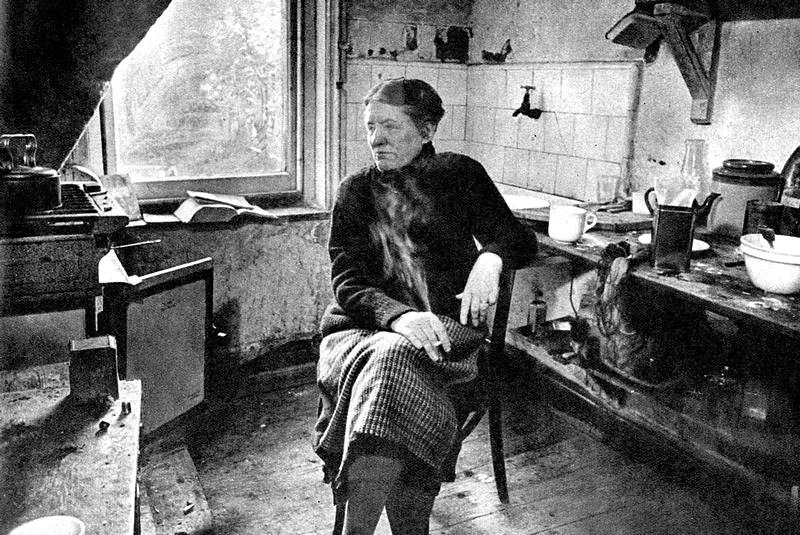
Edmund Vance Cooke was a Canadian poet. At least I think he was. There’s not much on his life I can find, and sometimes his last name is rendered as “Cook.” His sparce Wikipedia entry says he was born in what was then known as West Canada in 1866, and back around the beginning of the 20th century he wrote a type of popular published poetry in a style that has largely died out. Wikipedia calls his genre “inspirational verse,” and some of it I’ve found is that: paeans to earnest striving and social virtues that now-a-days would be reduced to short easily-sharable quotes or the captions on “hang in there” motivational/affirmation posters. But there are indications that social criticism was also part of his repertoire, and this poem I perform today has some bite to it. Though written in 1917, I felt I should work up some music and sing it as a freshly-made song in 2025.
One of the things that irks me most this year is the outrageous lying by my country’s mad despot and his fawning courtiers. I can’t say for sure what drives all these fabulations and alibies across his administration. For some personalities a lie is a demented reflex, a neurological tic. Others spout the lies as a cold tactical choice of propaganda, with a sense that it will gain them some rewards. A more generous assumed motivation: that by saying this or that is so, when it’s not, may help manifest the thing not yet in existence – and this is akin to what affirmations invoke for personal improvement. Alas, most of the things not yet in existence that our current regime members are manifesting by statement are ugly, cruel things. We shudder – while considering the exaggerations, we fear they might not stay lies for long.
Today’s Cooke poem “Sedition” is a statement of the countervailing powers of truth. It reminds me of an anonymous poem about truth that was widely printed in the same era as Cooke was writing, “Truth Never Dies.” Five years ago in this Project, I presented that poem and wrote about what I found about who had republished it. This link will be of interest if you wonder about that. Though it’s a statement without evidence, it’s not impossible that Cooke was the author of the much reprinted “Truth Never Dies” poem – but “Truth Never Dies” is a more religious and spiritual poem than “Sedition.” I composed music for the former with acoustic guitar and strings presenting it as a firm, but gentle prayer. The latter, Cooke’s poem, is more sardonic, defiant, even militant – and so I decided to crank up some electric guitars for it.
Here’s a chord sheet for my version of Cooke’s poem. I won’t take responsibility if you decide to play and sing it yourself, – that might make you part of a conspiracy.
.
I played three guitars in the recording via multitracking. For the electric guitar nerds, the center channel has a Gretsch hollow-body playing the chords, the right channel’s a Jazzmaster solid-body with a pitch-shimmering wiggle stick, and the left side a Telecaster whose wide vibrato here was created by having enough personal frustration to expiate that my fingers directly wrung the strings sideways to way above their fretted pitch.* I associate this kind of guitar solo with Canadian Neil Young’s credo that sometimes your intent is to not sound like a “professional guitarist,” some master of tasteful licks and precise intonation.
You can hear the performance with the graphical audio player gadget below. No gadget? I’m not lying – some ways of viewing this blog suppress the player, so I offer this highlighted link that’ll open its own tab with an audio player.
.
*”Hey, posh-guy, you’ve got a lot of guitars there.” I accumulated cheap imported versions of these guitars over 30 years, using trades, hunting up second-hand examples, and waiting for sales. Coincidently, the current regime’s tariffs are threatening what has been a golden age of reasonable quality, good sounding instruments for musicians with limited funds.
Welcome back to our regular fare after a spate of summer diversions. And what is it that you’d expect to see here? We take various words, mostly literary poetry, and combine them with original music in differing styles. I’ve done this Project for over nine years, and within the archives here you can wander through nearly 850 of these combinations. Since poetry can be described as words that want to burst into song, such combinations might seem an obvious task – sometimes they are – but I enjoy looking for unusual connections, conversations between tendrils and mycelium deeper in the soil, not just the majestic and visible branches everyone sees.
One frequent supplier of words to be recast in sound here is the seminal American 19th century poet Emily Dickinson. Dickinson’s mind is Shakespearean in its scope, and while her modes of expression vary to meet those needs, much of her poetry sits in a rich intersection between short epigramic verse that superficially seems like it could be stitched as some crewel homily, and unconventional, rebellious, independence of thought.
For example, this lesser-known Dickinson poem: “The spider holds a Silver Ball.” I’ll link the full text of it here. The opening four lines are praise to a spider’s industriousness, with the arachnid – unusually for this poet – standing in here for the highly common Dickinson totem, the bee. Dickinson, the avid gardener with a science-focused education, knows well the necessity of pollinating and honey-keeping bees. In this rarer appearance in her work, the spider is no such creature, for their work is occult or predatory. She praises its web-work none-the-less, that work’s imperial provisioning for prey goes unmentioned. This praise continues in the next stanza. The web is anchored or arises from “Nought” she says. The spider makes its spider silk from a secreted process, its attachment points may be a dimly lit corner unespied, its constructions do not exist until the spider’s efforts create them. But “Nought to Nought” is an omen too for all this effort as the final stanza will tell. Note too, Dickinson genders the spider: “His.” Spiders of either sex spin webs, but this action is male.
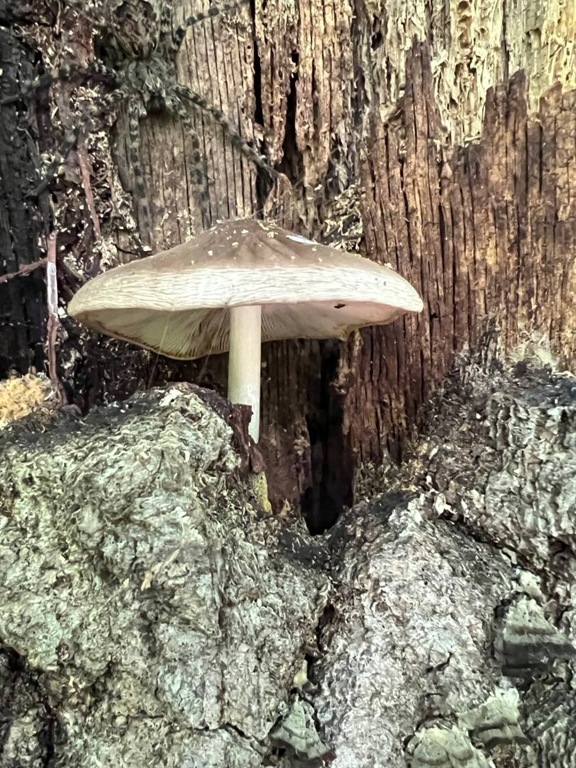
A mélange of moss and mushroom. Can you spot the spider’s unperceived hands in the picture? (click to enlarge)
.
I’ll make a leap here: Dickinson, the prolific weaver of 1,789 poems, identifies with this spider. One accounting has this as poem 513, so there are hundreds of poems behind her as she makes this one, and more than a thousand yet to go. The bees in Dickinson’s poems are usually cast as joyfully playing, the spider here is more obsessive. Even the dourest Puritan in her era would know the worth of the bee’s work: flowers, food, unspoiled sweetness. In the final stanza, the spider’s work is destroyed by what Dickinson genders as woman’s work, by housework – as endless as this spider’s spinning. Another leap: I wondered if Dickinson might have composed this poem while busy with housework, secretly engaged in the (gendered by her) masculine work of inessential gossamer creation – no matter if “Nought to Nought” is that work’s fate.
I combined Dickinson’s words with music that partakes of the sound of the 1960s psychedelic genre.* The joy of that kind of expression is the freedom granted to instruments to take novel roles and reconstituted timbres. To a loping 6/8 time, the bass is allowed to rise to sing, the electric piano has been having an episode, the guitars wander onto new paths, an organ breathes, the drums fibrillate. Over this I sing wildly, unconcerned to be overheard. You can hear this performance with the audio player gadget below. What, has that audio player seemingly come to nought? Some ways of viewing this post will suppress the gadget, so I offer this highlighted link which will spin a new tab that has its own audio player so you can listen.
.
*I don’t find this a strained pairing at all. The 19th century American New Thought and Transcendentalist strain was still alive in the Beat and later counter-culture outlooks that arose a century later. Dickinson’s recasting of language and syntax in many of her poems is like to the sonic experiments of psychedelic music, which I’m attracted to for their adventuresomeness rather than their drugs. What is novel about my application of this to Dickinson is that this element of her poetry is under-observed, while it’s more common to view William Blake as “A ‘head’ before his time.”
A funny thing happened on my way to winding-up my Summer diversion series of thoughts on Artificial Intelligence. I’d concluded last time: since current AI was capable of producing musical pieces in popular styles that could pass for human works in casual listening – or plausibly even more exacting listening – those who’d prefer music expressed by humans might need to change the things they look for and value in music. What kind of things? Accept more imperfections in the music, cultivate an appreciation for the humanness inherent in live performance, and increase their consideration of the intent and motivations of the musical organizations they support.
That last point, about more significantly honoring intent, had hardly inscribed itself as a blog post here when a mischievous thought came over me: while AI is created by businesses with commercial intent, human-made music doesn’t have to be. As difficult as it is to refine authentic intent from music made by strangers distributed in a marketplace, could we be fooled about intent by entirely software-generated music? So, what if I asked AI music generating software to produce a protest song? What if I went further and presented it in a misleading context?
Disregarding my environmental footprint for the duration of the experiment, I created a free account on an AI music generating site, and I set about creating a new protest song. Out of the many outrages of 2025 so far, I picked the authoritarian assaults on academic independence which have sought fines/bribes/tribute from some of the U.S.’s most prestigious universities (known in America as “the Ivy League”) while demanding oversight into their operations and academic programs on flimsy pretexts.
Like a lot of AI, the one I used for this works on a “freemium” structure, with limited features for non-paying users. To make a song I only needed to enter in a text prompt (length-limited for free users) describing it. I asked another AI engine to suggest a prompt and asked it to create lyrics for a song (though the song-creating AI site would be glad to generate its own lyrics). The more general AI answer-bot suggested including artists whose style the music generating AI site should seek to emulate. I picked Phil Ochs and the Fugs. I wanted something with real anger and satiric bite.*
I created around six songs. None of them gave me that, even when I tweaked my prompt. What came out was sweet-voiced singers with an attitude of pop-music yearning, or acceptably sorrowful disappointment in their delivery. The AI lyrics did come up with a few phrases that had some charge to them, but the lyrics generally suffered from what I personally call “Horse With No Name” defects.** My prompt specified “gruff,” “angry,” rough” or even “sloppy” to describe the vocal delivery I was looking for, and out came the singers with an air of polished regret, and lyrics that groaned under their attempt at machine-constructed sincerity. The best I could say for the lyrics on the songs? They might pass as modern recording-production-style versions of the parodies created for the Spinal Tap acting company’s folk-music parody It’s a Mighty Wind.***
These results fed into the context I chose to present them in. I wrote a script for a podcast, supposedly devoted to American folk and Americana music. I decided the podcast presenter would be earnest, but a bit removed from the less-commercial segments of American folk music, and so I made her British. She would be portrayed by the machine speech that I use on my writing computer as a proofreading aid.**** As the token human in this enterprise, I’d appear as a hype-man for the Parlando Project.***** Over the next day I wrote the podcast script and recorded it folding in sections of the machine-generated protest songs. I slightly degraded the audio quality for the British host’s dialog, though after I finished I now think I should have done that for my own dialog instead, as I’d be more likely the guest relying on a remote overseas link for the imaginary podcast.
I had fun doing this, trying to gauge how many tells that this wasn’t on the up-and-up I should drop before revealing the near total AI nature of the content in the last minute. For the names of the Americana acts that were purported to be performing the AI songs, I decided to burlesque the names of U.S. 19th century Fireside Poets. I think “Greenleaf-Whittier” is a great name for a band in that genre – failing that, Jeff Tweedy if you’re reading here, you’re welcome to it for the next Wilco album title.
Featuring the exciting new song “University Surrender” you heard on the “Kit That Sounds So Real” podcast.
.
The audio player below will let you hear the 18-minute program. The program opens with a snippet of an AI generated folk instrumental whose prompt I supplied was its title: “Obey in Advance.” Though only a small selection, I think it demonstrates that AI generated music without vocals is particularly “real” sounding. The program continues with parts of three versions of a song called “University Surrender” where the AI program supplied the words, music, and fully produced recording in three slightly different Americana styles it thought appropriate. The three versions resulted as I tried tweaking my text prompt – and while distinct, on repeated listening they seem somewhat “samey” to me. More smooth than I was asking for, “Ralph Waldo Bryant’s” version rising to falsetto delivery almost works for the material despite the pitch control artifacts I can detect in the computer-generated performance – but remember, as I said earlier in this series, the same artifacts are now common with recorded human vocalists in current pop. “Greenleaf-Whittier’s” cover did add one, nice, out-of-leftfield, touch: the flagrantly computer-voiced autotuned opening refrain of the title before continuing into its bouncy two-step country groove. And then there’s “Oliver and the Rolling Homes’” version of “University Surrender” whose arrangement serves up a country-music playlist/station format sound. I was laughing hard as I heard the small-town-worshiping-my truck-my girl -I may get a little drunk sometimes-but I’m a hardworkin’ man-like my daddy sonic approach, but this time holding forth on tenure and syllabus issues. And then there’s “Ivy Towers Bow” that is said to be written and performed by “J. R. Lowell.” The lyrics here were written by an AI chatbot and then those lyrics were given to the AI music generating program to make this song. Musically this one doesn’t give me anything – so generic. I almost didn’t include it, but I decided it was an example that a generate-songs-AI was on par with a text-focused AI when writing lyrics. The final song on the fake podcast might be the one of the group that does the best emulation. If I was listening casually and “E. E. Peterbuilt and the International Harvesters ““The Emperor’s New Chains” came on, I’d think it better than many songs in its style. Oddly enough, the AI program produced it when I goofed and clicked generate when I’d only partly written the prompt “Folk or Americana protest song, gruff voice…” and by not having to lyrically add the academic details that made Oliver and the Rolling Homes version of “University Surrender” so unintentionally hilarious, its Horse-with-No-Name lyric faults are not as exposed. If I wanted to pick one AI song from the ones I generated to fool a careful listener, I’d pick this one. You know you’re in the Uncanny Valley when the guitars have faded out and the robot vocalist gives us a little aside into the still open mic. Spooky.
If you don’t see the audio player gadget to play this imaginary podcast, this highlighted link was human supplied to let you hear it, and will open a new tab with its own audio player.
If my courage and energy hold out, I still want to write one more post about what I call “the guild issues” that concern some artists engendered by plausible AI results.
.
*The AI program didn’t object to those two 20th century folk-rock artists of outrage and cutting satire being supplied for models – but it completely ignored trying to emulate them. When I tried “Bob Dylan” – suggested by the separate AI that’d given me a prompt I could use elsewhere – the song AI immediately refused to do so, presumably due to a specific concern about IP.
**”A Horse With No Name” was a 1971 song, recorded in England by a band led by expatriate Americans. The recording, done by humans, not AI, sounded like someone had anachronistically entered our future and asked AI to “Create a song that sounds exactly like a Neil Young record.” The lyrics went forth despite including some awkward lines like “There were plants and birds and rocks and things,” “the heat was hot,” “’Cause there ain’t no one for to give you pain,” and “Under the cities lies a heart made of ground, but the humans will give no love.” To spare us from more lyrical howlers, the song also featured a lot of repeated “la la la’s” in its chorus, well-performed in a CSN&Y style of harmony.
The song was a substantial hit in both the U.S. and Britain, indicating that it worked as a song for its audience none-the-less.
***Hey, I’m a fan of Spinal Tap. Everyone is! And rating art is a fool’s game – but “It’s a Mighty Wind” is every bit as good, maybe better.
****The “read aloud” feature in the current versions of Microsoft Word is a huge aid to my self-proofreading. With my neuro-wiring, it lets me catch a great many errors I’d otherwise miss, and using the female British voice enhances the “hearing this anew, as if I didn’t write it” factor that makes it so effective.
*****The stuff I say in the middle of the satiric podcast concerning the Parlando Project is how I actually feel about the nine-plus years of stuff I’ve put out here.
There’s an undercurrent of grief beneath life. I don’t say this as a sentimentalist, it’s just there. This doesn’t preclude joy – it may in fact demand it.
I awoke at dawn today, August drizzle falling. I connected briefly with a livestream of the candlelight anniversary memorial service in Hiroshima,* and then shared a few tears with my living wife. Tears from each of us mixed on my face, shed for my late wife now dead for 24 years this morning. After she left for work, I took to my daily joy and hopped on a bike and rode to breakfast under gray skies without remaining rain.
I usually read the news with breakfast, a long habit – and I still do, though there’s little joy and much sense of loss in it these days. I took an old pocket music player with me (which no longer works except for the radio)** so that I could listen on air to the children of a recently assassinated state legislator memorialize her and her husband killed alongside her. They played their parent’s favorite songs mixed with sharing stories of hearing those songs in the back seat of a minivan while all sang along in flagrant voices. See what I mean: grief demands joy.
Perhaps you don’t. I express myself awkwardly, some will wonder what I’m on about. Let me look at it from the perspective of absent connection: the man who has gained some wealth by bamboozling someone or by force of power, often has the briefest of joys. The one who seeks joy in the suppression of others, has a meagre joy constructed out of a comparison to other’s pain inflicted. Grief for them might be a weakness, a sure sign of submission. I, a nobody in this world of power, can laugh at myself writing this and tell myself I should stop trying to be mistaken for Kahlil Gibran.
Today’s musical piece came about when someone shared a poem by Elinor Wylie called “Wild Peaches.” Wylie, a contemporary of Edna St. Vincent Millay, gained an audience during the last decade to be called The Twenties. She was born into a successful family steeped in political rectitude, but her love life became a national scandal. She eloped with the son of an admiral at age 20, but soon left him for a married, older lawyer by the name of Wylie.*** The abandoned husband committed suicide after she left him, and the lawyer Wylie and Elinor fled to England and lived undercover under an assumed name. Eventually the couple married and were able to return to the U.S. in time to have that relationship too fall apart.
Hanging out with the East Coast Modernists, the now Elinor Wylie launched her poetry career. The scandals likely helped and hurt that career, but Millay and some other women poets were writing with complexity in melodic verse about eros (and what surrounds it) – and for a while they found readers hoping to understand “the New Woman” of the 1920s. As it turned out their careers were helped and hurt by many of them writing rhyming verse in metrical forms. Even before Modernism, rhyming verse was already becoming associated with less serious poetry, and women writing about eros were judged less substantial than men writing about the supposed important things. The oncoming middle of the 20th century was to be very concerned with important things – many deadly through new bombs or other means.
“Wild Peaches” was published as a series of four sonnets, and I’ll link the full text here. My performance is only of the first one, which I think can stand alone and is representative. Rewardingly musical, the first impression one might have is of a poem that’s kin to the famous Yeats’ poem “The Lake Isle of Innisfree.” Instead of an Irish bee-loud glade and house of wattles made, the poem’s voice is describing an Eden, a locus solus, a blessed arcadia, in the south-eastern coast of the U.S.**** But wait, there’s an undercurrent.
This is the poem of a woman who had twice eloped – the second time was subject to an international “womanhunt” – and neither partner stuck. The voice of the poem knows full well flee and exile may the entry and exit point of such an Eden. I love the ironic turn the sonnet takes even within its octet when it goes all Frank O’Hara – though written before that poet or Disney’s Davey Crocket had come into existence – with the man taking to wearing a coonskin cap and the fleeing couture-debutante clad in homespun. The exultation of “We’ll swim in milk and honey till we drown” is delicious, moving from Exodus past the parted sea to drowning.
Elinor Wylie, not wearing homespun fabric
The sextet seems to offer more Eden – but wait, the best season is Autumn, the season of The Fall, and we are left with the abrupt movement from wild fruity abundance to a subsistence bringing death, and a hunter whose shot will not miss.
Oh mercy, I’m going to go all Gibran again: death will surely win one battle, though love can win many battles. That’s what I’ve found – and though she died young, Elinor Wylie later seems to have found her most successful marriage the third time around.
After our last piece where I accompanied my speaking ghost with lots of electric guitar, today’s piece is full of bowed strings: cello, violin, and viola da gamba. In secret I’ll tell you I played most of the string parts for my Carolina Eve in Exile with my MIDI guitar. I’ve taken to calling pieces such as this “Punk Orchestral,” in that I’m not getting overly fancy with the rank and order of calling these instruments up. You can hear my song made from the first sonnet in Elinor Wylie’s “Wild Peaches” with the audio player below. No player? You’ve not been driven out of the garden, it’s just that some ways of viewing this blog will suppress it, and so I’ll supply this highlighted link that will open a new tab with its own audio player.
.
*For several years after my late wife’s death, I didn’t notice that it happened on Hiroshima Day, but I’ve found that linking a single death with the death of thousands underlines my point about humanity’s shared undercurrent of grief and loss.
**I could have Internet-streamed the children’s memorial radio program of course, but I decided to use the old device because it reminded me of the era I shared with my late wife.
***The imp of the perverse in me can’t help but think of the lawyer’s family name with the animated coyote and his well-funded Amazon Prime account who is none-the-less doomed. We find that funny.
****We can locate this poem’s Eden from its fruits. The wild peaches indicate it’s southeastern as that non-native fruit is only cultivated below the Mason-Dixon line. Wild peaches are the remains of abandoned orchards or animal-carried/buried/excreted seed-pit refugees of cultivated fruit. The poem’s other fruit, scuppernong, is a wild white grape native to the Carolinas.
August brings me this triple obligation: it’s the anniversary of the public launch of the Parlando Project, of my late wife’s death, and of the atomic bombings — three things varying in nearness, scope, and heart-weight. Two of them plainly have to do with grief — and poetry’s connection to matters of death and survival is there to be examined too.
Today’s musical piece isn’t exactly literary poetry, as its survival can largely be laid to singing, not printing and the murmuring eye.* “The Unquiet Grave” is one of those works from that prolific author Anonymous. Their publisher? The memories of people who wanted something to sing. The version of “The Unquiet Grave” that you can hear below was collected by Cecil Sharpe in Great Britain from the singing of a “Mrs. Lucy White at Hambridge, Somerset, 6 August 1904.” This is a portentous coincidence: I just went to the book where I saw that version to gather the note on its collection, and that date of the year is the very day my late wife died; the year of collection, the same that the house my late wife and I bought and I still live in was first occupied; and the place it was sung “Somerset,” says August in its sound.
With all the words flowing through the Internet, you still might want to pause and listen when the ghost begins to speak.
.
The story in the ballad is compressed, but it opens with a lover’s mourning. The next event, the dead partner becoming present and speaking is not just supernatural, it’s also an empirical report of what many of those in grief experience.
Just last week I was listening to Fresh Air’s Terry Gross interviewing podcaster/comic Marc Maron. As they talked, ostensibly about Maron’s career, the two bonded over their own recent partner’s deaths — Maron’s a couple of years ago, Gross’ earlier this year. They each shared that their dead spouse’s presence and voice had vividly returned to them, and each averred that this experience was not horror-show scary — rather it was, while remaining strange, comforting. I can remember one of my own experiences around a year after my wife’s death. I was becoming involved with my present wife around this time, and I felt it awkward that here was the presence of my dead wife returning. I don’t know if I spoke to my dead wife’s presence out loud, but then in such a spirit world our conversations likely needed no sound or syntax, only the sense, and that sense was a common realization between us that it was awkward, but that this new complexity was fine. More than speaking — do ghosts laugh? Do we laugh in their presence? I think we both might have that night.
I’ve always felt that “The Unquiet Grave” has a practical, darkly humorous, intent. If ghosts have additional knowledge, extra-existential wisdom, what the ghost in the song shares is that one can cherish the dead, even hear them speak, but that they are changed forever — and the living can, should, change too. When the ghost says that you wouldn’t want to kiss the corpse’s lips, the gothic joke on deadly “mourning breath” almost writes itself.
The words in Lucy White’s version, which I remained faithful to, somewhat fumble the lyric’s closing statement. What the final exchange the lovers share means to say is “When the autumn leaves fall from the trees/and (then) spring up green again.” I just sang what was on the page, but that fumble is, I now think, also exemplary of grief, it’s misdirection. Grief’s disruption, like a slight-of-hand magician: something is here (like what you meant to say), and then it’s, poof, gone.
*It’s hard to date the ur-versions of folk songs, though many were printed in the 18th and 19th centuries, first by commercial broadsheet publishers and then by collectors and song-catchers like Cecil Sharpe and Francis James Child. Child collected “The Unquiet Grave” in America in the late 19th century and numbered it 78 in his ballad collection. It’s always seemed to me that “The Unquiet Grave” (also known in versions as “Cold Blows the Wind”) is an extended variation of one of the oldest fragments of English language poetry“Westron Wynde,” which has been dated to the Middle Ages, plausibly to quite early in that era.
It took me an extra beat or two to continue this series, because I soon see myself as inappropriately going on too long about myself — this recounting influences and small events, even if personally meaningful, starts to seem out of proportion. I don’t know if there’s another way to write memoir than to engage in that “objects closer to the mirror” distortion, but I can’t help but think it’d be more appropriate if there was some greater payoff in achievement. The simple fact of the matter is that these are not stories of a performer’s early days before finding a notable level of success with audiences — more its opposite.
I’m grateful for the hundreds that might read one of these posts, for the thousands of times someone has listened to one or another of the audio pieces over the years. I try and honor your attention by being respectful of your time. I’m not so much afraid of embarrassing myself as I’m afraid of wasting your time.
A number of bands that came out of Minnesota in the Eighties did gather national attention — the scene punched above its weight — but as in most artistic or commercial activities, even a successful scene had many more failures-to-thrive than notable acts.* This band of poets, Dave and I, wasn’t going to be one of the notables. Today’s performance was an inflection point for that.
We’d recorded our official album, which was released on cassette tape for lack of capital funds to get LPs pressed.** The local alt-weekly, The Twin Cities Reader, reviewed it, and its cover linked us, the LYL Band, with a new record from The Time.
The Time article promised on the front page teaser was a longer feature in the same issue. Great, but too forgotten too often local rock band Fine Art and their guitarist Colin Mansfield gets mentioned here too.
.
As reviews go, Paul Fishman Maccabee’s “So engagingly out-of-tune and cheerily offensive: it could well become a cult item” wasn’t exactly Robert Sheldon’s “Bob Dylan is one of the most distinctive stylists to play in a Manhattan cabaret in months,” but it allowed us a modicum of creditability. We were trying to evolve from a pair of acoustic folkies to an electric rock band (the recording was largely played on electric instruments), but we were doing that in a meandering way. A neighborhood guy, Jonathan Tesdell played electric guitar — and, we were assured, conga drums. I hoped he might become our analog to the Fugs Ken Weaver as he joined up with us.
At the time of that Reader review we got an offer to play at the University of Minnesota. We took them up on it. We were practicing regularly now, trying to solidify our repertoire. This could be, if not our break, our foot in the door.
A small blip in our ascension dropped before the show date: the University called and asked what kind of music we should be billed as. I think Dave gave them a capsule description of our weirdness — and Dave’s an articulate guy — whatever he said it included the genre label “Punk Folk.”
That week as I walked across the never-named-that John Berryman bridge to the U, I noticed the posters along that span and on into the campus. They said “local PUNK FUNK.” Typo? Mishearing? I don’t know, but if Punk Folk wasn’t yet a common genre category in the early Eighties, Punk Funk was a term Rick James was using at this time for his work, and in the less-commercial indie scene the term was used to describe acts like James Chance’s NYC No-Wave skinny-tie-white-guy James Brown extrapolation. We were a trio expanding from acoustic instruments to electric ones without a bass player or a drummer.
Okay.
Photo in the poster by Renee Robbins. L to R: Dave Moore holding my tiny CasioTone that was my first synthesizer (it was also a calculator). Jonathan Tesdell, the new guy in the group and 25th Century Quaker, and Frank Hudson trying to look like he had Jazz chops, which he didn’t. Yes, our backup singers “The Cookies” did serve cookies and cider to the audience. The Replacements confounded audiences at key times in their career, but they never tried that.
.
The day of the concert came. We loaded Dave’s newly purchased used Farfisa combo organ and my homemade speaker cabinet for it, Jonathan’s Firebird electric guitar and Roland amp, my sound-hole pickup 12-string acoustic and heavily modified Japanese Sixties’ electric guitar along with my Fender Princeton amp into our rattle-trap old cars. On arriving, we found the concert location was a broad stage, the width of the room in front, with audience seats for a few hundred.*** The venue had supplied a full-sized Yamaha grand piano for Dave to play. I recall it had a paper band across the keyboard, which I joked was like the “sanitized for your protection” bands on a hotel toilet.
The audience arrived, accumulating to not a full-house. My memory isn’t clear on this, perhaps just a third or a quarter of the seats. Even so, that could mean at a minimum there were 80 people there, and unlike the shows at Modern Times, most weren’t folks we knew from the neighborhood. I don’t know what Dave or Jonathan felt, but I was hoping to put on a good show, to put forward our intent: some satire and civic points, some music with the not-necessarily-perfect, but perfectly-necessary energy of the still underground indie music movement that was also called around then “College Rock.” How well would we go over with this barely-Rock, with this audience, at this college?
I was on the stage performing when my nerve started to fail. That came during the song that the audience showed the most response too: four-songs-in we played a number that I think we informally called “Booker T” or “Memphis Thing”, an instrumental based on a nice riff I’d come up with as something of a concession to new-member Jonathan, the non-poet who wasn’t much of a lyrics guy. I could sense the audience perking up with that piece’s groove, hopes out there in the seats that things were going to lock in for more of a Rock show. Did some of the audience come for the poster’s Punk Funk? Did they at least expect something more like the other young Twin Cities rock bands that would play the Longhorn, 7th Street Entry or Duffy’s? Whatever, I knew “No, it’s not going to lock in. We’re going to do more folk songs about social issues and weird observations from two poets.” Not being able to change that, however true the set list was to our concept, dismayed me — yet I needed to carry on, while confidence was draining away.
I recall those feelings hanging on after the concert. Rather than having stubborn pride in presenting our band and its shambling, eclectic, cabaret setlist, I felt I’d let the band down. If Dave, the better performer felt any of this, he didn’t show it, and Jonathan , as ever, was by nature a quiet, pacific guy. I remember sitting in the car after loading back out immersed in a sort of punk folk funk, and on the radio — of all things — came Jimi Hendrix’s “Voodoo Chile/Slight Return.” I, the guitar-playing poet. heard him in my mood not as the obligatory guitar-great Hendrix, but as the lyricist Hendrix, the kid who’d scrawled spaceship doodles and poetry in his school-lined notebooks.
I stand up next to a mountain
And I chop it down with the edge of my hand
I pick up all the pieces and make an island
Might even raise a little sand
That’s what artists do. We are at essence pretentious, that thing we fear, that prideful sin we are sometimes called on. And the charge, that indictment, is sometimes true: we fail, or sometimes certain audiences fail, sometimes we lack conviction, sometimes we are convicted, a just verdict. Still, we think we can raise mountains, raise up islands from our imagination. Sometimes that imagination lets others climb on those mountains, take shelter on those islands — other times we fall through our dreams. When nothing is beneath our feet, are we falling or flying? Hendrix continued, singing:
I didn’t mean to take up all your sweet time
I’ll give it right back one of these days
When I took up your time today with the continuing shaggy dog story of my band of poets, I asked if it was worthwhile telling this story about a band that didn’t make much of an impact. Here’s a plausible reason: despite that outcome, I’d do it again — maybe harder next time— and the music-making with fellow poet Dave Moore continued, continues. I know some of my readers are younger and are making music or other art within a career that doesn’t yet know it’s apogee. Have courage: you’re falling or flying.
Here are two pieces from a lo-fi tape of that U of M concert in 1981: Dave’s adaptation of a poem by Kevin FitzPatrick “Bugs in the System” and my own Surrealist summer meditation “China Mouth.” You can hear them with the graphical audio players below, but if you don’t see those players, the highlighted titles are links that when clicked on will open a new tab with an audio player.
And here I am singing the third song in the concert’s set list, “China Mouth”, a song of Summer discontent. The “Memphis Thing” groove-oriented instrumental I write about above was the next song we played.
.
*An off-the-top-of-my-head Eighties Twin Cities list: Prince, The Time, Hüsker Dü, The Replacements, Soul Asylum, Babes in Toyland, Alexander O’Neal, The Jayhawks, Flyte Tyme (Jimmy Jam/Terry Lewis, largely as important producers). And like most scenes, the above acts are a quick list of those someone elsewhere might have heard of, when there’s a list at least as long of good acts that remained at local hero status. Given the LYL Band’s penchant for satire, I could also have mentioned that the Eighties saw the Twin Cities grow a substantial comedy scene, one participant in that became our bass player for a while.
**I believe it was the first cassette-only release in the Twin Cities scene. I duplicated the cassettes myself, and Dave made the packaging for them. I got the idea from ROIR in New York City who in 1981 put out its first cassette-only release (James Chance and the Contortions). Their release and ours followed the introduction of the Sony Walkman, a small battery-powered portable cassette with headphones that was a cultural artifact of the era. I wrote a press release for our recording that exclaimed “Teach your Sony Walkman to crawl!”
***Looking online today I see there are two possible Wiley Hall rooms, one that seats just under 700 and another 362.
Today’s performance happened a decade later in 1981. This is a series about performances, so I’ll leave out a lot that happened in-between, but in summary, I left school, began working in a nursing home and subsequently spent almost twenty years working in nursing roles, the bulk of that in what were called, in those days, Emergency Rooms.* I rather liked the work, as it was undeniably useful, and the broad ad-lib nature of the responsibilities fostered teamwork between staff. There was something else about it too: if one’s own life was not going smoothly or following some path of professional advancement, a great many of the people you took care of were having a worse day than whatever day you were having.
In the mid-Seventies I decided to try to teach myself how to play guitar, and a couple of years later I moved to Minneapolis Minnesota, where I reconnected with Dave Moore. In the middle of that decade a musical movement was forming which had no name for a year or so until it started being called “Punk.” Once something gets a label, folks will come along and take what the label describes as a goal or set of expectations that should be met — but the musical acts that were already there when that label was created didn’t have those restrictions. They were all over the place in musical intents and tactics.
But there was something that united those that were there to be called “punk” founders ex-post-facto. I’ll use this military metaphor: what happens when a regime has fallen, when the standing armies are no longer functioning, yet a struggle continues? Pressed into the battle are the irregulars, the untrained — and those punk-before-the-name bands prime movers were often: poets, artists, & writers, not musicians. Nor were these figures reactionaries who hated hippies, Rock’s traditions, or exploratory musical moves. For the large part they wanted to take up the fallen banners of what had been exciting about Sixties music and to carry them forward. Where they were in opposition, they were against those credentialed musical acts that weren’t doing that.
Well Dave Moore and I were writers, poets. I’d learned a little about how to play guitar. Dave could play keyboards. This new musical moment was allowing a new “underground” of original music bands to pop up in Minneapolis. What Sixties banner could we take up?
The list of artists we shared as touchstones would be long, and what we thought we could take from them would be a long list too. Let me select but one: The Fugs.
Andrew Hickey, the writer behind the excellent music-head project The History of Rock Music in 500 Songs has a maxim he deploys often in his work: “There’s no first of anything.” When a wise writer gets to questions like “What was the first Rock record” or “Who first played electric guitar” and stuff like that, it’s actually impossible to set objective criteria or establish exact dates, but being aware of that useful maxim, the Fugs can be claimed the first Punk band, and they didn’t start in the middle-Seventies, but in the middle-Sixties.
The Fugs and their implications and cultural inflections are too long a story to tell in this post. If my energy holds out, I’ll make my account of the Fugs a “bonus episode” here, but in short, starting at the beginning of 1965 in NYC’s Greenwich Village, two poets Ed Sanders and Tuli Kupferberg began caterwauling songs with various accomplices in what they advertised as “Total Assault on the Culture.” I suspect they saw themselves as an outgrowth of the “Jug Band Music” branch of the Fifties and early Sixties folk music revival,* but the Fugs material was a substantial expansion from the folk-revival jug bands. The Fugs performed single-entendre odes to sex acts, anarchist satire and political protest, translated excerpts from ancient Egyptian or Greek literature, settings of literary poetry, dispatches from drug takers, and the other daily concerns of Bohemia.
Kuperberg and Sanders did not have professional voices. Their first album is so out of tune that the vocal timbres can drive even those that might entertain their political and cultural points to “turn that damn ‘singing’ off!” You’ve heard me sing here — that sort of “we’ll give it a go anyway” audacity actually comforted me.
Dave and I started playing informally in our living rooms, and between the two of us we quickly developed a dozen or more original songs. Our fresh material addressed the social issues of the on-coming Eighties: the Reagan rightward tilt, the local “big boys who always run things” (as Dave put it in one of his songs), and working class experiences. Unlike the Fugs we largely eschewed the aggressively sex-positive topics and the recreational drug-use reports.*** This rundown makes our early songs sound more like doctrinaire agitprop that I think they were. As songwriters we both were fond of the character study, which is by its nature more complex than a protest sign or bumper sticker.
Dave (the more businesslike and socially competent of the two of us) soon set us out to perform publicly by making arrangements with Ed Felien, a long-time city activist who was at the time running a café called Modern Times in South Minneapolis. We started to use a stage at one end of the dining area there to perform publicly.
One of Dave Moore’s posters for the LYL Band appearing at the Modern Times Cafe in the early Eighties
.
Audiences were small, but it was fun to do. The stage had an upright piano for Dave to play and the place had two vocal microphones connected to a low-volume PA. I played an acoustic guitar which I had to pick with all my might to keep up with the volume of Dave’s two-handed piano chording. I was the weaker of the two of us as a performer, but because of our equality practice of alternating songs, I could feel that Dave’s steadier and more confidently presented songs could keep the audience satisfied, and I enjoyed the accompaniment role during his songs.
So one day, we’re playing on the Modern Times stage to a small crowd. Late in the first set we did a topical song of mine “The Ballad of J.W. Hinckley,” a song set parodically to the form of Steely Dan’s “Do It Again.” The song was voiced as being sung by the titular young man from a well-off family who had just shot President Reagan and his Press Secretary in the hopes of impressing Jody Foster. The point of the song was that due to Hinckley’s privilege and America’s laissez-faire gun regs, he was free to make his attempt even after he’d been caught trying to carry guns onto an airline flight. Yes, I suppose there was a wicked wink in my use of the chorus borrowed from Steely Dan’s song: “You go back, Jack, do it again” — but the subject of the Dan song is a chronic loser, and the Hinckley character in my song was non-heroic too.
We took a little break between sets and we were winding up the first song of our second stint when a thin older man entered the dining area carrying a long-gun. Dave was sitting at the piano, facing sideways, stage right. I was right down in front at the lip of the low stage. The man walked up next to the stage, raised his gun at me, and began his spiel.
So what! Let’s take up a song in honor of Mr. Reagan — in his honor….He’s a wonderful man. He may turn this country around. Let’s have both sides of the story. I think I am well educated (both sides) and I don’t have a pointy head anymore.”
Well, once again someone was missing the subtle point a song was trying to make — but I didn’t try to debate the armed man. In my ER job I’d dealt with many angry people, even agitated, insane folks in the midst of mania or paranoia. My default tactic in such ER cases was to listen to them calmly, perhaps waiting to gently redirect them if they calmed down or had a question. It was actually rare in my ER years to have to struggle to restrain them (those who had been violent outside were brought in already restrained).
I listened to the man talk, trying to present myself as interested in what he had to say. What he said seemed almost composed, as if he was (like myself) trying to perform. He was present for less than a minute, but in gun-time things slowed down. I remember trying to judge just how much height I had from the low stage: could I kick or throw myself down over the leveled barrel of the long gun, forcing it to ground, followed by my younger body pinning the older man? No, my acoustic guitar would impede me. I can’t recall if I thought to look at the position of the man’s trigger finger — perhaps I thought such a clear glance rather than paying attention to his speech might be a tell. I didn’t have time to recalculate much, as the man finished saying his piece, turned and walked out onto Chicago Avenue just as he had come in.
Dave, I suspect elevated in expressiveness from being in his outgoing performer mode, said into his vocal mic “We love it when guns show up!”
Did this incident cause me to have stage fright problems? You might think it odd, but it did not — I still wanted to perform, but my problem as a performer continued to be my lack of sufficient performer’s skills and my issues with being confident in what I was able to convey, leading to a progression within a performance of accumulating failure of “nerve,” and the ability to project confidence.
On top of one of the tables in the Modern Times dining area, I had placed a little tape recorder to record our performance. I’d hit record for the second set minutes before the man walked in with the gun. Later that year when we created our only official record, we melded in part of the incident as an intro to the studio version of “The Ballad of J.W. Hinckley,” and you can hear that with the audio player below. One additional note on the ending part captured in this performance of the song: in my younger years I could improvise poetry over guitar. I think I was modeling that on early Patti Smith, whose first recorded pieces captured at poetry readings were done that way.
Audio player gadget below. What, no gadget to be seen? It’s not stage fright, it’s just that some ways of reading this blog will suppress showing the player. This highlighted link will open a new tab with its own audio player.
.
*In most hospitals these days they’ve been expanded to departments or subsections, with varying services. All the systems that deal with the acutely ill, trauma victims, mental health crises, or those that have no other place to go for healthcare have been expanded — and I lived through a lot of that change in my lower-level position — but the first Emergency Room that I worked in was literally a room or two located by a ground level entrance where an ambulance could pull up likely staffed by folks with a higher degree of licensure to drive a commercial vehicle than medical training.
**This was in effect a largely white effort to revive a largely Afro-American genre of string band music with vocals that often would include double entendre songs performed at lively tempos. One advantage in the commercial folk-revival was that a jug band group could allow more specialization, grouping effective instrumental musicians with appealing singers. In the mid-Sixties US West Coast, the Grateful Dead and Country Joe and the Fish started as jug band revivalists. On the East Coast, Jim Kweskin’s Jug Band and the Loving Spoonful worked out of that style.
***Exceptions? We did cover two Fugs tunes “Slum Goddess of the Lower East Side” and “I Couldn’t Get High;” and though we never played them live, we did play the Velvet Underground’s “White Light/White Heat” and an original song adapted from a local poet’s poem called “Pussy from the Black Lagoon” that was renamed on our sole official recording to “Lucy from the Black Lagoon.”
The Fugs were typical male mid-century bohemians in that women’s equality and perspectives were issues rarely addressed. One of my early original songs from 1980 dealt with the then famous case of Mary Cunningham, a freshly promoted VP at the Bendix Corporation who was rumored to be having an affair with the CEO. Employees gossiped, and the Corporation’s board requested that Cunningham be fired. She resigned. The CEO? He remained. I didn’t know then, and I can’t find a quick answer in a web search today if they were actually having an affair, though the two did marry
I don’t know what I should tell him about the performance.
I think I know some things he doesn’t, but of course all knowledge is transient, subject to new knowing, new conditions. And the matter is complicated because the person whose performance I’ll present today is by my teenage self.
I was a few weeks into being 19. I was beginning my second year of what will become a foreshortened higher education at a small college in Iowa. The year before, my first year there, had been a high point of my then shorter life. I met my continued friend and musical co-conspirator Dave Moore there, along with his partner Celia Daniels; Jim Scanlon from Chicago, a right guard football player who wore an ankle length wool cape and shared lefty politics; John Schuler, a southern Illinois boy who soon grew a full John Brown beard and became a searcher for American ideals; and Louis Fusco, an east-coast kid who told me he’d sat right next to Steve Winwood’s organ on a stage back in Fusco’s hometown, and who like me had a little cassette deck and liked to record with it. Since I had grown up in a 700 population town near nothing much more than that, I’d never met anyone with these varieties of interests and experiences. I had made do with reading. First, 19th century gothic Poe, then iconoclasts like Mark Twain, George Bernard Shaw, and William Blake. Listening too: The Fugs and the Mothers of Invention, the skeleton key blurt of Bob Dylan, the psych-fi of the Jefferson Airplane, and that Rimbaud of Venice Beach: Jim Morrison.
But all that was assimilated inside my own head — an empty auditorium. Now an old man, that’s where these things, and much since, still echo.
I’d likely tell that teenage me that I was not conscious of class differences. I’m largely right in that — but the 19-year-old might say I knew of those differences, he was just ignoring them. In this time-spanning colloquium I’d reply ignoring this is close-enough-same to ignorance. The school had rich kids, and kids more secure in the mid-century middle-class than my family was. Besides the loans that seemed massive to me in Sixties dollars, I made ends meet as a “Work-Study” student, washing dishes and doing other tasks for the on-site food service. Most of the students were there enjoying their draft deferments and class-appropriate dating and social opportunities — education was largely a customary set of exercises secondary to that.
At the end of my first year, Dave, Celia, and Jim all left this small Iowa college for a better one in Wisconsin. We’d all worked on an “underground newspaper” at the little Iowa college — mimeographed pages filled mostly with satire, though one page printed my first published poem, an ode to the new Brutalist student center on campus that owed a lot to my fresh fascination with Wallace Stevens. That newspaper may have been how I was selected as editor of the official college newspaper for my second college year at the end of my first. I was the last man standing from that independent effort, even though I knew nothing of the editorial role. Celia gave me a crash-course in print layout and production, and I learned in a day from her things that I still used years later.
I’d first met Dave Moore when he presented a Sunday service at the college chapel in the fall of my first college year. The service included his reading from Dalton Trumbo’s Johnny Got His Gun and Bob Dylan’s “With God on our Side.” So, as the new school year began, this elevated-by-vacuum me decided to present something similar.
There were a couple of problems with that: I was (still am) a lousy performer — but I didn’t know this yet; and I would have to find something to present, choose a message which I’d justify by what was billed and playing inside the auditorium of my head. For some people this might be a good enough idea: their internal repertory aligns with the zeitgeist. With mine — not so much.
What was playing in my head? Leonard Cohen. In my last year of High School I heard a recording by Noel Harrison, the nepo-baby son of famous non-singer Rex Harrison performing Cohen’s song “Suzanne.”That 45-single record had briefly fallen within the nether borders of the local Top-40 format radio station, and hearing it with no introduction or other context was profound. It starts like a somewhat genteel love/or crush song — but bang! there in the second verse Cohen brings Jesus in, as a character fully as present in the song as the love object — and then, as you’re reeling from this, the final verse assays a synthesis of the first two verses while folding in some workman sailors. Sixties pop songs were allowed psychedelia by then, but few leapt and gathered with such craft and reach. “Suzanne” and its value had been discovered by Judy Collins the year before, and it was placed on her LP In My Life where it kept company with songs by the Beatles, Brecht/Weill, and Dylan. Since hearing Collins’ version presumed access to the LP, it was Noel Harrison on the radio who did the job of introducing Cohen to me before I encountered Collins’ better version.*
There was a strong resemblance later in Cohen’s career: in the 21st century Cohen’s song “Hallelujah” went from his own recording of it that his record company deemed uncommercial** to a widely beloved song of generalized endurance. How many were drawn by the similar jump cuts of devout psalmist David and his functional harmony lesson, the same’s Biblically accurate homicidal lust, and the light bondage of being tied to a kitchen chair? How many elided over the sex and stuck with the spirituality? I can’t say, but my judgement then, like my judgement of the bubbling under “Suzanne” in the Sixties was that many heard a different song than I was hearing. And expressing that difference could be, well, easily felt as snobbish.
My campus memory fades, so I’m not sure this is the correct side of the library where the performance took place. The library was less than 5 years old then, and subsequent landscaping may have changed the grassy area.
.
So, one early fall dusk, in The Sixties, on a small Iowa college campus, I gathered my coterie for this chapel service, outdoors on a grassy mound by the library. I can’t recall why outside rather than inside the chapel, though the chapel bells can be heard on the recording announcing the start. Brian Lynner, who’d founded the college’s SDS chapter but was now concentrating on becoming a good actor would sing “Suzanne.” Another student, who’d I’d met just a couple of weeks before, Don Williams,*** would play a fine rendition of a Leo Kottke song,**** and talk briefly about selfhood. And I would perform — for the first time really. I didn’t play guitar. I didn’t sing. I’d read from Leonard Cohen’s 1966 novel Beautiful Losers.
Beautiful Losers is an unusual book, ostensibly a novel. It contains everything found in the jump cuts of “Suzanne” and “Hallelujah” and then some. There’s polymorphous sex, a lengthy sub-plot on the as yet uncanonized 17th century Native-American Catholic saint Kateri Tekakwitha, a hilarious deconstruction of the famous Charles Atlas comic book ad, a vibrator that attains sentience, and much, much more, including a remarkable litany about magic that seemed apt for performance to me,***** but I started my Cohen reading with something else from the book: a satiric recounting of the contradictory desires a likely Cohen stand-in character had for his life before flowing into the more celebratory and spiritual litany of “God is Alive, Magic is Afoot.”
Not the best order I’d tell that teenager now. The first section likely alienated the audience before the second could beguile them. And to conclude the service as a matter of benediction, I read short poem of my own, one that sounds presumptuous and pretentious to me now. That teenager thought he was being brave. Is he right, at least in part, at least from his side? Oh, if only we could sit, separated as I pretend today, and talk.
You can hear my part of the chapel service, recorded live on a cassette tape in The Sixties with the audio player below. If the player doesn’t appear out of the mist of memory, it’s only that some ways of reading this suppress it, and I provide this highlighted link that will open a new tab with its own audio player.
.
*Collins is largely responsible for Cohen becoming a musical performer. When he played “Suzanne” for her, he told her he wasn’t even sure it was song (it had been a page poem first) and Collins assured him it was a very good song. Shortly after this, and her recording of it, Collins cajoled Cohen to perform “Suzanne” at a benefit concert. Her account of this is somewhat surprising, as Cohen had been documented previously as a skilled performer reading his own poetry in 1965’s “Ladies and Gentlemen Mr. Leonard Cohen,” and in broadcast interviews on cultural programs he was consistently provocative and confident in even the earliest extant interviews. But the Collins story has it he stumbled only partway into the song, tried to leave the stage, and was only able to complete the song with Collins returning to the stage and singing the song beside him. I knew none of this in The Sixties, but Leonard Cohen, the man who was to inspire this simultaneously over-and-underconfident teenager in Iowa, was in this account capable of conflicted shame in calling forth his performing nerve.
**The immortal words of his record company said after hearing and rejecting the album containing “Hallelujah” were “Leonard, we know you’re great, but we don’t know if you’re any good.”
***I keep saying this to the void, but I owe Don Williams an immense debt. His approach to guitar (I suspect secondary to his family’s ability to provide him lessons back in his Minneapolis hometown) formed the basis of my approach to the instrument to this day. Due to Don Williams’ entirely generic name (no, he’s not the late 20th century country crooner) I’ve never been able to track him down to thank him.
****Kottke would have been largely unknown outside of the Twin Cities at this point. His 6 and 12-string Guitar (the “Armadillo LP”) was freshly released on John Fahey’s tiny Tacoma label, and the Kottke song Williams sang was written before that LP.
*****The same year, singer Buffy Sainte-Marie thought so to, and recorded a musical performance of the “God is Alive, Magic Is Afoot” section of the novel. Other than that passage, nothing of Cohen’s novel made much of an impression on the culture, even among the eventual admirers of Leonard Cohen as a singer-songwriter. Cohen himself didn’t retrospectively speak much of it, describing it as a grab-bag, last-ditch effort to make a literary reputation beyond his native Canada just before his pivot to music. Cohen did recount though that when he first met Lou Reed at the Chelsea Hotel in NYC in 1966, Reed immediately gushed: “You’re the one who wrote Beautiful Losers!”
It’s known that Emily Dickinson played piano, but my scattershot scholarship doesn’t inform me if she played any other instrument, or exactly what kind of music she played or appreciated. Many of her poems use hymn or ballad meter, and I was still a young person when I first was told that you can sing many a Dickinson poem to the tune of “Amazing Grace,”“The Yellow Rose of Texas,” or “The Theme to Gilligan’s Island.”
That factoid tells us that her metrical musical inspiration is hard to pin down, for in her 19th century a great deal of music followed that form. By our time, ballad meter is heard as presenting a certain kind of old-timey folk-music vibe — in Dickinson’s 19th century a wide variety of more or less contemporary music used it.* Did she ever sing her poems, or perhaps noodle a tune on piano while composing poetry? I know of no accounts. Still, when I ran into this early Dickinson poem, written by her as a twenty-something before the bulk of her poems followed during her highly productive thirties, I couldn’t help but think of it as being made to be sung.
“I had a guinea golden” is a poem about loss of friends or lovers, and it’s not hard to think it a characteristic work of someone in their twenties. Dickinson grew up in a dynamic time, in a small college town. Her school-and-college-age friends would, as they likely would today, be due to scatter to occupational and romantic opportunities during that decade of life, and the biographic data on Emily Dickinson would give us a goodly number of separations from meaningful people in her life during this time. From memory, I can think of only one who was separated by death in this part of Dickinson’s life (Benjamin Franklin Newton) — and I mention that because it may be impossible to be certain about how seriously Dickinson took this poem’s lament at losses.
My suspicion is that “I had a guinea golden” is layered. That it catalogs more than one loss (the guinea coin, the singing robin, the bright star) and takes time to note that each of these losses are not generally the loss of wealth, bird song, or a starry firmament seems to say to me that these losses are less serious than they feel. In letters to those Dickinson longed to hear from, she often takes a stance that she feels betrayed or onerously deprived of contact from her separated friends. In the informality of friendly correspondence that reads as playful there, and so it could well be here in this poem too. As we reach the poem’s — now song’s — conclusion, I suspect this lawyer’s daughter (unlike our country’s mad king) well knows that unforgiveable treason is not actually indictable just because someone has traveled away from Amherst. But even if playful, the piece does speak to how these losses feel, and in performance I chose not to wink at the pain of the symbolic losses portrayed.
Back in 1775 this mad king was taxing and tariffing Americans out of spite, and sending government troops to “protect” American cities that wanted no part of his chaotic misrule. This was the gold guinea coin that might have paid those troops.
.
Well frankly, I was glad to be able to use the limited instrument of my voice once again to record anything. Since late June I have had some kind of flu or respiratory bug that had me greatly fatigued, coughing, and so brain-fogged I could read only superficially. I’m not sure that intentional irony has yet come back fully online, so I performed “I had a guinea golden” as a serious lament. I’ll let Dickinson’s words and the listener provide the layered context. You can hear my performance with the audio player gadget you should see below. No player visible? “Treason!” “Exile!” “Avicide!” No, it’s just that some ways of viewing this blog suppress the player, and so I offer this highlighted link that will open a new tab with its own audio player.
.
*Poets too, including ones we know Dickinson read, used the format for literary ballads not necessarily meant to be sung.
Today’s piece is kicking off a Summer where I’m going to be doing some different things here than what the Parlando Project usually does. Though the Project’s “usual” varies, the capsule description typically applies: “Combines various words (mostly other people’s literary poetry) with original music in differing styles.” What’s coming this Summer?
I’m not entirely sure yet. There may be more behind-the-scenes stuff, even some “inside baseball” topics about recording, composition, and musical instruments. I think, some personal memoir, a few more peculiar “cover versions” of other folk’s music — we’ll see. I’ve never emphasized those things, so I don’t know how this will work yet. Come September, I intend to return to our regular stuff: writing about my experience of other poets and their poems as the Project moves toward its 10th anniversary. I hope there will still be some things of interest to those who come here for that. For regular readers, particularly those that have followed this Project for a while, I’m hoping you’ll enjoy this Summer’s personal digressions.
I recorded music with Dave Moore last week. Dave and I have known each other since we were teenagers, and we’ve made music as the LYL Band for 45 years. For much of that time Dave was a driving two-handed keyboard player, pounding first an upright piano, then a Farfisa combo organ and electric piano. The Farfisa had grey keys for the bass register, and Dave was often effectively the bass player in the various LYL lineups. Two-handed keyboard players are a tough thing to integrate into the typical Rock band. That kind of playing can fill a lot of the harmonic space — but in some of Rock’s history, guitar voicings are expected to outline the chords. As it turns out, this was OK for me, as I was never a competent conventional rhythm guitar player. Though LYL had an additional guitar player sometimes, I worked out an unconventional role, most often playing single notes and double stops that decorated the chords that Dave laid down, or adding timbral color with guitar effects.
By the turn of the century, we fell into a regular pattern: around once a month we’d set a date. Just before the appointed time, I’d be ready in my studio space and would start to play a little melodic line or spare pattern. Dave would come by a few minutes later, let himself in, and he’d walk up to the keyboard position in the studio space as I continued to play. I’d lean over and reveal the key I was playing in, and off we’d go. I’d have some words ready, a literary poem for Parlando perhaps. Our familiarity bred musical content: I was accustomed to Dave’s keyboard moves, he likely knew mine after all this time too. We’d extemporize a weaved top line. In 2-6 minutes I’d wind it up. We’d say hi to each other. Dave would next hand me a sheet of lyrics. Sometimes with chords, sometimes just some jottings as to predominant ones or key, sometimes just the words. He’d start to play and sing and I’d find my way to play something that I hoped would fit in. That piece would end, and then I’d hand Dave a chord sheet with lyrics to something I had put together. Though sparse, my sheets would be more organized, allotting info for Dave to drive the basic harmonic content for what I would sing and play along with him.
The alteration proceeded as such from there.* After about an hour we’d take a break, talk a bit, and then we’d pick up the rotation for another hour. There would sometimes be partial takes, even (rarely) a “let’s play through it again” request. There’d be short delays as we shuffled through papers, or switched instruments or keyboard sounds, but there wasn’t much deliberation.
What did the recordings reveal afterward? Some trainwrecks certainly. Some searches for inspiration that snoozed off. Particularly in my case, a lot of poor attempts at singing. None-the-less, there’d also be some stuff I’d think worth working with. You’ve heard some of those spontaneous live-in-the-studio takes here.
As it happens, other than their being two alternating songwriters, this is close to how Bob Dylan worked in the studio throughout much of his career — though he worked with trained studio musicians for the most part — skilled folks who could bring a lot more facility that Dave or I can supply.**
Why’d Dylan do that? Well, I’ll have to ask him, though somehow, I haven’t had the chance. My guess is that when it did work, a real sense of something happening in the room among a group of people was transmitted. An exploration. An edge of the seat, this hasn’t yet been formed, a how will it turn out feeling the listener can share.***
Let me repeat myself for necessary clarity: my skillset as a musical instrument operator is such that I think that it doesn’t fulfill the job description of a musician. I won’t impose a summary on Dave, but I think he’d be unlikely to claim high-level musical skills. I do call myself a composer, and Dave has started to call me a producer. I wish I had more skills, but I work artistically with the ideas and actualities I have.
One thing was different last week. For nearly 20 years Dave usually played an older non-MIDI keyboard at my studio space. I may write more about the context later, but I’m thinking it’s time to move to MIDI. Dave has no experience with MIDI and computer instruments, so this will be a journey. I was able to find a good open-box example of this affordable, semi-weighted MIDI keyboards with aftertouch.
.
So, last week, after decades of this, when Dave and I met, I was in progress, playing a guitar riff, and he, on arrival, began playing electric piano. I had set out a drum loop and had a bass track running that hung around the key center. The piece I read as I played my electric guitar was a sonnet, a recent one in my sonnet-series about Alzheimer’s disease and a care-home for those suffering from it — and how we, outside the disease, interact with those within it. “The Sound of Sense” doesn’t lie: Robert Frost actually did think there was a basic undercurrent in how poetry works — that it’s like how we hear others speaking just out of earshot.
Dave’s not Bill Evans or McCoy Tyner. I’m not John Coltrane or Mike Bloomfield. Some people say I sing like Bob Dylan, but I think on a good day I might sound something like Bob on a bad day. Here’s something I’ve been thinking lately, as successful music gets more produced and marketed from the moment of conception on: it’s still good to have some notes made that don’t know what the note to follow will be. If that next note is unexpected, even “off,” — well that’s better than always knowing what the next note is. And that latest artistic worry: Artificial Intelligence and LLMs? They’re programmed to work-to-rule, creating statistically what you’d expect next.
Two old guys playing live in the studio together. I perform a sonnet I recently wrote that Dave hasn’t heard. He and I weave together in a loose, homespun warp and woof, and unlike a lot of poets reading to music, I spend a minute playing electric guitar at the end, trying to not play the next note that you’d expect. You can hear that performance with the audio player below. No player? You aren’t out of AI credits or something — this highlighted link will open a new tab with its own audio player.
I hope we’re going to have an interesting summer.
..
*When other musicians played with Dave and I, I tried to continue that strict arbitrary rotation — everyone got to start a piece in turn.
**A few years back a huge box-set including alternate partial and unsuitable takes from Dylan’s classic Sixties period was issued. Fascinating, listening to and hearing the outright failures or “just not it” attempts. Given what I know those musicians involved could do, knowing those failures keep me from utter despair when I listen to a busted LYL take uttered from my limited skill-set.
***Some classic Jazz recordings of the LP era were done this way, though often with a substantial shared mental “book” of structures and cadences for the skilled musicians to rely on. It may be one of those shared illusions, as there’s no strictly technical reason that Kind of Blue or A Love Supreme couldn’t have been recorded as most modern pop music is recorded: many instrumental tracks played separately and laid behind featured top-line tracks constructed of many passes collaged together. Those old Jazz records feel like the musicians are breathing together in the room to me, in my mind’s eye I can see them glance at each other — but we can be fooled.