I have no direct information, but I experienced today’s Claude McKay poem as a companion piece to the poem I performed last time, “To Winter.” “ To Winter’s” voice was somber and alone, and the sparseness of winter is welcomed within the moment of that poem. “After the Winter” in contrast leaves a present cold weather moment quickly and turns instead to a hopeful warm weather reverie. Here’s a link to the text of today’s other winter poem.
As I’ve already mentioned in this series, McKay’s poetry often includes flowers, and so it is with this one. I casually compared McKay to Emily Dickinson in this regard – and they are two poets who studied plants scientifically but also portray their aesthetic beauty in poems – but Dickinson’s flowers can often be philosophical, creatures of a searching, perhaps existential, mind, while McKay’s blossoms are flagrantly sensuous.
Not by clay and wattles made.
.
In the poem here, like my present February in northern America,* is still in winter, and any early birds are shivering, but in the reverie, there’s a bee among the flowers, just as we might find in Dickinson. Yet, as I read this poem I thought of another poet that McKay’s poem could be in conversation with: William Butler Yeats.
Tribute, coincidence? One more thing I don’t know, but as I read “After the Winter” I strongly felt its resonance with Yeats famous “The Lake Isle of Innisfree.” ** If McKay was thinking of his homeland of Jamaica, and Yeats of Ireland, the catalog of objects in their pair of poems sing harmonies: a built cabin and a cottage; bean rows and blue bells; bee loud and droning bees in a pair of glades; lapping lake water and laughing crystal rills. One difference in McKay’s cabin vs. Yeats’? Yeats dreams of living there alone, while McKay’s poem speaks of a “we” there.
Am I charging McKay with some crime of unoriginality? Nope. If he’d read and enjoyed Yeats poem (something I think likely) there’s in my world of poetry and song no harm in adding his own verses longing for his own homeland. Poets and singers do this. No less than a Robert Frost did his own reply to a lyrical passage from one of Yeats plays. Folk singers, folk musicians make a practice of this. This thing you’re reading, the Parlando Project? I’m borrowing from poets across the ages and places, singing or performing their words in my way, sometimes altering them intentionally or otherwise. If I sing a more than 100-year-old poem written by a Black Jamaican born in the 19th century, I’m adding myself, my inhabitation to it. If a Jamaican recalling in his deep heart’s core his rural childhood home while standing in another, colder country, sings along with an Irishman standing on urban pavement in London? That’s us, that’s our shared humanity, hearing and taking in each other’s songs.
How did I inhabit McKay’s poem musically? A predominate instrument sound in my performance is a Middle-Eastern santur, the ancestor of the hammered dulcimer of Coleridge’s Kubla Kahn. And I finish the performance by indulging in an electric guitar solo played on a Telecaster: the country & western instrument designed by a one-eyed American. You can hear that with the audio player below. No audio player to be seen with either eye? Some ways of viewing this blog suppress showing it, so I offer this highlighted link that will open its own tab with an audio player.
.
*I was able to replace my dead LCD screen today. If you dream about a quiet bucolic place were you can hear bees and gentle breezes rustling some botany, I would suggest not going to a Microcenter on a Sunday. On the other hand, it’s good that there is such a bazaar beside the “pavements grey” where you can find a necessary cable to go from mini display port to full-sized display port.
My winter has been impacted by things a regime of some coarsely-ground humans brewed up, but it’s been good this February to take a quick dive into the poetry of early 20th century Jamaican-American poet Claude McKay. Yesterday I was closing in on completing a new musical piece in my series combining McKay’s poems with original music in differing styles. I’d sung McKay’s “To Winter” accompanied this time by electric guitar instead of acoustic, and I had constructed some nice harmonic support from spare MIDI piano. I wanted a melodic top line though since my rough-hewn singing wasn’t doing enough to carry that role in the song. I decided to use a Mellotron virtual instrument.* Long-timers here may recall that I love some of the sounds that cranky mechanical 1960s tape-based sampler produces. Back then they were sold because it used actual recordings of real instruments – but the results? They didn’t sound all that convincing – and all that machinery was subject to glitches and breakdowns. However, once one stops aiming for verisimilitude, its sounds have a certain character. It probably doesn’t hurt that their very cheesiness brings back memories of crackling mid-century LPs and hazy concerts.
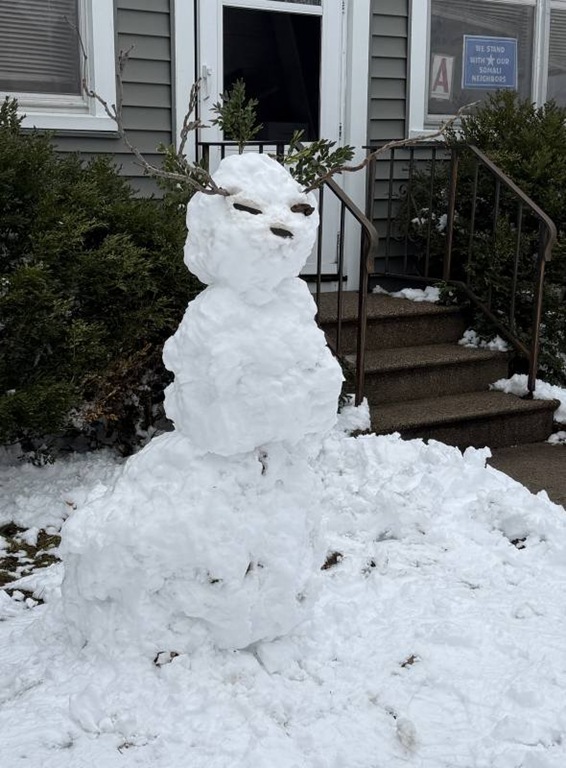
I was able to record those Mellotron parts, but my city was filling with heavy wet snow while I did that.
Authoritarianism of a meteorological kind as it accumulated, but I had another task for Wednesday. My newly inherited 12-year-old car had a worn drive shaft that needed replacing. I was to drop it off at a mechanic’s shop in a nearby suburb, and my wife had set a time to give me a ride back. She wanted to go right away, as the roads were getting worse from the snow. Long story short, what would have normally been a 45-minute round trip turned into over two hours of slow going.
It was later Wednesday evening when I returned to mix the resulting new and old tracks for the song in my home office, and I couldn’t get my home office Mac to light up my computer screen. First thought: a normal glitch, as the Mac sometimes just forgets that it should see the screen, but a restart or a re-plug did nothing. Connecting the monitor to another computer revealed the sad tale: my 15-year-old LCD screen had chosen that night to die.**
And this was a problem. All my mixing software is installed on the computer connected to that dead screen. So, no mixing Wednesday. It occurred to me: maybe the now dark computer monitor decided to go out because it was Ash Wednesday: remember, from silicon dust you came and to silicon dust you’ll return.
Thursday morning I pulled a smaller, lower resolution monitor from my studio space and hooked it up so I could finish this piece.
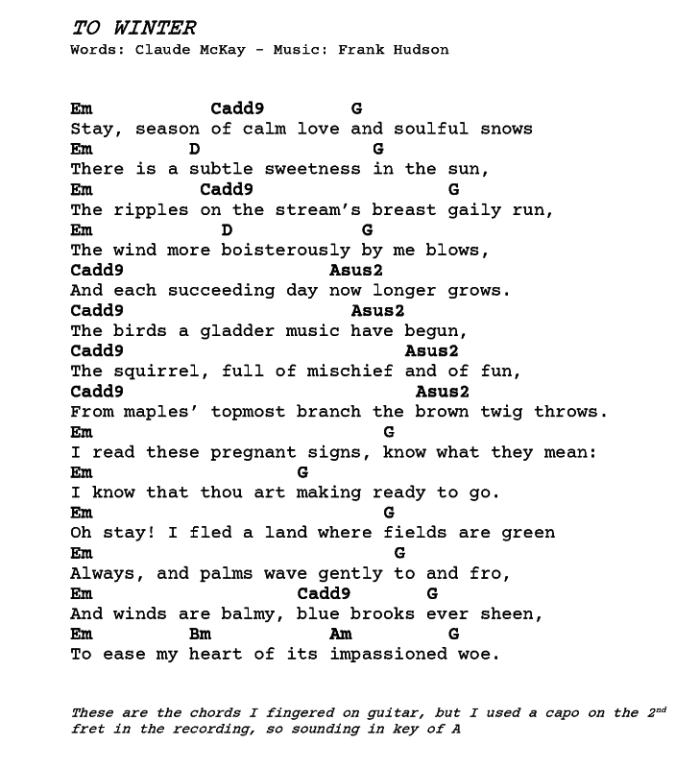
Just as I trust the mechanic to fix my drive shaft, I trust that someone out there can probably sing this song better than I can, so here’s a chord sheet.
.
“To Winter” is Claude McKay considering this very time of the year in the Northern U.S. Days are getting longer, there’s more animal activity, water, once ice, will break and flow. McKay’s poem has a complex reaction to this. He concludes he’s feeling winter inside within the moment of the poem, and finds winter outside permits that mood. Last time, with his “Tired Worker” I found some tension between McKay’s Keats-like language and prosody and the weariness of a 20th century blue-collar laborer. This poem’s my-time-is-like-Keats’-time-may-be-like-some-later-reader’s-21st-century-time choices cause less strain.***
What a wonderous range of coincidences wove into the past few hours. I chose the Mellotron, 19th century orchestral sounds as approximated by mid-20th century technology, mixed on a modern computer whose old LCD monitor left this mortal coil on a snow swirling night at the beginning of the Abrahamic religion’s overlapping spring holy days.
The mechanic has seen to my drive, shaft (“can you dig it”) so that it no longer makes disconsonant noises. I should have a replacement high-resolution computer screen by next week. February snows can be wet and heavy, but to water and mud-luscious they will soon enough go. Crude regimes? I can’t say just myself, but perhaps Carl Sandburg’s “The People, Yes” will increasingly say. So much to repair.
I hope to have a couple more Claude McKay pieces here soon, but to hear this one today, use the audio player below. No audio player to be seen? Mais où sont les neiges d’antan – but I offer this highlighted link as an alternative which will open a new tab with its own audio player.
.
*A virtual instrument contains the modern, much more sophisticated expression of the same idea (the various notes and timbres of a “real” instrument stored as digital recording data instead of one timbre and expression on a strip of magnetic tape for each note pulled along by clockwork springs and levers). My initial attraction to virtual instruments was reading that for only a handful of dollars one could rather precisely “fake the fakery” of the Mellotron without searching out and maintaining a finicky, costly, and increasingly antique instrument.
**The deceased was an HP Compaq LA2405wg model from back when that deleterious merger was fresh. It was a stretch for me to afford then, but in 2010 it was a rare 16:10 1920×1200 display, and I can’t even begin to calculate how many hours I’ve looked at characters and controls on that screen! Everything I’ve ever mixed, every video I’ve ever done, and a lot of writing and research for this Project were done on it.
On the page, and probably in my recorded musical performance, this poem is an odd combination. Here’s a link to the text of Claude McKay’s “The Tired Worker.” Its subject is altogether common: the fatigue of someone who is overtaxed by their job, and a night whose worry and weariness has paradoxically robbed them of enough rest to hope for a better tomorrow. Claude McKay, the author I’m featuring this month, knew these feelings firsthand from the jobs he’d held to support himself as a newly landed US immigrant. I dare say most who read this poem have had nights like this too. As poem subjects go, it’s likely as broadly relatable as love and desire.* McKay doesn’t go into detail what kind of work the poem’s titular subject does – but calling them a “worker” and expressing their experience of tired hands and aching feet would indicate a manual labor or a service job.
And here’s what strikes me (and perhaps you) as odd, encountering this in my 21st century time: the poem is written in flowery, elevated, 19th century language. For a 1920’s worker to speak of their daily lot as if it’s an 1820 poem contemporary with John Keats seems anachronistic. I’m trying to think of what a current equivalent of this would be, and maybe that’s impossible in that we can’t see, as we can with history’s perspective on McKay’s poem, how out-of-place this poem’s language is with the daily language of its worker or worker-reader.**
That this poem was first printed in The Liberator, a radical socialist publication founded and edited by Max Eastman may be one clue. I’ve spent a few hours this week paging through its early 1920’s issues published from within the Greenwich Village progressive ferment of its time.
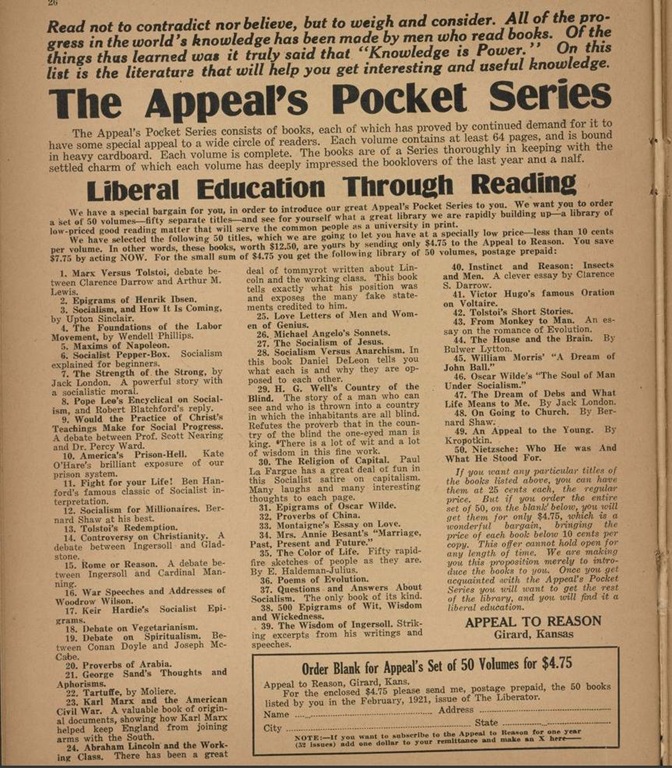
I’ve been fascinated by this scene, partly because I had a shirttail relative Susan Glaspell who was an integral part of it, but also because it was a rich mixture. Political, sexual, and artistic radicalism were literal bedfellows. The Liberator featured a great many ads for political tracts, but also for literary books, and many of latter were low-priced reprints aimed at a bohemian’s or workingman’s budget.
Doomscrolling in the 1920s? Michael Angelo’s Sonnets, Tolstoy, William Morris, Shaw, Voltaire, Wilde, and Nietzsche. Also socialism and the story of what Karl Marx did during the American Civil War. 10-50 cents a piece, or all 50 for $4.75. If one can’t sleep after a long workday, such a TBR pile near your bed could reach out to you.
.
And in between John Reed and Eastman’s first-hand reports from the Russian Soviet Revolution, there was much art and poetry. The art included political/social satire cartoons, illustrations/posters (often in a bold style depicting heroic workers or radicals,) and black and white art depicting nature or the human form. The latter was Modernism of a kind, though I don’t recall much full-fledged abstract works. The famous NYC Armory Modern Art show was nearly a decade past at this point. Carl Sandburg*** had won a Pulitzer in 1919 for his Imagist and free-verse poetry. From the same NYC scene as The Liberator, Others: A Magazine of the New Verse had completed its 4-year run publishing avant garde poetry. Yet, there was much less free-verse in The Liberator than one might expect.
It turns out The Liberator founder/editor Eastman was an early opponent of literary High Modernism. **** If the world and society needed to change, change radically, the old verities of prosody could still serve well to elevate mankind as they strove for that change.
Did Claude McKay feel the same way? I don’t know enough to say. During the early 1920s, he’s listed as an editor on The Liberator’s masthead. Its broad progressive outlook generally supported racial equality, and the NYC Harlem Renaissance and the Greenwich Village scenes overlapped.
Claude McKay and Max Eastman
.
Is that why McKay wrote his worker’s poem this way? There could be more to that choice – he apparently liked the sound of 19th century British verse; and knew how to extract some word-music beauty from it, as I hope examples I’ve performed may show. Perhaps he felt he was expressing his own soul existing within that workday fatigue – he wasn’t some generalized Worker, but his own particular self, Claude McKay, a man taking pride in knowing this part of his received culture. If so, a man, an Afro-American man, could express that dull proletarian grind with the same word-sounds that once extolled Grecian urns and English nightingales.
Yet, there’s a palpable disconnect here, and I was going to perform the song. I decided to just do my best to not linger on its anachronisms, the “O….thou.…wilts” of this poem. Maybe, the combined character speaking here as I performed it in 2026 is a man living in three centuries simultaneously while speaking in the manner of one class while living in the manner of another. McKay may be not so much colonized, as a colony-creature, a siphonophore banding together more than one mind and tongue. As I wrote talking about McKay earlier this month, poets are often, in effect, immigrants or exiles by their natures, souls seeking and divided from the world and nations they find themselves in.
You can hear my musical performance of Claude McKay’s “The Tired Worker” with the audio player you should see below. Has the graphical player gadget said screw-it and called in sick? No, some ways of viewing this blog suppress showing the player, and so I offer this highlighted link that will open a new tab with its own audio player.
.
*Once more I’ll remind readers that I’ve encouraged something I call “The Sandburg Test.” The test is to ask, does at least one poem in any substantial collection of poetry deal with the world of work? If you’re reading a Carl Sandburg collection, the answer will be yes. Other poets? Well, read, and ask yourself.
**The closest I could come up with would be the trope of some Americana artists of adapting decades-older styles of music and lyrics to express modern problems – but most of those borrowed styles are less formal and more-or-less reflect working-class speech of the past times.
****Eastman is a character I don’t have room to go into today. Escaping by the skin of his teeth from the grasp of the first American Red Scare as an editor of The Liberator’s radical forebearer The Masses in 1917 – that magazine was shut down by the federal government and he was arrested, charged, and tried with only a final hung jury keeping him out of prison. His long life saw him continue to resist the rise of obscure Modernist literature, while moving from founding fiery left-wing magazines in the WWI era, to becoming an editor of the Readers Digest during WWII, to contributing to the post-WWII launch of the conservative The National Review. and to at least qualified support for the second great American Red Scare in the 1950s.
Valentine’s Day comes within Black History Month in the United States. Might be coincidence – but when it comes to diverse lyrical depictions of love, desire, heartbreak, and joy-in-connection depicted in song, this would seem appropriate. But this wasn’t always so.
Read on. We’re going to talk about poetry and flowers – well, sort of, and there’s some nasty bottleneck slide guitar at the end of this.
Choosing the poetry of Claude McKay as my Black History Month focus this year, I’d have to deal with some preconceptions of his work. One, his poetry is written in the 19th century style that the Modernist poets I often select for use were all about replacing. I admire that early Modernist outlook, but it’s not required if the older prosody and what it is conveying attracts me. A second factor is that McKay (like many poets that don’t reach the upper levels of The Canon) is only known for one or two poems – poems anthologized enough to be recognized, but also poems misrecognizing the range of his poetry. Another Afro-American example I’ve featured here is Chicago poet Fenton Johnson who is known almost entirely for one poem, the short, bleak, despairing “Tired” that begins “I am tired of building up somebody else’s civilization.” McKay’s equivalent is the defiant sonnet of self-defense “If we must die…” which is a striking, memorable, work – and then there’s one other poem of McKay’s that retains some current readership, his complex and eloquent poem “America.” Despite these old-school accentual syllabic rhyming verse structures and elevated literary language, either of those McKay poems could be read today, in this America, and be understood as vigorous statements about contemporary civic issues – so perhaps there’s nothing wrong with those two being McKay’s representation. They’re not valentines though.
But.
Reading through McKay’s 1922 Harlem Shadows collection and his other 1920s work, I’m struck by how much of his poetry deals with his immigrant status – and then even more: how many are love poems or poems dealing with desire and eros. In the short term, this cost McKay. Long time readers here, or those familiar with American Black history in this era, may remember that the Afro-American cultural and political leadership circa 1920 were all about establishing the sober respectability of Black Americans, and erotic expression was not part of that. This wasn’t just run-of-the-mill prudishness – after all, rape was part of the crimes committed against Black Americans, and also a criminal fear used to trump up racism and violence against Black men. In either case, and beyond abuse, sexuality could be too easily seen as an “animal nature” thing not befitting a safe civic personhood.
So if we take Langston Hughes’ The Weary Blues poetry collection published four years after McKay’s Harlem Shadowsyou’ll see some documentary depictions of nightlife depicted journalistically, and praise for disreputable Jazz music then associated with “loose living” – subjects that were considered edgy enough for The New Negro gatekeepers then – but you won’t see Hughes including a bunch of poems about erotic love.* Harlem Renaissance predecessor Paul Lawrence Dunbar wrote some sentimental love poetry which just might have some subtext,** but it was without the heat of desire. McKay, on the other hand, filled his 1922 book with it.
If he got away with it at all, it was because McKay hid his eros in poetry like that in today’s poem/now song with a hot-house language of flowers and landscapes cloaking the heavy-breathing. I had trouble when labeling my Apple podcasts posting of this song today. Should I click the warning “explicit” or stay with my usual “clean?” Do I have, as my own city’s bard once proclaimed, “A Dirty Mind” to think that this poem is written knowing that flowers are a plant’s sexual organs?*** In the end, I clicked clean, not because the poem isn’t saturated with desire, but because one must read it as a double-entendre to see that. My hope is that any kids that might find it (or its text I’ll link here) will gain research skills of some value, and I won’t go through the lines of the poem and “translate” what I think is being depicted – that’s the last thing kids want to hear an old man speaking of. IYKYK.
One other thing is striking about today’s poem, and much of McKay’s poetry of love and desire: there’s no gender in it. Accounts and accepted evidence vary somewhat, but many who want to determine McKay’s own biographical sexuality think he was bisexual. Given that his poem seems to be set in a diverse flower garden, it might resonate with a variety of ardent lovers as we approach Valentine’s Day.
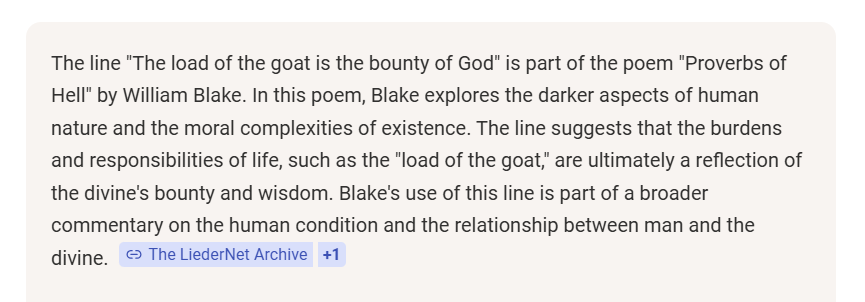
When I tried to type Blake’s “lust of the goat” into a search engine to check the exact wording, I typed something that autocorrected “lust” to “load.” To my amazement AI decided to explicate goat loads of meaning from that typo.
.
Music? One DEI I can’t foreswear is whatever I find myself doing musically, I’ll want to try something else if I see I’m settling into a pattern. So, back into the cases go the acoustic guitars. No spare pianos either. Glass bottleneck on the finger, Telecaster plugged in, and grindstone to the amplifier gain. The lust of the grit is the bounty of God! You can hear that with the audio player below. What, no player gadget? Joys impregnate! Sorrows bring forth! Clicking on this highlighted link will open a new tab with its own audio player!
***McKay came to America to go to an agricultural college, horticultural birds and bees would be a given. Flowers are often represented in his poetry, as much as in gardener-poet Emily Dickinson’s verse.
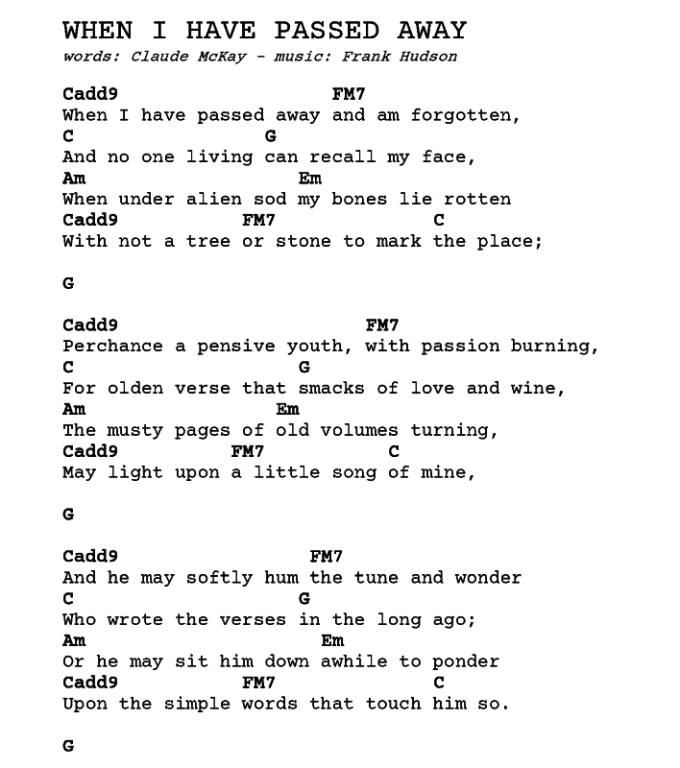
Here’s another short poem by Claude McKay made into a song. In his “When I Have Passed Away” a young poet seems to be imagining his own legacy – a prediction both restrained and hopeful. As in the first poem of this Black History Month series featuring his poetry, McKay will subtly mention two things that are potentially othering his living voice. Within the poem’s first quatrain he writes of a belief that he, the author, will likely be forgotten and uncelebrated. He posits an unmarked grave, which strikes one as a sad conclusion, but I think his second line “And no one living can recall my face” has an element of release. In this obscure future a reader will likely not know his black-skinned face, that instant, contemporaneous, racial stereotyping will have been overthrown by a forgetting time that has discarded his particular self. And as in “The Cities Love,” he will remind us that he’s writing this as an immigrant, who will likely die and be buried away from Jamaica, the country of his childhood, in “alien sod.”
Here’s a chord sheet for today’s song. Somewhat like McKay, it’s my hope that someone else will someday choose to sing some of these Parlando Project songs
.
Let me interject myself into McKay’s story here. I think many, perhaps most, American poets find themselves in a state of exile. Our dominant culture doesn’t greatly care for poetry, and it cares even less for poets than for their art. Yes, I am making a broad generalization, but McKay in his poem seems realistic in his expectations. If we become by choice or exile citizens of poetry, we will speak a different dialect with strange accents, we will be inured to different customs, we will have saints and prophets un-worshiped here. If Claude McKay can realistically expect that – in McKay’s case, it will not be his poetic citizenship that exposes him to common and actively state-sanctioned dangers and discrimination so much as the inherent alienation bestowed upon an immigrant with dark skin.* None-the-less, I write this to point out that McKay the poet might share this smaller, ignored and unvalued, status with other poets too.
McKay’s second quatrain hopes for some distant youth and a surviving dusty volume of verse. Perhaps this youth might be an immigrant from the country of poetry and song who has found themselves a minority in our nation of casual oppression and mercantile investment.
Again, I feel I must appear again here, though I am not exactly what McKay expected. I’m entirely far from young. I read this poem in a scanned e-book – not dusty, though my touch screen had a light scrim of fingerprints over his more than 100-year-old words. When McKay writes of his page poem as a “little song” and implies it has a tune, I’m called to do the Parlando Project thing with it. Here we are then, separate: this young Black immigrant from Jamaica, and this an old white man away from his tiny Iowa town he grew up in – we meet on these simple words of his and, touch – and I find I must hum out a tune for Claude McKay whose name and some little of his life I do know.
You can hear that song with the audio player below. If you don’t see a player, if there’s no tree or stone or html gadget to mark its place, I’ll offer this highlighted link that will open a new first-edition-with-dust-cover browser tab displaying its own audio player.
.
*I think here of Renee Good – killed on the broad avenue across the alley behind the window where I sit writing this – a border-crossing death in a cultural battle where immigrants are the “vermin” from “garbage countries” projected as monstrous invaders to justify thuggery and the decrees of tyrants. As a poet, as she was, no one would have asked for her papers, her hard-won college award for her poetry, even if that made her one who will try to find her way as an immigrant-of-a-sort in the land she was born in. It is also not out of the question that she was executed, at least in part, for her being gay.
It’s Black History Month, and this year I’m planning on presenting a series of musical pieces based on poems by Jamaican-American writer Claude McKay. McKay is often associated with the early 20th century flowering of Afro-American poetry and the arts called “The Harlem Renaissance.” Like some filed under that name, he did live in New York City sometimes – but also like some, he also lived elsewhere. Born and raised in Jamaica, he spent time in Kansas, South Carolina, New Hampshire, England, France, Russia, North Africa, and Chicago.
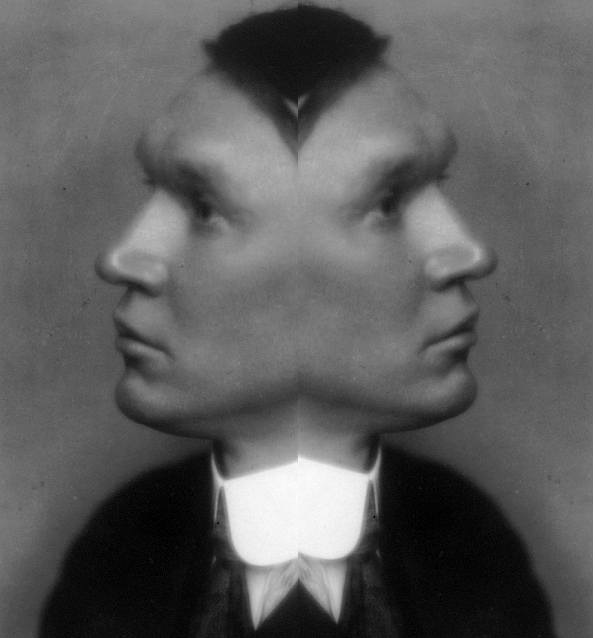
Claude McKay in 1920, shortly after he’d immigrated to the United States
.
Today’s piece, “The City’s Love” is a poem from his inaugural American poetry collection Harlem Shadows published in 1922. It’s a poem written in the voice of an “alien guest,” a situation that McKay would often touch on in his early poems as he contrasted his Jamaican youth with his immigrant experience in the U.S. Given that my America, and in particularly my city, is currently enmeshed in vindictive federal government acts directed at immigrants, I thought this poem would be a good one to start with. Throughout my city and the state of Minnesota, immigrants from many countries are spending days frightened of summary detentions by a poorly led and oft-times violent set of armed troops. These troops seem to have been given orders to just hunt and stop anyone who appears foreign to them, citizen or not, here legally or not.*
McKay’s immigrant situation, his wonders and hopes, his fears and literal alienation, would have had their own particulars. He first landed in Jim Crow era South Carolina, but he also saw the genesis of “The New Negro” in New York City. In the moment of “The City’s Love” his poem presents, the color-line seems bent or broken, and like the Paris of Rimbaud’s dawn, the city seems able to hold him in a love embrace. A beautiful vision, but one he also knows is “strange.”
The conciseness of McKay’s poem also recommended it to me, as I must struggle to get my poetry and music work done these days. I rapidly recorded the vocal and acoustic guitar part, banging out five quick takes of which this is the fifth. Late at night, when even the clicking of a pick on an unplugged electric guitar’s strings might disturb my household, I put on the vibraphone synth patch part and mixed in some simple, low pitched grand piano. Though I just finished mixing it this afternoon, I think this song’s rubato approach works, and you can hear it with the audio player below. No audio player? It hasn’t been detained, some ways of viewing this blog won’t naturalize its presence, so I offer this highlighted link which will open a new tab with its own audio player.
.
*I have to write “seem,” though their directions seem clear thanks to citizens who have taken to following and observing them, but one of the tyrannical elements of this is that the federal leadership is dishonest or secretive in rotation about exactly what the troops orders are, and what they are doing. Early in these actions their targets were claimed to be “The Worst of the Worst” and a handful of mug sheets would be proffered by the Feds of violent criminals – on examination, many/most of whom were found to have been handed over to them at the conclusion of their prison terms by the local authorities. Since then, we cannot know exactly how many have been detained in Minnesota – though the number is in the thousands by various statements and estimates – but there is no official reporting. Outside observers and journalists are responsible for us knowing how commonly citizens and those legally present in the US are detained – but again, there is no accounting of that by this massive and secretive government force, much less any apologies or repercussion for mistaken or baseless detentions, which should shame a republic. “Illegal” status is a matter of federal legal definition with many grey-areas and transitive situations (such as application for asylum – an increasingly lengthy process) and our Mad King has acted to try to change by fiat the status of those previously “legal.”
The recording of this musical version of a short Robert Frost poem somehow was able to slip itself in-between standing watch, comforting, and grieving this month in Minnesota. Increasingly people outside our area are expressing admiration for our fortitude, but inside our local theater of atrocities, I’d say our thoughts and feelings are still a jumble. My aged body has its limits, but I’m trying to support others during this time. Things you might see here? I still find it difficult to integrate these events into the long-ongoing Project.* There’s a great deal of news coverage and analysis being done elsewhere, but during this time you have been spared hundreds of words I’ve written and then not posted, longish things where I sought to add to that. My audience isn’t that large; my remaining skills in prose I’d self-assay as not unique enough to be required. My Parlando Project creative time is constrained both internally by aging and my acute reactions to the present crisis, and externally by limited times when I can use some musical and recording tools.
Yet, somehow, this piece is here today. Does it address the events here this January?** I think it does, at least partially, but first here’s a short account of how it was made.
I’ll skip the details, but the present recording logistics here limits the ways I can record guitars, though guitar is the instrument which I have the most facility with. Electric bass, my “second instrument” is easier. Recording an electric bass by directly plugging into a jack in an audio mixer or interface has long been a best practice for everyone from home recordists to pro studios, and since there are no amp speakers in the chain and a generally inert plank of wood holding the plucked strings, this is near silent in the room and it eliminates microphones capturing unwanted noise. Electric guitar can be recorded the same way, but for some stylistic choices you want the guitar to react to sound coming out of a speaker – and furthermore (for me, anyway) I express things differently when I’m moving air loudly in a room when playing electric guitar. This doesn’t factor into playing bass. So “A Minor Bird” started out with me working out a computer drum pattern and playing a bass line. I created a chord cycle based on the bass line (the reverse of how I often do it) and used a computer piano to create a MIDI piano roll expressing those chords.*** I then edited that MIDI score to get a part that pleased me. I next hacked playing a Hammond B3 organ part myself with my little plastic keyboard, though mercifully, all you will hear are the best bits. The next track was my singing Robert Frost’s words. Each of these steps could be done in the odd hours I could grab, so the song took form in dribs and drabs over a few days. I had intended to overdub an electric guitar solo in the middle, but that time wasn’t there, which leaves the drums/bass/piano trio grooving alone, which might even be addition by subtraction.
This Frost poem is not one of his better-known ones, though published in his 1923 collection New Hampshire, the book that won his initial Pulitzer Prize. The first thing that struck me about it is how modest and unassuming it is: four couplets long, no exotic words, a vignette with two characters: a bird and the poet/speaker. I would almost say that there is no prerequisite reading or coursework needed to understand the poem, but my next thought was that the situation here, poet and a single bird, might be in conversation with other poetry. One could think of other romantic poems of a poet and birdsong – Keats’ “Ode to a Nightingale” for example – but if I was to think of a single poem that Frost is writing his in conversation with, it would be Poe’s “The Raven.” Both poems are set in the context of the faceted emotions of grief/melancholy/depression. Both have the poet wanting the bird to leave, but despite the shortness and plain language of Frost’s poem, there’s room in his short poem for a volta, a turn of thought. Frost never names the species of bird, but by calling it “a minor bird” in his small poem, he’s also explicitly casting the bird’s song as being in a (sad) minor key. The poem’s conclusion is that the calling of grief and sadness should be included in our consciousness.
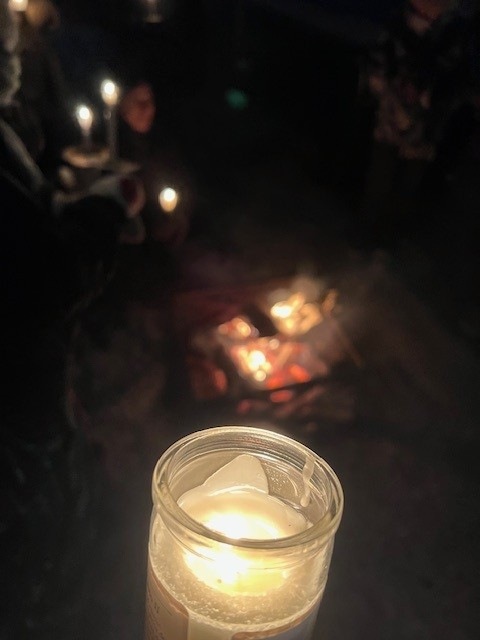
Saturday, after the latest killing of one of the observers who was filming the actions of the Federal troops elsewhere in Minneapolis, other observers in our neighborhood and their families gathered in the below-zero dark on our streetcorner, each of us carrying a candle from our houses.
.
The doorknob where I write this has a lanyard with a whistle. It’s to grab, to take outside in the winter cold and to make our minor sound at anything from the incursion into our city that calls us to flock witnesses too. This state in this country, and this composer and plain singer of Frost’s words, have had their griefs this month. We have chosen not to shoo them away – despite the raptor dread encircling our minor birds, we have not silenced the song.
To hear the performance of Robert Frost’s “A Minor Bird” use the audio player below. No player? Nothing has caused it to withdraw, it’s just that some ways of reading this blog won’t display the player. This highlighted link will open a new tab with its own audio player.
.
*Perhaps I’m an odd duck, but to release art about these events worries part of me that some portion of the artist is seeking to use these largely selfless and unsigned acts of resistance as a platform to promote their work.
I’m not saying you should feel that way! And yes, I am quite aware that conversely some artists and their work have been down-rated, suppressed, and punished due to their art for causes.
My feeling is more akin to the idea that in either case, the thoughts of pros and cons of careerism must be humbled by the everyday bravery and service Minnesotans have shown this month.
**Under what name will this month’s resistance be recorded under? “The Battle of Minneapolis” has already been used for a 20th century labor action. I’m fond of wordplay, but “The Mother Whistlers” is too humorous. “The Minnesota Witnessers?” “The ICE Breakers?” “The iPhone Militia Movement?”
When you listen to the song you can hear below you might doubt me – but it is not a topical song written about recent events. It was written by Parlando alternative voice Dave Moore in 2014. Dave’s the keyboard player and the better singer in the LYL Band, and that same year I recorded us playing it with him singing and pounding the piano, and me squawking in with some backing vocals and skidding guitar. Dave tells me today he was writing the song while caring for his father in the times surrounding his dad’s final illness, and he was thinking of the work of someone that goes even farther back than 2014: the 19th century American Abolitionist and speaker Wendell Phillips. Dave’s father was a preacher and a man of strong principles, but Phillips would take a backseat to no one on standing and speaking for his convictions.
As to Phillips’ convictions (as I’ll do once more before this post is done) I’ll try to be brief – but in considering the refrain in “I’m On Fire” it’s important to note that people, even ones who somewhat agreed with Phillips, noted he was a little off the scale in his fervency whenever talking about injustice. And Phillips’ stand on slavery was not the popular, acceptable opinion when he began to express it. Phillips started his Abolitionist calling knowing full well that another prominent Abolitionist speaker had just escaped being lynched by a mob. Dave’s energy with the piano in today’s piece rightfully reflects how Phillips expressed himself.
The Boston Public Garden memorial to Wendell Phillips. Ice or ICE not visible in this picture.
.
And so it was that Phillips was once asked, “Why are you so fiery all the time Wendell?” Phillips replied “Yes, I’m on fire – because I have mountains of ice before me to melt!” More than a hundred years later, a man who became a U S Senator from Minnesota, Paul Wellstone, liked to remember that Wendell Phillips quote. And Dave Moore, our singer and songwriter remembers Phillips too – he has a long-running cartoon in a neighborhood paper where he often brings out Wendell Phillips quotes to assay our analysis and actions regarding current injustice.
Phillips’ ice metaphor, that cry against intransigent injustice will make it seem like Dave was freshly writing about Immigration and Customs Enforcement (ICE) in Minneapolis today. Once more I’ll be brief, but I have foreign readers here, and they might not know what’s been keeping me from working on this Project much in this new year. The following section has been written and rewritten a half-a-dozen times in the past week, and I’m largely going to surrender to highlights, because those that know and see what I’ve seen this past week are already saturated with the things I might try to describe, and those that have certain other judgements that benefit, comfort, or blind them, likely require more vision correction than I can prescribe.
Our home state of Minnesota is currently suffering an intentionally vindictive armed incursion by secretive forces sent by our mad and ill-tempered ruler, who says, right out, this is his retribution. Yes, this is also ostensibly about immigration regulation enforcement, but this is largely a pretext, as the rules for immigrants are being changed week to week, and the enforcement seems capricious and sloppy. If this was some laudable reform targeting people they tag with rote-repeated epithets of being murders, rapists, and gangsters, you’d expect constant published detail of accomplishment, with hundreds of chapter and verse rap sheets to show their work – yet to a significant degree, no one knows completely who is being taken out of their homes, cars, schools, or workplaces. The point, or the result, is to make a great many feel they could be next, particularly if they object to this, since that’s being a “violent agitator.” These so-called agitators are often standing on sidewalks and street corners in their own neighborhoods, on their own blocks, even on their own doorsteps – or they are at their own shopping sites, schools, or workplaces, armed with but cell phone cameras and whistles to call others similarly “armed” to protect them (somewhat) from the masked squads. Some step forward to try to get the names of those who are being detained (since the secretive authorities do not reliably release those names) and getting near enough to hear that risks their own detention. Their cameras minimize, but do not eliminate the street beat-downs and such that would otherwise occur. “Less lethal” bullets, chemical sprays and grenades also get used. They call some of these actions “targeted,” but the targets seem out of focus. US citizens with accents or too much skin color get grabbed, and if you squint a First Nations citizen can look like one of those foreigners. Gotta be hard to deport a Lakota – where’s the plane to fly too? Maybe they put them on a plane, draw all the window shades, make zoom-zoom engine noises, and then let them off?
Given the poorly trained, ineptly led, error-prone outside troops, and all their quick with the ordinance reflexes, these encounters with cruelty-is-the-point apprehensions aren’t prayer circles. Many locals observing this in their neighborhoods are angry and disgusted and they are shouting out shames and curses.
If you’ve seen reports this past week you’re horribly aware that one of these neighborhood observers was shot at close range in the face and killed in front of their spouse, or you might have seen another raid during which a woman driving on one of the busiest avenues in Minneapolis comes upon a half dozen ICE vehicles blocking the street. Some of the agents wave her to turn off to a side street, then others decide she must be a protestor and break a couple of her car windows and drag her out the vehicle still caught in her seat belt as she wails “I was just trying to get to my doctor’s appointment.”
Well, I live between those two avenues. When urbanists talk of walkable neighborhoods they’re likely not thinking of walk-up atrocities, but this is where I, and my little family, live. I’ may have written too much or too little of these things, and just as with other attempts to write about this experience this week I’m not sure I did an adequate job of it – but no gentle poetry sung today though I have this old song that sounds right. Click the audio player below and let poet/cartoonist/pianist Dave sing his song. No player? It hasn’t been detained, it’s just that some ways of viewing this blog don’t show the player, and this highlighted link will open a new tab so you can hear it.
The month’s name January is derived from Janus, the Roman god of gateways and change, conventionally portrayed as a being with two faces: one looking forward, one backwards. And we have a new year, a place to do that – although this New Year’s Eve, someone revived a quote ascribed to a telegram sent by Dorothy Parker to Robert Benchley on New Year’s Eve 1929: “You come right over here and explain why they are having another year.”
A Roman bust of Janus. You know one of the tough things about having a beard? Trying to trim it symmetrically in a mirror. Now imagine Janus trying to do this.
.
I have a musical piece today, one using words by an unusual Modernist, Vachel Lindsay who published this poem in 1929. Though the poem mentions footprints in the rain, when I read it, I immediately thought of walking or riding my bike in the snows of Minnesota. In the up and back of those trips, often taken in the early morning, I’m conscious of the fresh tracks I’m putting down in the snow – that they are marks of me being there, moving, while I think of this act. On the return leg, I sometimes get the notion to look for my tracks from earlier in the morning. Looking down, I can never find the exact pattern of my treads – more falling snow, or wind, or others tires and feet have obscured them.
“We met ourselves as we came back.” Vachel Lindsay for January
.
What was unusual about Lindsay? This later poem of his wouldn’t look so out-of-place on the page with his contemporaries, but he came to poetry through a long tramp, and several times before WWI he took off as an itinerant on long walking journeys through parts of the United States carrying a sheaf of poems he called “Rhymes To Be Traded For Bread.” To some degree this romantic notion worked, but his breakthrough occurred when he was noted by Poetry, the Chicago-based magazine of the new literary poets. After that, Lindsay became known for public performances of his poems in a boisterous reading style with the energy of waving arms and a booming sing-song vocal cadence that he unapologetically called “Higher Vaudeville.”* Some likened his performances to Jazz, but as I’m made a point of noting in other posts here: in the 1920s that didn’t mean “an art music consumed mostly by connoisseurs,” but a raucous and uninhibited sacrilege. Some recordings of Lindsay exist, but I don’t know how he would have read this particular poem. I decided to do a full Rock quartet setting, and I’m banging a tambourine as I performed his words. You can hear that performance of Lindsay’s “Meeting Ourselves” with the audio player below. No audio player? You don’t need to retrace your tracks, some ways of reading this blog suppress showing the player – but you do want poetry with electric guitar and a guy slapping a tambourine, don’t you? I don’t ask for bread, but you can use this highlighted link which will open a new tab with its own audio player. Want to see the poem on the page or read along? Here’s the link to that.
.
*Lindsay has largely fallen off the literary canon podium, but his hyper-expressive reading style might have traveled via incorporeal and non-literary spirit mode to the more outlandish Slam poets of my lifetime. I’m unaware of any other poets back in the last decade called The Twenties who sought to emulate Lindsay’s controversial style exactly, but live performances of literary poetry, even with music, were not unheard of. Carl Sandburg before he became a published poet, tried to make his living giving lively Chautauqua lectures on the topics of the day, and after his Pulitzer Prize for Chicago Poems, he took to performing folk songs along with his poems at readings. William Butler Yeats, whose poems so sing on the printed page, floated a serious effort to have his poems performed with music, only to receive decidedly mixed reviews for the results. Both of these poets knew Lindsay and had some appreciation for his verse. It might be supposed that by being so outlandish in public, Lindsay allowed them cover for a quieter, but still expressive, poetry performance style.
How about Afro-American poetry performance? In the reverse of his “poems for bread” trade, Lindsay recommended Langston Hughes poetry to others after Hughes, while working as restaurant staff, handed diner Lindsay some of his unpublished verse. Hughes recognized the wider modes of Jazz and Blues ahead of many, and melded it into his poetry. Lindsay’s poetry reading style also referenced extravagant preaching styles, and early Chicago Black Modernist poet Fenton Johnson, a contemporary of Lindsay, put that rhetorical expression into his poetry.
It’s New Year’s Day. Most everyone’s looking forward, but I’m going to double-jump into the past, first to exactly 99 years ago, and then to more than 160 years ago.
I do a lot of stuff from the Modernist era of the first part of the 20th century here at the Parlando Project, but of course not every poet was going all Imagist or Surrealist or whatever new ist was their jam. And one can well note that written poetry in this era still retained a bit of the mass-media or populist strains that are harder to find in our 21st century.* Non-literary-circle people then still might read poetry or write it without taking a stand between Amy Lowell or Ezra Pound.
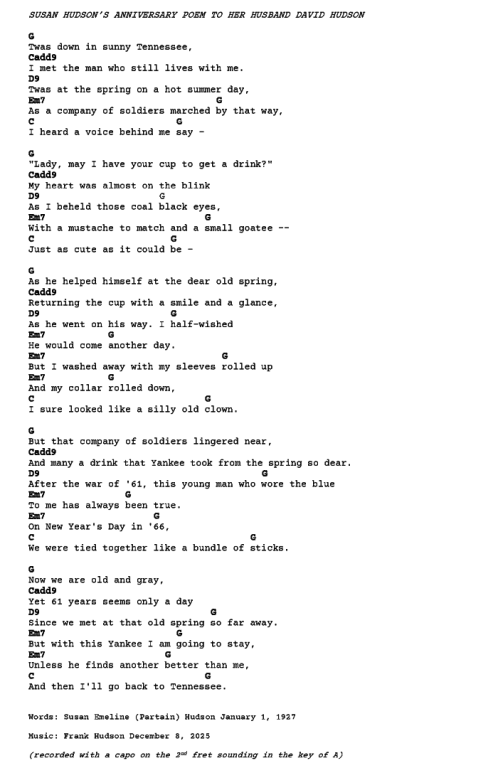
An example: on New Year’s Day in 1927 an 80-year-old woman wrote an anniversary poem to her husband of 61 years. Susan Emeline (Partain) Hudson was my great-great-grandmother, the mother of my great-grandfather for whom I am named. Her New Year’s poem isn’t looking forward much, but then her husband would die later that year, and she would die within two more years. Instead, her poem recounts how the couple met and gives some hints about how they came to settle in Iowa.
Susan Emeline Partain was born in 1847, the daughter of a carpenter who lived in Chattanooga, Tennessee. Tennessee’s stance during the American Civil War over slavery was somewhat unique. It was a slave state, but it joined the Confederacy only after the war broke out – though eventually supplying the second highest number of troops to the retain slavery side.** Yet the state government also officially withdrew from the Confederacy shortly before the end of the war, and this move meant that Tennessee didn’t come under the short-lived era of Reconstruction when the federal government sought to remediate the former slave-holding and secessionist leadership. Tennessee was also the place where the very first WASP-supremacy KKK terrorist group was founded, right at the end of the Civil War.
But I go forth, and here’s the background of the tale Susan Partain Hudson put down. That husband was David Hope Hudson, a young corporal from Ohio who enlisted in the Union Army. His unit was fighting in Tennessee, and involved in some of the bloodiest battles of the war. On and around New Year’s Day 1863 they are engaged in the Battle of Stone’s River. Union forces suffered 32% casualties over 4 days of fighting. For those that aren’t military history nerds, that approaches Charge of the Light Brigade levels of carnage. That summer these Union forces take control of a critical railroad/riverboat center, the town of Chattanooga. Later that year, in the autumn, they are in the battle of Chickamauga as the Northern forces seek to expand their control in that region. Once again, casualties on both sides are terrifying, 28%, and given that 150,000 troops were engaged (counting both sides) it was the second bloodiest battle of the American Civil War to Gettysburg.
Chickamauga was a Union defeat. The forces that included David Hudson had to fall back to Chattanooga. The Confederates, bloodied by the equivalent casualties to the Union at Chickamauga, didn’t press on against the retreating Union army, choosing instead to surround and cutoff the town of Chattanooga. For about a month, the Union army is besieged with no supplies able to get through. Hardtack and salt pork run low, are rationed. And here I need to leave off details, as I haven’t found a detailed account of that month for the Union army troops, or for remaining civilians.***
Susan Partain was a teenager living with her family there, and it’s possible they remained in the town, or at least in the area. Without details, one can only speculate on what things were like for Susan and David during this siege. I’d hold that it’s possible that the cup of water that her poem speaks of was symbolic of more than that, though the poems says the exchange happened in summer and the siege-stage of these battles was in the fall – but clearly this matter is much more risky than a simple flirtation between two young people. Susan’s poem doesn’t give us those details, but her audience – chiefly her husband now near the end of their long-life together – wouldn’t need for that to be said.
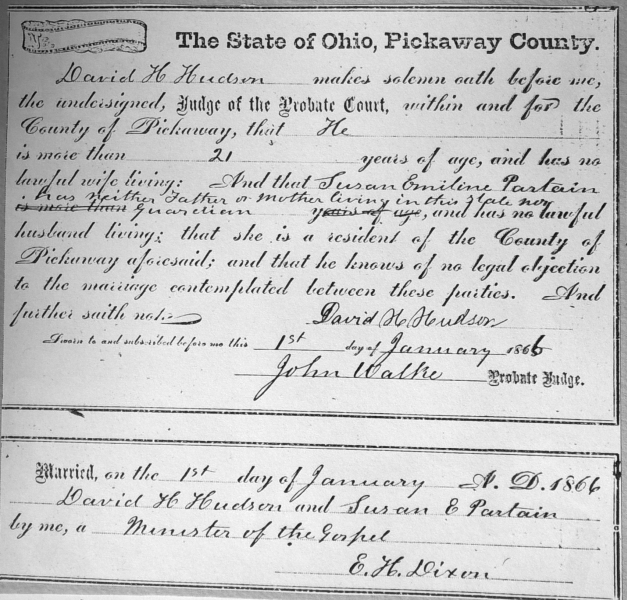
We also don’t know everything Susan’s family felt. Hudson family lore says they might have had Union sympathies, but also that they weren’t supportive of Susan’s romance with the soldier. In the summer of 1865, Susan’s mother died, and that may have broken some constraints for her. David, still stationed in the south, was mustered out in October 1865, and he and Susan eloped off back to Ohio for that New Year’s wedding.
Two things I notice in this marriage certificate: that it may have been necessary to be in another state for Susan to marry without her father’s permission, and that David, or whoever filled out the Jan. 1st date, may have suffered from the still common error of writing 5 first before revising the year with the current 6.
.
Susan never saw nor stayed in contact with any of her family back in Tennessee until 1905, by when many of her elders were likely dead and she wanted to find out what had happened to her siblings. The newly-married Hudsons also didn’t stay in Ohio – Susan was viewed with suspicion there too. The place they chose to raise a family (eventually, 11 kids!) was Iowa, where David got work in a coal mine.
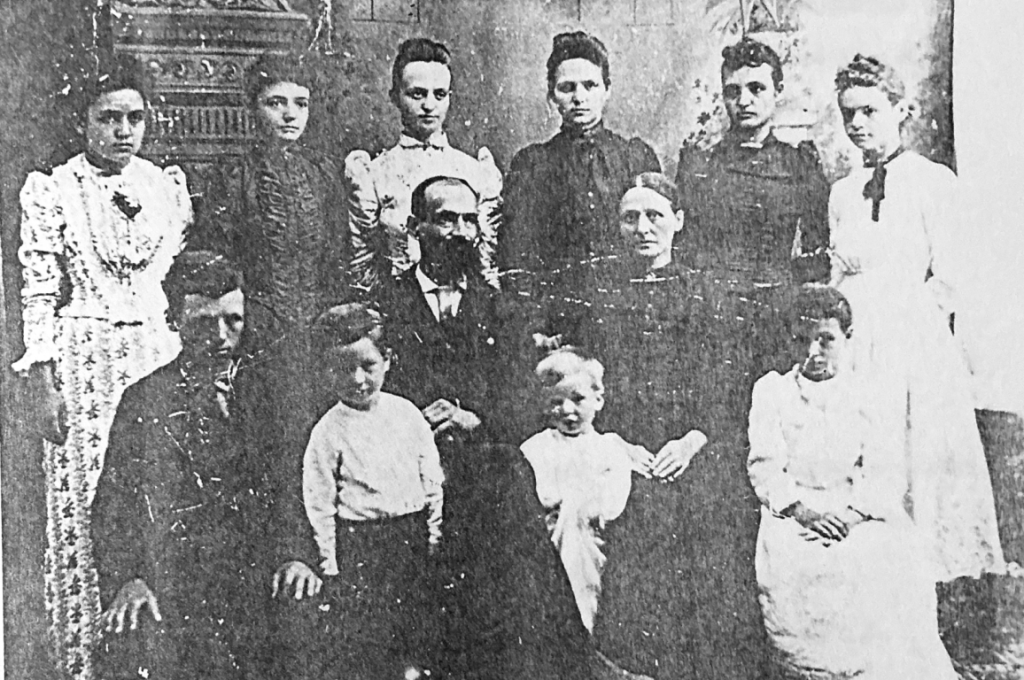
“From Kisses we make mankind:” Dave and Susan Hudson with 10 of their (take that Nigel Tufnel) 11 kids. The tallest boy on the front left is Frank Hudson, my great-grandfather (who looks a lot in this picture like my dad in his younger years).
.
But it’s still a love song – these are my kin, and as Paul Éluard would have it, their kisses helped make me. They married, looking forward on New Years Day 1866. And Susan made this poem that says they celebrated a long life together in 1927 when looking backwards on another New Year’s. Some other little things before I hand you over to the song made with Susan Partain Hudson’s words. Susan mentions being struck by David’s dark moustache and goatee. A few decades ago, I took to that facial landscaping, proximally because I don’t like the irritation of shaving those areas – but who knows, maybe something whispered the idea from some DNA, and my wife only knows me, from the day we met, with that face. And writing poetry? At least one of Susan’s grandsons did too, as I have seen a poem written by my grandfather to my father on his birthday. And the other half of this Project, music? Susan’s family name, Partain, is common in Tennessee. In days when literacy was far from universal, the exact written spelling of a name was not strictly enforced, and a leading spelling variant of Partain is Parton, also commonly found in Tennessee – in particular, with one Dolly Parton. Family genealogies have found no link whatsoever, but that hasn’t stopped me from stretching beyond fact to joke about “Cousin Dolly.” I should also mention that much of what I know about this story comes from work of a later David Hudson, my uncle, who put together information remembered or gathered by other older relatives.
Susan’s poem in chords-sheet form for those who’d like to sing it themselves.
.
I’ll leave it to you how much Tennessee heritage can be found in the song I made from my great-great-grandmother’s poem, but like Dolly I compose a lot on guitar, and I also plucked a little mandolin to frame today’s musical piece. You can hear it with the audio player gadget below. Has any such player eloped from your view? Well then, I offer this highlighted link that will open a new tab with its own audio player.
.
*Today is also Public Domain Day in the US, works first published in 1930 are now freely available for reuse. Each year a couple of places celebrate with a list of the works now freed-up. In previous years I’d gratefully see a handful of poetry collections or poems in those lists. This year? Nothing highlighted in the summaries. I think this is a double reflection. By 1930 both poetry as a mainstream publishing genre and the Modernist revolution have entered a downward slope, and landmark collections of verse are rarer; and for putative readers in 2026, it’s likely understood that only a handful of readers will be looking for poems to gather.
Populist poetry, everything then from newspaper and radio poets, to greeting cards with short verse, to scrapbook keepers, to folks who simply wrote their own verse for themselves/friends/family without any aim of publication – all these are hard to locate in our current year. “Instagram poets” and others who use social media are perhaps something like this past group. Early in this project I suggested that this kind of poetry, even “bad poetry,” wasn’t harmful to literary poetry, that it wasn’t any different than other “high arts” that tolerated examples that were simply vin ordinaire.
**Wikipedia says Tennessee also supplied a relative high number of Union soldiers for a Confederate state.
***The siege was lifted when a couple of Union Generals named Grant and Sherman sent troops to break the Confederate encirclement, but of course there was more fierce fighting around Chattanooga related to that effort.




 Frank Hudson