Continuing my April National Poetry Month observance with another poem from Louis Untermeyer’s between-world-wars anthology Modern American Poetry. This one’s from a better-known poet than last time.
NPM starts with April Fools Day, an outdated holiday since we already had President’s Day in February, and can-you-believe-it outrages are somehow less funny this year. Yet, it’s also the day my late wife and I got married back in the 1980s. Not exactly a golden age back then either, and my wife would explain the decision to get married as a statement of the stubborn optimism of loving fools.
The poet who I’ll sing today published under the name H.D. – a nom de plume that still has a modern vibe for a pioneering Modernist. Maybe someone in our digital screen age will pay tribute by calling a project extending her work “QHD?” Something else that I’d expect might still sound modern is how she came to be a part of the Modernist vanguard that formed in England among a group including Americans living abroad. Hilda Doolittle was a young woman who had a college sweetheart. It appears they planned to get married. That other, a he in the pair, moved to England to meet up with the great Irish poet William Butler Yeats. His name was Ezra Pound. Young Hilda eventually traveled to London to reconnect with Pound.
Somewhere in the passages of boats and time the romance between the two died, for there’s no guarantee that optimistic fools will continue to share the foolish accords of love. Pound was a talker, a planner, a promoter of the kind of modern American poetry Untermeyer would start to collect a few years later in his anthology with that name. Meeting Hilda in London, Ezra hatches a plan for H.D. that’s not marriage.
Looking at a bunch of poems that Hilda had brought with her to England, Pound pronounced them delightful and perfectly modern, an unbidden expression of the new poetry movement he and his little group were promoting. Pound, ever sure of himself (a trait that is dangerous in politicians, but often advantageous in artists*) scribbled at the bottom of Hilda’s poems “H.D. Imagiste.” Later on the Frenchie “e” got dropped and the new English language poetry Modernists were Imagists.
Now, I wasn’t there – chronistically excluded – but if there was a function like social media then I can Imagist a whole lot of takes on this. Manipulating the poor girl! Way to change the subject EP. Patronizing, much?
Well, here’s the unexpected part: H.D.’s poetry was striking. Still is. She could write very compressed short poems, nothing wasted: no dallying narrative story-telling or clearly identified speakers, but the images inside these enigmas so clear and evocative.
In his introduction to H.D. Imagiste in his anthology Untermeyer wrote:
She was the only one who steadfastly held to the letter as well as the spirit of its credo. She was, in fact, the only true Imagist. Her poems are like a set of Tanagra figurines….The effect is chilling – beauty seems held in a frozen gesture. But it is in this very fixation of light, color and emotion that she achieves intensity. What at first seemed static becomes fluent; the arrested moment glows with a quivering tension…. A freely declared passion radiates from lines which are at once ecstatic and austere.
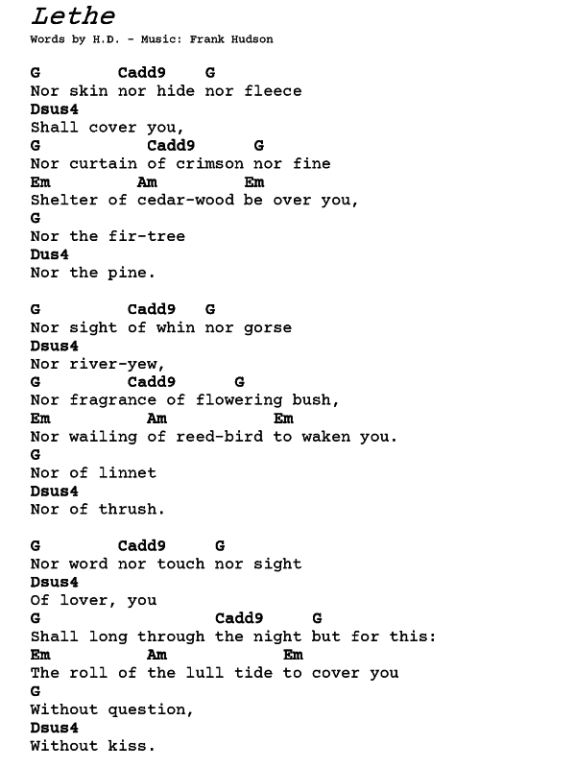
The poem I selected from Untermeyer’s selection is the one called “Lethe,” and it’s a good example of this effect. She leaves interpretive space in this poem: one could read it as a curse or an elegy. Is she decrying the separated lover, wishing upon them even more separation from nature, comforts, and others? Or is she with chilling remorse stating the plain facts of the dead: that they are separated – and we the living, separated too, but able to feel and sing that. Her poem is a sensuous litany of what the dead’s senses will not feel.
Today’s “thimbleberries.” I didn’t know what “whin” mentioned in the poem was. The Internet’s department of tautology department tells me its a variety of the gorse plant.
.
I chose the latter when I performed it – thinking on a day for fools, of marrying to share each other’s foolishness. You can hear that performance of H.D.’s “Lethe” with the audio player gadget below. What, you can’t hear the no wailing of reed-bird to waken you? Some ways of viewing this blog suppress showing the audio player, so I offer this highlighted link that will open a new tab with its own audio player.
.
*Ezra Pound’s confidence did extend to politics. Alas – to say the least.
April is U.S. National Poetry Month, and this year I’m going to focus on poems found within an in-between-the-World-Wars anthology titled Modern American Poetry, edited by Louis Untermeyer. It’s a book that might have been assigned when my parents were in college, filled largely with poets that were born in the vicinity of the turn of the 20th century. I don’t know enough to comment on Untermeyer’s taste in selecting his early 20th century poets, but he seems to have interests in some areas that overlap my own: early Modernism,* humor, and poetry with proletarian and gothic themes. I assume there’s at least a trace of literary log-rolling in the selection of some of the less-well-known poets in the book, but in the short essays that he writes to introduce each poet Untermeyer often finds room for sharp critical comments – this to me is evidence of a fair-minded attempt to get his time’s consensus consideration of American poetry since Whitman and Dickinson.
My plan (to the degree that my life allows plans, which is arguable) is to present around 10 poems from the hundreds in Untermeyer’s thick book. I expect one or two will be “poetry’s greatest hits” that I haven’t otherwise gotten around to, and others will be unknown poems by little-known poets. Long time readers may recall a statement I’ve taken to calling Donald Hall’s Law. That poet, a prize-winner, once wrote: “Most poets, even prize-winning ones, will be forgotten 40 years after they die.” Modern American Poetry went through 6 editions between 1919 and 1942, and from a quick look, the last of the included authors died in the 1980s, and so are subject and evidence to that law. Will my efforts and your attention amend Donald Hall’s Law? Slim chance, but I enjoy sporting with its iron rule. Once some pressman ran these pages through their oily machinery, they pressed a democracy between the boards – and so, next to your Wallace Stevens and Robert Frosts, there’s the someone elses who led a life, observed it, did their best to craft some poem to convey that.
And here’s the first of those: George Dillon. Know the name? Know their poetry? This isn’t a test – I didn’t. Some reading this are likely living poets,** and you might have careerist moments in some early AM hours once the muse has worn off. Are you submitting enough, and to the right places? Did you do enough to promote your collection? Are you behind in your social media or correspondence? And while you never think this one yourself, you might still think someone else is thinking “Who do I have to sleep with to gain some traction?”
I’ve reached a age. I look at Donald Hall’s Law and am strangely comforted. I don’t need to be encouraged in dream-stoking stories about poets who achieved lasting fame. I seek out instead stories that say someone else was once here, wrote a little, and I can find them, find some pleasure in a poem or two, and say: that’s enough, or better than some other human clap trap we had no choice in hearing.
And so we have George Dillon. He made it into Untermeyer’s anthology, slotted between Robert Penn Warren and Kenneth Patchen. He was an editor at Poetry Magazine for over a decade! He won a Pulitzer Prize for his 1931 poetry collection! He and Edna St. Vincent Millay were lovers!
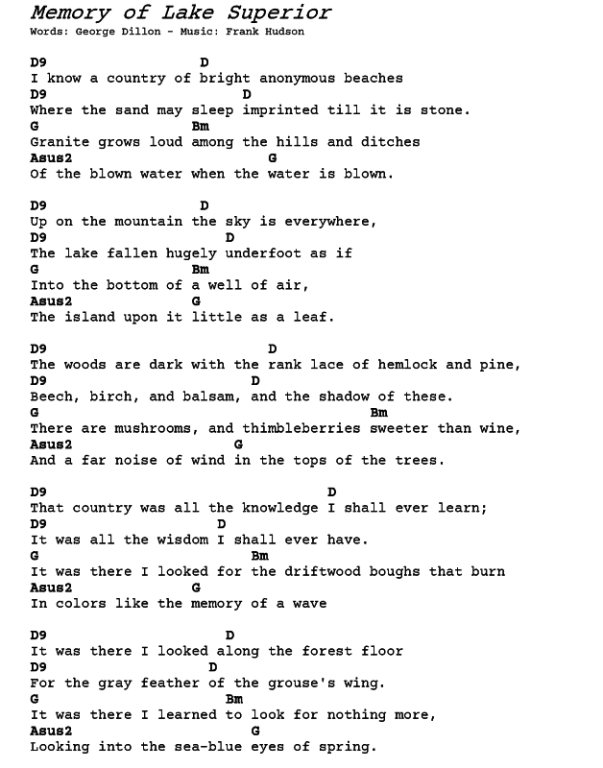
Chord sheets like this one might encourage you to sing this poem too.
.
I said Untermeyer could be toughly critical even of those he included. Here’s the end of his introduction to the selections of Dillon’s poetry in the anthology:
His defect is his fluency; he is sure of his craftsmanship, a little too sure. The subject-matter is conventional to the point of being stereotyped and the tone in the sonnets is a shade too pompous. Yet the verse is unusually flexible and few will question his gift of song.”
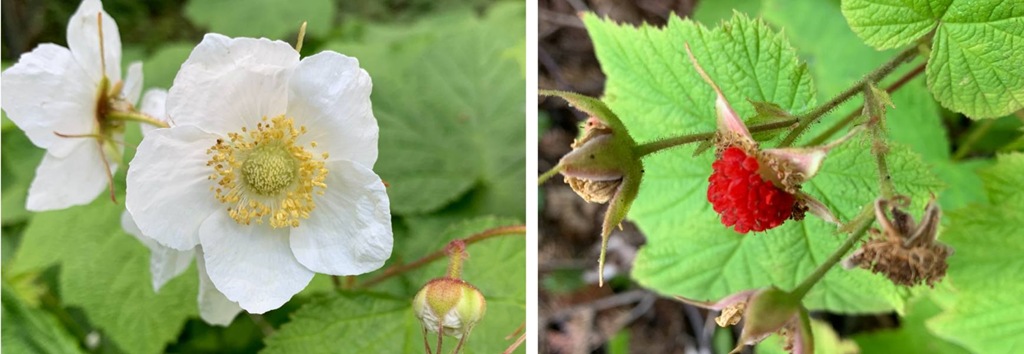
Fair enough. When I look through a collection seeking something to use here “gift of song” is going to attract me. And there’s another factor. The title of the poem I set to music is “Memory of Lake Superior.” My late wife lived in Duluth for a while; we both loved the north shore of that Greatest Lake. My living wife too hikes there even as I’ve become too old for long walks. Besides the “words that want to break into a song” effect, Dillon’s poem is well observed: the famous red-brown sandstone, the fungal debris on the forest floors. My wife tells me*** that the thimbleberries there that Dillon mentions “have larger flowers than razzberries.” It’s National Poetry Month, sure, but I thought leading off with a Spring poem with home field advantage would be appropriate.
Thimbleberries, their flower, their berry.
.
You can hear Dillon’s “Memory of Lake Superior” with the audio player below. Are you asking, “Has Donald Hall hidden the player to enforce his law?” No, just some ways of viewing the blog won’t show the player gadget, and so I offer this highlighted link that will open a new tab with its own audio player.
.
.
*My initial interest in the early American Modernist era was fed by having a relative (Susan Glaspell) who was part of it, but the practical aspect of having work from 1930 back being in public domain and free for unrestrained reuse makes this era primary for poetic texts to combine with music here. Though the bulk of Untermeyer’s anthology republishes work from before 1930, I am using a later edition, and it’s possible a few of the works may be borderline: e.g. Dillon’s poem is obscure enough to not have an easily findable date of first publication.
**Dead poets reading here have damnably low engagement scores, and Ouija board planchettes never click links or hit “like.”
***Again, living wife – though a ghostly partner who whispers woodland lore to me from the undiscovered country would have a certain gothic charm.
I’ve told some folks that I’m working on Emily Dickinson’s “No Kings” piece this week. Now, that’s hardly true. There is a king in this poem and he doesn’t come off so well in its telling; but there’s a naïve maiden too, and Emily’s going to paint her as much a fool as the pompous potentate.
If much has been made about the use of hymn meter in Dickinson’s verse and connections there to her skeptical view of conventional religion, plot-wise this poem takes its tale from an extremely common folk and folk-broadside trope: the foolish maiden. In countless variations some man of high-degree dallies with a young woman of the common folk, and it usually doesn’t turn out well for the girl.* In the best of it, he’s a cad and leaves her; in the worst, there’s murder most foul in the offing. Many folk songs, including those in this grouping, open with it being a Spring morning. Springtime promises, it seems, aren’t to be trusted the voice of folk music says.
I’m not scholar enough to tell how many such songs Emily Dickinson knew, but they were highly common in her time, and I suspect she was using that folk-music plot here to make her point about what life promises us, and about trusting kings.
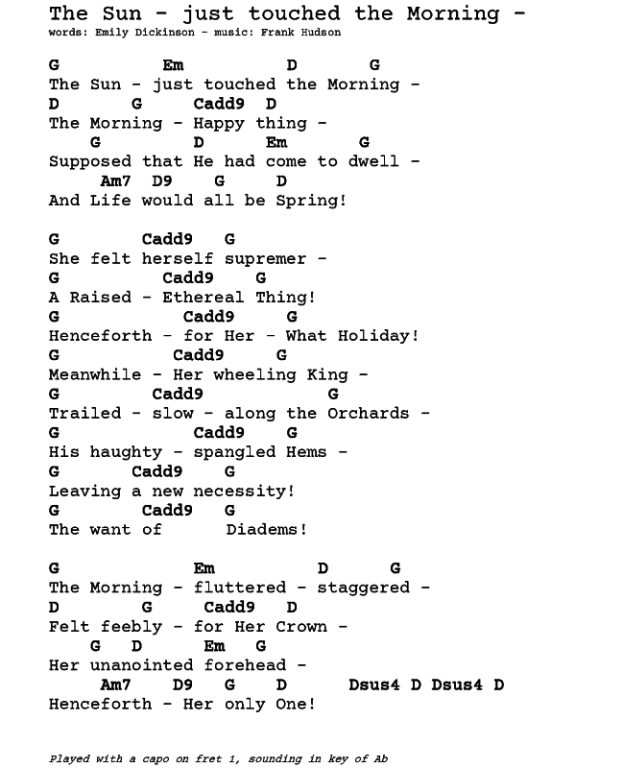
Here’s a chord sheet to assist if you’d like to sing this in your parlor. I like the sound of 9th chords, but they were chosen here to ease my fingering on guitar and can likely be simplified if that suits other players.
.
In “The Sun – just touched the Morning” we have the morning herself playing the foolish maiden and the sun is the sun king who likely believes that when you’re a king they just let you grab it. The sun, as we might guess, soon has to be moving on doing important stuff like making dew into a passing mock-up of glittering jewels, but Morning thinks she is to be his queen. Dickinson reports Morning trying to act like the imperial Sun, crowned with a dew-drop diadem: “She felt herself supremer – A Raised – Ethereal Thing!”
Dickinson knows how this comes out: there’s no crown on offer, no coronation. Some divine right will not tell us who is right, honorable, reciprocal, or trustworthy – that will be up to our “unanointed foreheads.”
So it is: hymns generally tell us how to live right, how to praise a beyond-human perspective, while folk songs take on the task of telling us not to be a fool.
As I composed this, I tried to use a 19th century popular song kind of feel, but ended up being enticed by rock quartet instrumentation with a chiming electric guitar element. If I was to do another version, I might lean more into parlor instruments – but this’ll have to do for now, for we have present business with kings we refuse to allow.
You can hear this song version of Emily Dickinson’s “The Sun – just touched the Morning” with the audio player below. What? Has the king refused to fund any such audio player? No, it’s just that some ways of reading this blog won’t show the player, and I offer this highlighted link which will open a new tab with its own audio player so you can hear it.
This Saturday in Minnesota was marvelous. We already go a little crazy when the temps reach 50 degrees Fahrenheit – there are always folks out in shorts and short sleaves as soon at the bulb’s red rise tips over 49 degrees, but Saturday my thermometer read 79 degrees by the afternoon, and everyone that could was outside. Walkers were everywhere, and if they had dogs, they had a shared happiness. The smaller crew of hardy bicyclists I see within Winter were joined by a fresh multitude of carefree riders in summer attire coursing through the city. I myself rode to a place a block or so away from my wife’s apartment when we were courting, and there I had a double scoop of ice cream which I ate sitting on a bench outside soaking up the sun.
I’m feeling my age as more than just an additional year in 2026, but to be old or young or anywhere in-between in such a Minnesota day induces a feeling of specialness. Perhaps for the young the coming spring and summer can have an interval long enough to induce boredom, a sense of regular expectable warmth, and a dispensable ease of adventure – but to be old is to know the shortness of things.
Sunday returned to gray skies and an ordinary chilliness. Saturday seemed like a dream. Spring and Summer are still promises, more sure than many human promises in this corrupted world, but promises still.
All that dilly-dallying with ice cream delayed me completing making a song from this Edna St. Vincent Millay sonnet. Earlier this month I was saying Millay wrote complex love poems. Well, she wrote complex Spring poems too. The sonnet I was working with is one of the Spring ones, but like her apostrophe poem from earlier this month speaking to mankind, this time it’s an apostrophe to the season. It’s an intimate dialog with elements of greetings to Spring, but as that season arrives, the poem tells us it also knows it will depart.
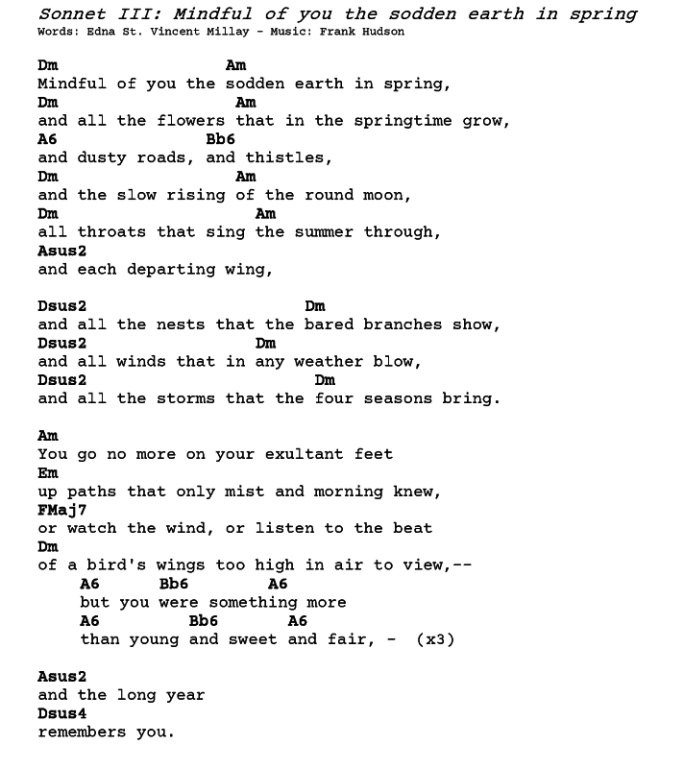
I’ve found that Millay’s poems often improve with performance. While not exactly a slam poet with planned-in applause lines, Millay’s language (even with its touch of archaic poetic diction) has a pleasing sound, and near rhyme and rhyme add a sensuous chime to the lines. It really is one of those poems that ask to be sung. That said, I found myself modifying Millay’s line breaks as I set it to music. The chord sheet version I provide today can be compared to this link of the printed text to see how I adapted it. I also added a refrain again.
Some less common chords in this one, but I offer these chord sheets in hopes that other singers will try these songs out.
.
One last thing developed from the poem as I did this work: the poem, ostensibly addressing Spring, may be speaking also to the passing youth of the poet, and the line I chose to refrain is repeated to bring forward that which I felt on that extraordinary warm Saturday when I performed Millay’s poem, that we can cherish (and be considered) being more than young and sweet and fair. We all live as promises.
To hear that performance of Millay’s sonnet you can use the audio player gadget below. No audio player seen? That throat isn’t gone on departed wing, it’s just some ways of reading this blog suppress showing it, and so I also offerthis highlighted link that will open a new tab with its own audio player.
Are we through with Irish poets? No. Is there going to be less politics this time. Well, sort of. This Project’s goals were not to provide political commentary – the Internet has plenty of that in all varieties – but I’m beginning to have some appreciation for what a hero of mine Carl Sandburg said when asked about his radical politics while already at risk because of his is-this-really-poetry free verse, he answered that politics must find its way into his poetry, in that it was part of him, surrounding him and his times.
So, here’s a poem by Irish poet William Butler Yeats about being weary of politics – yet, he couldn’t avoid it, it was part of him and part of his times too. This poem’s weariness elicits a short catalog of international political issues that he thought of while exclaiming he’s not wishing to think of them. It’s also an old man’s poem, written near the end of Yeats’ life, when he was in his seventies. I’m older than Yeats was when he wrote this, but I too can see what old men do with the weapons of political power so discordant from the Spring that still exists and says we are not here to be the last ones living, but to be as the first ones. Here’s a link to the text of Yeats’ poem, “Politics,” and it’s an interesting link for more than just a reference to the text.
Let me delay you just a bit from listening to the song I made from Yeats’ verse to speak a little about its making. My household this year has become a haven for a small group of young people going through living as if they’re the first ones. Mostly, I try to stay out of their way, but their hustle and bustle in this house complicates the process of creating these pieces you read and listen to here. In these days, I remind myself of the musicians and composers’ prayer: “May music find a way.”
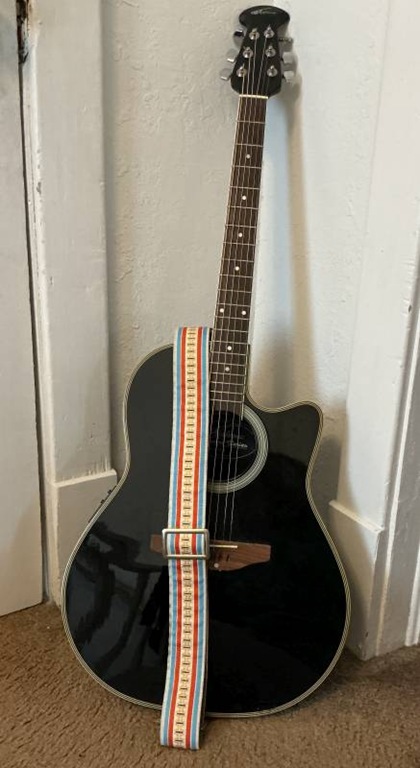
Unable to use one of my good acoustic guitars in my studio space, which I would normally record with a sensitive microphone, I decided to realize the song I had made using a guitar I keep in my home office. It’s an Ovation Applause, a battered old thing, designed as an experiment in making a cheap instrument out of materials thought unmusical.* The body is plastic with plywood, and the neck doesn’t seem to be made from wood (other than the fretboard facing).** Before I bought it used decades ago, my Ovation suffered from a fall or other accident as a lower edge has shattered and there’s a spiderweb of fine cracks extending from the site of that blow. For the past few years this guitar has been stuck in a rack out in the open in my home office because there’s little or nothing in it that could be damaged by the dry winter air there.
Many serious acoustic guitar players make something of a fetish around the woods and construction details of their instruments. It’s not just rosewood, it’s Brazilian rosewood. Sapele isn’t really mahogany, and don’t let them tell you otherwise. Spruce, sure, but from what forest region? Did they use old-school hide glue to assemble it and nitro lacquer to finish it?
This guitar is in opposition to all that: certainly the familiar of a heretic.
So, how’s it sound? Let’s give the witchfinder their due – not to put to fine a point on it, it sounds like crap. If you want richness of sound, this is poverty. There might be some value in its current role: a tool to compose on. That mystery neck has stayed stable all these years, it’s still easy to fret. And its sparce sound would keep one from being to enamored of a something that sounds pretty without having anything beyond its timbre to recommend it – but I’m not sure I’d go that far: it was even more inexpensive being used and damaged, I have it, it’s a hardy thing, and its small size makes it easier to play sitting in an office chair.
It’s looks legitimate & peaceful sitting there, but what might it summon with its tinny horn?
.
And one night this month, I had an inconvenient time to record a realization of a fine poem by the famous Irish poet Yeats. Yeats got a Nobel literature prize. Yeats became a Senator when his country achieved independence. Yeats is so honored in Ireland, a poem of his is on their passports. Yet, I played my song version of Yeats on an old battered guitar, its cheapness designed in.
And you know, I appreciate a good sounding acoustic guitar. Those folks in thrall to the details aren’t imagining things. But then my singing voice isn’t a finely crafted instrument either, and I’m asserting I can express something of the essence of Yeats’ poem anyway. You can hear it with the audio player below. No player? Has that old wizard Yeats summoned the devil to fly from the shuttered Ovation Connecticut factory with Hartford’s Mark Twain and Wallace Stevens riding with his hoard to take that audio player from you? No, it’s likely just a matter of some ways of reading this blog choosing to not show the player gadget. This highlighted link will open a new tab with its own audio player.
.
*The Ovation brand still exists, a shadow of itself, having been haunted through a series of owners. The plastic bowl-shaped back – though often paired with much better sounding other components than my low-end example – is still controversial. In its glory days, Ovation was well-known for pioneering under-saddle acoustic guitar pickups. They were so preeminent there, that in the last quarter of the 20th century if you were to see a popular guitarist in concert in any sort of larger venue playing acoustic guitar, you’d be more than likely to see them playing an Ovation guitar that looks remarkably like my more lowly example.
Eventually other manufacturers caught up with their own acoustic guitar pickup systems, eclipsing Ovation’s USP. Come the 21st century, the New Hartford Connecticut Ovation headquarters and factory, home to these innovations, was closed.
**At least some early Applause models used aluminum necks. I can’t say for sure what’s under the black paint of mine, but it sure isn’t wood.
Here’s a poem that I’ve turned into a song for my second post honoring two Irish-American poets who led a St. Patrick’s Day poetry reading in Minnesota for several years before their death. Of the two, Ethna McKiernan had more direct ties to Ireland, having spent some time living in Dublin, and then in Minnesota running an Irish book and music arts store in the Twin Cities for many years.
For a part of those years I was acquainted with Ethna through the Lake Street Writer’s Group,* where a small group of poets shared works in progress and discussed on the side our lives and outlooks. When I look back on those years, I miss those writers, but I also fear I was inappropriate in critiquing their work, particularly Ethna. My style in that sort of thing tended to be highly detailed (picky might be a word), and even if I would lengthen my responses to their work in progress with “you could consider this or that alternative” because I believed in an honest “test reader” response without claiming to having some reliable recipe for a successful poem, or authority to ask them to change anything. That claim, that belief, should have opened me up to considering “so why then bother them (or myself) with these suggestions or reactions?” I have no academic training in poetry (Ethna did) and in my late twenties I gave up working at submitting for publication. Ethna did publish. She and Kevin each had several book-length collections as well as the usual small-press acceptances. All this would testify that whatever I thought about poetry’s workings, those ideas were unlikely to be commercially helpful.
Well, you can’t apologize to the dead. They either know better or not at all. I meant well, and I could be amazed by Ethna’s best poems. So, here’s to letting you know about their work here, which I hope is a pleasure for you. And if you would like more of that pleasure, Ethna’s last book, a new and selected collection finished as she was in her final illness, is available here from her Irish publisher.
I think I heard Ethna read today’s poem selection, “The Day My Mother Gave Me Away to the Tinkers,” more than once, including at one of those annual St. Patrick’s Day public readings, where it’s an apt choice, what with its Dublin setting. Before reading it, Ethna would instruct the listeners that, just as with many people of our shared generation,** her mother had issued the threat inside the poem’s title in jest, at worst during momentary frustration; and that the subject of her poem was but her teenage mind thinking in response “Well, I’ll take her up and that, and then she’ll be sorry.”
What else do I want you to know before you hear my song performance of this poem? First, for practicalities sake, there’s a man singing this mother-daughter poem. That might be a detriment. Otherwise? I made a mistake singing the name of a baker mentioned in the poem, Johnston Mooney and O’Brien. I dropped the “Johnston,” but at first figured no one would care, that it must be just some immaterial tiny particular bakery – but it turns out that firm is a famous and long-standing Irish baking concern, Oh well. I hope you enjoy the song anyway.
Forgot the “Johnston?” Never darken (or spread jam on) my doorsteps again!
.
You can hear it with the audio player gadget below. Has any such audio player disappeared? No, the gadget’s mother hasn’t given it away, it’s just that some ways of viewing the blog must want the audio player to not be seen (or heard) – and so I offer this highlighted link that’ll open a new tab with its own audio player.
.
*Alternative voice here Dave Moore, and our other St. Patrick’s Day poet Kevin FitzPatrick, were principals of the Lake Street Writers Group.
**My own mid-century mother had her variation of this “give you away” phrase, and but seven kids to test her patience.
Two Minnesota-based Irish-American poets who Dave Moore and I knew and worked with (Kevin FitzPatrick and Ethna McKiernan) used to give an annual St. Patrick’s Day poetry reading in the Twin Cities, a tradition that was ended by their final illnesses and death a few years back. It’s occurred to me that I can carry on that tradition here, so, let’s do that. I’ll start with one of Kevin’s poems.
Kevin’s poems are often parables. He’ll tell a story, most often using simple, off-hand language, though that story may encounter unexpected jumps. A bit of dry humor will often stop by. From working on and talking about poetry with Kevin I learned about the craft and intent in his language. The poems rhythm, sequence, and word-choice were honed – what seemed casual was thought out, and being able to see many of his poems move from earlier drafts to final versions, I’d see Kevin’s poems ending up working like good, even more highly compressed short stories. Like Joyce in Dubliners, the mundane and the particular are a setting in which to find an epiphany.
Here’s a poem, “Two Cities,” from one of his earlier collections, 1987’s On the Corner. It’s set distinctly in Minnesota’s Twin Cities (Minneapolis and St. Paul). These are two, barely fraternal twins. Minneapolis: larger, traditionally more Protestant (its early civic leaders were often New England WASPs) including a strain of tony liberal Republicans that have all but disappeared. St. Paul, more Roman Catholic, smaller, less seated with secular high-culture institutions, a stronger union town. Though not identical twins, they are cojoined, their borders entirely coincident.
Kevin starts this poem with a tiny, vague head fake about an empty pole, and then drives right into one of the borders. Is it real, even if no one cares to maintain the sign? There are certainly different governments as he shows us in an efficient aside, different even to something as central as time zones. Some residents think the differences in the two town’s citizens are strong, shown in the dive bar anecdote that had me laughing again as I re-read the poem.
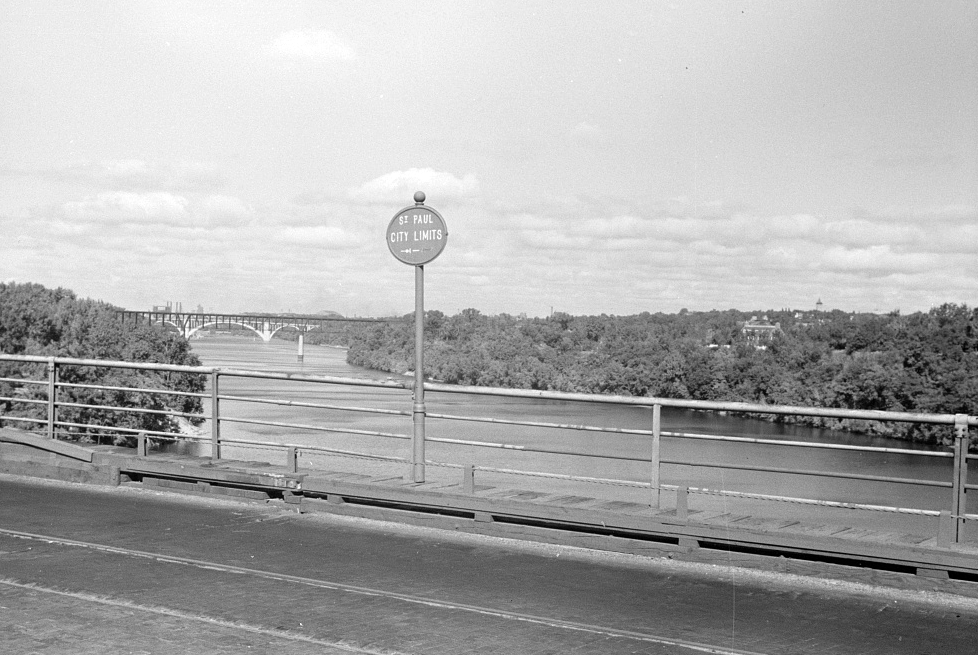
The Lake Street Bridge in the mid-20th century at its St. Paul border. I can’t find a picture of the missing bi-directional sign FitzPatrick writes of in the poem
.
He wraps his poem up with another character – and Kevin’s poems are full of characters. Unlike the typically solipsistic modern poem, he casts voices that ask us to consider something/someone else. How quickly Kevin draws him! “Jim” is a military man’s son, not a stay-put native who thinks his birthplace tells who someone is. Perhaps too, from the nature of his family business, he knows the violence that maintains borders more than chipped signs. And “Jim” gets the last word, or rather a last hope: that we can rise above things like borders, see ourselves as ourselves, not as cliches of birth or origin, bound by imaginary map-kept lines.
Is Jim the fool for his hope, when even two neighboring cities in the same state can divide themselves up with rough and ready human pattern matching? The poem sits between those alternatives. By bringing it up, the poem, the poet, asks us to decide.
So, a parable. Yes, its detail is about two cities Kevin and I lived and worked in for several decades. Yes, I’m remembering Kevin for a national culture observance, and remain here, after him – honoring, as it happens, poets with an Irish background. But I write this winter in a time when immigrants are held in a bureaucracy with cruel penalties and moving/sign-less lines. And with wars now too, where the lines of governments are crossed by a mad emperor. Kevin FitzPatrick’s poem reminds us, we all make ourselves (people, towns, nations) what we are, and we might waste our time making someone else what we think they are.
I performed the poem, reading it, to the best of my ability, as I think Kevin might have. I did add one of my “inline epigraphs” to the poem’s text, a line from a song that you’ll hear at the end. Musically I once more unleashed my company of electric guitars, though the Telecaster solo in the middle got caught out by someone’s arrival that meant that would be the last take. While I’m a guitar cosmopolitan, there is something special available from a Telecaster when it and an amp mesh up. You can hear this performance with an audio player you should see below. Has it disappeared like that border sign? No, it just that some ways to view this blog will 86 showing the player, and so this highlighted alternative link is your asylum, able to open a new tab with its own audio player.
Did I promise an upcoming, complicated, love poem from Edna St. Vincent Millay last time? Well, let me deliver that.
This poem is one that taunted me to sing it as I read through several dozen Millay poems early this month. Millay chooses rich yet strange images in it, the poem’s erotic mood includes complex uncommon elements within its lyrical account of two consciousnesses which have met and are about to separate, and that makes me think of other songs I admire. Its splendor in an alienated nighttime moment makes me think of “Visions of Johanna,” while it’s notes of respect beside begone absence makes me think Dylan’s suite of songs within Blood On the Tracks. And Millay’s choice of images here verge toward the surreal enough to think of Robyn Hitchcock as I worked out the music and performance you can hear below.
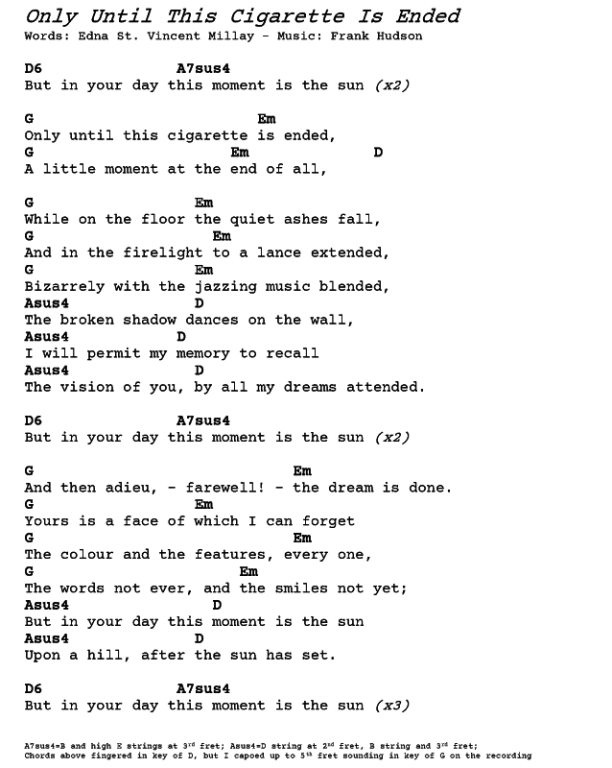
I chose to leave this chord sheet showing the chord forms I fretted on a standard-tuned guitar, even though the recording sounds in a different key due to my use of a capo. This is an easy song to play on guitar, even strummed rather than using my cross-picked arpeggio playing style, and I wish to encourage others to sing these Parlando Project songs.
.
I choose one lyrical change as I made the poem into a song: I decided to create a refrain out of one of its lines. I’m personally OK with songs that eschew choruses and refrains, and a great many poems taken down word-for-word as song lyrics will not have that element that’s increasingly prominent in popular songwriting. This choice brings forward that two-consciousnesses element. The poem has the poem’s voice (for simplicity, I’ll call that voice Millay’s) speaking what we’d call these days “her truth.” Though the poem is compressed into a lyric moment, that truth is that there’s been a pleasant enough erotic event between two people, but that Millay knew, or has decided, that that’s enough and this will not be an ongoing erotic bond. For a woman to publicly write this over a hundred years ago was striking – this poem’s honesty is precedent to those more contemporary expressions.
But the poem is more than precedent, let me linger on the images, starting with the titular cigarette, that quick and casual tube of tobacco. Rather than fade into Millay’s century ago, this reader (now singer) is drawn back half-that interval to when he, and most in his circle, were smokers. For Millay the cigarette would’ve been a somewhat modern signifier – and one without the more lingering girth of the cigar or the apparatus of pipe smoking – but for me, I was drawn back to what I tried to explain to my wife yesterday was my youthful erotic imprinting on cigarettes. My thoughts were not the trope of the post-prandial smoke after a buffet of lovemaking (something I never chose to do) but on the smell and taste of tobacco about the lover’s body. To younger moderns, disdainful of my evoking that, I’d try to explain that a common sharing of certain oils and ash on our skin and lips was kind of intimate comingled pyre. Millay doesn’t explicitly evoke that – I think the modern briefness and offhand casualness was her intent, but she portrays another image I think here that is specific to cigarettes in my memory” a well-packed, factory made, Modernist for Millay, cigarette can produce a lengthy ash as it’s smoked. I can still recall one college literature professor, one with a very John Berryman beard and manner, who would, while animated with some literary thought he was expressing, continue to puff on his cigarette as the distal ash grew to maybe half the length of the number in his mouth. This drooping ash would jiggle as his lips that held its cigarette continued to expound, and the suspense of its suspension would sometimes disconnect my attention to what he was saying with the other part of his mouth. All our thoughts, all our desires, all of us, will eventually fall to ash might be the image here, and I believe that’s the lance Millay evokes in her poem.*
There’s also fireplace, firelight in this shared post-lovemaking pyre, and Neanderthal meets Plato expressionist shadows make a visual Jazz noise with some off-screen radio or record player. For Millay a palpably Modernist mise-en-scène, but even for more modern moderns, there’s really nothing to turn off, it’s just lovers, so entwined, but these visions…
The final six lines make it so precise and so clear: something, a lasting erotic pairing, is not to be. Millay’s voice here is precise: this person momentarily beside her will not hence imprint with their body, hers – but that other’s words will stick with her? Something they said? Something they wrote? Since there’s no hint of rancor or lack of respect in the boundaries of this lyric poem, it may be the latter, a love of the poetry of the word not the poetry of the physical deed.
And in Millay’s final six lines comes that line I’ve chosen to refrain, a choice that brings her to an in passing but significant notice of that other consciousness inside this short poem’s fleeting embrace further to the fore: “But in your day this moment is the sun.”
What is that saying? That the other takes this as more overt than the covert firelight and briefly burning cigarette? Probably. That could easily be read as more than a bit egotistic, a trope in the more well-worn notched bedpost of the male “Babe, I gotta be moving on” road song. Or it could be, as I tried to make it my musical performance of Millay’s poem, a rueful acknowledgement that there’s a gulf between the two consciousnesses, even inside their closeness in the moment of the poem, now song.
So, complicated – a love song, or a song of something close to love.
That musical performance is available below with an audio player gadget. What? Is that side of the embed empty, the sheets now cold? Ah, the poem-now-song peddler now speaks, there’s jewels and binoculars – no, a link, a link, a highlighted link, that will open a new tab in your browser that will have its own audio player so you can hear it.
.
*Yes, yes, this obligates the sometimes “a cigar is just a cigar,” Freudian mention. That it’s a cigarette here – a genderless tobacco product rather than the male-coded cigar or pipe – is Millay’s choice.
Apologies to those who came to this post in expectations of a follow-up to my (however simplified) approach to Art Song last time. I’m looking forward to finding time to use my acoustic guitars and imperfect singing voice – really, I am –but sometimes you have to deal with the internal question “You’ve got a strategic stockpile of electric guitars, so why don’t you use them?”
A midcentury person, I grew up in a world with the fear of nations who for ideological supremacy or imperial colonialist designs, would bomb, invade, and make war on others. My country, the United States, was to be a bulwark against this – and so, might these other countries launch an attack, perhaps on a pretext that they were preempting our weapons and opposition to theirs? The scenarios were detailed in dream shadows: missiles across the arctic, a covert foreign army across our southern border, some manifesting murderous domestic fifth column.
And now I have those fears again – only it’s my own country that will be the attacker. Manifest Destiny seems to have a new expansive definition: the whole world. The mad despot I fear now sits in my capitol. First, we got the flavor of what government round ups of our neighbors would feel like, and then our “warfighters” blitzkriegs across this-and-that border. The borders that are preeminent principles in the former are of no matter in the latter.
Perhaps I’m oversimplifying things – or you wish it was simplified in the way our leaders rule correct in their current mood Yet, perhaps, we haven’t simplified these things enough. I’m not writing this to be clever or to lord over you with some moral superiority, I’m just disgusted by warfare cast under shoddy precepts by callous and vainglorious men.
When Millay wrote “Man” in her title, did she mean a general, genderless, “mankind?”
.
So let me get on with it – we should have some poetry and some purported music. I recently read this Edna St. Vincent Millay poem. You might think of Millay as the writer of wistful poems on inconstant love and desire. Yup, she wrote those poems, and some of them are quite good. Desire and how we keep or loose it is a deep subject, worthy of verse, and metaphysics and theology elsewhere in poetry have less to testify about the times we are naked before the shroud.* But there’s an angry Millay that I’ve also featured here too, and this one suits my household’s current mood. When this poem of hers, “Apostrophe to Man” was published it was not some sort of detailed position paper in verse either. Here’s a link to the text of that poem. I suppose one could try to make it sound pretty in spite its spite, but there’s a Stratocaster not Stratofortress that wishes to launch ordinance on you there today. You can hear my assertion of something much like music around Edna St. Vincent Millay’s poem with the audio player below. No player to be seen? It’s not a stealth fighter or secret police thing, merely the inability of some ways you might read this blog to show a graphical audio player gadget. Use this highlighted link then, and a new tab with its own audio player will appear so that you may hear a screaming coming across the sky.
.
*No real footnotes this time, but I still hope to have other musical presentations that attempt beauty this spring.
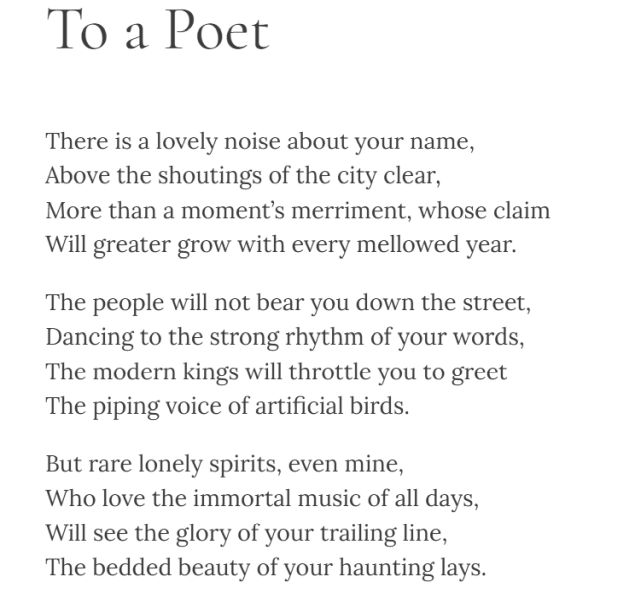
Here’s a new Claude McKay poem song setting, “To a Poet,” completed as part of my concentration on his poetry this February. Somewhat of a “deep cut” in McKay’s poetry, but as sometimes happens when reading a bunch of poems, there was one set of lines that stood out as I read this pioneering Jamaican-American poet’s work. I’ll get to those lines, but first a detour about the music.
Which is something I don’t write much here. The Parlando Project started as a musical idea, though I always thought I’d want to say something about the experience of encountering the poems on the way to making the music, and so this blog. While true engagement with the blog posts here is hard to judge – something made harder by occasional bouts of what appear to be bots skimming (and reskimming) posts here since last autumn – there’s been a satisfying and unrelenting increase in visits to this blog over 10 years. Blogs may no longer be the new-hot, but the visits keep coming. Thank you, readers, and I wish that my personality and situation would allow me to be more attentive to your comments.* I treasure anyone that spends a little time here.
But the musical pieces, the cause of this all? They get no more listens than they did only a few years into this Project when monthly readership and listening numbers were roughly equal – while presently listeners are maybe 10% of the numbers of readers. I’m realistic about the limitations of my musical expression. I’m about as far from a poptomist composer as could be imagined, and I’ve long feared that not sticking to one style of music creates what used to be called by radio programmers “button pushers” – those who hear one or two songs they strongly dislike and decide to go elsewhere. I understand, people react to music sensually, emotionally, and so a bad experience with music creates a stronger distaste than a duff blog post or the choice of a poem some don’t care for – but my music making reflects my listening, it’s eclectic. I’m committed to musical adventurousness and variety, and so by intent or missteps the music may not always be something you’d choose. I don’t believe I’d enjoy this Project if it was anything else.
But one musical constraint has always been with me: my singing voice and its take it or leave it limitations. Spoken word poetry, even with integrated music, is one thing, and I’ll do that, but some words tell me they expect to be sung, and almost always, that means the singer is me. I’m grateful for the times my long-time LYL bandmate Dave Moore has given me and my listeners a break, and there have been scattered other “guest vocalists” over the decade. Today’s song is different. I wanted to do something (however simplified, as I think simplified music retains powers) more like Art Song, the composed music that features trained singers who express strong melodic contours through skilled techniques, rather than off-the-cuff, I’ll-give-it-a-go, folk-singing.
Go ahead, scroll down and listen to today’s piece setting to music the words of Claude McKay. I’ll wait. And here’s the text of McKay’s poem that was performed with my music.
.
OK, you’re back. Who’s the guest vocalist? The stage name is Felicia. Felicia is a virtual instrument. Readers here may recall what that is, but I think it’s important to reiterate: a VI is often a set of atomized recorded samples of a real “acoustic” instrument, a whole range of notes with articulations expressing a range of colors. Let’s not confuse two-letter-acronyms, VI is not AI as expressed by services like Suno which take an overall text description of the nature of a song and create in one fell swoop the finished melodic lines of the singer (and all their arrangement and accompaniment) by apparently recombining conventional musical materials. If I take a VI of, for example an organ, and invoke it on my computer it won’t play a toccata, early Phillip Glass, or “Rock Lobster,” or anything like those pieces, no matter how I write a run-on requesting sentence about it. It instead needs me to play my MIDI guitar or little plastic keyboard, or inscribe notes on a MIDI piano roll notation. I could (as a very limited keyboardist) invoke arpeggiators or chord and pattern generators to extend what I play or write – but it still feels like composition to me. In contrast, AI like Suno feels like I’m a royal patron asking my musicians for some conventional musical noise to underscore my cultural pretenses, caring only that it be inoffensive.
Another difference: even a despot likely paid their court musicians something. AI? Not so much. The company that sells the Felicia voice VI (Dreamtronics) claims it pays the human singers that it samples to make its products.
Still, I expect this revelation, or its implementation in this piece, will repel some listeners. The spirals inside the ear have their own Uncanny Valley, and I too feel that fearful symmetry. It sounds like a human putting artifice onto itself or an artifice taunting the qualities of human. I put up with it because I had a goal, and my voice could never sing with the VI’s technique, particularly over a longer piece. I played the vocal line on my little plastic keyboard, and typed each syllable as text that the notes would sing. Early vocal VIs were very picky about needing explicit phonetic text, but this one knows much more about the baroque tangles of English pronunciation, yet I still had to tweak some syllables. The program has a range of controls for expression variations – learning how to use them will improve results – but it presents default expressive choices that keep the monotonous spiel of old-school robot speech away.**
Felicia made it much easier to get something that wasn’t fakey bad or unintelligible as older vocal VIs I’ve tried, even as I still felt the need to do work to improve problematic passages. It took me several hours to create the vocal line realization you hear in today’s piece. A trained human singer at the mic could have done it in an hour, even including leeway for retakes and “try it this ways.”
One thing I noticed: even when I had polished up the intelligibility of the VI sung text, the meaning of the words seemed abstracted to me as a listener. Oddly, this is the same thing I sometimes hear as a listener with Art Song, where the composer’s elaborate melodies or the singer’s concentration on demonstrating virtuoso technique make the words vehicles for expressing music more than shared experience. Human vocalists singing Art Song, in their own way, produce their own unsettling Uncanny Valley.
Which may bring up the question, why not just use a real singer? Yes, that would be better. I, who am socially awkward, not able to schedule a time to do my creative work, and heading-up a non-revenue Project can say that would be an ideal, but unlikely, option. Furthermore, in the process of composition I wouldn’t be able to test my musical choices as a limited singer, so there’d likely never be a score for such a singer to follow.***
Will I use a vocal VI again here? Likely, though I don’t think I’ll use it most of the time, or even often. My voice is my voice, and I feel I should use it. Still, I was very happy that I could realize this musical piece. Through the technology of VIs I was also able to play the atomic recombinations of an oboe, a viola da gamba, and a hurdy-gurdy as part of the accompaniment.
OK, so back to Claude McKay’s poem. Like his “When I Have Passed Away” from earlier this month, McKay’s poem here speaks of posthumous poetic legacy. In the context of this month while using a computer VI to sing his words, I was much taken with the pair of lines in his poem: “The modern kings will throttle you to greet/The piping voice of artificial birds.” Maybe 100-years-ago, a prophetic McKay knew how I’d come to try to make a song of his poem using a voice of artifice under the rule of a disordered king and assorted technological barons.
You’ve already heard that song haven’t you? What, you didn’t obey the words and stop partway for the music? You’re a rebel! An outlaw! A traitor! You have one – no, two – more chances to hear my musical setting of “To a Poet:” with the audio player you should see below, or with this highlighted link that will open a new tab with its own audio player.
*Besides mundane life-chores, these increasing problems are partly from aging, and partly secondary to the folks I share my home and life with. It’s hard for me to devote regular and predictable time to this Project, and when opportunity time comes, my nature is to work on finding new words and creating the musical pieces. For some reason (aging? self-doubt?) it’s increasingly hard for me to make the social small-talk that should be trivial and expected.
**I doubt this variation of expression is heavy duty AI either. For a long time VIs have used a pseudo-random cycle of expression variations as an option in their programs. I didn’t get a sense the VI generally knew from the denotative sense of a word or placement in a sentence or musical phrase to give it a particular kind of invocation.
***A product like this, it seems to me, would be ideal for a composer who doesn’t sing well and who would like to rough out scores before an actual performance, as it might give a better quick approximation than just playing the vocal line’s notes on a piano for instance, just as orchestral composers are increasingly roughing out arrangements on other virtual instruments.


 Frank Hudson