Each in His Own Tongue and the “middlebrow” problem

Social media likes controversy, so it’s no surprise that two things have recently mingled there in provocative assertion: poet Mary Oliver and the dread “middlebrow” epithet.*  It’s not a long bridge between the two: Oliver’s poems are put forward as all too middlebrow in this charge, and middlebrow is a sign of significant lack of ambition or achievement. I’m not a fan of the term “middlebrow,” for a hierarchy is implied and I don’t care for hierarchies much — but to speak of this I should define middlebrow poetry. A definition that works for me is: poems that remind us of something we already sorta-kinda know, but maybe couldn’t quite put into words. These poems are usually immediately understandable on first reading by a significantly literate reader.

Why’s this bad or lacking? If this is a singular mode it rules out poems that tell us multivalent things, or mysterious things that require more thought to comprehend, thought perhaps taken in stages. It rules out shocking, utterly surprising poems. And such poetry doesn’t feed our playful desire to puzzle-solve with clues we are proud to have acquired.**

My view? I think various modes of poetry (even differing modes of reading the same poem) have diverse values, and I’m more than OK with that. Poetry’s eye should be the insect’s compound eye, containing a hundred, a thousand, ommatidia. And so, if it was up to me, the best cultures wouldn’t be restricted to, or rewarding of, one poetic mode. This may be a visceral thing with me: I get bored with all one type of thing quickly. Building towers of hierarchies might be fun, and illustrative of what one can stably hold long enough to build such a tower, but in the end, the domain one will look out on will have a lot of scenery that isn’t in your tower. In the right mood, I can get pleasure out of looking at the commonplace apprehension poem and a “difficult” avant-garde one — and in the wrong mood on my part, or insufficient achievement in the poet, not a touch of pleasure in either mode. And beyond all this meaning and metaphor, there’s the oldest part of poetry, the part even young children understand, that poetry also has abstract pleasures like music has — poetry is the instrument on which the meaning plays.

A great many of the poems in our pair of 1920s children’s poetry anthologies are as middlebrow as any Mary Oliver poem brought up on charges in this controversy. This shouldn’t surprise us. A modern children’s anthologist looking to duplicate the task of those in the previous decade called The Twenties would, I think, do likewise. Some of those pressures would be commercial: what will sell to parents, libraries, teachers. Some would be practical: these children aren’t yet bored with the lessons of the world — those lessons are new and useful building-blocks for their youthful towers — and maybe a lesson of my old age (and a lesson of Mary Oliver) is that I shouldn’t have been bored with the lessons of the world either.

I think too of what happened as the first childhood readers of these poems in the 1920s progressed into the economic distress of the Great Depression, the rise of nationalist dictators, the Second World War, and the Damoclean Cold War. All through the middle of their lives how much time would they have for poetry that offered them the highbrow pleasure of gnostic meaning, of shocking new combinations and collisions?

The answer is: some would find the time, some went on and made their own verses in those modes — and many others would not. Some kept food on the table, kept bolts tightened on airplanes, tended the sick, kept fuel in NATO tanks facing east. Some had their yet young lives ended sans poetic envoi. Others desired, birthed, and raised my generation.

Highbrow, middlebrow, it is neither sophistication nor no-nonsense populism to forget either part of that cohort.

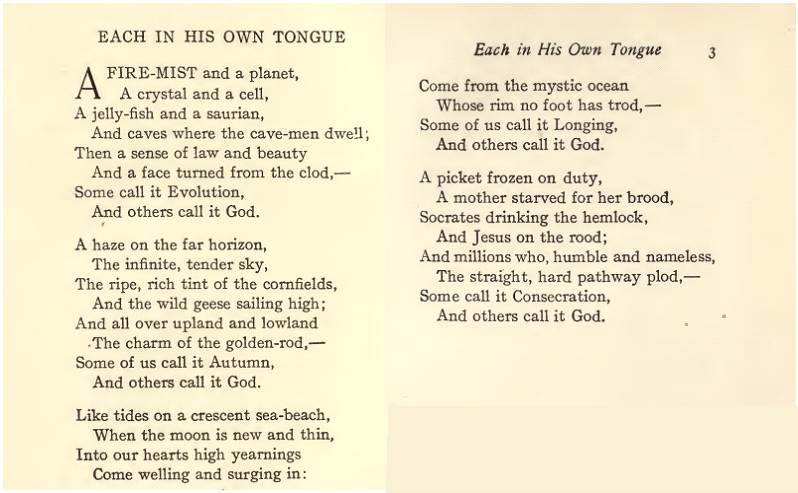
On to today’s poem, an example of a poem that earnestly intends to be a lesson: “Each in His Own Tongue”  by William Herbert Carruth. Look! Mary-Oliver-approved wild geese make their appearance in it, decades too early! I also offer this month’s puzzle challenge: the pair of 1920’s anthologies I’m drawing from were gendered: one for boys, one for girls. So as with each post this month, you’re asked to guess in which volume did the poem appear. Answer lower down.

Each in His Own Tongue

dedication to Ina Coolbrith

Here’s today’s poem as it appeared as the title poem in a book-length poetry collection by Carruth.. Marginalia picked up in the scan of  a copy of that poetry collection. Wonder who Ina Coolbrith is? Here’s a link.

.

The brief Wikipedia stub for Carruth tells me he was “president of the Pacific Coast Conference of the Unitarian Church.” One of my preacher relatives once said of an Unitarian school he’d attended “The only time anyone would speak of ‘God’ is when someone stubbed their toe.” I read this morning a brief poetic knot of a summary of Oliver’s earnest lessons delivered by A. M. Juster who wrote that he’s “Not a big fan or a big detractor of Mary Oliver” but then sums up his impressions of her work by saying “I also think her spirit wanted to write religious poetry, but her mind wouldn’t let her.” Each in their own tongue I’d say, ungendering Carruth. Carruth wrote “His,” and his poem appeared in the Boys Book of Verse. You can hear my musical performance with the audio player gadget below. No gadget to be seen? This highlighted link is a backup which will open a new tab with an audio player.

.

*Here’s a link to a well-done post on the controversy, and a refresher on Oliver’s poetry if you are not familiar with it.

*This last factor is less-often laid out as I just did, perhaps because it doesn’t seem serious when complex poetry is discussed. But let’s admit it: great portions of humanity loves puzzles and challenges in which they feel rewarded if they can progress farther than some other human.

Sea Fever

For National Poetry Month this year we’ve been looking a poems that were selected in 1922 and 1923 for a pair of gendered poetry anthologies: The Girls Book of Verse  and The Boys Book of Verse.  Today’s poem is another reasonably well-known selection, John Masefield’s “Sea Fever.”

I’ll not have much to write about the poem itself, it speaks so straightforwardly. I will say that I always thought of it as a poem by an older poet, and an archaic one at that in that it speaks of ocean-going sailing ships. Turns out, I read this poem with misapprehensions. Reading briefly about the poem, I found it was published by a poet only in their mid-twenties, and though the long-lived Masefield’s life overlapped mine — he was still England’s Poet Laureate during my schooldays in the United States — he indeed worked on windjammers.

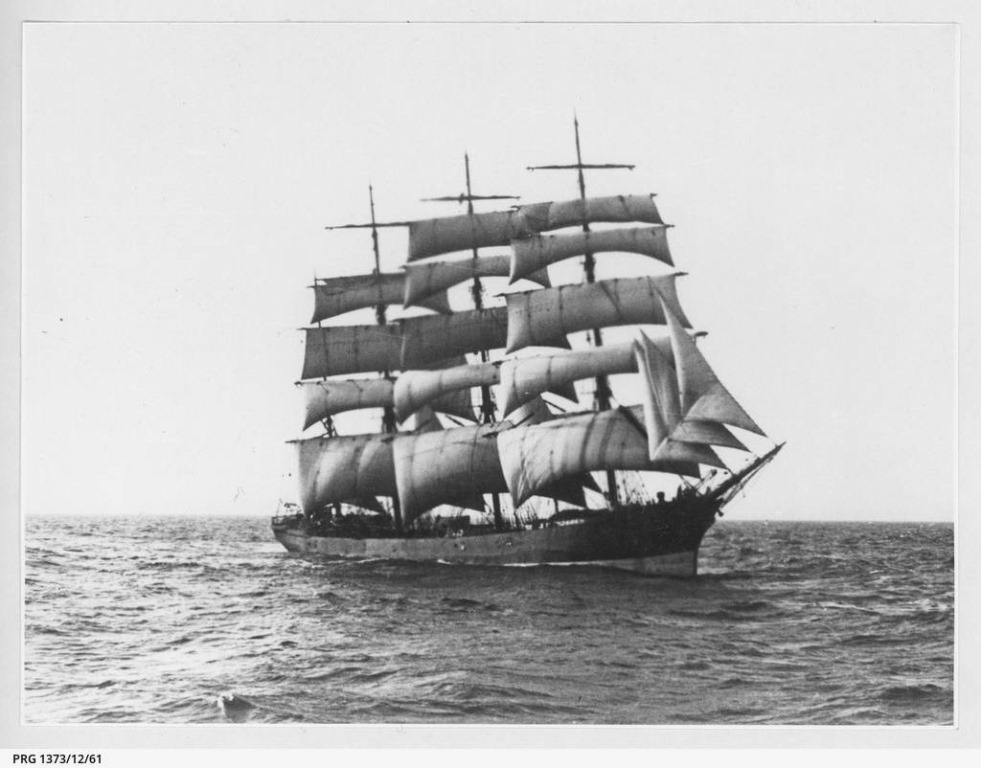
The Gilcruix

The young Masefield sailed on the cargo ship Gilcruix at the end the 1800s, and yet the ship looks like it could have been from the beginning the 1800s.

.

These two 1920’s poetry anthologies clearly wanted to encourage reading for the children that would grow to become the fabled Greatest Generation of the Great Depression, WWII, and the Cold War. Ironically, Wikipedia says Masefield was unhappy in school and shipped out to a life at sea “to break his addiction to reading, of which his aunt thought little.”

Masefield worked at sea and in America* for the next decade. The seagoing did not cure his reading addiction,** he continued to read on shipboard and eventually began to write himself.

While “Sea Fever”  is more in the mode of poetic memoir than our poem last time by Emily Dickinson — it’s a nice bit of parallelism that Dickinson imagined books as a replacement for sailing far away, and Masefield imagined he could sail far away as a replacement for books!

As with our other poems from this pair of gendered anthologies this month, I’m going to ask you to guess if this was in the boys or the girls poetry anthology — answer below.

Here at the Parlando Project we take words, usually literary poetry written by various poets, and set them to original music in different styles. Not for the first time, this is a poem that already has a fairly well-known “art song” setting: one by John Ireland. Ireland made a lovely song, and not an overly elaborate one melodically for that sort of thing — but it’s beyond the limits of my vocal talent. So, the setting I created and performed with just my cruder voice and acoustic guitar is what you can hear below. I don’t know if you will be able to hear the canvas slap or the wind through the rigging in this version, but I was trying for that and a hearty song feeling in this one. There’s a graphical audio player to hear it below, but if that player is not visible, this highlighted link is your backup. It will open a new tab with its own audio player. Was this song of manly company on the high seas in the girls or boys book? It was in the girl’s volume.

.

*In between voyages, Masefield worked in a factory in Yonkers New York, something I did in my early 20s too. I may not have shared his nautical adventures, nor will I ever become the poet laureate of anyplace, but that tiny little happenstance made me feel kinship with Masefield 70 years apart.

**More of what is likely only coincidence: when Lou Reed’s protagonist in his song “Heroin” escapes into his drug addiction he likens it to a wish that he’d “Sailed the darkened seas on a great big clipper ship sailing from this land here to that.” If Reed had started his other song of that era “I must go down to Lexington 125, to the call of the running tide” we’d have an actual connection to go on.

There is no Frigate like a Book

For National Poetry Month I’ve set out on a feature where I’m examining the poems in a pair of poetry anthologies directed at children which were published roughly a century ago: The Girls Book of Verse and The Boys Book of Verse. Each collected around a hundred poems in a variety of styles, sub-categorized in broad subject areas the anthologists thought reflected childhood moods and interests.

That child audience became our ancestors. The early readers of the first edition would have been the oft-praised Greatest Generation which grew up in the Great Depression and served in the titanic national struggles of WWII and the Cold War. It’s likely that childhood has changed since then, but did these books in any way equip the young minds for the panorama of their future?

One of the pair of anthologies used this well-known poem by Emily Dickinson as a lead-off poem placed even before the table of contents. How many libraries had, maybe still have, this poem on the wall of their children’s section? I can’t say, but I recall seeing it in more than one in my post-WWII childhood.

Some of the words, if laid plain on the page, might risk being obscure to a 1920 or 2020’s child. Dickinson and the anthologists seemingly had little fear of that. A frigate is a class of fast war ship. Do children still have youthful romance with sea-ships? Born in a landlocked Midwestern state, I did — reading of and knowing all the classifications of ships, famous naval battles, famous captains, that sort of thing. Modern youthful D&D fantasists of the earth-like realms seem kind of land-bound to me, perhaps because Tolkien seems to have left his sea-faring tales to the long unpublished Silmarillion. Current SciFi readers might still have all the trappings of sea-battles recast in airless space, but that is less the exact particulars of historic ships.

FRIGATE

Bookplate, warship. Did you know the warship was largely saved from rot and disposal by a poem?

.

Coursers too is not a word in most modern children’s vocabularies, and I have my doubts for a 1920s child. It’s a term for a fast-pursuing horse, and by extension those that ride them. With frigates just preceding it, I always heard and misremembered the word here as corsairs, a term for pirates or privateers, and it’s possible Dickinson thought she was punning there.

Dickinson’s second stanza makes reference to funds, and by extension class, in its metaphor. Rather than the appeal to straightaway imagination in the more remembered first stanza, here she makes the case that it doesn’t take much money to read. Dickinson’s family seems to have been roughly middle class, despite some challenges in her family’s finances during her childhood. Extensive world travel might have been outside their means or attitudes, but books wouldn’t have been. Oddly though, she says the “poorest” can have this book-led adventure. Does she simply not know of that level of poverty, or is this just “poetic license?”

I’m grateful to my parents and librarians for extending limited means to afford books as a child. My mother, an avid reader, knew how to use library extension services to order nearly any book, and I can still recall my joy when she’d open a substantial cardboard box from a letter-placed order which would include several books picked by some far-off librarian to be about sailing and historic sea battles for me to read. My father would let me ride in the empty well of his bread truck to be let off at the county seat which had a beautiful and bountiful library for me to wander in.

Here’s a standing question for this month’s pieces from the two gendered anthologies: do you think it was the for boys or for girls book that lead off with this Dickinson poem? Answer below.

A note about how today’s musical setting of Dickinson’s poem came about. At around 10 PM, which ought to be bed-thinking time, I was still thinking about more recording opportunity to bank musical pieces for this Project. Like last-time’s Blake piper, today’s poem’s book-with-far-flung-words seems to invoke not only poetry, but this Project itself — so I thought I should do this one sooner rather than later. My wife, who’s sometimes bothered trying to sleep if I strum an unplugged electric guitar in the next room was out house-sitting for a friend. I need a tune! I grabbed an old plastic acoustic guitar with a large crack in its top that I bought in a second-hand shop decades ago and now keep out in the dry, wood-cracking-weather of my home office. The chord progression I settled on was simple. My melody, like many of mine, is doomed to be served by my voice, and so is utilitarian. After finding that music in the nighttime, I decided to record a short demo then and there. It was after midnight. I rigged up some way to record the cracked plastic guitar — a brittle and unappealing pickup as there’s no room for a mic on its body like I would use in my studio space — and set one down.

No Frigate

Simple guitar chord sheet in case you’d like to sing this song yourself.

.

The next morning I listened to the demo and thought it aspired to be presentable. To disguise the crinkly sound of the guitar I did my best to sweeten it with EQ and reverb — but more elaborately, I composed one of my simple string trio parts to further cover the guitar sound up. You can hear that night sound Tolless-Traverse with the audio player below. No player?  This highlighted link is a backup way, as it opens a new tab with its own audio player. Was our poem, written by a woman hunting on fast, pursuing ships in her imagination, in the girls or the boys verse anthology? It was the boy’s book.

.

Piping Down the Valleys Wild

From my Parlando outlook, this is a fine choice to start off a look at our twin girls and boys 1920’s poetry anthologies for National Poetry Month. Today it’s a poem by William Blake, a poet still known and rated today, and a poem that includes a child and praise for music inside of it. It’ll make a natural beginning I figured.

After I made that decision, I started to notice a couple of things. The poem began to seem stranger than it somewhat straightforward first reading might suggest. The odd thing I noticed first was the amount of insistent repetition in it. Lyric poetry, and even more so poetry meant to be sung. will often refrain lines, repeat entire verses or sections — look at many a modern charting pop song and you’ll see hooks as repetitious as today’s poem — but it still struck me as odd. The child continues to ask for song. The piper plays it. Immediately, the child asks for the song again. Parents experienced with young children may relate here — insert your own bête noire kids-song ear worm and insatiable toddler — those requests can be cute and dulling at the same time. Blake’s child is laughing at the time of the first request, weeping at the second, Why? Best guess: because the song is over, and they must hear it again. But then the child asks for a third song — perhaps the same one, perhaps not — and they are asking for it without the piper playing the pipe. Since most pipes are wind instruments it’s likely the piper in the poem hasn’t been singing the first two times.*

Combining the child’s responses after the first two requests which the piper has immediately fulfilled (laughing, weeping) the child “wept with joy” after the third go-round.

The picture I get here is joy in repetition, and woe at ending. The child makes one more request: the piper should cease the singing and write this music down. The piper MacGyvers up a pen and ink and gets to scoring.

Piping Down

Simple guitar chords on the chord sheet this time.

.

Then we’re told the child vanishes. This shouldn’t surprise us. If we were paying attention, this child appeared to the piper “on a cloud.” This child wasn’t a flesh and blood child — wasn’t one of the potential readers or listeners to the anthology’s contents — it’s a spiritual emanation of childhood.

OK, that’s a little weird, but Blake was a self-confessed visionary, and literary inspiration stories can be peculiar. Just another day at the poetic office for Blake. And as the piper makes his own pen and ink, I thought of one of the things that I found most inspirational in Blake’s life: that despite literary poverty he mastered the means of creating his own poetry, art, and engraved books.

Just after completing my musical version of this, another area of concern came to me. Just how strange did this seem to the children in the 1920s or to their parents who might read this to them if they were younger children?

I was a young child in post-WWII America, and in my time and place, I would have been puzzled. About the only piper I’d have any reference to was The Pied Piper, a page-bound storybook character. Yes, various kinds of musical pipes were extant then, as there would have been in the 1920s, but nothing I would expect in my time to see being played in wild valleys. Blake’s poem was over a century old when the 1920s anthology was made—  maybe late 18th century England had itinerant rural pipers?

As they grew up, the child reader, then or now, would likely understand this is fantasy, even if exactly what Blake was getting at with his fable might be missed. Its value would remain as a set of word-music that speaks to the joy found in music and the arts.

Is anyone trying to guess if this was in the girls’ or boys’ anthology? Male author. The cloud/child is male, the piper is not gendered. Is joy in music a gender role thing? Not really.

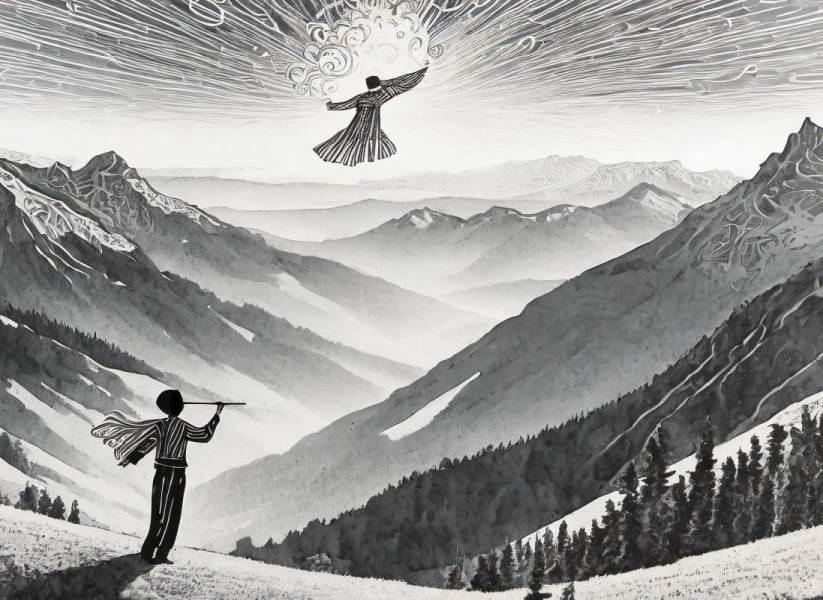
wild valley piper 3

Wilderness cumulous-carried spirit children are not a reliable compositional prompt.

.

It’s from the introductory section of the “for girls” book. My music is a simple folk music setting: acoustic guitar and bass, and eventually an Irish tin-whistle for piping. The tin-whistle is a played VI.** Two other instruments make a subtle entry in this recording. There’s a quiet electric piano in the piece, played and mixed so low it almost sounds like an overtone of the guitar, and another VI of a small obscure 1940s keyboard instrument, the Solovox that comes in for the next-to-last verse.

The Solovox was an FDR-era monophonic analog keyboard synthesizer, with glowing tubes and a wood-veneer case like a large table radio of the time. I used it for two reasons. If this song floats in fairy-tale time with children appearing and disappearing out of clouds, I thought the piper’s sound could change from the tin whistle to something more mid-20th century as a marker of how the children the anthologies were written for grew and changed. But also, I’ve seen, even briefly played, a particular real Solovox. The mother of alternative voice and keyboard player in this Project Dave Moore had one, and when he was young his mother would play piano and deftly slip one hand over to play melody lines on a Solovox. Dave now has his mother’s example of this old instrument, and has had it fixed so it plays, though with some glitches.

To hear “Piping Down the Valley’s Wild”  you can use the graphical audio player you should see below. Player vanished?  This highlighted link will open a new tab with an audio player. I plan more poems, adapted musical pieces, and observations from The Girls/The Boys Book of Verse  coming up soon.

.

*There are methods to do that, where a singer alternates using their breath to sound the instrument and to sing lines of song. And there are bagpipes and the like where the wind comes from a bellows. But the child has asked the piper to drop their pipe and sing, so it stands to reason this is a request for the piper to sing a song with words after playing instrumentally for two renditions. The song then progresses from melody, to sung words, to finally written words — a plausible metaphor for the writing of a poem.

**I explained VI/Virtual Instrument technology last time, but in short it’s playable software that tries to contain all the sounds an actual instrument makes, often by capturing all conceivable notes and many articulations of those notes with a microphone it makers placed on the real instrument.

National Poetry Month 2024

Earlier this Spring I had an idea for a Parlando Project feature for this year’s National Poetry Month. It was based on something I read in the blog “My Life 100 Years Ago,*”  as blogger Mary Grace McGeehan turned some of her attention to children’s literature. As those interests crossed over for her, I learned there were a paired set of poetry anthologies from a century ago, one first published in 1922, The Girl’s Book of Verse, and the other the following year, The Boy’s Book of Verse.

A reason I’m drawn to poetry is that poets often examine and see things many others would miss. I read of those two titles and was intrigued. Lots of things to examine. One, the books are gendered — unsurprisingly, they only saw to market two volumes then — and being published in the early 1920s they might say a lot about how the anthologists viewed childhood and gender roles at the time that Modernism was starting to become a substantial part of literature in America. And for those targeted boys and girls (and their parents) the world was changing in areas well beyond poetry, music, and the arts. Adult women had just been given the right to vote, and there was increasing belief in expanding women’s roles. Fathers had in some cases returned from America’s first extra-continental wars.**

And there was another reason, I had recently come to see appealing elements in some of Robert Louis Stevenson’s poetry aimed at children as I revisited it. It’s long been a cultural commonplace that Mark Twain and Lewis Carroll are children’s books with layers of understanding, not just fantastical adventures. And in our present culture a great deal of our marketplace is taken up by young-adult books and genres that often have roots in youthful reading: Fantasy and Speculative Fiction for example.

So, what if we step back a century and see what’s there? I found a number of interesting poems in the two books, and my plan was to step up the posting tempo of this blog to at least double time. There’d be writing on what I observed in the books, and the Parlando Project’s combining of literary poetry with original music in various ways and styles would top that off. I started stockpiling some compositions, even recorded initial tracks for a couple. I was realistically readying myself for more activity here than usual to celebrate NPM 2024.

NPM 2024 poster 720

I didn’t know this would be the poster for this year when I started out. Seems appropriate for my plan.

.

Great plan.

Great plan, meet life.

I’d already figured what would be the first two pieces of this series. Monday I was going to complete recording the music I had set for the first one. My old-man energy didn’t hold out, and mid-morning recording expectations turned more into an early afternoon plan. Monday afternoon, I grabbed my music to go record, and..

The music stayed on the table. More family distress came home. I haven’t found a way to write about this that feels appropriate to me — and I’ve felt so blessed the past eight years of this Project to have so much time to do the extensive work it entails that I don’t want to be disproportionate in measuring my little change of plans this week against the reasons for distress. Today’s concluding summary: this is an introduction of my original intent, and a public statement that I still have hope for some variation of the plan still coming off for this April Poetry Month here.

My appreciated long-time readers will know to wait — and new visitors: there’s a lot here for those interested in poetry and the various ways it can be combined with music. You might want to search for a poem or poet and see if we’ve already presented it. Over 700 pieces, there’s a lot here — but it’s all over but the footnotes today — and those footnotes are something else this blog picked up from Mary Grace.

.

*Her blog started out with a pledge to only read material from 1918, but it has transitioned to an occasional look through stuff that was contemporary a century ago. Lots of considerations of what women in this dynamic time were presented with, often through magazines of the day. This stuff fascinates me. It’s the mundane and commercial mirror to the era when a lot of the poetry I’ve presented was created.

**How about other historically significant issues in this last decade that called itself The Twenties? Social inequality was certainly on some adults’ minds then, but that generally goes unreflected in these middle-class oriented poetry anthologies. I may take a second scan, but the issues of America’s racial caste system are largely ignored, though there is a bizarre Longfellow poem I hope to at least mention in the series (even if I might never figure out how I could perform it). Another thing to think about as we consider these century-old books: the children’s audience here would be inside that Greatest Generation who experienced the Great Depression, the global rise of nationalistic fascism, and eventually an even greater world war and its aftermath. Is there anything here in these poetry books which the authors suggested their mothers should be handing them that helped them through that?

Jazzonia: May Music Find a Way on International Jazz Day

The end of U. S. National Poetry Month is approaching and there are things I meant to get done (and didn’t) this year, but the last day of April is also International Jazz Day, and I can’t let that go by without a piece to celebrate. Poetry Month and Jazz Day — shouldn’t that be a piece of Jazz Poetry read in front of a Jazz combo?

I looked around the house and didn’t find one. Not the Jazz poem, it was easy for me to think of Langston Hughes, one of the originators of the form, and find a poem of his, “Jazzonia”  that I didn’t perform when I celebrated his book The Weary Blues  a couple of years ago.

No, it’s the Jazz combo that’s missing. Not in the garage, not in my studio space, not under the table in my office amidst that messy pile of stuff. Not in my phone’s contacts list. None marching down the street in my city too northern and cold for Mardi Gras.*  Oh sure, there are a couple of Jazz clubs in town, and local musicians who can play Jazz, but I don’t know them. I’ve handed out Parlando demos to a couple over the past few years, and heard nothing, which may indicate politeness around my audacious use of my limited skill-set — and that would be right. I can sort-of hang with a Jazz feel on a good day with guitar as long as I’m under control of the context,** but Jazz isn’t about tightly controlling the context. It’s about surprise, about flexible chops that fit with a multitude of things.

So, I went about doing my best with what I had at home. I have a little device I use to practice instead of a metronome. It lets one play-in a set of chords in rhythm, and then generating from the form you play a drum and bass track following the harmonic material in tempo you’ve given it. It’s a fine quick practice tool, but I’ve only used it a couple of times here for public Parlando Project pieces.

I prefer to put in work on the digital drum tracks, adding hand percussion, even playing a real ride cymbal I collected from a neighbor a few years ago, editing the hits and beats on drum patterns — but I let that go this time. The machine had supplied a serviceable walking bass part, I let that stand as well. I played the guitar part in a single pass after warming up. I had to duck out a couple of egregious clams, but it represents one of my good guitar days.

Jazzonia 2

In the whirling cabaret, guided robots and human jazzers play for Poetry Month and Jazz’s Day.

.

Looking at Hughes’ poem (full text here)  I see that he specifies there’s six Jazz players in his poem’s combo. If I count my reading at the mic as a player, that got me up to four, including the two robots on bass and drums. So, I next checked out my naïve piano skills. I was pleased with a couple of little motifs I came up with. My repetition with under-elaboration of those motifs marks this piece as more of the simplified “Soul Jazz” emanation*** than a hardcore blowing session. That’s OK with me, I liked those records. For the sixth and final musician, I played some vibraphone over MIDI from my little plastic keyboard.

The above account may have convinced too many readers to not listen to the result, but for a one-day-wonder I think it came out pretty well. It’s a little longer than most pieces I present, but that lets its relaxed celebration grow on you if you’re receptive. The audio player gadget to hear it is below for many, and this backup highlighted link is for those that don’t see that.

.

*One thing my town once had, and I now miss, was the May Day parade that happened each year in my neighborhood. Elaborate giant puppets, kids on decorated bicycles, dancing troops, folks on stilts or riding on fantastic creations, and usually more than one amateur shambling marching band with a touch of second -line New Orleans flavor. Alas, lack of funds and what seems to be a case of sectarian infighting has stopped this annual event. I did some videos of this while it was still a going thing. You can see some here, here, and here.

**Jazz guitar is much about chord chops, something I’m embarrassingly bad at. Similarly, advanced Jazz harmony will confuse me quickly if I try to understand it in real time. Luckily, with this Project I usually get to be the composer and bandleader, so I work with myself the player to do what I can accomplish.

***You’re still here reading the footnotes? Good, this probably should have been the main thing in this post. Langston Hughes’ long life and immediate and lasting appreciation for Jazz meant that he could write about and be influenced by early Jazz when Dixieland was fresh, and then he continued to dig it, incorporate it, and perform his poetry with Jazz musicians in the post-WWII years. So even though Hughes wrote “Jazzonia” about 1920’s Jazz, he lived long enough that he could have performed it more in the mid-century bag I experienced then and sought to manifest today.

What’s extra cool about how Hughes presented the still emerging Jazz of the 1920s in “Jazzonia”  is that he sees it already as part of a continuum from the African Garden of Eden, and then via Cleopatra, and through Harlem Renaissance — so it’s no surprise his Jazz, and Jazz itself, can keep on reformatting itself into new ways of expression. The honesty I shared regarding this audio piece above? It’s part of living the Musician’s and Composer’s Prayer: “May music find a way.”

The Things We Thought (That We Should Do)

We mentioned Emily Dickinson in our last post, and it’s time to return to this essential American poet during this National Poetry Month. I saw this charming poem of hers earlier this week and thought I might be able to do something with it.

Over the years here I’ve delved into some of the more cryptic Dickinson poems, but her poem beginning “The things we thought that we should do” is reasonably clear on first reading, at least until you get to the end. Here’s a link to the poem’s text if you’d like to read along. This three-stanza poem uses exactly one rhyme, which helps its flow stick together, appropriate for a poem about how our lives sometimes seem to take us down one track that we never get around to changing. Our inability to shape our lives to what we think we should do is the first stanza’s statement. The second puts the untaken should-path and compares it to travel, or rather not traveling. Dickinson was often portrayed as homebound — though an examination of her life says she traveled more than many women of her time — but I think this is more metaphor than memoir. This stanza ends with the idea that one may then pass on the untaken task of some travel to a “son.” This may be legal language sneaking into Dickinson again,* but I also wonder if she’s punning on “sun,” since she has elsewhere used the day as a miniature measure of a lifetime. If so, she’s saying we think we’ll do these should-things tomorrow, or in the sense of generations following us, in another lifetime.

Poetry vs Law 800

Poetry? Law? Poetry? Law? Screw it! I’m going to go outside and putter in my garden.

.

The last stanza is the response, the turn, the summing up. It starts out: If we haven’t been disciplined enough to do our shoulds, we likely won’t get our restful reward in heaven. And then the last line “But possibly the one —” Ah, the Dickinson dash, that little transition — but wait, there’s no more text. It ends on the dash!

This is ambiguous, and her syntax is jumbled. Did she not complete the poem, is this an unfinished draft? Or did she want the thoughtful reader to come up with the resolution that’s not stated, but derivable from the situation: that there’s a heaven even for those not doing all the shoulds, all the time? When she writes “possibly the one” is she saying that there’s only possibly  one heaven, but she’s not certain — or even, that the heaven one finds outside the shoulds is plausibly the one?

I was able to bring together the music and performance for this one quickly, which was necessary since I’ve spent the past two days taking care of a computer failure over on my spouse’s desk. But I should — no, it’s not a should, it’s a desire — get another piece posted this April. So, acoustic guitar, piano, standup bass, and just a taste of celesta were called into play to realize the music that unusually is made up of mostly major 7th chords. You can hear it with the graphical player gadget below, or if that’s not there, with this backup, a highlighted link that will open a new tab with an audio player.

.

*I’m increasingly noticing that Emily Dickinson, growing up in a multigenerational family of lawyers, seems to have picked up a fair amount of legalese. As a woman in her time, she couldn’t take up the family trade, but her mind enjoys playing around with the concepts such as ceding a should obligation to another as if in a treaty or a property transfer.

When reading this poem, I also think of psychiatrist Karen Horney’s “Tyranny of the Shoulds” — and in this manuscript version linked here, it looks like Dickinson had considered “tyranny” in place of the version we have with “discipline.”

Completing my National Poetry Month daily posting with two beautiful pieces

It’s been quite the job of work to do daily posts with new lyric videos here this April in celebration of National Poetry Month, and I haven’t taken the time yet to see what impact those extra efforts have had. Though I was re-releasing already recorded audio pieces from the earliest years of this six-year Project this month, even the fairly simple lyric videos took more time than you might think — and then there was the selection of which pieces to present, as well as writing a few hundred words on what I currently thought of each of them.

Well, not only is today the last day of National Poetry Month, it’s International Jazz Day, and I felt I needed to make a nod to that today. So, let’s play two!

The first piece is, I think, one of the prettiest of the more than 600 performances we’ve presented: Carl Sandburg’s “Autumn Movement.”   Sandburg gets tagged as an urban poet, and of course he broke into the scene with Chicago Poems in 1914. But he grew up in a more downstate Illinois town, and traveled around the less urban areas of the country before spending the majority of his “now you’re famous” years on a small goat farm. “Autumn Movement”  is from his 1918 Cornhuskers collection, which as you might expect from its title is not all city living.*

Here’s Sandburg with farmland not skyscrapers

.

While “Autumn Movement”  is short in word-count, I did get to playing a bit as I tried my best to approximate in this piece the stylings of Bill Frisell with my Telecaster and fretless bass. Frisell, who can play more contexts more better than I can properly imagine, is usually labeled a Jazz guitarist. I’m not, labels or otherwise. I just have a lot of guts — but the result is  pretty.

As per our April thing, you have three ways to hear “Autumn Movement.”  You can use the player gadget just below. No gadget?  This highlighted hyperlink will do it too. And the lyric video is above.


.

And the bonus second piece? “Sonny Rollins, The Bridge, 1959”  is not an early performance (I performed and presented it earlier this year) but for International Jazz Day I thought it’d be good to have another piece that not only uses Jazz musical flavorings but actually deals with being a Jazz artist — or by easy extension, an American artist in any medium. If I’m not a proper Jazz composer or musician, I take great strength just from considering their achievements, their dedication, their originality. Given that most of the giants are Afro-Americans who’ve had a whole ‘nother level of obstacles and expectations to get over as serious artists — well, the mind boggles and the heart swells considering them.

And one more chorus: three ways to hear it: the graphical player just below this, the backup highlighted hyperlink, and the lyric video just a bit lower down on the page.

.

I hope this experiment has been enjoyable for the regulars here who may have joined the Parlando Project already in progress and who perhaps haven’t heard the earlier pieces — and it was my hope that it would also bring some new readers and listeners into the fold. If you’re one of those: welcome! I’m not predictable in what kind of poetry or music I’ll use, but I do consistently try to keep it interesting and varied, and I’d sure like to have you come along with me as I do that.

And here’s my ode to the inspiring Sonny Rollins in lyric video form

.

*I’ve always enjoyed the story of Bob Dylan seeking out Sandburg as the younger singer was just starting to reach a level of national fame in 1964. While trying to locate Sandburg, Dylan was unable to get the locals to recognize a “Sandburg the poet” he was seeking, but then they asked back if he was looking instead for “Sandburg the goat farmer.”

Robert Frost wrote a lot of poems about rural life, including many of his best and best remembered, but his contemporary Sandburg, Mr. City of the Big Shoulders, probably spent more time around actual farms and farming.

She’s so unusual: "The Trees are Down” for National Poetry Month

Americans know little of English poet Charlotte Mew, who wrote today’s poem during “the last Twenties,” but her poetry shows some unusual qualities, particularly for her time.*  For example, this poem starts off off-hand and rises at its end to hearing an angel — so beginning like a reserved Frank O’Hara and ending as if she were Rilke.

Oh, and in the middle of the poem, there’s a short meditation over the corpse of a dead rat.**  Joyce Kilmer must have forgot to add that kind of touch in his better-known Arbor Day connected poem!

Accounts from those who were acquainted with Mew often commented on her eccentricities, and even though Virginia Woolf and Thomas Hardy thought highly of her writing, Mew’s writing career never really gained traction. Over the decades since there’s been some increase in interest in Mew, especially in England. I’d suppose that the eccentricities and tragic arc of her biography help some with interest, but in the immediacy of Parlando’s performances we’re left with just the text of a poem like this. This performance is a live LYL Band take, and like much O’Hara, I found the conversational style makes the text easy to perform.

As with Frank O’Hara, or Emily Dickinson for that matter, just what Mew is getting on about in her poem may not be grasped on one listen or read-through. Yes, the poem’s audacious empathy for the trees comes through easily, but what’s the purpose of that rat? I think Mew is explaining that it’s the absences, the deaths, that more fully convince life into our memory, and that this is so for the “god-forsaken” rat and the angel-blessed trees.

The poem’s Plane tree is a species well suited to urban spaces, able to survive the Victorian pollution of London that Mew was born into.

.

One last day to go in our celebration here of National Poetry Month, but I’ve got some plans for a big send-off day tomorrow if time and life allows. As with most of the 30 performances of a variety of poems that we’ve re-released this April, there are three ways to hear Charlotte Mew’s “The Trees are Down.”   You can use a player gadget below, this highlighted hyperlink (supplied for those who won’t see the player), and via a lyric video above.

Thanks again for reading and clicking play. It should be obvious if you read or listen to the things here, that there’s a reason I’m attracted to the unusual. You must be too. I’m grateful for that.

.

*That relaxed  beginning, interrupted by the interjections of the workmen’s voices all related in long prosy lines is still an unusual effect today. Maybe the beginning has some Whitman in there too?

**Without plan, 3 poems in the 30 have had rats in them. T. S. Eliot’s “Waste Land”  river rat in “The River Sweats,”  Du Fu’s scurrying rat in the ruins from “Jade Flower Palace,”  and now Mew’s spring corpse rat.

See Emily (Dickinson) Play — I recast her poem “May-Flower” for National Poetry Month

Yesterday I said poetry isn’t just beauty and wonder. Well, sometimes it is. Like this recasting of an Emily Dickinson poem into outright 1960’s wonderment.

I carried around a copy of the original text of “May-Flower”  today for Poem in Your Pocket Day, but alas I wasn’t assertive about it. Should I have been?

The staff at the café I biked to were maybe my best chance, but I was still waking up. Then at the bank, my own variation on Miss Stillwagon had needed to take several helpful minutes to go over questions from an African immigrant accented small businessman before I stepped up to her window, and I didn’t know if she wanted to know about Dickinson’s spring flower just then. Instead, we exchanged the brief small talk about how cold this April has been.

Then at the grocery store I always take the human checkout line, thinking that that supports someone’s job in this scanned beep and bloop age. The cashier in the lane I picked must have hit her off-switch for the Lane 8 sign simultaneously as I plopped the first bag of cherries I’ve seen this season on the belt.

“Didn’t you see my light was off?” Which I hadn’t, probably looking down in my cart for the next item to unload. “Well, that’s OK” she said as she efficiently rung up my small batch of items in a dozen seconds. Still, she didn’t seem all that open to Emily Dickinson’s offering of the aspects of a flower. Out in the parking lot, as I packed up the groceries, a pickup truck pulled in and had, I noticed, a “Media is the virus” Alex Jones bumper sticker. I was putting my N95 mask back in the envelope I pocket it in. I didn’t think it worth putting the mask back on to ask him about “May-Flower.”

So, you are left to hear it.

I sometimes sense when reading a certain kind of Emily Dickinson poem that she’s in a visionary or unusual state of perception. The various theories about her mysterious illness including vision symptoms are one level of explanation, but then I also suspect her cast of intellect and a dose of Transcendentalism could explain some of it. So it is with “May-Flower,”  which is ostensibly a riddle for which the reader is to guess the particular type of flower. That may be her intent, but the scattered aspects of the flower she reveals, and her trademark specific originality of word choices*  are as full of swirling fluorescents as any psychedelic poster or LP cover.

Was it the pinkness of the flower that made me think of Syd Barrett era Pink Floyd?

.

In this classic performance from our archives, I decided to further unravel the poem she wrote — and then re-weave the words in a variety of orders and alignments while playing electric guitars, bass, and combo organ in my best rock ballroom approximation of Sixties’ amazement. The 1960s — not Dickinson’s 1860s.

You can hear it three ways. There’s a player gadget below, but some won’t see that and can then use this highlighted link instead. And as we’ve done for almost every post this National Poetry Month, there’s a fresh lyric video above too.

.

*I recently read a short piece on Dickinson by Alexandra Socarides. In it she reveals a poetic mentor, Carolyn Williams, had taught her an interesting way to appreciate Dickinson’s originality. She calls the exercise “Dickinson Mad-libs.” Here’s how she describes the exercise best done with lesser-known Dickinson poems: “I choose a line, a stanza, or a whole poem, and I take out some of its words (usually nouns and adjectives, but sometimes verbs as well), and I simply leave blanks where those words were. Then I ask the students to fill in the blanks. I tend to switch up which poems I use, even though I know several that work particularly well. I’ll never forget the time I used “Grief is a ________.”

If you don’t know “May-Flower” and haven’t listened to today’s piece, or if you want to try this exercise with another poet, here’s the Mad-Libs game for the poem’s first stanza:

May-Flower

Pink, small, and [ADJECTIVE].
Aromatic, low,
[ADJECTIVE] in April,
[ADJECTIVE] in May,

Give anyone, even a poet, guesses — a dozen or a hundred — to what Dickinson would use in those three blanks, and what would be their batting average? And here’s the even better trick: because of the sound of those words, I don’t have any sense that their author is over-trying to be “original.” The sound attracts you to them, however rarely you’d expect them.