The Listeners: a classic of mystery

Judging from the numbers of its inclusions in Internet lists of spooky poems, Walter de la Mare’s “The Listeners”  comes to mind to more than just me when people are asked to think of Halloween poems. Yet it has no monsters, no sudden scares, no wicked battles, no fully-described supernatural events.

It creates its strange effect in this strange way: it gives us lots of details which may seem inessential, and next to nothing of its central situation. The plot is simple: a man travels to a building on horseback. He knocks at the building’s door. No one answers. He leaves. As an elevator pitch summary, it has little to call us in or disturb us. Why does it leave us with a wondering chill? It’s those details. Here’s a link to the poem.

First off, there’s a supporting character in the poem which seems to have only one for sure, the Traveller. That character: his horse. We meet the horse right at the start, noticing that it is unconcerned and grazing as the Traveller opens with his door-knocking announcement of arrival.

We’re also told it’s night. Only slightly unusual, in that one generally doesn’t schedule appointments at night. The Traveller knocks again. We’re told the building has a turret. Castle or fortress, or just a decorated Victorian era house? We know by this it’s not a small hut or cabin. The listeners that are spoken of soon are something of some means.

The Listeners Illustration 1080

Our two characters: the Traveller, and the horse he rode in on. One thinks it’s very important to be there, the other couldn’t care less.

.

We’re told the Traveller has grey eyes. What an odd detail! We’re not filling out his driver’s license after all. Grey is a quite rare eye color in de la Mare’s Great Britain or Western Europe. Does the poem mean to suggest the Traveller is coming from a far distance?

Is there anyone inside the house? The poem mentions “phantom listeners” and these listeners are in the title. “Phantom” says they aren’t in the house at present in the way the Traveller and the horse are outside the door. We learn that the house has a hall, reinforcing by detail that the building isn’t small. The Traveller senses these whatevers, their “strangeness.” How are they strange? Nothing is said — but our second character, the horse, remains only interested in grazing.

The Traveller is insistent, pounding louder, shouting the intriguing line “Tell them I came…that I kept my word.” This is the plot’s climax, we don’t know what duty brought the Traveller there, perhaps from a long way off. Of course, we wonder what the bargain is, what the promise was. Is our wonder stirred by not knowing? Mine always is.

Another detail: we’re told the Traveller is “the one man left awake.” How are we to take that statement? That the “phantom listeners” are asleep and can’t be awakened? Or should we take it more catastrophically: that the “phantom listeners” aren’t human, never were, and that the Traveller is the last man at all, anywhere, awake? I never considered this latter reading until typing this tonight —perhaps I’m over-reading — but if so, is the Traveller coming to ask them to lift that spell, the only man still with agency to plead?

I love the final quatrain of this poem. Our horse returns, and the listeners, we’re told, can hear the creak of the leather from its saddle stirrup — a lovely detail, and a quieter sound compared to the pounding and shouting that has preceded it. Finally this sound: the evocation of the horseshoes ringing on hard stone inside a world of otherwise silence. The horse may be unconcerned by the silence, perhaps even the lack of any other awake people is not of any matter to it.

My music for this features the electric 12-string guitar, an instrument that I love. You can hear me perform Walter de la Mare’s “The Listeners”  with the audio player below. If you can’t see that player, no need to knock louder, use this highlighted link which will open a new tab with its own audio player. Thank you for being The Listeners for this Project!

.
Does your garden have ghosts, part 2: Hardy’s “The Shadow on the Stone”

Yesterday in our Halloween Series I mused on the appearance of ghosts in a garden with Millay’s blithe apparition. As I present today’s musical piece adapted from literary poetry, Thomas Hardy’s “The Shadow on the Stone,”  let me start by asking questions. Many others will follow.

Do you want to see a ghost? Is that wanting part of what makes it appear?

Hardy’s poem is poised in that first question. As I have performed it as a song with music that I wrote for it, I should wonder if the words are clear enough in themselves to tell us what the situation is. Looking at the text of Hardy’s poem, I think it’s mostly self-sufficient in that regard, though some mystery (possibly useful mystery) remains if nothing else is explained.

When I first presented this in 2021, I went into the biographical specifics that engendered this poem, but for today let me just say that the “she” that the ghost is supposed to be is Hardy’s dead wife who was completely estranged from him before her death.  Nothing in the poem spells that out, nothing tells us that when living she had grown to find Hardy completely unsuitable. Well nothing, save for a line that we can hear as modern idiom that Hardy may have intended only as a brief metaphor: “Her behind me throwing her shade.”

The Shadow on the Stone illustration 1024

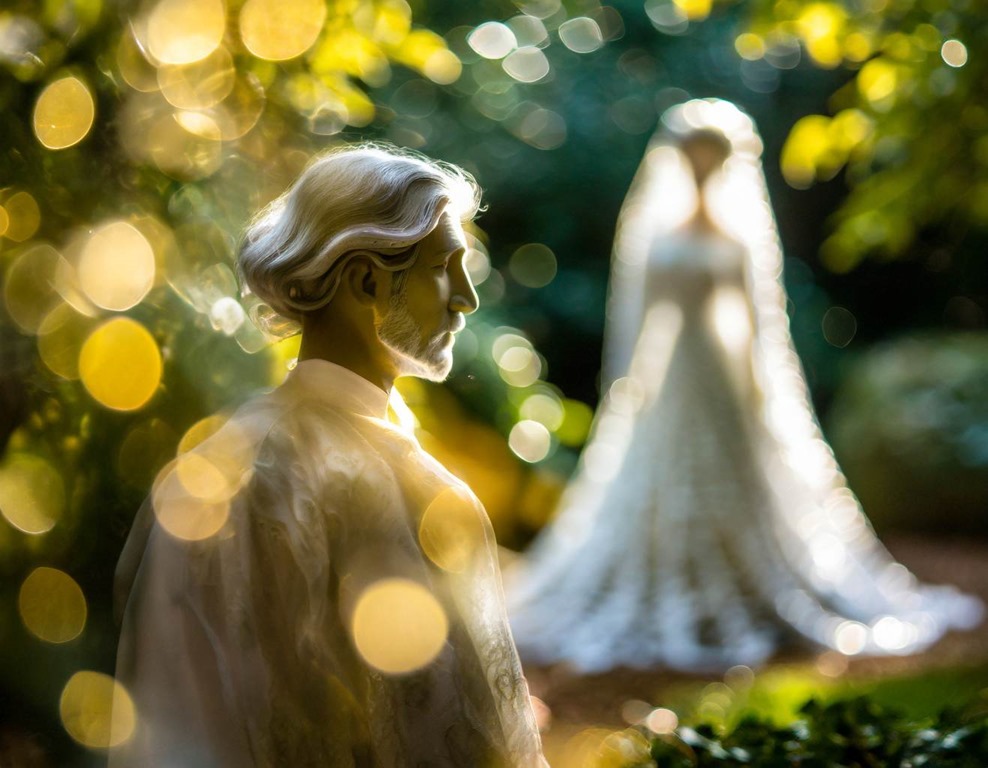
Ghost from a machine: illustration from Adobe Firefly, the AI engine that proclaims it doesn’t use uncompensated artists work.

.

Such a complex ghost, or a wish for a ghost, this is!

Does Hardy want to see the ghost? Does Hardy fear to see the ghost? Can either of them speak? Are either of them changed from what they once were? Is he haunted by her, or haunted from her? All the answers are all the answers here. The curly shape of the question mark the shifting curve of an ghost manifesting.

Spontaneously when doing the vocals for this piece I decided to throw in some more answers at the end of my song in the form of “inline epigraphs” that Hardy didn’t include with his poem, but this performer did.

You can hear my performance of Thomas Hardy’s “The Shadow on the Stone”  with the audio player gadget below. You don’t see a player?  This highlighted link will make one appear in a new tab.

.

Millay’s “The Little Ghost.” Does your garden have ghosts?

Last time in our Halloween Series, an A. E. Housman poem combined with music had death on a knife edge. Placed at the end of the growing year in northern places, Halloween comes at a time in a yearly cycle that suggests death. Note: that statement includes the word “cycle.” Humans have memory, and song, and eventually writing, so we know the turning round — the end of the growing comes before the white none of winter and before the regreening of spring.

Should it be so with death, that full nothing? Some hope and believe that so, though we can have no memory of that. But even one life has many turnings, places we pass through and leave. Today’s piece ends by portraying that we open and close gates of memory, gates that are no longer there.

Edna St. Vincent Millay wrote this poem of a non-threatening ghost. It’s an earlier work, and some see the ghost as a wisp of her not-long-departed girlhood. I’ll add that the choice of having the ghost appear in a garden speaks to the placement of Halloween in a harvest/leaving time of the year. Gardens have needs: nutritious soil, water, sun, and care. Perhaps they need ghosts from time to time as well?

The Little Ghost 1024

“She paused—then opened and passed through a gate that once was there.”

.

The music I composed and played for Millay’s “The Little Ghost”  shows South Asian influences, what with harmonium, tambura, and my vibrato note electric guitar playing. You can hear that combination of words and music with the audio player below. No player to be seen?  This highlighted link is an alternative, it’ll open a new tab with its own audio player.

A fantasy wherein death and death predicted is balanced: “Her Strong Enchantments Failing”

Today’s piece in our Halloween Series is clearly fantasy. What value has fantasy?

Well, it’s often fun; it exercises the imagination by giving it an unlimited field. This potential has a natural limit however — humans are uncomfortable with the unlimited. We are animals quite tied to limits, to the actual, the particular. Even fantasy not intended as allegory must reference those things inside the everyday limits of our world, of our time. The SF of the past is often quaint with those make-dos, specifics that seem anachronistic to the stories unknown time. Watching a Sixties Star Trek TV show we see the family on the Enterprise bridge, the patriarch in an easy chair, the subsidiaries at kid’s-height tables, mom at the Radar Range — and all are watching one screen in front of them. Their haircuts are all in style for our now past mid-century. The warfare tactics: broadsides and boarding parties, already obsolete when freshly filmed. Watching it now, the other side — our present-day watcher’s side of the screen — we are farther into the future than these characters are.

I don’t believe poet A. E. Housman retains the readership in the U.S. that he retains in Britain. His best-known poetry collection A Shropshire Lad  is as series of poems considering rural adolescence and youth in the 19th century. UK readers might likely find that place in cultural memory more easily than Americans — but Houseman was not just local color. He was a classical translator and scholar of achievement. He knew how to put classical restraint, objectivity, and concision to work in poetry, like in this fantasy poem I set to music a few years ago, and will present today: “Her Strong Enchantments Failing.”

Her Strong Enchantments Failing

I like to include these chord sheets here from time to time. It’s my hope that better singers will improve on my own performances. Lot of suspended chords here, as this song’s moment is suspended.

.

The poem is set in a timeless place, though time still has days and death. There’s magic and spells there, laid out in a sharply chiseled first verse. I love the cinematic zoom from falling castle towers, to empty potions, to a knife at the titular her’s neck. And as page-poetry it’s eminently singable; and for a performer, the compelling force of the storytelling is what every singer would want in a lyric.

The situation violently balanced in the final two verses may just be plot for the author. The Queen’s slayer is about to process his knife’s edge. The queen, who’s emptied her spells and potions knows that they will work in magical or biochemical time by the next day. I have no idea if Houseman had any intended allegory to a situation here, something that might have been clear and present to his contemporary readers. When I performed this in 2020, it was then a fine fantasy poem, so well-drawn and easy to sing. Today, I can look at this autumn’s news and find easy parallels to current events.

You can hear my performance of A. E. Housman’s “Her Strong Enchantments Failing”  with the audio player gadget below. Can’t see a player? Not a spell, just the limits of some ways to read this blog. Here’s a backup highlighted link that will open its own audio player.

.

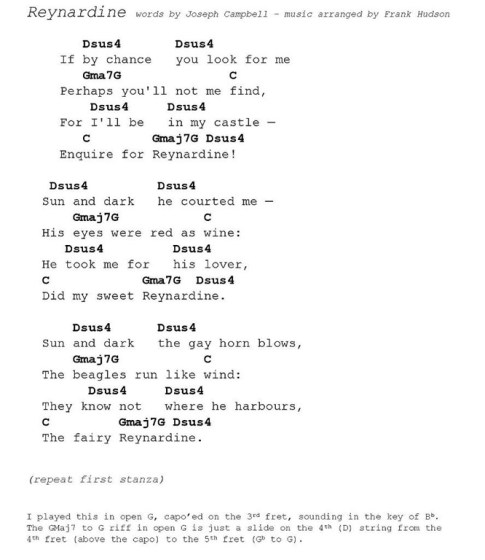
Exit the were-fox, chased by the land-holding patriarchy, “Reynardine"

Did T. S. Eliot for Halloween* suffocate our audience with too much of the musty air of the classroom? I hoped those loud synth fanfares would set such terrors to run. Maybe not. Well, I’m ready to tempt you back with a bit of love and seduction, a song set away from graveyards and into castles. Our Halloween series continues, and this time with 100% wooden music I played on an acoustic guitar.

So, ladies in nightclothes flaunting impossibly flowing but still in good array hair, running through the forest under a moon over the branches kind of stuff? Maybe. First some literary history. Don’t worry, I won’t take long with that, and there’s a good creature-feature song at the end.

We started our Halloween series with Frost and Eliot, poets that many will know even if poetry isn’t an interest. Today’s piece uses words from a well-known name that when applied to a poet isn’t well-known: Belfast writer Joseph Campbell is that name. Yes, every cursèd time I mention his name here I’m required to say “No, not the Power of Myth guy.” Poet Campbell was a contemporary of Yeats. And like Yeats he visited London when F. S. Flint, T. E. Hulme, and the “What’s with the initials guys?” Yank-transplant Ezra Pound were taking up their make-it-new idea to be called Imagism. Several years before Pound and Flint published their famous essay on the tenants of Imagism, Campbell published some of the earliest Imagist poems.

Campbell’s relationship with Yeats is complex. They both were heavily into valorizing Irish culture. Campbell was even more so into Ireland throwing off its exploitative English colonial status. Both seemed to have an interest in the faerie and spirit realms, though Yeats had an interest in practicing wizardry, while Campbell, AFAIK, didn’t. Both had interest in music, but Yeats was specifically resistant to having his poems sung conventionally, while what of Campbell’s work survives (underrecognized) is as a lyricist** for songs better-known than he is.

As a song, today’s piece, “Reynardine,”  became oft-performed in the British 20th century folk revival. When those performers would present it, they would introduce it as an old song — which is true in part. Its melody is largely based on an old air. The name of its main character, and something in the general trope of “I’m in love with a mysterious bad boy” did have old ballad antecedents. But those revivalist performers would usually want their audiences to know that the main character, the haunting love interest the singer knows but society doesn’t, is a shape-shifter, a were-fox.

Campbell’s words as printed in “The Mountainy Singer” are better, more direct, than the lyrics usually used for performing this song. I made one change: Campbell has “took me for his leman” in his, and I translated this to “lover” for clarity.

.

As I discussed briefly when I first presented this one a couple of years ago: that doesn’t seem to be so in the extant pre-20th century versions of this song. In 1909, our “Reynardine,”  now a were-fox eluding the patriarchy and foxhound driving hunters, was published in two books: as a collected Irish folk song from Belfast, and as a page poem in Campbell’s poetry collection The Mountainy Singer.  This idea of the song’s dark hero emerged that recently, and I have every reason to believe it was the little remembered Joseph Campbell who cast him that way.

I did my best with my performance of this one, thinking I was emulating those folk revivalists whose work I greatly admire. The one special thing I did was use Campbell’s set of words as printed in his poetry collection. With one small alteration, I think they work well to sing to modern audiences, and his version has the compression and specific mystery that can make Imagist poems and short lyrical songs compelling when contrasted with lengthy poems and discursive sung ballads. Audio player to hear the performance below. No player? This highlighted link will open a tab with a player.

.

*Unlike the other pieces I’ll present in this series, my settings of Eliot are not listener favorites. I watch the stats here while not spending much time trying to maximize them. Eliot draws some interest outside the U.S., and very, very little from here in the States.

I also want to say that I want to celebrate Halloween this year (more about why later in this series) and I want to do it as Emily Dickinson once wrote she did in approaching some topics in her poetry “I sing, as the Boy does by the Burying Ground — because I am afraid.” But writing as Eliot did of his unreal city of corpses that can’t be hidden, and casting it as a song of fantasy, vision, or delusion, can be offensive in a time where real corpses are piling up not from natural death, but from human intention.

If I offend you, you likely aren’t reading this far. I assure you I offend myself in doing so. “You! hypocrite lecteur! — mon semblable, — mon frère!” “You! Hypocrite reader! — my fellow, — my brother!” quoted Eliot, quoting Baudelaire, quote I.

**Even as the composer part of most of the Parlando Project, I want to say that a pet peeve of mine is folks crediting a song solely to the music composer. I hear this all the time with contemporary songs, particularly when the melodist has sung the piece: Brian Wilson, Carole King, Elton John, and so on. Besides his unacknowledged work in recasting “Reynardine,”  Campbell is the lyricist for “The Garten Mother’s Lullaby”  and “My Lagan Love.”

They don’t stay in the sodden graveyard. Our Halloween series continues with “Unreal City.”

When I said Halloween series, did you assume that that would mean the sidelines and backbenchers rather than the serious literary poetry we sometimes take out for a musical spin here? Let me break through that expectation quickly with today’s selection from seven years of the Parlando Project — it’s a part of a literary poetic landmark, T. S. Eliot’s“The Waste Land.”

When it comes to dread, I’m not a fan of jump scares — I rather prefer the slow build — but did I frighten some casual readers who are reaching to click to the next web site already? I hear you muttering.*  “The Waste Land’  — isn’t that long, boring, indecipherable, so full of stuff you need footnotes for?”

OK, so you believe you have a fresher aesthetic than some old Modernist war-horse — but I do wonder if there isn’t a chill as sudden as a just unconcealed weapon or bared fangs, a suppressed shuddering beneath the contempt. “Is there going to be a test? Do I have to write an essay on what it means — pretending it means anything  to me?”

Schoolwork. Many learn to love and to hate poetry in that single place.

Done over several Aprils here on this Project, I used music and performance in my serialized presentation of the whole poem to remind us of the abstract ways that music makes us feel through non-literal modes, without explications and decoder rings. The unreal city section of “The Waste Land,”  sliding for now over the specifics of place names and time-jumping references, is just a nightmare of the possessed and undead, of a speaker so PTSD’d by a world decimated by violence, epidemic, and careless oppression that the masks have fallen off the faces of his city. The dark humor of friendly small talk is of dogs digging up corpses.

Additional advisories: wear sunscreen, and don’t look directly at the sun without the proper filter.

.

You can hear the performance of the unreal city section of “The Waste Land”  with the audio player many will see below. No player visible?  This highlighted link will open a new tab with a player that will let you hear it.

.

*Sure, you have that over-tape or closed shutter on your web cam, but rather than composing, recording, or researching new pieces, I instead have been listening to the microphones on your devices. I actually don’t care what you say about parents, children, partners, bosses, or coworkers. I’m listening with dread to what you say about my making the best of my voice and somewhat restricted musical skills. Dogs digging corpses out of the garden aren’t scary compared to those fears.

And of those infamous footnotes in “The Waste Land?”   Have you considered this: are they a frightened nerd being asked to show what he means?

Our Halloween Series begins with “Stones Under the Low-Limbed Tree”

What’s coming up? Halloween! And I’ve decided to dedicate the rest of this month to accelerated posting of some of the Parlando Project’s favorite pieces of fright, fantasy, and the uncanny. There will be ghosts a-plenty, curses, creatures, spells, and graveyards. The Project has done over 700 combinations of various words (mostly literary poetry) and original music over the past 7 years or so. The poetry is of different styles and eras, and the music differs to, at least as much as I can make it do so.

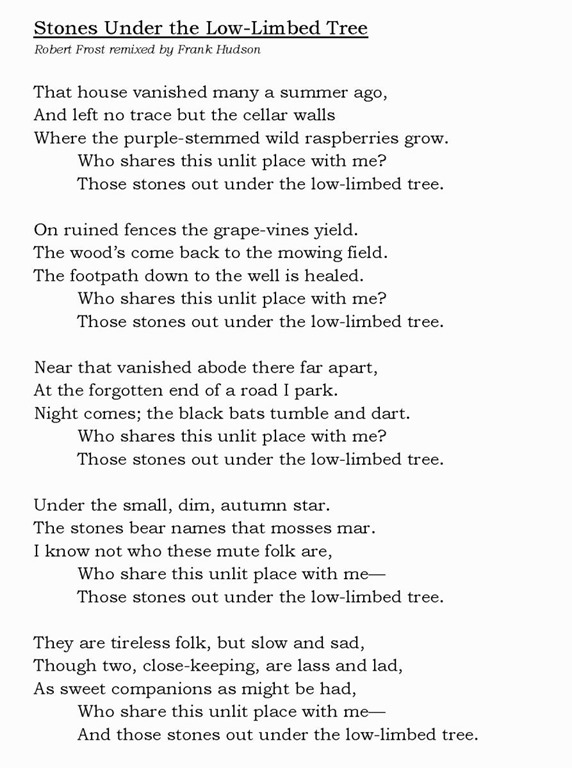
Here to kick things off is a poem by one of America’s favorite poets, Robert Frost, that I adapted and recast in making it into a song. Can Frost do eerie clothed in nature’s homespun? I think so. Frost called his poem Ghost House.”   I revised it enough that I decided to use a different title when I presented it in 2020 as “Stones Under the Low-Limbed Tree.”

If you compare my lyric to the original poem hyperlinked above, you can see I refrained things more than Frost did in his page poem

.

You can hear the resulting song with the audio player below. No player to be seen?  This highlighted link is an alternate way to hear it. It’ll open a new tab with its own audio player.

.