The Spider and the Ghost of the Fly

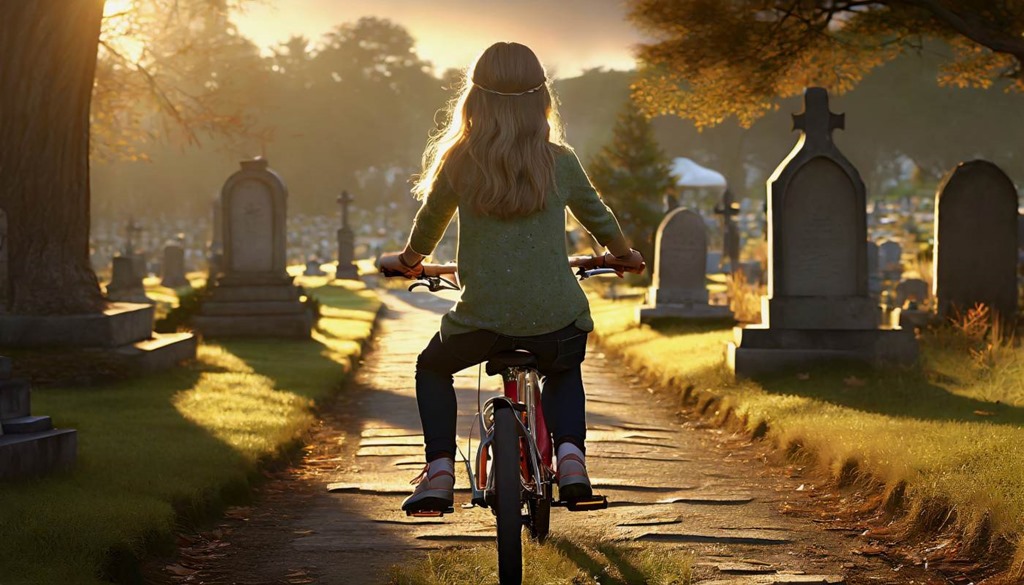
As Halloween approaches, here’s a song that focuses on the playfully frightful aspects of the holiday. Wait a minute – I debated typing “playfully” there with “frightful.” I went with that combination as it’s my best guess at the intent of the Vachel Lindsay poem that I converted into a song, though I can’t be sure.

Playing with fear and horror is clearly a part of Halloween. We expect children to celebrate the holiday, and the adults participating in Halloween celebrations plan them to be happy occasions, even though the decorations will be full of spiders and their webs, and monsters, and skeletons, and those dream-flickering pumpkin skulls.

But if you take the poem (now a song) at face value, this is about a woman who is personified as a predator, the femme fatale trope and her victim fly. Had poet Lindsay felt himself wronged by some lover to come up with this piece? I don’t have biographical evidence to point to with an emphatic gesture,* and the internal evidence within the poem speaks to me of a playful mode to the condensed tale of horror it tells. There seems to be a paradoxical agreement on the part of the singer: they’ve been done wrong, but they’re going to speak lightly about this, and while the song’s fly doesn’t say it out-loud, they might be open to just a little more peril.**

Spider and the Ghost of the Fly

A poem that literally describes tearing the wings off flies, yet I’m still holding it as playful.

.

Earlier this month I wrote about the mid-20th century “folk scare” in passing, and as someone who has some grasp of the songs revived by that movement, I couldn’t help but think that Lindsay referenced a floating verse that appears in some American folk songs. Did anyone else catch it from listening or reading the text above?

The spider takes her prey with the line: “She drove me to her parlor/above the winding stair.” Reading this, I immediately heard a specific tune – cementing the idea that this poem would get the Parlando Project treatment. What tune? One widely sung song that features the verse about a woman taking a lover to her parlor goes by the title “Cindy, Cindy.”   Besides the parlor destination – sometimes sung in the folk song as “She took me to her parlor and she cooled me with her fan” – most “Cindy, Cindy”  versions have devouring women in them too, with verses like “I wish I was an apple a-hanging on a tree and every time my Cindy passed she’d take a bite out of me”*** or even “My Cindy is a pretty girl. My Cindy is a peach; she throws her arms around my neck and hangs on like a leech.”

Quick research says that “Cindy, Cindy” was sung in America in the early 20th century when Vachel Lindsay wrote his poem. I’m going to suspect Lindsay knew one of the variations of it – and he might have thought some of his audience would too.

So, I’m calling it: playful. Likely erotically  playful.

I also suspect my music for today’s performance of “The Spider and the Ghost of the Fly”  had “Cindy, Cindy’s”  tune in its ear a little bit too. You might be able to hear that performance with the audio gadget below – but like the devouring and dangerous love between the spider and the fly, some of you may find the audio gadget hidden and suppressed. Aha! I have this highlighted link, a veritable grail-shaped beacon, that will open a new tab with its own audio player so you can hear the song.

.

*Vachel Lindsay and Parlando Project favorite Sara Teasdale were romantically linked for a time. For more on the story of how that turned out, you can read one of the most popular posts in this Project’s history. The Teasdale poem musically performed in that above linked post also talks about the surrender of love.

**As per Sir Galahad’s tale in Monty Python and the Holy Grail.

***This verse in the folk song rhymes in with the apple stealing fairies in Leigh Hunt’s poem from earlier in this month’s series, and I’d suppose the song’s connection of apples with erotic passion may echo back to the Garden of Eden. And that choice of Cindy as a name? Could that be evoking sin?
The Three Friends: an audio play adaptation of a Walter de la Mare short story

I indicated last time that I had another piece I wanted to present before Halloween by Walter de la Mare, that British master of the subtle supernatural. It took a bunch of concentrated effort to produce something of a realization of it, but it’s as ready as I can make it in time. How’d it come about, and why was I not sure I could promise it?

I use the Internet Archive often as part of this “not just non-profit — it’s non-revenue” Project. One of the things the IA has is a large library of scanned public domain literary works,* which affords me a handy way to look through “many a quaint and curious volume of forgotten lore.” In the run up to Halloween I made a note to see if there was some Walter de la Mare work I could use for my Parlando Project purposes.

This Project lets me not only explore the well-known writer’s and musical composer’s habit of procrastination, but also the reader’s and researcher’s branch of that foible too. I put that book search in my I’ll-do-that-tomorrow bin for about a week. “I’ll get around to it” I told myself.

And then in mid-October some numbskulls hacked the Internet Archive causing it to go largely offline for more than a week. When the scanned book section returned to availability, I was already into making other new work for this year’s Halloween series, but a few days ago I was finally able to access some additional collections of de la Mare’s work from the IA. In looking through those, I found that Walter de la Mare wasn’t only a poet. He also wrote short stories, which like his poetry, exhibit his dry sense of the strange. “The Three Friends”  is one of his shortest published stories — short enough to work into one of my short-format audio pieces.

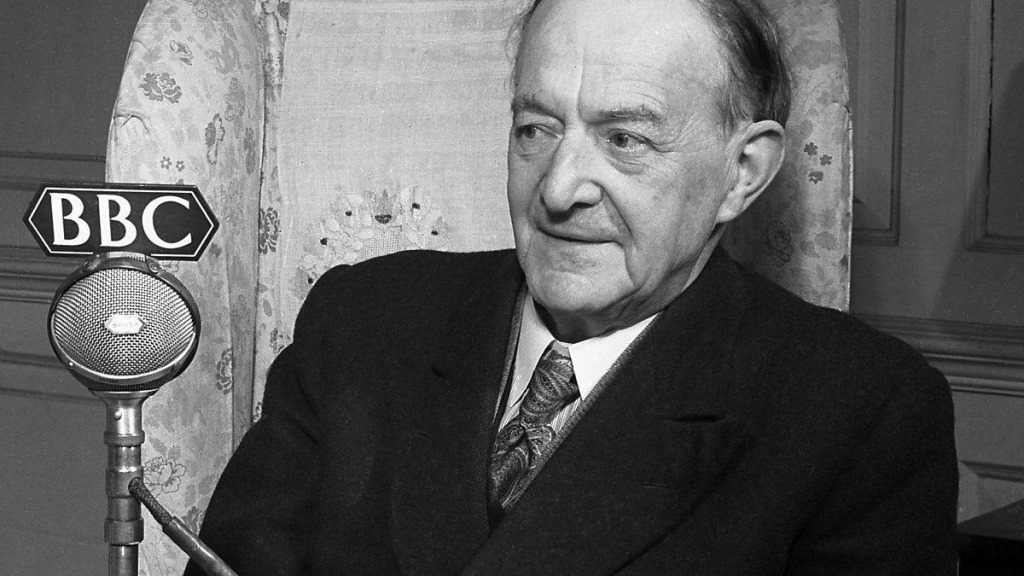
Walter de la Mare in front of a microphone

When Walter de la Mare worked the mic, he had a whole radio network to support him.

.

“The Three Friends”  is dialog-centric, and in less than a day I was able to jury-rig up a three-person play out of it — but who’d be my voice-acting ensemble? It was less than 72 hours until Halloween. I’d have loved to have used Dave Moore’s voice, but my production schedule is catch-as-catch-can, and I didn’t know if I could corral him in time. My wife agreed to play the part of Lacey, the tavern keeper member of the three friends, assuming she wasn’t completely worn-out from her work and the rest of her life. Last night she stepped up to the mic and recorded that part in a quick pass. I made a logistical compromise and recorded the other two parts with my own voice, also working quickly.**  By about 9 PM last night I had the dialog recorded.

Between then and about 3 PM this afternoon I worked on the audio production of the recordings, selecting a bit of instrumental music (from my last-weekend exploration of a new audio software feature) to serve as a plausible theme music for “The Parlando Project Theatre of the Air.” The 19 hours from first opening up the microphones to an audio play ready to upload weren’t all Project work: I did go to sleep after midnight, I got up at dawn and did a bicycle ride to breakfast, and early this afternoon I made another bike trip to the grocery store — but there was a lot of production work trying to meet the needs of this format that isn’t what the Project normally does. “Radio play” music production isn’t the same as recording and mixing a 3-minute song, and I had to learn how to apply my computer audio tools in a slightly different way. If you haven’t done audio production, it’s a heap of tasks even to get a half-way polished result: finding environmental sound effects, balancing levels, fixing the most egregious dialog glitches, deciding if any pauses are too long or too short, and so on. The result of this experiment is good enough to present, though I note things that I would have liked to do better.

So, what’s the story our actors are presenting for your ears today? Two friends are casually talking about a problem bedeviling one of them. That troubled man, Eaves, has been having reoccurring dreams or visions. His friend Sully tries to make light of it, but in the course of their evening they meet up with the third friend who works in a tavern, Miss Lacey. They talk over Eaves’ problem: you see Eaves thinks he has pierced the Samhain veil. Has Eaves seen, will he tell of, “the undiscovered country from whose bourn no traveler returns?”

Well, it’s de la Mare. Most writers would break out the purple pen to write such visions, de la Mare wants to make a more subtle (and human) observation. The orchestra (well, the piano trio) has started to sound. Take your seats and listen to the short, 10-minute world-premiere performance of the audio play “The Three Friends”  by using the audio player below. What, has someone tall with a large hat sat in front of your audio player gadget? I provide this alternative, a highlighted link that will open a new tab with its own audio player.

.

*The Internet Archive has also taken an aggressive stance to works that are not clearly in the Public Domain. That activity is controversial and has had some legal judgements handed down for rights-holders. I won’t take your time to go into all that, but its scanned PD literary archive is a treasure for readers and researchers.

**Oh, if only I was one of those skilled voice actors who can call up entirely different vocal timbres to create distinctive sounding character voices! I tried to mitigate the lack of distinction between Eaves’ and Sully’s voices both being portrayed by mine by using stereo separation on today’s audio

The Song of Finis

Last time in our Halloween series I reported that Edgar Allan Poe had movies made from some of his poems — well, sort of.  Today’s poet Walter de la Mare’s poetry, in title and under his name, wouldn’t have served for such, because so much of what de la Mare does is understated and inferred. He’s one of those poets that when read casually seems to not be doing as much as he’s actually doing. There may be no fireworks going off when you read a de la Mare poem of the supernatural— until after reading it once and remembering the poem later, you may sense the flash-bang-backs of what’s there and evoked.

Today’s Walter de la Mare piece “The Song of Finis”  is an example. It seems simple enough to be children’s poetry, and indeed his publisher bound selections of de la Mare’s more whimsical short poems to market them as children’s books. “The Song of Finis”  presents an eerie short scene and situation, supplying only the barest of details still rich in specificity, and wraps it all in some fine word-music that urged me to make a song of this proclaimed song.

The Song of Finis

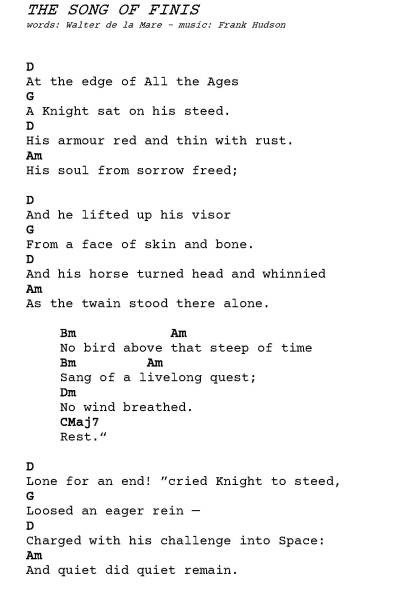
I present these chord sheets so that you can sing these songs yourself.

.

We have a knight, but one out of his time, yet still errant. The once shining armor is rusted.*  When he lifts his helmet visor, we see yet “skin and bone,” a choice that lets us imagine a gaunt face suggesting the skull beneath. He’s alone somewhere warm and windless (warm enough to summon the tea-time image of steeping).

There are but two lonely sounds of dialog recorded. His horse whinnies knowing something’s up, and the knight calls out “Lone for an end!” The latter is a bit poetic-dictiony, but I’ll allow it to depict the out-of-time knight, and I suspect de la Mare wants us to hear “lone” as double-sounding for “long.”

What happens in the poem’s conclusion? Does the knight and horse charge off some cliff to end his anachronism? Or is he challenging that empty place he finds himself in with that single cry that has no answer? My thought, it’s sort of both, the song of “Finis” is about endless endings, and the desire for one last adventure.

knight with angels 600

In de la Mare’s poem there are no angels

.

You can hear my song setting of Walter de la Mare’s “The Song of Finis”  with the audio player gadget below. It’s not finis is you can’t see that audio player, as I supply this highlighted link that will open a new tab with its own audio player. Not finis for me either this year, for my plans are to return soon with at least one more de la Mare fantasy piece before this Halloween charges into memory.

*As a fan of the 20th century Rock group Procul Harum, I wondered if the band’s lyricist Keith Reid read de la Mare’s poem once and remembered it in his song “Conquistador.”

Poe’s The Haunted Palace

Let’s continue our series of fantasy and supernatural poems with a musical performance of a poem by Edgar Allan Poe — a poet that might be expected to appear in any such series. Before we go to that poem and my performance, let me take a quick jaunt back to my mid-century youth.

Poe sat in a unusual place in literature back then (and probably still does now). His writing, including his poetry, remained in circulation. Unlike Longfellow, it wasn’t likely because it was deemed worthy lessons for young people — Poe’s writing kept its place for its gothic sensation into the 20th century. Without Poe or his sensibility, would there have been then a Vampira, EC horror comics, pedantic pulp detectives, Lovecraftian horror, a great deal of Heavy Metal lyrical content, or a post mid-life movie career for Vincent Price? And that’s not even broaching the topic of Poe’s influence on the French Symbolists, who took elements of his strange and abnormal on an emigration journey from the asylum to the academy.

For a year or so around middle school age, I went on a Poe jag, reading a great many of his stories in collections that also included his poetry. It was a short-lived enthusiasm, and I’m not sure what remains of it. Did I start there with my love for an unreliable narrator? Was the on-the-spectrum “Aha” moment attractive to me neurologically anyway before this reading? Since I can’t say, let’s get on with an example of Poe being the inevitable poet that a Halloween series calls forth when the boundary-line between the dead and the living becomes permeable.

The scenery about the ghosts in “The Haunted Palace”  is something of a poetic trope. Poetry loves a ruin, and poets being the unacknowledged back-benchers in the world of political power, there’s a draw to poems about the death of kings — and so we have poets writing “Ozymandias”  or “Jade Flower Palace.”

Poe though is drawn almost entirely to the sensuousness of the decay here. There’s no lesson about unwise or tyrannical rulers in the poem. There’s no tragedy — if we can even guess the kingdom’s tragic flaw it might be that it was all too beautiful.*  On one hand I find the poem a hallow poem of hollowness — but intended by the author or not, that hollowness is a statement about great kingdoms and their lovely riches. And the ending’s invocation of always escaping — and therefore not escaping — unsmiling ghosts of hideous laughter completes the poem with a powerful rhetorical burst.


Take a sideways jump to the genius of SCTV

.

Perhaps because of the simple harmonic structure of my musical setting, I worked some hours unproductively this week on additional musical decoration. I made two attempts at twin bowed-string lead lines for this, and abandoned both those ruins to our mutual benefit. After that wrong turn, I decided that the piece’s feature is more its swaying, understated groove which I left to stand for its value. Mid-century ghosts visiting this music are welcome to do The Frug or The Jerk while listening, but those on any side of the Samhain borders can visit “The Haunted Palace” with the audio player gadget below. Has such a gadget disappeared within a fetid mist? Oh, no matter, you can hear it with this highlighted link then, as that will open a pale-doored new tab with its own audio player.

.

*Poe wrote that the death of beauty was the ultimate poetic theme — the gothic manifesto in short. I’d note in that an undercurrent there that many (most) artists feel: that they create all their beauties, only for them to become abandoned ruins with rare and uncommon audiences. As Frank O’Hara’s fraternal twin brother Count Floyd said: Pretty scary, huh, boys and girls!

A Birthday, Vampires, and The Greatest Original Music Band Minneapolis Ever Forgot.

If Halloween is about shadows, ghosts, the dead and un-dead etc etc, it comes in the month I celebrate the birthday of my friend, the living Dave Moore, an occasional alternate voice here at the Parlando Project. Dave’s a poet, songwriter, cartoonist, and my longtime musical partner in the LYL Band. Back in the 1970s his lyrics were frequently used by “The Greatest Original Music Band Minneapolis Ever Forgot,” Fine Art.

I wrote about Dave and Fine Art a few years back. TL:DNR summary: Fine Art were a Rock band that emerged in 1978, issuing a self-produced, self-titled, vinyl LP, and then performing often in what few Twin Cities locations that were open to the handful of original music bands.* “Punk” was still the sticky label used for young bands that performed non-conformist new material then, but it was not a homogeneous scene of Ramones and Sex Pistols cadre three-chord-shouting-in-leather-jackets-and-frayed-cotton.**  Television, Patti Smith, Pere Ubu, Talking Heads — all these were formative bands in the Seventies, present at the beginning. Yet, oddly enough, labels like New Wave, and Post-Punk were generated to try to describe those that didn’t follow the stance of regimented simplicity for concentrated force and/or skill-set necessity. Fine Art were one of those from that non-traditional tradition.

As the famous Minneapolis First Ave club moved to presenting young original music bands, Fine Art played there regularly in the early Eighties, both in the small side-room the 7th Street Entry and in the big main room. When someone reprints a poster of that fabled club’s scheduled acts from that era to highlight Husker Du, The Replacements, Soul Asylum, or even Prince, you’ll often see the Fine Art band name playing the week before or after.

When this era is covered in overview, even by locals who want to concentrate on “the scene” not just the national acts that emerged, Fine Art barely makes the footnotes. That’s not exceptional, history-is-written-by-the-winners and all that. But here’s the thing: Fine Art’s material was all original (they never performed a cover), and it was very very good. The band two guitarists were excellent: Ken Carlson’s driving chordal center on rhythm guitar and Colin Mansfield the genius lead guitarist who could do song hooks or Free Jazz, sometimes in the same song. The two women lead singers format was unusual then as now, and the original pair Kay (Carol) Maxwell and Terry Paul, and later Kay and Jennifer Holt were effective. But it’s the songs, those constructions that were passing sounds on a club stage and remain only on the barely surviving and out-of-print records that shock me to revisit. They’re still  unconventional — and as such, they still sound fresh 40 years later. Dave’s lyrics are part of that, even if he wasn’t the only lyricist in the band.

Vampires. Coffins. Fear of being suffocated. A song with a Dave Moore lyric from Fine Art’s LP issued at the start of the band’s existence in 1978.

.

Fine Art didn’t survive past the Eighties, but the LYL Band still gets together. You still can hear songs Dave wrote and ones he contributes to here sometimes. I do my best trying to be musically adventurous to support Dave’s words.

In one’s youth you are told you should think of the future.

Generally, you don’t.

In one’s old age you are said to think too much of the past. I generally don’t. A smaller future is the treasure I consider, the treasure I want to spend. Playing with and knowing Dave is part of the treasure.

.

*I think this surprises some younger indie musicians or fans today. In the Twin Cities in the Seventies, if you wanted to play in public in a band you were expected to perform songs people knew, which meant cover songs. If you wanted to buck that trend, there were in 1978 maybe 2-3 places that would let you try it. When you hear of The Replacements doing one of their live piss-take cover song tangents, there’s likely just a bit of residual anger at that constraint behind it.

**In retrospect, many assume an amoeba, fish, surfacing amphibian, stooped monkey, biped man with club picture of how indie evolved from punk. But the earliest CBGBs bands were a very mixed lot. The Ramones stood out  because of their fast, faster, and fastest strumming rock minimalism in that scene. And Ur-source band The Velvet Underground mixed simple and complex, pop ambition and alienation noise with abandon. New Wave and Post-Punk existed from the beginning — or before the beginning. Fine Art may have produced fewer hard core adjacent songs as the band evolved, but they were always composing fresh, heterodox musical concepts.

All Souls’ Night, the conclusion of our Halloween Series

You may wonder if our Halloween Series has continued past Halloween — but in pedantic fact,* the calendar date referred to in this poem’s title is November 2nd. Halloween has no particular religious element for most these days in the US, but originally it was All-Saints’ Day Eve (saints=hallowed people), the day before that observation.

That Halloween was for spooky, eerie, and likely non-Christian things was kind of a “get that all out of your system before the day for all saints comes around” proposition. So, if All-Saints’ day is on November 1st, what is this next-up All Souls’ Day? It’s a day for all the dead souls who aren’t  saints — that is to say, for most of us. The ubiquitousness of the total of all those who’ve ever lived, minus those few that were saints, is a likely cause for this holiday to fall into obscurity. It’s the Participation Medal of the holy calendar.

Similarly, the author of today’s text, Hortense Flexner, is not a famous poet, though she spent her entire life working in the field of literature and education. For some reason, probably the effectiveness of the poem and its continued relevance, this single poem out of her life has survived her to be passed around the Internet and in publications as a Halloween poem.**  She subtitled it “1917” on publication, no doubt in reference to the suffering and casualties of WWI — but it’s since needed no dated subtitle. I’m risking little to suggest few read it now as a historical document of situations more than a century old.

All Souls Night

Once more I present a chord sheet so that other singers can spread the singing of this.

.

Today, to anyone her words reach in times of fresh suffering and a glass separation between those comfortable and those afflicted with new death, “All Souls’ Night”  requires no further instructions from me. I’ll just say there’s an audio player gadget to hear it below, and if you don’t see that, I supply this highlighted link that will open a new window with an audio player in it.

.

*I have family members who were Protestant ministers. I’ve had friends who had at least passing familiarity with the Catholic religious calendar — but I’m evidence in that I knew Halloween in its devout practices of costumes and candy, and vaguely its religious connection to All-Saint’s Day, but nothing at all about All Souls Day.

**Although this poem is the last in my Halloween Series this year to get a blog post, a previous post here presenting “All Souls’ Night”  has gotten steady visits throughout the past few weeks.

A Winter’s Tale: A cold mystery for Halloween

Having done over 700 audio pieces in the more than 7 years of the Parlando Project, I take pride in the variety of the original musical settings I’ve supplied for them. Oh, there are more than a few of the performances over the years that embarrass me: stuff were my problematic vocals don’t deserve parole, or arrangements where I can’t now tell how I ever thought they worked, or those where it would have been better if I’d had access to better musicians than my overdubbing, but many of them still sound good to me.

None sounds better than this one as we near the end of my Halloween Series presenting some of the listener favorites from those 700-plus pieces. “A Winter’s Tale”  sets a should-be-better known poem by D. H. Lawrence. For some of you that poem’s climate is going to seem premature — and you may even wonder why it fits a Halloween theme. I assure you in Minnesota, in the northern parts of North America, this poem is not out of season. We’ve had no snow yet, but my morning bike ride was –5 Celsius. And tomorrow? Those thin polyester costumes sold at stores for trick or treating are not right for many a Minnesota Halloween. And any creativity in making one’s own costume is suppressed by the eventual need for an overcoat which will cover it. And what of Lawrence’s poem — here’s a link to the text of the poem — what’s Halloween about it?

Winters Tale 1080

A long way between houses just for some candy.

.

Well, it’s quite mysterious. This is the third time I’ve presented it, and I’m still not sure what the specifics of the described wintery mystery are. At times it seems like a breakup or strained love poem. Other times it seems like a hunting poem, metaphorical or not. It may have some connection I’ve not fathomed to Shakespeare’s play concerned with virulent mistrust. If it’s a hunt, I can’t even say who the speaker/singer and the hunted are. One or the other may even be Winter itself. That mystery and the air of danger are enough to make it a Halloween poem, and after my musical work, a Halloween song.

You can hear it with the audio player gadget you should see below. No player to be seen? This highlighted link is a backup that will open a new window with its own audio player.

.

“Stones,” rolling slowly and backwards

Nine days ago I started this Halloween Series with my sung adaptation of a graveyard poem by Robert Frost. Now we’re nearing the end of the series, and today I’m going to present another graveyard poem that sits with my sense of Halloween, Ethna McKiernan’s “Stones.”

I also promised in the beginning of the series that I would say why I’ve decided to make an extra effort to note Halloween. Decades ago, I met a young man (we were both young then) who had many interests, John Brower. The immediate bond: we both loved unusual music, not just strange or adventurous Rock that one could find in many a large record store back then, but harder to find Modernist orchestral music, and the even harder to find musics from other cultures around the globe. John also had a strong interest, much stronger than mine, in fantasy and horror genre fiction and film. What links those two groupings? For one thing, they were outsider-ish things then. If you want direct evidence of this mysterious connection you only need to investigate the trope of using the musics of the first of John’s interests with the movies and TV shows within his second one. The first signals the second: dread, tension, and the unknown. Scary movie, unknown planet, unsettled minds, eldritch times and places, it was a good chance that the less tonal string sections, the theremins and early electronica, the gongs or tuned percussion, the swooping vibratos and strange timbres of otherwise unheard avant-garde or exotic musics would emerge in the soundtrack. In the obverse, can anyone think of a well-known happy or loving scene similarly soundtracked with odd music? I can’t.*

But that doesn’t explain John. He gathered about him an eclectic mix of folks interested in these things, many of whom would be loners by inclination or classification. And every Halloween he would take them into the dark autumn north woods to his family’s cabin for a celebration of the holiday of the things less -heard than feared, we all in this group lit by the light of frightening movies until deep into the night.**

John grew up, continued to be engaged in many things, keeping those core interests and working to foster them. Then he died suddenly, while still young by the way I’d measure lifetimes from my current age.

There so much more to his story, and I’m sure parts I don’t really know, but within the briefness I prefer for these posts I want to say that I learned things from John and his enthusiasms, and in the scattered pre-Internet age he was a rare ear interested in some of the things that I spent my time thinking about and seeking out. Two decades after his death, I still will hear a piece of music, see a movie referred to, or encounter a piece of dark fantasy, and I’ll think of John, remembering some of what he thought of it, or I’ll be occasioned to consider what he might say about it today,

John had this spirit of Halloween, the old spirit of the things we repress and shush-up the rest of the year. Now, long after his death, and the death of others who so graciously tolerated and helped inform my interests in music and poetry, I have this personal graveyard in my head that I’m tending. As the Blues Poet Bo Diddley sang, I find “I’ve got a tombstone hand and a graveyard mind…”

Stones Illustration 800

One of the most striking and effecting poems in my Halloween Series, Ethna McKiernan’s Stones. If you want more, and I’m thinking some of you will, buy her book, linked below.

..

Which brings me to today’s poem I set to music. Regular readers may recall Ethna McKiernan from earlier posts. She was part of a small poet’s group alternate Parlando voice Dave Moore and I were part of — and unlike Dave or I, she published her poetry regularly both locally and via her connection with Ireland.***  She died nearly two years ago now, but in my head she has a mind’s gravestone like my late wife, like John Brower, like Ethna’s friend and poet compatriot Kevin FitzPatrick.

Poets, musicians — we play in our heads all the time. We look back at inscribed dates inside there, and compose in that dark using beats and sounds strung over time. Those beats come to rests, those sounds fade to silence. When I set Ethna’s poem “Stones”  to music I chose to refrain a line from her beautiful poem so that it won’t end before you pay attention to it: “I am watching over all of you.” In Ethna’s poem that line is hauntingly unclear by design. We the living are charged with watching over our personal graveyards. We hope, transparently and by wisps of sight, that their residents are also watching over us.

Happy, yes, Happy Halloween that we knew them. The audio player to hear me trying to do justice to Ethna McKiernan’s poem “Stones”  with my own music and performance is below. No player on your screen? This highlighted link will open a new tab which will supply you with an audio player.

.

*While the avant-garde or the exotic was only used for terror and unrest, for some reason the foundational composer of western classical music, Johan Sebastian Bach was the other go-to music for frightening undercurrents. Why? As young children, did filmmakers sit under towering pipe organ tubes fearing that wolves would appear out of that forest, or that teetering from low notes, that they would fall over and crush them?

**John was one of the first folks I knew with a home VCR, and even as video rental stores started to emerge he proudly purchased movies he admired, just has he collected esoteric avant-garde records, and small-press books. Neither of these things were inexpensive to his income level then, but he considered this his form of patronage of artists and their art.

***As she was dying, Ethna finished her final new and collected book, and it’s very very good. You can order Light Rolling Slowly Backwards  from your local bookstore or from the publisher at this link.

William Blake’s The Poison Tree

There’s much commerce between fantasy and fable — and William Blake, as literal as he may have drawn the angels of his visions, was one such trafficker. In this poem a metamorphical form of pomology creates out of anger a beautiful, attractive, and cursed fruit, so I thought this poem suitable for our Halloween Series.

One question asks for an answer in Blake’s poem: what makes the poison apple grown from wrath, fear, and tears “bright” and “shining,” and eventually so irresistible to the poem’s enemy?

Many readings concentrate on the poem’s singer, the one who instead of forgiving as he had done with a friend, grows their anger, sorrow, and fright into the Poison Tree. But let’s consider the other party, their enemy. Let’s look at the song from their view.

The emotions that grow the Poison Tree are often stronger than the more positive emotions like trust, love, and mere happiness — and the alloys of these negative emotions can be made into purer metals. Thus the human reaction, however unacknowledged, to envy the tactics of our enemies. Oh, what great evil they use, how powerful that is, how greatly we’ve been hurt by it — so, shouldn’t we be allowed at least some of the fruits of that tree? No, not all the root and trunk of that evil —for we are not like our enemies, — we are just owed a little of that power, maybe one apple?

The poison apple “shines” because it seethes with the power of hatred. It’s “bright” because the dark fruit becomes reflective the moment we reach to pick it. A convex apple is a strange mirror. We see ourselves magnified, we see our enemies too, we see wrath distorting us.

Blake’s fable in that reading says then: do not plant that poison tree from the injustice done to you, as the poem’s singer does, for the fruit will be impossible for your enemy to resist. “Oh, that’s not so bad,” you may first think, “the foe ‘is outstretched beneath the tree” as the poem ends. But beyond the poem’s ending there’s another refrain: the foes survivors have wrath, fears, and tears — and a seed poison apple for another tree.

One thing I admired about Blake was his multiple skills, out of which he created the poetry, the book design, and the artwork for his Songs of Innocence and Experience. Indie!

.

My performance of Blake’s “A Poison Tree”  is full of the sound of an American invention most often used by British bands of the late Sixties and early Seventies, the Mellotron. The Mellotron was supposed to be a home or light theater/salon entrainment device. It had tape recordings of instruments, including recorded sections of orchestral strings and woodwinds, one recording for each note to be triggered by a keyboard. When it was discovered by rock bands they found they could saturate their recordings in these orchestral textures. Because the articulations of the taped instruments were “canned” not freshly played, the result was a little ersatz — but eventually this was embraced and the output of the polite Mellotron was sometimes patched through overdriven amplifiers like an electric guitar might be. That’s part of the sound in the LYL Band performance of “The Poison Tree”  that you can hear with the audio player gadget below. No player?  This highlighted link is an alternate way to hear it, as it will open a tab with its own audio player.

.

Emily Bronte’s Cold Halloween Spell

Continuing our Halloween Series featuring some of our listener’s favorite fantasy and supernatural pieces from the seven years of the Parlando Project we get to today’s short Emily Brontë poem “Spellbound.”   Once more we have an eerie situation with withheld information that adds to the mystery while paradoxically compelling our attention.

Before beginning the Parlando Project I was only aware that Emily Brontë had written poetry, holding that fact as having no other consequence. I’m not even sure what drew me into her poetry — memory fades — but it may have been finding out that another Emily, Emily Dickinson, read it. Brontë’s poetry, which preceded her famous novel Wuthering Heights,  was at least partially extracted from a series of writings she and her young siblings created within a set of fantasy worlds — and though this short discussion of Emily and Anne Brontë’s imagined world of Gondal doesn’t list this poem as being part of that universe, “Spellbound’s”  setting doesn’t sound out of place from the northern, winter island in their Gondal.

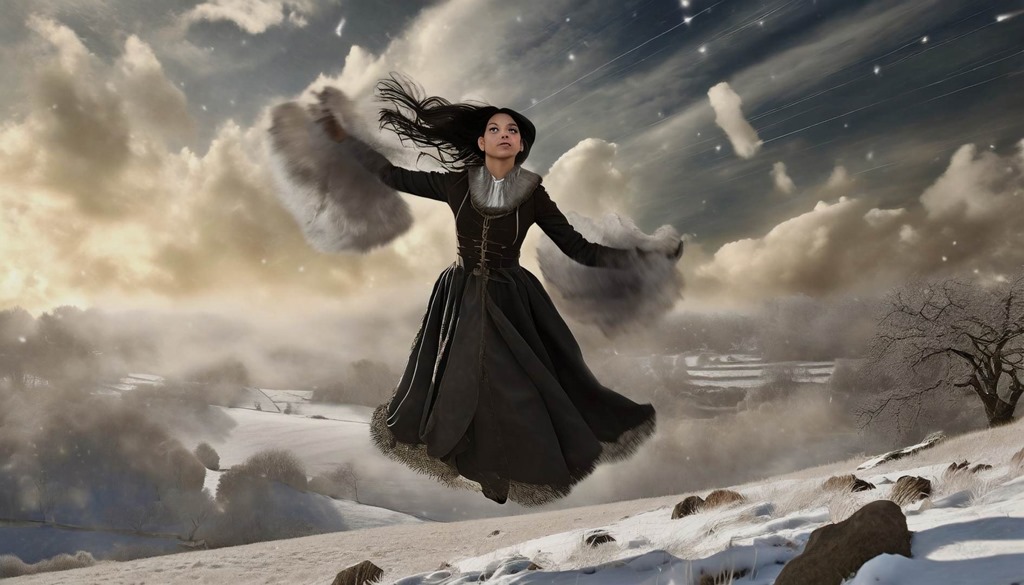
Nor out of place in the northern U.S. where I live, where the wind and weather is casting us to cold with predictions of snow and ice within the next 24 hours. When I first presented this poem three years ago,* I was intrigued by the prepositional position that the poem’s speaker seems to be in. In the poem they say that clouds are above them and the wintery wastes are below. It could be that Brontë was only envisioning a highlands or hillside perspective, but my mind’s eye had the spellbound speaker suspended, frozen in mid-air. Perhaps again, my imagination overtook me in that detail, but then I’m glad for Brontë’s imagination which created this chilling and enchanting poem that let me picture that.

Bronte's Spellbound 1080

Another illustration created by enchanting Adobe’s Firefly with an incantation. Firefly claims that it doesn’t use uncompensated artists work in its AI model.

.

I rather like the music I came up with for this one. Maybe you will too. An audio player is below for many of you so you can hear the performance of it, but some ways of reading this blog will suppress that page element, and so I also offer this alternative: a highlighted link that will open its own audio player gadget.

.

*If you follow this link to my original presentation of “Spellbound”  you can see the lyrics as part of a chord sheet in case you would like to perform this song yourself.