Young People Scream

Today’s post will combine a few things: there will be a link to a video of a new odd cover version of a song “Young People Scream,” written by someone who’s not Bob Dylan, and I’ll continue the behind-the-scenes story of how I’m making new musical pieces, but first I’ll explain why posts and interactivity from me has been low since the last part of June.

I’ve been sick for over a week with some kind of respiratory bug, and for a big chunk in the middle of it I was about as sick as I recall being for decades. At the worst, I was feverish and my stamina was very low — walking to the bathroom was a chore. I slept off on through a few days, and when awake I was foggy, unable to deal with any complexity.* Things have been improving over the past couple of days, though I still have a cough and tire easily. My wife preceded me with the same crud, and she’s still got her cough, so I’ll likely be dealing with that for a while yet.

I’ve been exploring some changes in how I record with my long-time friend, poet, songwriter, keyboard player, and alternative Parlando vocalist Dave Moore. A combination of things is suggesting those changes, part of which is that Dave’s playing skill-set has become constrained with age’s infirmities. I wrote last time that MIDI will give us new options to ground the pieces’ chordal cadences within modern computer recording software. Will this work, or do I even know exactly how I’m predicting it will work? Don’t know yet. I’m getting some more cabling next week that I’m thinking will offer some additional audio routing in my studio space for Dave, but today’s cover song recorded in June is an example of a way MIDI was used to shape a recording.

Super-quick intro: MIDI is a way to record things, but it doesn’t record audio. Typically, it records what actions happen when someone plays a controller — in Dave’s case, a piano-style keyboard. If Dave presses the C, E, and G keys on that keyboard, MIDI records when he pressed each of them, how hard he struck them, and how long they were depressed. The sound of that C Major chord we hear when those notes are playing together is created as a separate step. As he plays, a sound is heard, just as if he was playing an organ or conventional electric piano, but this sound is generated by software with only a small fraction of a second delay. An entirely conceptual composer could even play MIDI with no sound, but aside from Conlon Nancarrow humans naturally want to hear sounds when they use the controller keyboard.

As Dave played today’s piece live with me a few weeks ago, he heard a combo organ sound as he played and sang his part. There was a drum loop going to give us a time reference, and I played the electric guitar part you will eventually hear live with Dave and the placeholder drums.

Afterward I listened analytically to what had been played live. His without-a-net, one-pass vocal worked — and as I’ll talk about in the next segment, I discovered that I loved the song he chose to sing. My guitar part was meh, not good enough to feature, but not totally dire. That organ part? It had a few stumbles, but the greater problem was that the vocal had a nice laid-back groove, but the organ’s characteristic timing, attack, and timbre didn’t mesh with that feel. How to fix?

I extracted the MIDI from what Dave played, stripping things back to the chordal structure divorced from the sound. I used that chordal structure laid bare to guide an upright bass part, and using acoustic drum sample patterns I created a Jazzy-sounding drum set track. Having the drums, bass, and guitar grooving together, I used the program that extracted Dave’s chords for me to play that chord information derived from the live performance with a grand piano sound instead of the small combo organ Dave was hearing as he played them live.**

The resulting piece is here in this video.

.

Now what about the song that all this work was done to present? I suspect “Young People Scream” speaks to something some young people are feeling. Hell, I’m not young people, and I’m feeling this! Given that it was first released in 1982 by a still in his Twenties singer-songwriter Robyn Hitchcock, there’s a lot of ambiguity and context shifting when we experience the same song today — probably was so from the beginning too, because Robyn Hitchcock has a long career that I’ve admired of writing songs that are attractively elusive. He may do this using surrealism’s tactic, the remixing normal to seem strange, but in this one I sense asides to irony and satire.

Hitchcock’s own version on his Groovy Decay album was performed with a rock-a-billy arrangement. This would have been then a 30-year-old musical style, but one that had been revived by young musicians spinning off from the Punk and New Wave musical rebellion — and so, “Rock This Town” by the Stray Cats was a 1982 hit. Conscious or not, I suspect a certain slyness on Hitchcock’s observation and choice there: young people in 1982 using their parents’ youthful rebellion’s mode — a mode they’d largely abandoned with embarrassment as those thirty-something Boomers moved on to the modern Rock and pop sounds or the “Greatest Hits of the Sixties, Seventies, and the Eighties.” As the first verse has it, tweaking those younger rock revivalists by telling them “It all been done before” could get a “don’t care” reply.

Despite the upright bass in this current LYL Band version, it’s not hot-tempo rock-a-billy. Instead, I wanted to let the tension-releasing satiric vitriol delivered with a dry “just the facts” attitude by the singer come through. Even if he’s not literally screaming, I think the singer, to a degree of undercurrent, has to appear driven around the bend with their disgust at the older generation — and while I don’t know the author’s intent, I think Hitchcock’s words convey that indignation. The video ends with the on-screen statement it does because I’m “older people” and I’m disgusted, though my throat is still too sore to scream aloud today.

*It was difficult to read when awake, though I had some intense fever dreams while sleeping for entertainment. I did catch up on some episodes of A History of Rock Music in 500 Songs, which are outstandingly detailed and interwoven. If you like the surprising stories and unlikely connections I do here, and would like that sort of thing done at greater length and intelligent confidence within the world of Rock and popular music, you will like this too.

**The program I used for this, Toontrack’s EZKeys, does a pretty good job of automatic transcription. I’ve also used the Capo transcription app for this, but I think Toontrack’s chord detection may use some musical context information that Capo doesn’t in order to get closer to a useful chord sequence right off. Something that EZKeys clearly does: it allows one to apply music grooves or feels to the chord cadence it extracts, which saves considerable time. Those with good harmonic ears could of course do this by hand (with one’s ear? Musicians, we poets will dock you for mixed metaphor!)

Langston’s Blues (Dreams)

Some of you made it through my summarization of the musical career of the Cats and the Fiddle Jazz combo this week, but even though I was writing about music, we didn’t add much poetry there. One little thing I found out since I wrote that summary: that eBay matchbook collector item should have tipped me off about the site of one of those young Chicago kids’ gigs — a way stop on a trip to Hollywood to try breaking into the movies. It wasn’t at the “Airplane Café Club” as Marv Goldberg had it from his research, but the “Aeroplane  Café. I’ve found a postcard. Looks pretty swanky. I wonder how the Cats act went down there in 1936 — did the Denver white swing kids dig their act? Four or five years later I’d give our band of audacious teenagers better odds on that.

Well, however they were received, they were young, they had dreams of a career ahead of them.

Aeroplane Cafe

Looking at what musical acts were playing Denver at this club and elsewhere during the ‘30s, it was mostly white bands for dancing. Black bands started appearing on the bills in the ‘40s. My research said the Aeroplane Cafe lasted until the ‘80s, hosting in its last years rockabilly bands.

.

So, let’s combine some literary poetry with music, Parlando style today. The words are by Langston Hughes, one of the first poets to recognize that Blues and Jazz were poetic, suitable for praise in poems, suitable to combine with Jazz words he’d contribute. When the young Hughes wrote today’s words for publication, he called the short poem “Dreams.”   I heard it as a kind of Blues, a Blues with a sorrowful side, but with an admonishment to endure. If some reading this are having a February of backlash and disappointment tempting despair, this is after all Black History Month. Afro-American poet Hughes knew that dreams may well be knocked down, ignored, belittled. Yes, I know the word “woke” is a word in present contention. I find it odd it is used by those who smirk and dismiss the word as they speak it, aiming it toward those who know very well the reasons that dreams are extinguished.

Hold fast to dreams
For if dreams die
Life is a broken-winged bird
That cannot fly.

Hold fast to dreams
For when dreams go
Life is a barren field
Frozen with snow.

I’m looking at a bare and snowy landscape out my window this evening. I rode to breakfast in 10 degrees with a cold wind this morning. I read the newspaper when I got to the cafe, because I’m a man who still spills eggs and hot sauce on the news in the morning. None of the news was good.

I spent my last couple of days making the musical piece work as well as I could make it, tickling an old guitar that I played when I was young, playing piano the way I can: a finger or two on the keys, tracking the left and right hand parts separately to disguise my ham-handedness — because music may find a way. I sang Langston Hughes’ words quietly, mouth up near the microphone. I had to, it was near midnight when I sang them, and my family was asleep and I want them to keep their dreams.

I want you too to keep the sweeter of your dreams. Waking right now can script all the nightmares and anxiety dreams that need no help. When the best mysteries come under the eyelids, ones almost too good to remember, I want you to keep them, even just the sense of them.

The audio player to hear my adaptation of Hughes’ poem I call “Langston’s Blues”  can be heard with the audio player gadget below. No gadget? It’s off dreaming, but you can also use this highlighted link which will open a new tab with its own audio player.

I’m planning to return in a few days with more on why I wanted to work at figuring out all I could about that young Jazz combo of the 1930s and ‘40s.

Timothée Chalamet, A Complete Unknown, and a mid-winter song: Three Angels

I’m trying to decide between work on finishing a new Parlando piece combining literary poetry and original music, and seeing what I can do for a February Black History Month observance here. The first is mostly done, the latter is but ideas at this late date.

What to do? In my typical direct approach, I did something else today. This weekend I watched Timothée Chalamet appear on Saturday Night Live as the musical act on the long-lived sketch comedy television show. Chalamet is fresh off an acclaimed performance as the young Bob Dylan in the film A Complete Unknown.

I mostly liked that movie. Biopics are always dodgy things to do, as most people’s biographies when told straightforwardly do not have enough dramatic concision to make a compelling two-hour film. Which means they all have fibs in them, and they will perforce leave things and people out. It’s become an apparently unavoidable cliché to remark on this element by quoting a line from another film, The Man Who Shot Liberty Valance: ” When the legend becomes fact, print the legend.”*  This misses the point of John Ford’s great film. When that line is uttered near the very end of that movie, Ford has shown us a compelling tale of a man, played by Jimmy Stewart, who had many great things about him, a man who at the end of the film had risen to become an honored Senator, a plausible Vice President even — but Ford also told us of another man, played by John Wayne, who may have been less interesting as a biography, but whose acts are critical to the movie, and who gave up more than legendary fame when making his choices. Ford isn’t praising that “print the legend” eventuality. Ford’s film prints “the fact.” He thinks that’s more interesting.

A Complete Unknown  tries within conventional running time to tell a complex story: of a young man who’s forming himself — not so much finding himself — as he wants to be unfindable. Instead of doing a “great man” tale, it wants us to see the other folks around him, lovers attracted to and understandably frustrated by Dylan; and a pair of men: one a businessman, the other a saint of citizenship (Albert Grossman and Pete Seeger). In between these, Johnny Cash plays an imp of the perverse. That complex tale is told at a brisk pace. I was able to forgive that. Yes, there are characters undervalued, incidents re-arranged in the timeline — but in the movie’s defense I’d say it couldn’t be otherwise, there were just so many  talented and interesting people in that time and place.

And then we got to the final incident, the film’s climax. Here time is suddenly allowed to expand and we are given more detail about something that lasted maybe 48 hours in real time. Some of that detail is accurate, much of it is not. Most of the inaccuracies are aimed not to expand the complexities of the relationships and times, but to simplify them and underline a simplistic point. Finally, the movie has introduced all these characters, and this is the place where the earlier parts of the film are exposition, and you can get them to fully spark and rub with their differing viewpoints. Instead, that doesn’t happen, you get instead a rock’n’roll pantomime, with caricatures shouting and everything but a pie-in-the face fight.**

This is not the fault of the performers though. The cast does a fine job, and before his actual work could be seen, Chalamet’s ability to pull off his performance as Dylan was generally doubted in online forums of musicians and music fans. He did fine, and as the movie publicity has informed us, he “did his own stunts” by learning to play guitar and harmonica and to sing live, and this led to this past weekend’s choice for him to appear as a musical act.***

Again, Chalamet exceeded expectations. His opening Dylan song, “Outlaw Blues,”  (done as a rap-chant with Jack White/Black Keys-like elements in the ensemble) was fresh and effective, including that Minnesota call-out to being “9 below zero at 3 o’clock in the afternoon.”  Even more surprising was Chalamet immediately going down-tempo with a real rarity that would have stumped all but the deepest of the deep-cut Dylan fans: “Three Angels.”   It’s a brief song from a now little regarded Dylan album New Morning.  It seemed a throw-away even in that less-celebrated collection, an off-hand narration of an urban winter scene post-Christmas. From my Parlando focus, it attracts me though. It’s got some elements of one of poet Frank O’Hara’s “walking around poems,” that paying attention to what we are not usually paying attention to mixed with a casual surrealism. Everyone in the song seems a non-sequitur somehow, and why does the truck have no wheels, why is the cop skipping? Three fellas are “crawling back to work” under the same number of angels playing silent fanfares in snow, and we may not know if those three are wise men or not, as nobody stops to ask why they are going to work. Here a link to his set of performances.

So, I admire Chalamet’s taste in Dylan songs there. Perhaps if he lives to my age he’ll also be good enough looking to play me in my biopic. But watching his performance my ego remembered that decades ago I did a cover of “Three Angels”  myself, one done early in my ability to overdub parts creating a one-man-band on a recording. Today I found the recording and made this short video to present it.

I think I did this recording on a “portastudio” cassette, or on my first computer-based recording system.

.

*Here’s a good run-down of that “print the legend” trope, which takes care to get the details right.

**If you really want to know the complexities, I recommend the book which the movie bought the rights to: Elijah Wald’s Dylan Goes Electric.   I thought I knew all the details of the film’s famous climactic Newport Folk Festival scene, but I learned stuff from Wald’s reporting and extensive context on the “folk scare” American folk revival. Sure, 99.5% of the folks who watched the movie will not benefit from getting this book, but the .5% who would, need to read it.

***In the post WWII era, there were a lot of poets who in their dreams wanted to also be musical performers. Easy to see why too: poetry was a small cultural sideline, but for much of this era it was possible to become highly popular and well-paid as a “rock star.” It’s less acknowledged, but the same could be said of some actors — despite the fame, adoration, and income levels achievable in commercially successful acting being roughly equal to popular musicians. In 2025, I believe this is less often true — more and more professional musicians these days have meager incomes. But there may still be some desire to play Orpheus in real life among a sub-set of actors.

What do I think? I think poetry and music are kin, and if my thought-dreams could be seen they’d probably put my head in a guillotine. And despite the fame level of Bob Dylan, Chalamet is helping Dylan’s art by illuminating it. Good on him.

Paying the Piper: Epilog

Those following my June series on my trip to investigate the life of a largely forgotten poet, folk-song collector, and teacher Edwin Ford Piper may wonder why I titled it “Paying the Piper.”  There were a couple of reasons I knew as I started writing the series after returning home after the trip.

The first: I’d be paying attention to Piper when nearly no one else was. That may be a strange choice, though it’s one I’m largely comfortable with. I enjoy looking at places others aren’t, and I love stories that connect seemingly unlike things. So, Piper’s settler family moving to the frontier of Nebraska just after The Civil War, raising a poet-son who educated himself on the plains amid those who stayed, and those who passed through. I being a guitarist who grew up in the folk song revival, I appreciated that he collected the songs that entertained those people, songs that I could run into decades later because of the work of collectors like Piper. Even my search on that elusive question I couldn’t solve had it’s rewards: what of the pervasive Workshop and MFA culture of poetry of the last 70 years arose, perhaps unwittingly, from Piper’s own methods.*

The reason we call it paying  attention implies it has a cost. I could have done more new musical pieces here, ones featuring poets there is more general interest in. The longer posts in June took a lot of work for a small audience. I chose to pay that cost. If you come here for the more known poets and for the musical performances, some of those are already in progress this week.

My wife and I returned home in the evening after my sojourn to the University library in Iowa City. I had a lot of notes, and pages captured but not yet analyzed, and I had ordered a couple of books to help that would arrive in the upcoming week. It was good to have gone on this trip. It was good to be home. Now the second paying.

What was the one thing I was most looking forward to at dawn the next day? Getting on one of my bicycles and moving my old body briskly through the cool morning air. I would ride to a café and have a frittata and a big glass of iced tea, read the newspaper, and think about poetry or music tasks for the upcoming day.

I walked out that next morning to the garage access door, and I found it slightly ajar, unlocked. I opened it. Sometime during my Iowa trip, my family’s bicycles had been stolen.**

I could write a thousand words here on the stolen bikes if I thought there was a readership for that. I lost my old original generation mountain bike. It was the first bike I bought to ride through Minnesota winters back in the early 1980s instead of buying a car. I rode it in snow as planned, and over rough trails in woods — and in a couple of returning trips, in the river valley hills and gravel roads of Iowa where I grew up, With less knobby-tires it worked well to ride around the city too. Over a decade ago it was the bike I attached a trailer bike to, to take my young child for rides. In the last few years it had become my rain bike since it had full length fenders, and it was the one I rode when the place I’d need to lock up was a little more risky. I’d figured, scratched up and faded, outdated in every regard, it didn’t look like anything to steal. But, it was gone, though I tell myself the memories aren’t stolen.

Diamondback Ridge Runner Spring 2013 600

Picture of the OG mountain bike taken a bit over 10 years ago, when it still had the trailer-bike hitch on it.

.

20 years ago I decided to replace it, and bought what was then a modern “Hybrid Bike.” It was an aluminum Trek, not the fanciest in their line then, but it had indexed gear shifting and the ability to run thin high-pressure tires that I thought would make the bike nimbler. However, the bike and I just didn’t bond. It never was a joy to ride, even with the 28mm narrow tires that were expected to make it faster and easier rolling. Aluminum frame bikes, particularly the ones from that generation, are known for having a harsh ride, maybe that was it I told myself — but whatever, it just wasn’t any fun. Then a couple of years ago I obtained a set of new wide 50mm tires that didn’t fit the bike they were bought for. I’m not sure why, but I mounted them on the aluminum Trek along with a Brooks Flyer leather saddle (that’s the one with springs). The bike was transformed. The extra tire air volume and the saddle not only made the bike more pleasant to ride, those tires made the bike feel more nimble (and more tolerant of bad street surfaces). In the past year it had become the bike I rode more than any other. It had been some mice and a pumpkin, then a splendid carriage and horses — and now, poof, it was gone.

The bike I was looking forward to ride that morning? A purple REI Randonnee that my wife and I had bought used with the idea that she might want to try longer bike rides at some point. It too was probably 20 years old like the Trek, but it had a smooth riding double-butted steel frame. That touring idea never worked out, but I had modified it over the years with a better set of handlebars, a tweaked stem height, some used “brifters” for indexed shifting (my wife never cared for the bar-end shifters it came with). I ended up riding it on longer rides. It was comfortable, responsive, and I miss it.

Also lost, both my wife’s and my winter “Fat Tire” bikes.

Just inanimate things, but I ride my bikes almost every day for joy and utility, the loss was something like loosing a pet.

All lost as I was in a library studying the life and times of a largely forgotten poet and singer of songs people kept.***

.

*I might write more on that Workshop/MFA issue for poets and writers later this summer, but one of the folks who helped guide me on my search S. L. Huang wrote a thoughtful article on the dangers of this paradigm for many writers which I’ll link here.

**I won’t go into the details of how/why the garage was unlocked, though I likely know.

***Besides the thing-grief of these oft-used tools for joy being gone, and the work of trying to nail down details with the Edwin and Janet Piper stories, a large part of my June was taken up replacing the stolen bikes. You’ll meet the replacement bikes later, likely in use.

Paying the Piper chapter 6: bonus library time & the widow Piper has some formidable opinions

After my rewarding visit to the Carl Sandburg birthplace, our plan was to return to Iowa City and leave early the next morning to return home. I felt I knew more about the lesser-known early 20th century poet I’d come to find out about, Edwin Ford Piper, and I had had the experience of seeing something of Sandburg’s roots. My wife had gotten to explore several habitats. And I was pleased to find out my old body could still get around walking while carrying a 10 pound bag — even as a shade of the young student I once was.

Every trip is like this for me: enjoyment at the new place, appreciation of the new things experienced — but once the final day arrives, I’m ready and looking forward to returning home. But that evening as we were getting ready for bed, I was making a quick check of Internet things and saw that I’d received a response from S. L. Huang, a writer who had initiated my interest in the idea that Piper had been foundational in the University of Iowa Writer’s Workshop method of teaching creative writing students.

Why would I (and plausibly you) care about that? The Iowa Writers’ Workshop was the origin-point of some things that have become pervasive in creative writing: the MFA degree, the workshop method of developing writers and critiquing work in progress, and the practice of literary writers being brought in and paid to be instructors in such programs.

Little I’d read in the Edwin Ford Piper papers before the Sandburg finale had addressed that element of his life directly, but Huang’s reply said there was more info on this in his widow Janet Piper’s papers which the University special collections also had. I mentioned this to my wife — she was agreeable to leaving at noon instead of dawn for the long drive home, and she would find one more landscape to explore while I made the walk back to the library for a half-day looking at Piper’s wife’s papers.*

By now I already knew the routine in the special collections reading room. The tough part would be that Janet Piper’s collection was larger than her husband’s, and only generally cataloged. I had gone into the husband’s papers knowing at least a few things about him, but all I knew about Janet Piper were references that she thought “politics” had led to her husband’s early and sudden death in 1939 just as the Workshop was getting underway.

Janet Piper files 800

A small portion of Janet Piper’s papers in the University of Iowa collection, but my best guess at what might answer my questions about the beginnings of the Iowa Writers’ Workshop.

.

It’s taken me until the first day of July to read and comprehend what I captured for later perusal in those few last hours at the reading room. Later in June I also read Stephen Wilbers’ 1980 book The Iowa Writers’ Workshop  which aimed to show how that noted program came to be. Wilbers corresponded with Janet Piper while researching his book, duplicating a slightly earlier attempt by Janet W. Wylder to get information from Edwin Ford Piper’s widow. Wylder was attempting a similar book on the Writers’ Workshop that was never completed.**

Janet Piper’s papers include correspondence from these two with her, and a more than 100-page, response that seems to have gone through several revisions and titles, eventually being called “Edwin Ford Piper and the Iowa Workshop: a prehistory.”   It’s likely the best we have on the later adult life of Edwin Piper, who taught at Iowa for more than a generation and encouraged student creative writing throughout that time — right up until his sudden death just as the official Writers’ Workshop was launched. But spoiler alert: his wife’s account doesn’t live up to that promising title.

Since Janet Piper is even lesser-known than her husband, here’s a capsule bio extracted mostly from what I read in her papers and some web research:

Born (family last name: Pressley) in 1902 in Des Moines Iowa. May have moved to eastern Nebraska sometime in her childhood, and eventually attended college there and completed a Masters. She knew other young literary people in Nebraska and was already a poet who had won a couple of awards for her poetry while in that state. Began advanced degree work at the University of Iowa in Iowa City in the 1920s. Her academic work was interrupted by her 1927 marriage to Edwin Ford Piper, one of her professors, and by the following birth of their only child Edwin Ford Piper II in 1928.***  She writes little about the day to day of her marriage other than asides to the considerable duties of motherhood and being a faculty wife. She seems to admire and support her husband in his work and notes increasing change, stress, and conflict at the University then. She had resumed her academic work toward a PhD by the later 1930s — and then in 1939, her husband dies suddenly. She describes completing her final thesis defense in the midst of new widowhood in a disassociated state, flying on under auto-pilot. Various statements, some as corroboration, say this is likely the first PhD granted for a thesis consisting of creative writing.

She leaves Iowa in 1940 and within a couple of years takes up a teaching position at Sam Houston State in Texas, where she taught until retirement. In 1949 she made a suicide attempt by pills and was committed by her 21-year-old son to a facility in Texas, where she later writes she received the kind of coerced treatment, including electro-shock, that was common then. There’s some heartbreaking but formally-stated correspondence in her papers with her son from the early 1950s when they are estranged. She blames him for that mental facility commitment, and she says that he blames her for expecting too much of him as a child and not giving him appropriate attention.**** At her retirement in 1972 it’s written that she has continued to write poetry. She lives until 1997.

The Iowa Writers’ Workshop in their official histories started in 1936 — or it started in 1939 in other accountings. Edwin Piper had been encouraging students creative writing for decades, but the administration was now committed to allowing these efforts to be given academic credit and to become substantive toward degrees, a new concept for American academia. From Wilbers’ book and Janet Piper’s account, Edwin had some level of prominence in the mid-1930s in this now officially academic writers’ program — Wilbers writes it was more over the poetry sub-section while Janet Piper portrays her husband as being increasingly marginalized by the department’s administration, making the department head Norman Foerster a particular villain in the matter.

Yet, in a 1976 letter Wilbers includes in a footnote, a fascinating (but secondary to our story) figure Wilber Schramm recounts that he took over as director in 1939, being drafted into the job because of a pressing need occasioned by Piper’s death. In the Workshop’s official history, Schramm was the first director of the Iowa Writers’ Workshop, but Schramm doesn’t tell it that way.

Alas, from what I’ve been able to find out so far, there’s no solid information about how central Edwin Ford Piper was to instigating those Iowa Writers’ Workshop changes to how literary writing and writers live and work in our century. His career shows he’d long favored working with young writers, but Janet Piper portrays that she and her husband didn’t like some of the leaders making Iowa a pioneer in granting degrees, or their matter of going about it. There’s a cryptic report from the 1930s that Edwin didn’t like how the Workshop was turning into a promotional effort which I cannot completely evaluate. I was at first skeptical at Janet Piper’s constant reference to the malign forces of something she calls “New Humanism” ruining her life, her husband’s life, and literature in general. I knew nothing of that term, but a little research confirms that that was overtly the flag that her chief villain Norman Foerster and some of his allies were flying.*****

For a person like me who likes to know how directional changes happened, to see what turned us from one path to another, it was engrossing to try to chase this down, even if the crossroads turned out to be shrouded in fog. I’ll close by saying I’d like to thank Edwin and Janet Piper. Though they are dead, and they likely never concerned themselves exactly with my questions being formed in the 21st century, their papers gave me a window into their times and challenges. I’d like to thank the folks at the University of Iowa Special Collection section who were always helpful to this old and informal scholar. And thanks to you, rare and curious readers, who granted attention to this 1930s couple caught up in the changes in American literature and this 2020s couple celebrating their anniversary with their particular interests.

Watching my time carefully, just a few minutes before noon I packed up in the library, went down to the street, and swung into the car as my wife pulled up at the entrance curb. We were leaving for home.

.

*Coincidence: as I went looking into the beginnings of the Iowa Workshop, she visited the Devonian Fossil Gorge which I later read famed Workshop Director Paul Engle also liked to examine while still a student.

**This double pump seemed to frustrate Janet Piper. She at first thanked Wylder for rekindling her memories of her dead husband and her time with young writers at Iowa. Piper’s response appears to be a version of the around 100-page memoir which includes a long side-discussion of New Humanism. In her following correspondence with Wilbers she’s upset that Wylder had in effect ghosted her, and she wonders why Wilbers doesn’t have the material she sent Wylder. Moderns, remember: this is the era when producing 100 pages meant typing that singular ms. entirely and inhaling correction fluid, not just cutting/pasting and pressing send, or dumping pictures off your phone’s camera roll.

***More notes for Moderns: I can hear the ick factor bursting in your minds. This sort of thing was quite common, even into the years of my youth. Their contemporaries wouldn’t necessarily think this scandalous — or even unusual — though the age difference (56 to 25) here is broader than many of these male prof/female student marriages. That said, everything you object to was still possible despite different mores. Janet Piper’s papers give no indication it wasn’t a happy marriage.

****Whatever led Janet Piper to her suicide attempt isn’t spelled out in what I’ve read. The number of stressors and level of endurance it would take to be a single mom, a widow, a rare woman/academic in an era when that was even tougher than today, and while society is in the transition from the Great Depression to a World War — all that might batter anyone’s defenses. Similarly, I can only imagine a 21-year-old son having their only parent, their mother, trying to kill herself and being put in a position to try to decide what to do about that. I don’t know the particulars of Texas law at that time, but authorities themselves might be pressing for civil commitment. I’m not suited to be a novelist, but reading in Janet Piper’s papers on this matter I thought “There’s a novel.”

*****Let me resist trying to give an outline of New Humanism. Like a number of Fugitives, New Criticism proponents, and neo-Thomists that followed this movement and somewhat evolved from it, they tended toward political conservatism, and in the 1930s many were, at the least, permissive of fascist authoritarians, which some (including JP) might lay to them being already authoritarian in aesthetics. Janet Piper speaks distressingly of fascist Iowa professors in that era, even names some. Janet Piper’s papers that I’ve read don’t tell me exactly what Edwin Piper thought of this. Though a Chaucer specialist carrying that interest into a project completed at the end of his life, Edwin’s papers don’t demonstrate a pervasive appeal to timeless classical truths, and his folksong fascination would likely oppose a tight highbrow/middlebrow/lowbrow outlook. I can’t say for sure what Edwin Piper’s politics were, but his widow seems left/liberal in the 1970s and makes no mention that they disagreed on politics back in the 30s. Janet Piper’s summary that “politics” led to her husband’s early death leads to the question: what level of politics? In her mind it appears university politics and civic politics were indivisible.

When asked about this era in the 1970s. Janet Piper continually wants to talk about what she views as more than a cultural tendency or scheme, and more at an active, effective, powerful conspiracy originated by New Humanism. At times she’s detailed and footnoted with her charges, at other times vague and implying great harms in a broader and fuzzier way. More than once in her papers she refers to Ezra Pound, T. S. Eliot, and Conrad Aiken as the heads of a secret cabal advancing evil work — and I can’t quite “read” if I should take those expressions as satiric exaggerations. In a letter from Robert Hillyer, he agrees with her that she’s not a crank, using that word as if it had been applied to Janet. In what I read she spends less time than my curiosity would like expounding what she prefers in literary or cultural theory rather than what she damns.

It would take more study and knowledge to fully understand or evaluate that element in Janet Piper’s later writing. This element, often present in what I read, shows a life of great reading and learning exceeding my own, evidence of great energy for a person roughly my age — and likely at times I can’t quite measure, effective moments of literary criticism and insight.

Paying the Piper chapter 3: Paper or Song?

While researching my questions about Edwin Ford Piper in his archives at the University of Iowa Special Collections Library, did other things occur to me? Yes, a few things did. I’ve warned you, I never seem to be able to tell stories simply.

I tapped this thought on my laptop computer during the first day with the yellowing paper newspaper clippings, cursive correspondence, and paperclipped notes on scraps of paper surrounding me: “Paper or Song?”

I hoped that would be enough to remind me of what occurred off to the side as I worked my way through this somewhat random archive containing the folk songs Piper had collected around the American Midwest early in the 20th century, often from rural settings.

Given the high cost of the more or less instant communication in my rural youth, I easily recognized Piper’s world of correspondence, little journals, and newspapers of the region. If my mid-20th Century had long-distance phone calls, or I suppose telegrams (I never sent the latter, but a couple appear in Piper’s files), long-distance calls were an expensive thing, something you saved for emergencies or life events for the most part. As in Piper’s days, tasks like exchanging folk songs or literary networking was something you might engage in with pen in hand like some medieval monk or courtier.

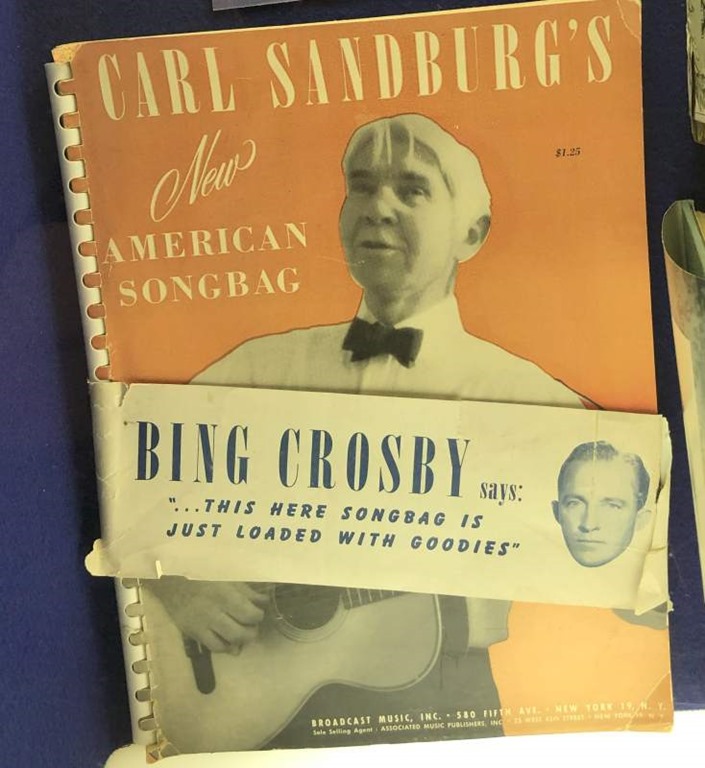
Bing Crosby Says Folk Songs are Goodies

We’ll bring in Carl Sandburg, and Carl’s birthplace where I saw this blurbed edition of his landmark folk song collection later.

.

That information’s travel was slow: what one found in one small town might appear days later in the mailbox of another town, but it had persistence. It opened the possibility of staying around longer than the electronic instants we exchange now on little glowing rectangles. This document I’m entering into a computer gets saved to a solid-state device, and backed up to another — but who would care after I’m gone or know how to access if they did? This blog, widely public as it is today, exists more or less at the mercy of my monthly payment from my no-profit enterprise.

In summary: slow communication in Piper’s time, but a chance it’s kept long. Fast, facile communication now wizzes past in a flying timeline and disappears.

How much did Piper save? I can’t tell, we only have what we have, not what we don’t. In my last day at the Special Collections I read an in-passing comment from his wife written decades after Piper’s sudden death, telling which professor took over his position and classes and of the two of them going to Edwin Piper’s office and cleaning out the stuff there for his successor. Piper was not Robert Frost or Carl Sandburg then or now, but someone saved some things that could be held in hand so I could go on my time travel trip into the boxes in the library Special Collections.

Still, there’s nothing about paper that assures eternal. Beyond paper, Piper seems to have done good work, good things for others. As a professor there’s the legacy of his students and perhaps their students, and so on outward. The unarchived of us will have that too, with no library boxes, indexes, or perhaps even attribution.

But then this occurred to me, there’s something else, an archival format with a potential longer shelf life: songs. It was partly a folk song archive I had come to look at, and I’ve had an interest in folk song since I was a teenager. Therefore, I already knew many of the songs I came upon in Piper’s archive, at least in a version I could recognize were related to his. I’ve heard them sung, sung them myself. Some of them are old, some of them had Child folk song collection numbers since they were British Isles songs that had emigrated to North America and remained to be passed from one singer to another through time. Ford wanted to write them down, but at least at first it was said he just wanted to learn of them to sing them. Singing — that’s an instant, ephemeral communication — but at least for some songs, sometimes, there’s a lasting component that persists.

A folk song for this post? Here’s a song better known from the 1960s folk revival where its haunting supernatural elements started attracting singers in the British Isles, “Reynardine.”   While there are older songs with a like-named character, the version we know today descends from a song collected or recast in the first decade of the 20th century in northern Ireland around the time Piper was collecting his songs in the American Midwest.  You can read more about this at this earlier post, but here it is simply as a song to pass through your ears via the audio player below, or this backup link.

.

Paying the Piper chapter two: time travel, wagon trains in space, & folk song

The walk across town to the University of Iowa main library turned out to be no problem, even in the heat. I walked into the modern lobby of the facility decked out with LCD screen-signage, a set of computer carrels, and airy windows. I used handy lockers with touch-screen set-your-own-combination lock panels there to store my bag and hat.*  The library is one of those amended buildings, representing different eras in décor as it was added to over time or remodeled — so it was almost a theme-park-ride effect as I walked further into the main entryway to reach an old elevator with a flickering florescent fixture that took me up to the third floor with dark wood trim that reminded me of the libraries of my mid-century youth.

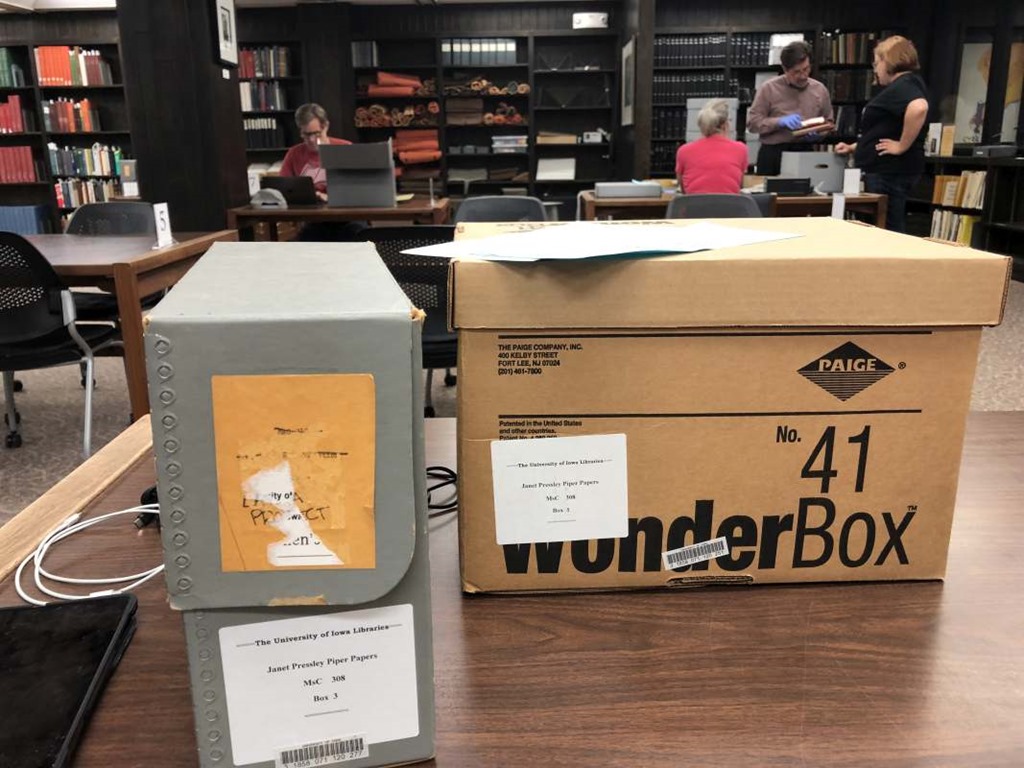
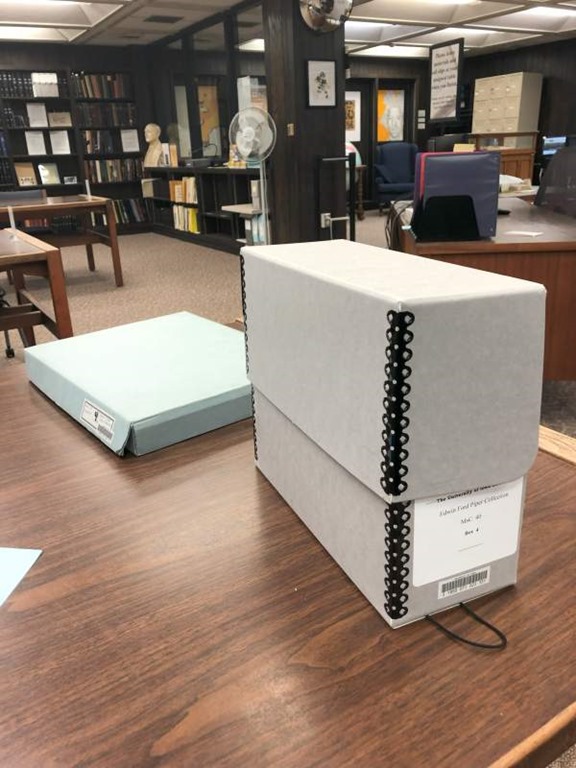
The special collections staff set me up on a placard-numbered plain table in the reading room. It took only a few minutes for my selected boxes from the Edwin Ford Piper collection to be delivered by cart. Looking around the reading room as I waited, there were filled bookshelves, a globe, a couple of busts,** and a few framed posters. Curiously, there were life-sized carboard standups of 20th Century Star Trek actors in their character costumes in a couple of corners. Why? Generalized nerd culture? LaVar Burton’s following enlistment in Reading Rainbow? I momentarily thought, at the commencement of my time-travel by library collections, that the original Roddenberry Star Trek concept was travel to “seek out new life and new civilizations.” They called it Star Trek,  not the second-word choice of the later movie franchise Star Wars,  nor something referencing a technology-based science fiction premise. Pitching to SF resistant TV programmers, Roddenberry famously described his show it “Wagon Train in space.”

The U of Iowa Special Collectons Reading Room 800

Transporter or time machine: archive boxes in the University of Iowa Special Collections Reading Room.

.

I don’t know how Piper’s parents came to rural Nebraska. His mother’s family (Ford) emigrated from Ireland first to Canada around 1810. The Ford brothers who emigrated were stone masons. His father’s line had settled in Massachusetts from 17th century, near-Pilgrim times. Piper’s mother was born in rural south-west Ontario and his parents were married there in Zorra township in 1848. The parents moved to Auburn Nebraska in 1869 where Piper was born in 1871. The 1869 date means it was likely by wagon, as that date predates railroads there.

I know no particulars about why the Ford brothers emigrated to Canada. 1810 preceded the infamous Irish famine years a generation later. My guess (by inference) is that the Fords were Anglo-Irish protestants. I don’t know why Piper’s father was in a non-descript rural area of Canada either.***

It’s hard for me to judge his parent’s economic status. Piper speaks briefly in papers in the archive about his father being a rancher who raised livestock and that the barb wire that titled Edwin’s poetry collection came to Nebraska with homesteading post-Civil War farmers who tended crop-fields cordoned off with that fencing, causing his father to move his livestock grazing farther west to Alma Nebraska (southwest of Kearney) and then Box Elder, which is more than halfway to Colorado. In a short biographic note Piper prepared and found in the archives he says he “rode in the movers wagon.” In the same note he says he had “broken sod and raised corn to sell at ten cents a bushel; I have paid three percent a month interest.” Since he went to Omaha and university there when he came of age and was an academic the rest of his life, this would indicate that his family wasn’t exclusively a cattleman or other livestock operation.

In talking about places and names I found in the archives, I get ahead of myself, it’s just clear that the young Piper was a traveling man coming from a traveling heritage. When we speak nowadays about the Midwest as “the heartland” or casually assign it as a homogenous place in stasis we miss that it was (even its rural areas) just as much an immigration site as the tenements of New York City — there was just more space between farms or towns.

In effect I was another immigrant in the library archives. I was eagerly opening the contents brought to the table from first box and on, lifting out folders from inside them and examining the mix of handwritten letters and notes, typewritten pages, fragile yellow newsprint clippings, and occasional whole publications. The libraries abstract of the contents, and the Piper collection’s mixed filing, meant that I never knew what I’d find “over the next hill.” I had been concerned if I could keep my focus on this task for a full workday. I could. Easily. I was back in the era which The Parlando Project so often refers to, the first quarter of the 20th century when Modernism emerged. I’ll look at Modernism later in this series, but the folk songs are things the travelers carried with them from the past. Same quarter-century, Janus like, looking forward and backward.

As the collection abstract promised, the folk music collection materials were considerable. Many of them have marginal notes or material showing either they came from other collectors or that they had appeared in versions in other contemporary published collections. Some of these notes are from a 1934 run through of Piper’s folk song materials by a graduate student who cataloged and categorized the material while Piper was still alive, though his organization is not reflected in the current filing in the archive boxes. That student, Harold Daniel Peterson, no doubt using Piper as an informant, says that Piper first collected the songs to sing himself, that WWI interrupted Piper’s personal collecting, and that post-WWI, his students at Iowa contributed songs their families and locals knew. Correspondence and marginal notes with associated names show that Piper seems to have assembled or participated in an informal network of other folk song collectors. Piper also mentions the Journal of American Folklore multiple times, and that publication and society started in 1888.

There’s a number of files dealing with hobo songs (some with notes presumably by Piper about the particular hobo who shared the song) and articles about hobo culture, Hobos were migratory workers who often hopped trains to move from place to place.

Coincidences can move me, even if I realize I’m the one making chance meaningful. The very last folder in the last box I went through in my days examining the Piper archive folk song collection contained a version of “Jack of Diamonds”  a traditional song with a variant that also goes by the name of a commonly included verse: “Rye Whiskey.”  Long-time readers here may recall that I was told by uncles that “Rye Whiskey”  was a favorite song of my great-grandfather, after whom I am named. In my time travel during this June trip I wasn’t just traveling to the time of Modernism’s emergence, I remembered at that moment opening that folder that I was traveling back to that man’s, a common laborer’s, time too. When investigating something else years back, I was taught that folk culture isn’t uncomplicatedly pure, always the result of children learning songs from the old folks on the porch of an isolated cabin. I recorded a performance with music of a plausible theory of how my great-grandfather might have come to fancy and appreciate that song. You can hear that performance with the audio player below, or with this highlighted link if that player isn’t visible to you.

To be continued…

.

*As is now common in special collections, there are rules about what you can bring into the reading rooms. Alas, theft has been a problem in such places, so bags (much less spill-risk food or drink) are not allowed. I noted the University’s rules also restricted paper notebooks and outside writing instruments.

**Of who? I never left my focus to find out, but the human form amputated to a head and shoulders is already concentrating on the life of the mind. The Piper Archive papers mesmerized me, time passed rapidly as I tried to take in as much as I could. The first day I had packed a bagel in my shoulder bag, necessarily left in the downstairs library locker in case I needed to take a lunch break outside of the Special Collections Reading Room. I ate that bagel in the evening back at my room.

***This basic genealogical detail is from a typewritten sheet titled “Notes on Family History” with some pencil annotations in Piper’s handwriting in the archives. It also says that he was “the tenth child in a family of eleven children” and gives the date of Edwin Ford Piper’s own later marriage to Janet Pressley in Iowa City as 1927.

Paying the Piper chapter 1

Very often I find myself unable to tell a story simply. While I find internal joy in expanding complexity there is a painful element too. Even when under the spell of things I’ve experienced and learned, I retain enough self-awareness to see what effect my expression has on others, the burden of strangeness. Then the reach between the teller and the listener becomes haphazard, unstable — pile it too high and it tiresomely topples — and so in some break for breath partway in, I realize I’ve dumped a cluttered mass of thought debris on a listener, long past any interest.

Perhaps this is why I’m attracted to lyric poetry, constrained as it is to moments, often held tight within the stiff glass bottles of forms.

Here’s a personal story that’ll go many places coming from the place I find myself in this June. It starts, I’ll guess, earlier this year when I came upon a poem, “The Last Antelope,”  a striking, empathetic account of the end of an animal’s life and wildness after settlers captured it. Edwin Ford Piper was the author, and there were only scattered bits of information to be found about him. Scattered and bits do not constrain my curiosity — if the bits were great distances apart, the space between them could hold a lot of things: born 1871 in rural Nebraska, parents part of early European-origin settlement there. Largely self-educated in a land of necessary child-farmhand-so-never-more-than-half-year schools, still goes on to university in Omaha studying literature with a specialization in Chaucer, and then to the University of Iowa where as a professor he helped establish the idea of teaching and granting degrees in creative writing.

The modern convention of a university as patronage for artists, and the rise of the credentialed MFA-holding poet is not without controversy — but isn’t it odd, this man who taught himself in a small town on the fluid boundary between the 19th Century Wild West and the 20th Century staid Midwest took that journey.

In the middle of this, the same man had a compulsion to collect songs ordinary people brought with them while journeying, the words and music carried in the light baggage of memory. He wrote down songs his relatives and townsfolk knew by heart. He asked others to send him more by mail. He paid particular attention to the songs of those on the move: hobos, cowboys, and other traveling workers. Did this connect with his literary poetry? There are no recordings of Piper reading his poetry, but accounts say he declaimed it with a musical lilt — perhaps like the surviving recordings of Yeats, or maybe like the more bombastic Vachel Lindsay — and at times he would break into full song. His students took to calling him “The Singing Professor.”

Since this Project is “Where Music and Words Meet” you can see why I’d be attracted. And I’m a small-Midwestern-town boy, though without degrees. But did that seem strange then, to mesh high culture and the songs remembered by old women and rude mechanicals?

Piper was born just west of the Missouri River in Nebraska — and in Illinois, just to the east of the Mississippi River and less than a decade later, Carl Sandburg was born to an immigrant railway blacksmith who signed his name with an X. Iowa, the state where I was born in the middle of the next century, and Minnesota, the state where I’ve lived the longest, sit in a delta between those two tremendous rivers. Sandburg too mixed the latest in Modernist poetry with folk songs he collected and sang. Did Piper influence Sandburg? Did Sandburg influence Piper? Or are they the same genus of plant, raised in the same climate, but in separate plots? Questions.

Answers fork like river systems. Even with little information being readily available on Piper, I was already in flood stage. And here’s how much my wife loves me: for our 20th anniversary she agreed to go on a road trip with me to Iowa City and Sandburg’s home-town of Galesburg. My scenery in Iowa City? An archive of Piper’s papers* held in the university library there. Our grand museum of the arts of poetry and song to visit on the trip: a railway worker’s shack in a small rust-belt city, a town worn-out but still running like a paint-shedding Oldsmobile.

Two considerations worried me as I thought about this trip, one for my wife and one for myself. For my wife, I worried if there’d be something rewarding for her to do while I enthused at the library. She was able to solve that one easily, locating nature reserves, parks, and trails within an hour’s drive. I often tell her that she’s a nymph, and I complement her on how seriously she takes her job to supervise the plants and animals when she returns with soggy hiking boots from her hikes with pictures of landscapes, mushrooms, wildflowers, birds, and other critters. I love her pictures and stories on return (her stories briefer and better organized) — but my old joints ache just thinking about hiking for hours.

For myself I worried about my old-ager endurance. The library was two-thirds of a mile from where we’d stay. I’d need to hoof it with my laptop bag back and forth, which would have been a trifle in my youth, but nowadays longer term standing and walking is troublesome. I considered taking a bicycle with me, which would have made the library to-and-from easy, but a lot of hotel/AirBnB places don’t have any good places to lock up overnight, and on further consideration I thought that a bike would just be one more thing to worry about, taking my focus away from the trip’s main goals. And then I worried too about spending full days at the library’s special collections reading room. Because my time was limited, and to minimize the walking, I planned no break for lunch. I’d need to keep my focus and energy up, something that I have not been consistently able to do this year even with all the comforts of home.

On average I bike at least once every day in my normal routine, often in the morning. In the past two years I’ve not been a longer distance bicyclist, but 30-50 miles a week easily exceeds those 150 minutes exercise recommendations, and it lets me get to a café for morning breakfast and handle a lot of routine shopping and other trips. I ride year-round. In 2016 I bought my first 21st Century winter bike with studded tires; and in 2019 I upgraded the winter season bicycle to a Fat Bike with monstrous 4.5-inch-wide tires that handled ice and snow with the challenging ice ruts and potholes that my city’s current “We’ll get to all the streets in 3 days after the snow stops” plowing regime supplies. My overall stamina for the walk wasn’t my worry so much as how well my joints and stiff back would take the more load-bearing walk.** And to make it through the day I’d planned, there’d be no old-man’s afternoon nap either.

Pay the Piper Chapter 1 800
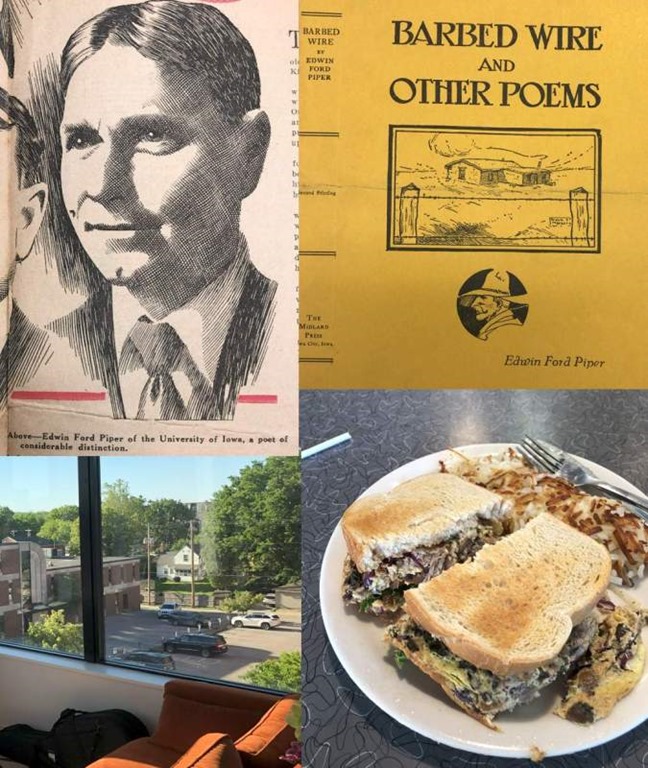
Piper, once a “poet of considerable distinction.” A later version of his collection Barb Wire. My Iowa City view, and yes the guitar got some use. Example breakfast.***

.

The first day we arrived at Iowa city was hot and very humid, so I put on my best hot weather clothing. Spouse-nymph headed off at dawn for her day’s supervisory encounter with nature, and I planned a big breakfast fuel-up. I’m a “eat little meat” kind of guy, but for good or ill I take the lacto-ovo part of my lesser meat diet seriously, so I’m a big frittata, omelet, hash, scrambler kind of guy most mornings. I note that I eat like an old-time farmer, despite never farming, but the good thing about this higher fat/protein kind of meal is that it can hold me until supper, and that was my plan.

I put on my best hot weather clothes, slung my bag over my shoulder, and headed for the university’s main library building for my encounter with poet-professor Piper’s papers.

Thus ends Chapter One.

Here’s a musical performance I put together in March of Piper’s “The Last Antelope.”   You can play it with the audio player you should see below. No player?  This highlighted link is another way to hear it.

.

*When I arrived at the library archives will-call desk, I asked them to pick Piper’s Papers. The librarian suggested puckishly that I was nearly reconstructing the old tongue-twister folk-rhyme, Roud Folk Song index 19745.

**Local papers/forums are full of folks who bemoan bike lanes in my city, often remarking that “not everyone is young and fit.” Despite that, most bicyclists I meet and see on my city’s streets aren’t of the MAMIL (Middle-Aged Man in Lycra) variety — and I’m maybe 1.5 letters of that acronym. I joke with my wife that as my joints get older, a bicycle is becoming a “fore-and-aft wheelchair” for me, allowing me increased mobility and beneficial low-impact movement for the old joints.

***That’s a St. Paul Sandwich: egg foo young on sourdough with lettuce, tomato slices and mayo. Near as anyone knows, my Twin City of St. Paul has no tradition regarding it, and no restaurant there serves it now. Its origin is something of mystery.

Reading Carl Sandburg’s American Songbag

I spent much of today reading through Carl Sandburg’s landmark 1927 folk song collection American Songbag,  all 500-plus-pages of it. It’s not the first time I’ve looked into the book, and indeed I’ve paged through it or jumped to songs I was interested in before. But next month I’m planning a trip to Sandburg’s boyhood home in Illinois and to Iowa City where I will be taking a look at some papers relating to early 20th century poet and professor Edwin Ford Piper who was one of the sources of folk song material used in Sanburg’s anthology.*  So, looking at the book in full seemed a good grounding for this trip.

I’ve made the case before here, such as this post from a year ago, that besides being a somewhat deemphasized Modernist poet these days, Sandburg is a primary model for the American Folk Music Revival, which eventually produced in the second half of the 20th century several genres of popular and semi-popular music.**  Here’s the matrix that Sandburg built in the 1920s, a hundred years ago:

  • American folk music can be appreciated like art music
  • It will be associated with literary poetry
  • It expresses, or can be adapted to express or accompany, progressive/left-wing causes
  • It’s multi-ethnic, and the contribution of Afro-Americans will be substantially acknowledged
  • Humor and funny stories will be part of its presentation

Sandburg was including segments of folk music performance as part of poetry readings before American Songbag.  AFAIK we don’t have any transcripts or recordings from that era, but all these things are demonstrated for the record in the 1927 book. Sandburg is not the only American doing any of these things a hundred years ago, but he’s doing all of them at once,  and he’s doing it with a degree of fame and cultural acclaim that was significant.

I was aided in my rapid march through American Songbag  by already knowing many of the songs it contains, and as I encountered them I remembered hearing them in my half of the 20th century performed by Woody Guthrie, Pete Seeger, Bob Dylan and many of those other “folk singers” that surrounded them.***  The Sing Out magazine and Jerry Silverman folk songbooks of the Sixties that are my foundation, are successors to Sandburg’s work, right down to the touch of  using vintage B&W line drawings as interspersed decorations.

Sandburg often includes little stories about the collector (Piper was one of a group who collected the songs “in the field” for Songbag)  and for those he collected himself he says a few words about how, where, and with whom he first heard the song. Here’s one of the most engaging of those stories I came upon today in the book:

Once when the night was wild without and the wintry winds piled snowdrifts around the traffic signals on Cottage Grove Avenue, Chicago, we sat with Robert Frost and Padraic Colum. The Gael had favored with Irish ballads of murder, robbery, passion. And Frost offered a sailorman song he learned as a boy on the wharves of San Francisco.

The song Frost sang for Colum and Sandburg? A subtle wry ballad of farming? A nuanced lyric of nature cooly observed? No, it was this one. Some will know it from its latter association with the Assassin’s Creed video game franchise:

.

*Besides the folks songs Piper contributes, Sandburg even quotes a part of a poem from his contemporary Piper’s Barb Wire  poetry collection in Songbag.

**Besides the Folk Scare of the 50s and 60s, the American “Rock Music” that extended Rock’n’Roll to FM radio, college campuses, and rock critics was generally formed from folks who had connections with the just preceding folk revival. Modern Americana and roots music links to the same strains and connections that Sandburg was personifying 100 years ago.

***Guthrie composed music for Sanburg poems later. Ruth Crawford Seeger (Pete’s step-mom, Mike and Peggy Seeger’s birth mother) was one of the composers who created harmonized music for the folk songs in Songbag,  and she also set Sandburg’s page poems to music. When the young Bob Dylan started to expand the poeticism of his song lyrics, he decided to pay a visit to Sandburg, briefly meeting him unannounced in North Carolina at Sandburg’s farm. Other folk luminaries connected? At least a couple songs collected from Leadbelly by John Lomax are included in Songbag.  Lomax is credited, but Leadbelly isn’t, though Leadbelly’s more general public career hadn’t yet started. Let me just say that Lomax’s relationship with Leadbelly is complicated. Just this month I was reading a recollection of a performance by Spider John Koerner (who first performed in the mid-century Minneapolis folk music scene along with Dylan) where he told a humorous story about a farmer who fed his pig by lifting him up to the branches of an apple tree. That’s a story Sandburg also told. I’ll also note that when I came upon several songs in Songbag,  the rendition I recalled from the Folk Scare of the mid-century was by Dave Van Ronk, a wonderful performer and a mentor to Dylan when he arrived in New York.

Black History Month 2024 and Langston Hughes’ birthday

Not to put the curse on things that fate might cast whenever you make plans, but I have a plan for February. I’ve been reading a bunch of Chicago-based early 20th century Afro-American poet Fenton Johnson’s poems this winter. Long time readers here may recall that I did a series on Johnson’s poetry in 2018, still early in this Project’s life.

Johnson is a bridge between Paul Laurence Dunbar, who died young after becoming the first Afro-American poet to pick up much notice, and the early poets of the Harlem Renaissance such as Langston Hughes who more fully brought Black American poetry into greater recognition.

One of Johnson’s poems, “Tired,”  is still included in some anthologies of Black poets, perhaps because pioneering Afro-American poetry anthologist James Weldon Johnson (no relation) included it. In my 2018 series I tried to outline my estimate of how Johnson came to write such a despairing poem and to explore other modes of his verse. Since then more information on Johnson’s early years has become available to me, and I have a more complicated theory of his poetic progress that includes more data points.

I hesitate to lead off with “Tired” to represent him, though it’s a fine poem which James Weldon Johnson selected bringing notice to Fenton Johnson. See this post to see what James Weldon Johnson wrote about it.

.

One thing that attracts me to Fenton Johnson is that he (like Langston Hughes) wrote using his experience of Afro-American musical idioms. Regardless of current panics and nonsense expressed around the issue, Black history is American History—and oh my, is Black music American music!   To keep’em separated would be so damaging to America’s culture. Oddly, believing that misapprehensions and ignorance must be behind such a self-defeating and self-denying idea, I continue to go forward trying to defeat that in my small way, despite realizing that there is much I don’t know and can’t portray as well as it might be portrayed.

Writing on and performing Fenton Johnson is a case in point. He seems to have too few considering him right now or bringing his story forward. I’d rather do the best I can illuminating his work with what skills and time I have, than to shrink from this out of deference or modesty.

Since today was Langston Hughes’ birthday, I’ll precede my Fenton Johnson February series with this piece of his that I performed previously for this Project. Hughes’ “Lenox Avenue: Midnight”  is a beautiful expression of that complex thing: Black Joy. I was audacious enough to add a couplet at the end of Hughes’ poem/text that was my reaction to what Hughes portrayed in his poem, which is just about as presumptuous as my attempt to compose and play something that sounds like Jazz. You can hear my musical performance with the audio player below — or if no player, with this highlighted link.

.