Jazz and reading John Darnielle: Part Two, This Year 365 Songs Annotated

Here’s the final piece of this two-parter, and the place where I take off that hair shirt for a while and present a review of John Darnielle’s new book This Year, 365 Songs Annotated.

I largely owe my appreciation of singer-songwriter John Darnielle to my daughter, who found solace in his earlier recordings as she moved through adolescence. One 2005 song, the one that gives its title to a new book by Darnielle, features a 17-year-old speaker refraining: “I am gonna make it through this year if it kills me.” It resonated more than a decade later with another 17-year-old. What a good thing for a song to do.

I knew Darnielle’s work from a couple of songs recorded under his long-running project name “The Mountain Goats,” most notably the mysterious anthem “Jaipur.”   My daughter gifted me his All Hail West Texas  album one Bandcamp Friday a year or so ago. My immediate thoughts on Darnielle were that he was a good song lyricist. Like the late poet-associate of mine Kevin Fitzpatrick, his work is full of “other people,” and those people are often working class or lost-soul types who make themselves known as if in overheard declarations in his songs. Writing in Boomer classic-rock consumer-guide style “he’s like…” comparisons are misleading in Darnielle’s case. Saying he’s lyrically a mix of Randy Newman, Bruce Springsteen, Ray Davies, and John Prine is a bad assay, because he’s like all of them at once or in sequence, and he is his own man too. Still, the range of characters is an important strength. A lot of poetry, and a lot of indie songwriting too, is a singular solipsistic narrative, and Darnielle’s of the songwriting school that avoids this.

This Year cover

More than a collection of song lyrics (though they’re good lyrics)

.

Yet, This Year  is largely the story inside one person, a memoir in a different form: a book of days where he writes somewhat sequentially, but not by strict intent or always, about how 365 songs came about, what he thinks he was trying to express, and what his life was like as he wrote and recorded them. The entries can be quite short, a couple of hundred words typically, though a few extend for a few pages. The lyrics to each day’s song are included with each entry, which is helpful for any reader who’s not familiar with his work. I’m half-way through reading it straight through, but the book can also be read an entry at a time, as sort of daily thought-starter. I’m somewhere between a hardcore fan and someone that doesn’t know any of Darnielle’s work, and I’ve sought out some of the songs after reading of them in the book.

Things I’ve learned? It was not apparent to me beforehand, but he’s a poet who converted to songwriting, and many of his early songs had preexisted as page poems that he wasn’t planning to sing. Reading his lyrics silent on the page in this book demonstrates a literary poet’s craft in his writing, but my finding this out in memoir is a testimony to their lack of crusty poetese. Poets as well as songwriters would benefit from exposing themselves to Darnielle’s lyrical tactics, and he talks effectively about them in this book. I also learned that he spent formative years in his songwriting’s development living in a small town in Iowa, the kind of place I grew up in, in roughly the same part of the state, though I’m more than a generation older than him.

Another part of his story, which unreels through the day entries each devoted to a single song from his now large catalog of original songs, is that he began recording and making these songs public using meager equipment. He so far mentions almost nothing about the particulars of his instruments which are likely unremarkable and inexpensive, and a considerable part of his early career recordings – including the original versions of some of his best-loved songs – were recorded on a boom-box cassette tape machine at home. I resonated with that, having spent around 20 years using such cassette tape along with low-budget equipment. A late 20th century indie-music and fanzine samizdat network allowed Darnielle a slow-burn career doing that, around the time that my own nerve to share my work had faded. He recounts in the book, that royalties from the tapes sometimes paid part of the $170 a month rent,* but he had a day job in a lower-paid nursing field, again something I rhymed with in my cassette years.

The short entries in the book also tell a story of Darnielle’s religious journey, which began as a Catholic youth and has had elements of return, though I’m midjourney on that arc so far in the book.

These similarities paradoxically bring up the personal gap which makes reading his book so meaningful to me now. From what I’ve read so far, Darnielle apparently retained confidence in his own work through these long-beginnings, low-rent, lo-fi years, and even if there are dark nights of the soul in coming parts of his book, he displays that now as he discusses the work in retrospect. I had, and still have, substantial gaps in being able to carry that in public during my cassette years. Having days of private levels of self-confidence in some of my musical work is not an effective dose to properly present it to others, and my doing so “blind” without that confidence led me to some painful comedy of misreadings of likely interest. Those two things (managing self-doubt, being able to present one’s work effectively to others) interact. Darnielle may have been more personally engaging, or just more persistent in his networking. Elements of luck might have been significant (with me, they were in my “day job.”) Thinking of this difference as I read Darnielle’s book, it’s (too) easy for me to think, “Well, it must have been easier for him, his work was so darn good.” He’s a better vocalist and performer than I am (no-biggie, almost everybody is), and though I’m not sure how far apart we are in “on a good day” guitarist skills, his song lyrics are teaching me new tactics even after decades of my doing this on the page and with guitar.

In the first part of this pair of posts I sincerely worried about my work and hubris when I put it up against the skillset and history of Jazz. Despite those differences in how we’ve used our parable of the talents, I find reading Darnielle’s book heartening so far. You don’t have to be a songwriter, if you are any kind of writer – and likely if you are an artist of any kind – spending time with this book may be helpful.

Here’s an early song of mine, recorded on primitive equipment before the nearing 900 songs of the Parlando Project had started counting off, but consistent with its principles, a setting of John Keats’ “In the Drear Nighted December.”   Audio player gadget should be below, but if not, this highlighted link will open a new tab with its own audio player.


.

*For any younger folks reading this, the $170 a month rent (for a house!) must seem a dormouse fantasy. For younger musicians, the idea that royalties from indie recordings might contribute in any substantial way to making rent must seem equally fantastic.

Jazz and reading John Darnielle: Part One, when I make a Jazz noise here

I’m glad my face ID still recognized me today to write this, since I’m in an unhappy, grumpy mood, and I don’t much like the self I’m in. This mood may be because it’s winter and cold with dark early and late, or because I didn’t get a bike ride in, or because folks with guns and ones with governmental power are doing cruel things for the proximate reason that they’re cruel. Grumpy and unhappy? Perhaps a reasonable response for winter, but is that same mood commensurate to the mass shootings in the news or the treatment of our country and neighbors by the mad king and his gleeful courtiers? I don’t know. Whatever I do (little) or think (enough? too much?) about these things ties me up in this grumpy place. In addition, we have a world of similarly unsatisfied folks to me – but these folks are pointing out that we aren’t thinking or doing enough in various best ways to defeat these horrible acts.*

Since I put my efforts toward music and poetry, I’m not going to charge you with not doing the right things to counter those general evils here. It would feel hypocritical for me to do so. But this dissatisfaction with the world and myself is bleeding over to my work today as well.

Early this morning I posted something on BlueSky about Jazz that could be easily misunderstood. So, I’m taking my chance to get it off my chest here so that I can be misunderstood or make a fool of myself at a greater length. There’s a new documentary that you can rent-to-view for $3 on Amazon: The Best of the Best, Jazz from Detroit.  This is a good film, made for the best reasons. My reaction is not their fault, and you shouldn’t hold it against them. The insightful Ethan Iverson has it right in summing up its value: “not just…a must-watch for fans, but also a superb introduction to jazz for the uninitiated.” But reading an interview with its creators and spending a rewarding 90 minutes watching it today also activated a problem I’m increasingly having with my musical work here. Let me summarize it as quickly as I can.

I feel embarrassingly limited as a musician. That I have a few tricks that I can pull off some of the time on a few different instruments must be balanced against the absence of some foundational skills that should be there. This is the reason that I’ve often taken to calling myself a composer, since my tactic is to create pieces I might play passably well rather than to show my lack of skill in doing musician’s work.**  But “composer” sounds even more presumptuous. I call myself, I think accurately, a “naïve composer.” I know dribs and drabs of musical theory, but again I lack the musical foundation that most anyone who calls themselves a composer would have.

I feel this lack of foundational competence often among musicians, and I’d feel it even more if I was around folks who are composers often enough – and there’s no place I feel it more than when you put “Jazz” in front of musician or composer. Watching Jazz from Detroit,  this fine film, reminds me of that; first because it makes the point that one of Detroit’s strengths as a “punches above its weight” center of Jazz music is that there were teachers in the school system and elsewhere in the city, mentors who helped young players understand and master the fundamentals of that art. These mentors guided folks who made Jazz and music their life and honors them. And it makes another point beside that one: they did this as part of a specific Afro-American urban culture that is not mine.***

Jazz for Detroit Title Screen

The film’s title screen.

.

OK, so where does that leave me, particularly at my advanced age? I somehow can’t stop at simply recognizing and honoring that, I’m drawn to dipping into that musical language at times here, even if I can’t speak it fluently, and I’m not sure that is a good thing. Are my efforts, which wouldn’t fool a skilled Jazz musician for a minute, profaning their art? Does even my small audience subtract from the possible audience for more dedicated and skilled musicians? Is this intentionally non-revenue Project undercutting folks who need recompense? Or even: is this self-flagellation boring, and something only someone with my level of privilege would undertake? Am I thinking about any of this too much, or thinking about it not enough? I don’t know.

But here’s what I do know: what I can observe I do. I keep doing this, even if it may be wrong – or guilty of a lesser sin, missing the point.

Here’s a piece of mine from a few years ago about the dedication of an actual Jazz musician, Sonny Rollins. Audio player gadget below, or alternatively, this highlighted link that will open a new tab with its own audio player.

.

*Some of them could be right on what we should be doing – but since they differ, some are likely wrong. All of these voices can’t be Martin Luther King writing from the Birmingham Jail, and there are/were folks then and now that didn’t think he was doing it right either. In our modern age I can’t help but suspect the “everybody to the left of Donald Trump is complicit in this mess” voices as bots.

**Put me in a room of not particularly skilled folk or rock players with my guitar, and on a good day I might fool them for a while at being a musician.

***This isn’t shouted outright in the film, but some of the elders speaking in it are, I believe, trying to make the point that the specifics of their 20th century Jazz-creating Afro-American culture require additional efforts to be valued and maintained.

Ode to a 1953 Automobile Ad

I’ve mentioned this Fall that I’m on a project to clean out the accumulations of my long life. There are various battlefronts in this effort, but last month I worked on emptying my stuff from a small storeroom in my house, which was filled with boxes, some of which hadn’t been unpacked since I moved 40 years ago. One box was completely stuffed full of spiral bound notebooks.

I had once saved the notebooks I used in my high school years and then throughout my twenties. This meant a slowly growing cache of them had traveled from a tiny hometown in Iowa, to a dorm in a small college in that state, and then to the locations I lived at in New York for six years, and onward the four places I’ve lived in Minnesota.

I had a typewriter, which I used for some more formal things and finalized school assignments, and then in the ‘80s I got a personal computer,* but for 20 years or so, my creative work began and was recorded with handwriting in these college-ruled notebooks. Early, when there were only a handful of them, I mentally cataloged them by the color of their covers. Even after all these years I recall a couple of the earliest ones as “The Orange Book” and “The Green Book.” Like Emily Dickinson I didn’t always save working drafts, written on whatever was handy, but when I felt I had finished a poem I’d make a good copy in my most legible hand inside one of the notebooks to be saved.

I’ve written briefly at least once about starting to write poems as a teenager, and I won’t go on much more about that today, but I was surprised at the urge – it was not planned. I felt compelled to do this for reasons I couldn’t tell you then, or now. Living in my tiny town I had no idea how many people were writing poems, but I presumed it a small number, as the literature anthologies I had in school made me think the number at any one time was a select few. This misapprehension led to a grandiose feeling that I was writing poetry! – this grand art-form of literary geniuses.

Clearly there was a lot I didn’t know, but in my case this helped me, giving me a sense of accomplishment. Did writing poetry give me an unearned, unrealistic, sense of self-worth? Yes, I think it did – but we all need a minimum deposit in that bank, and that was the source I had. And after all I was a teenager, and few of that age have any substantial achievements.

In that process of pulling aside these old notebooks I came upon “The Green Book” that I recalled when there were only a couple of these, and I set it aside to look through first. In it I saw my good copy of a poem I remember quite well from my early work, one I had thought was one of my better ones then. Looking at it as an old man who’s read much more, written much more, lived much more, I think enough of it to present it here in performance today.

I didn’t have many poetic models to draw on, but this one certainly came from reading John Keats “Ode on a Grecian Urn”  in my high-school literature class. I’ve performed Keats’ poem here, and I think I was already impressed at the ambiguity in the poem’s famous ending back then. My “Ode to a 1953 Automobile Ad”  was on the surface a free-verse parody, burlesquing Keats classical art object – but I was at least partly conscious of wanting to make some solemn points too, though I don’t recall thinking out all the themes the poem includes, so my best recollection is composing the poem without knowing all I was including in the text under my pen.

I think there was a  1953 automobile ad in my memory, though I haven’t found the one described in the poem.** Sometime in my early teenage years, a man in my little town – no doubt doing the same “death cleaning” I am doing in 2025 – gave me several dozen 10-15-year-old Popular Mechanics/Popular Science/Mechanix Illustrated magazines. I devoured them, first because I adored the hyperbolic writing of the self-styled dean of journalistic automobile test drivers Tom MaCahill who wrote for Mechanix Illustrated – but this was a strange genre of magazine. Part reviews of new models of cars and novel ideas in consumer goods, part pre-Whole Earth Catalog handyman tips and project plans, and part more general writing about science and technology including predictions for the future.

1953 Studebaker 800

The soft golden car in front of a Greek colonnade, or a peaceful ride in a Paris that 8 years earlier would have been in the midst of a World War.

.

I enjoyed the time-travel aspect of reading these magazines, visiting as an abstract thinking teenager the world of early childhood. The too fantastic flying car future has since become a meme – but the junior historian in me would think: the Korean Conflict was being fought as some of these old pages went to press (little mentioned in these mags, little remembered now too), the new age of atomic war fear was beginning, and in the sixties as I wrote this poem, Vietnam was echoing the Korea situation. So, as the poem was being written, there was then too the feeling of a glorious and blest domestic United States – yet with a “conflict” acting as a far-off minotaur ready to take sacrificial children.

So, I wrote this in the 1960s linking those times in the 1950s, and sublimation of killing young men is the topic. Inexperienced as I was, I tip my hat to the images the young person that would become me put in there: the camera and/or coffin dark box capturing the bright sunlight of the ad, the rust-holes in the teenaged car as the wound in the son. The use of Whitmanesque (or Sandburg or Ginsberg in their Whitman mode) extra-long lines is not something I do much now, but as I performed them this week, they seemed to work well enough.

This old poem is now published with a musical performance in the lead up to the holiday that was once known as Armistice Day – the very day that World War I ended at a moment when it was just “The Great War” and didn’t need a number, and didn’t expect to gain one – but now our wars don’t get the roman numerals, though fantasy film franchises and Super Bowls do. We didn’t get flying cars. We got armed drones.

You can hear me performing my “Ode to a 1953 Automobile Ad”  with the audio player gadget below. Has the audio player gone with Studebakers and saving old magazines?  This highlighted link is supplied as an alternative which will open a new tab with its own audio player.

.

*My penmanship was erratic and not consistently easy to read, so a typewriter was essential for things of any length destined for others. But I didn’t do creative writing on a typewriter – something about the mechanical nature seemed an authorship firewall: the machine made the letters, keys and levers away from the writer, and one couldn’t easily cross-out and add little marginal changes as one wrote.

One of the things found in the storeroom with the notebooks was a postcard about requirements for receiving a rebate on what would be officially my first personal computer: A Timex-Sinclair bought in 1982 – but that tiny $85 plastic wedge wasn’t able to take over from a pen or typewriter since it had a small membrane keypad that was only useful to learn to write computer programs with. In 1984 I got a Commodore 64 which could do limited word-processing, but I couldn’t afford the software that did that. In 1987 I got an Amiga 500 which came with a copy of Word Perfect – the then leading word-processing software product – and I began a slow and inconstant transition to using computers to do initial drafts over a decade or so.

**The 1953 year of the car in the ad makes me sure it was a Studebaker ad, for a remarkably beautiful new 2-door coupe was introduced for that model year. When I look for examples of the ad campaign, I see many of the Studebakers are depicted in yellow, but never in a family tableau described in the poem in the ones I could find. And there’s the chrome bird hood ornament. Was I thinking of the Packard swan? Looking at pictures of the 1953 Studebaker I see there’s a 3-bladed chrome insignia on the peak of the hood – meant to be a propeller, or bird, or abstract shape? I appeal to Brancusi on the bird.

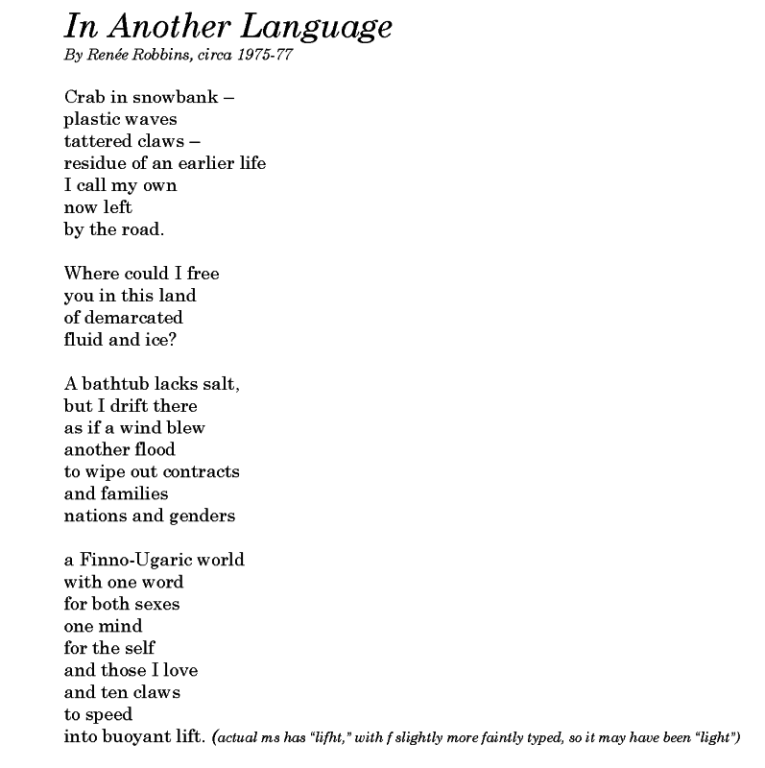
In Another Language

I mentioned last time that I’m cleaning out things I can no longer reasonably expect to use, and found a box which included poems by my late wife. Perhaps such things are past the use test, but I asked what use can I make of them?

After paging through the papers, I transcribed the handful of poems I found, typing them into documents on my computer, a now ordinary device which would have been a SciFi marvel to her back when she wrote these poems in the 1970s. Could I perform some of them, here, as part of the Parlando Project? Could that seem like special pleading, an enforced overlay of widower husband wants you to shed a tear for his dead wife? Let me try to move you past that. Decades after a death, and when one is old enough to reasonably consider one’s own death to be a nearish interval, shorter than the one from that loss, loss begins to take on a universal and obligatory aura. These aren’t sentimental poems – my late wife, Renée Robbins, was funny and was wearing the full costume of life when she wrote them. Those costumes of life go back into storage, kept for use in later productions. Perhaps her poem “In Another Language”  can be worn by someone still treading the boards?

Yes, these poems are little pieces of someone I loved deeply, written early in her too-short life, and bringing them on to you extends a tiny bit of what she was. Yes, it was particularly nice to feel I was working with and playing this part of her when I performed this poem this month – but yes too, it’s October: everyone’s wearing costumes and pretending they can see ghosts.

I can hear her responding to this situation. How? I’ll explain it with a quote from Woody Allen* that has been reverberating through my mind:

I don’t want to achieve immortality through my work; I want to achieve immortality through not dying. I don’t want to live on in the hearts of my countrymen; I want to live on in my apartment.”

So here you have it, a poem likely written while she was still in college, studying writing under Howard Mohr and Phillip Dacey. I’m fond of the obscure strangeness in the framing image. I can’t be sure what she, the author, was seeing. My best guess is a whole crab or lobster on ice in a seafood display, a mundane piece of unintended Surrealism – and being in a world of frozen water is also an accustomed strangeness to Minnesotans. I like the poem’s leaps, like the dream of the crab escaping to her bathtub, and the totally unexpected leap into the genderless cross-shifting-borders of “Finno-Ugaric.”**

In Another Language

Besides the crab image, I see Noah’s flood in the third stanza. I chose “lift” from the alternatives for that last line because it’s more sensual.

.

I performed Renée’s poem in a style that still hadn’t gone-out-of in the Seventies, as spoken word with an approaching-Jazzy musical backing: drums, bass, and two electric guitars. I believe the music, taken by itself, might shows the subliminal influence of a current band, Khruangbin. It’s subliminal because I don’t use as much reverb.

So, there you go. Looped through with the footnotes, we’ve got Khruangbin, Krasznahorkai, Woody Allen, my late wife Renée Robbins, Phil Dacey, The 1970s, and a fifty-year-old poem by a twenty-something. There’s a lot of intervals and strange harmonies there, but I’ll end with another quote from an artist (actually, from his less famous brother). I read this one in a recent interview answer given by Ken Burns when asked how he makes those famous “Ken Burns Effect” intelligence flights over photos as he edits his work:

It’s all music—my brother, Ric, said that all art forms, when they die and go to heaven, want to be music.”

So, there you go Renée, not immortal from non-dying – but you get music.

As you can see today, we stay narrowly focused on the topic here at the Parlando Project, and we will return with poems by more famous literary poets soon – but to hear Renée’s poem “In Another Language”  as I performed it with music, use the player gadget below. No graphical audio playing gadget? I offer this heavenly highlighted link that will open a new tab with its own music player.

.

*I know a fair number of possible readers of this have strong opinions when they hear his name. I’ve got at least half of those myself. There’s a second, artistic, set of subjects regarding his work that would overwhelm the focus of this piece. To stay on topic, let me just say that my late wife was a comedy fan who could recite from memory the entire 30-minute Firesign Theater Nick Danger radio drama parody, and that Woody Allen movies were a constant date night thread in our relationship. Renée had opinions too, consistently caring ones, but she would have laughed at that quote, and I’m laughing now too, but with a deeper resonance to that laugh.

**My memory of seeing Woody Allen movies with my late wife was intensified by the recent death of Diane Keaton, but there was even more coincidence as I worked on this: the Nobel Prize for Literature went to László Krasznahorkai, who writes in a Finno-Ugaric language. And yes, that language group is non-gendered, even the pronouns – at least from what I find when I checked on Renée’s reference in her poem. And if I may risk one more Woody Allen reference, in my life back then I was (roughly speaking) playing more the Annie Hall role.

The “Guild Concerns,” and mine, and yours, around Artificial Intelligence

I hope the hardy, but smaller, summer readership here has enjoyed this diversion from our usual literary poetry combined with original music subjects. It’s been somewhat difficult to write. Why?

When I run across comments or longer-form writing about artificial intelligence – given my interests, mostly from folks in artistic fields – the feelings and cold convictions I read come in hot. AI gives me a lot of feels too: frustrations, fears, disgusts, distrusts, worries, even amusements at its fails. Yet, earlier in this series I’ve honestly talked about AI features I’ve tried. I wonder if I’m alone in these mixed feelings – if I’m just a wishy-washy old guy who won’t say it plain. For my final installment let me focus on those concerns.*

I’ve referred to some of those “guild concerns” earlier in this series. Let me expand on that. Let’s say you are a professional, semi-professional , or aspiring visual artist, voice talent, translator, editor, writer, composer, musician. AI claims it’s achieved parity with your field’s trades. “No!”  you reply to any such suggestion, for you are informed of all the small things that a master in your field provides that AI, as yet, can’t. But along with that comes the fear that most customers and many consumers of your art may judge as inessential elements you’ve learned to provide and appreciate, that your professional value-add may be judged dispensable. Capital’s royal decision makers may not hear your objections, give them any bottom-line weight. There’s an unavoidable term for a resulting outcome: enshittifacation. Everything then may drop to just above the level that would drive commoners to revolution.

And there’s a tsunami of salt to be poured into artist’s wounds from the use of Large Language Models in current AI. LLMs digest realms of work by artists, almost entirely without compensation to them, and apply pattern and categorization processes to this hoard to make it into reusable parts that can be recombined into other work – work whose ownership has been severed from artists and transferred in part to oligarchical corporations. This injury isn’t speculative. It’s already occurred in titanic amounts to create current LLMs, and ex post facto attempts to get paid for this seizing of work or to prevent future accumulations of scraped up art are being resisted by the AI industry who is seeking government protection for this reuse.**

So, where organized as unions, workers in the arts have attempted to counter this, concerned both as keepers of artistic excellence and as counter-forces seeking to protect incomes for their members. Will this succeed? Who am I to predict, watching ignorant beach-sand techbro armies sweep across the darkling plains amid alarms. But I understand the anger/fear of the artists, endorse it.

But I, myself, am an odd case. Poetry has low capital needs, a loaf of bread, a jug of iced-tea, and a roof, and I’m good to go there – and the renumeration market for poetry is scant. I used to inconstantly chase after giving readings with a couple dozen attendees, or the small paper presses aspiring to three-digit sales. I still admire those things and support them, I just don’t see them as precious scraps to struggle over at this point in my life. With the Parlando Project I most often use other people’s poetry, using and promoting work from dead and/or public domain poets or small excerpts of words from the living. With this Project I can aim for my hundreds of readers or listeners for a piece – a tiny audience in Internet stats, but an appreciable reward by poetry standards. With my music production and distribution here (aided by affordable computer technology) I find that I’m part capitalist and part worker-in-song. And there’s a conflict there.

I’ve already confessed in the series that I sometimes use what is called AI to extend the long-standing feature of computer music arpeggiators, programs that suggest and play patterns of notes on command. Honestly, I don’t feel good about using these – there’s shame mixed in there with the approval I find with my producer’s hat on from the effective results they bring to the finished musical piece.*** It’s not just breast-beating when I confess it feels fraudulent to me to use some computer aided line or expression played with an accomplished verve. A human should do that, and I can’t do that, and yet that part of the ensemble is  there – I’ve allowed it, and its level of success to some listener could be assigned to me. The alternate path I left some time ago was organizing bands of musicians to realize the music I create. I may wonder about that untaken path, but then I consider how dissatisfied those musicians might be at my non-commercial aims, how frustrated or dismayed they would be with my musical naivete, how stressful and ill-fitting it would be for the composer-hat-me to wear the bandleader-hat as well. Yet, those struggles, despite unfitness on my part, may be the necessary dues to engage in musical work. Guild concerns might hand down a harsh judgement on what I’ve done: “If you can’t do that, you shouldn’t do that  –  you’re taking away jobs from skilled tradesmen.”

In this I support the guild with one side of my heart, and yet I could be charged with working against its union shop.

A musical piece from a pair of DVDs issued decades ago that my child and I treasured when we both were younger. I don’t have details about how this music was produced, with what technology, but this is so much better than the trite AI slop illustrations I could have chosen to use instead. The Animusic web site is defunct, and I don’t know how you could still purchase this.

.

Full-fledged AI music? The examples I provided in my last post satisfied my curiosity in my quick attempts to see what the current state of the art can do. Even more so than with my frustrations with AI illustrations I discussed in the first part of this series, I’m not tempted to continue to use that level of AI music creation. I don’t have to test my ethics in this: AI generated songs can’t get close enough to what I want, what I intend to communicate. I like playing instruments, and despite my not uncommon artists ability to procrastinate on getting down to composition of new work, once I’m into the process, I find it absorbing. If what results isn’t always a perfect realization of intent, so to it is with AI, and typing a few words into a prompt has no visceral rewards.

As I wrap up this series today, I’ve honestly tried to report my contradictions. If I’ve done anything, it’s my hope that you, my widely curious readership, will use what I’ve written to spur your own considerations of the challenges AI brings to art. I’ve used music as the main example, but literature and many other arts – as well as work that isn’t viewed as artistic – have like dangers, allied concerns.

.

*Let me mention that I also share environmental concerns with the energy usage to provide AI. While earlier in this series I wrote that we likely don’t really know what those energy needs are with precision – and our existing general use of ubiquitous computers both saves and costs energy in some balance that’s hard to calculate.

An another issue: brevity keeps me from delving today into the important risk of extended capitalist and or authoritarian control of expression by ceding tools of production to oligarchs.

And lastly, there is a great deal of techbro hype around AI. In some ways it’s encouraging and scary how well it works, and in others it’s risible and scary how badly it works. I don’t mind so much laughing at its limitations in the world of musical art – like the satire in the last post where it created outrageous protest songs that can still sound sonically plausible – but the thought of non-analog safeguards in life-and-death contexts is concerning. It’s already hard enough to hold capital to account for grievous errors and oversights. Giving another level of kings-X granted to the passive voice of “computer error” worries me.

**As I was finishing a draft of this on Saturday I read an egregious example of AI theft from a musical artist. Emily Portman (and others, it appears from the linked news story) had their artistic presence on leading music streaming sites invaded by someone greedy enough to try to steal the widow’s mite that independent artists receive.

***If I was to play advocate in my defense, I could say that the uses I make of these tools are not the same as typing in a few generally descriptive words and having AI generate an entire song (or painting, or story, or essay) such as the song examples I supplied in the last post. I work iteratively with the specifications and adjustments for the patterns – though so do many who work on elaborate prompts for generating entire songs – but I’ve supplied them with the harmonic structure by playing or composing the chords or melodic centers of the resulting pattern to be generated. Those substantive contributions I supply make a case for these uses being collaborative extensions of the human.

I’ve so long used drum machines – and entire accepted genres of music are built around the expectations that they will be used – that using computers to play drumbeats in patterns seems more allowable to my inner ethicist. If I dig deeper, and acknowledge that I know and appreciate the musicianship and sound of a good percussionist, this is inconsistent, but this is my honest emotional report.

Summarizing and speaking here in guild specifics: the composer in myself may feel justified, while the internalized musician’s guild inside my soul still feels shame at my stooping to this.

AI music may be telling us something about how music works for listeners – and we might want to change that

I had to catch myself editing the last post – as I discussed my use of virtual instruments in place of the actual instruments and the new plausibility of thoroughly AI music, I was tempted to overuse the word “verisimilitude.” Is that really something essential to the art of music? I like the cranky not-quite-real sound of the Mellotron after all. If musical art should be imagination, music itself certainly doesn’t care if the instruments are real – though musicians might, from legitimate guild concerns. Then we moved to having the computer play the instrument, and that too asks about human-displacement – and now we have AI creating songs outright from very generalized prompts. If you’re a composer, a musician, or a listener, this raises questions.

Let’s start by being honest with ourselves as listeners in avid or casual modes: as we pass through life, music becomes a sort of sonic homeplace – a location where something sounds similar to what we’ve heard before, with just enough difference to stave off boredom, just enough new to add the spice of novelty. Some musical ears live in homogenous towns, others in more diverse ones, but we go to music for the effects we’ve learned to appreciate.

Current entirely-AI music exploits this: taking what we know of form and sounds, following its predictability in a way listeners have been known to appreciate, and serving our aural expectations back to us. When they do that, the robots are telling us something about ourselves. As I ended my last post, if we object to AI music, it may be from the romantic feelings we retain for human artists. We want fellow humans to make these sounds with and for us, and our response may rise to disgust when we are tricked. And here’s a problem: it’s getting harder to say you won’t be tricked.

If this is so, what hopes do we have? One: imperfection, at least of a kind. Let me interject here that I’m not talking about the imperfections of boredom, of which there are many. I’m talking about music that may be a bit more haphazard and unpolished. If machines can precision-target our musical comfort-center receptors, then let us distrust that response at least in part.

Commenting reader rmichaelroman has already guessed that might be part of it, mentioning the performance, rough in recording quality and musical finesse, from the LYL Band at an Alternative Prom in someone’s basement years ago.  Even stored on honest recordings – live music, particularly live music that is truly live, with unplanned-out moments, with instruments reveling in their specific bodies, breaths, and vibrations – offers vivid imperfection.

Or too: voices with less talent than intent. I try to not over-burden my listeners with self-made excuses for my singing voice – but for all its limitations, it remains the one I have handy to realize the songs. Would AI be able to duplicate those imperfections? Perhaps, but it’s unlikely to want to.

When music practices and equipment reached points of greater mastery in the 20th century, reaction in the form of purposely avoiding those felicities arose. Midcentury pop music was opposed by the rising Folk revival and by early Rock’n’Roll. Then later, perfected Rock recording technology and improved musicianship found themselves met with Punk and Hip-Hop premised on the idea that a minimum of tech or muso-chops can still make an effective statement. By the way, I believe those technical hierarchies produced worthwhile music, but those that dispensed with them did so too.*

And when I wrote about voices with more intent than talent: for all the romantic imprecision of assigning internal motivation from a separated artistic product, what we believe we understand about why a piece of music was produced has importance. AI-music, however good it is at mimicking the technology and sound of music we like, presently offers only the weakest and least admirable answers to the question of why it was called into existence. To make some money? To make inoffensive sonic décor? To sell drinks to dancers? To show it can be done, as if that “verisimilitude” was the most significant thing about art? Some music I have liked was made for such mundane reasons, but in the future we may find intent more necessary to weigh.

I’ll leave with one more brief metaphor as AI-music reaches a level of musicological competence: we may have come to something analogous to painting’s role as photography entered the realm of visual representation. AI music in artistic hands may eventually seek out flagrantly subjective use of the technology – and music made by humans holding physical objects in real time will increasingly began to value qualities beyond sounding customary and “correct.”

If my energy holds out, there’s at least one more post in this AI series before I return to our regular combinations of literary poetry with original music, this one will address in more detail some of those music things I call “guild concerns.” If you miss the usual Parlando Project fare, there are over 800 examples of that here, so feel free to look around.


I wouldn’t want to call this performance imperfect, but there’s a human unexpectedness to it that satisfies me

.

*The 1950’s-early ‘60s folk music revival had elements that I found closely mimicked by the Punk/Indie movement of following years: the DIY convictions, the gumption to form or transform venues and record labels, the opportunities for out-of-the mainstream ideas and sounds to sneak in between the more polished and “professional” acts. Similarly, Hip Hop followed the folk process: use what instruments were at hand, assertion before sounding “correct,” recombining shared culture materials (floating verses and borrowed tunes for the banjo brigades; turntables, cheap drum machines, and samples for Hip-Hop, contemporary social comment for either). Musicologist Ethan Hein said in a BlueSky post that helped spur me to write this series, “You can get across the essential elements of hip-hop and house with buckets (Hein here is referring to overturned buckets used as drums –FH)  and voices. Computers and sound systems are nice to have but inessential. Long after Spotify is gone, people rapping over beats will still be with us.”

Artificial Intelligence in Music: the last wall of the castle

Just a note to readers coming here for the experience of literary poetry combined with the original music stuff we do – I’m still doing some “summer vacation” writing that breaks from that form this month. This post does deal with music – if from another angle – and I expect to fully return to our traditional presentations this Fall.

So, I’m at my frequent breakfast place on a fine August morning that has not yet reached the AQI-alert level of smoke. In an unplanned coincidence, Glenn walks in. We’d talked last week about, of all things, Herb Alpert, and his early 1960’s instrumental hits, particularly “A Taste of Honey”  which was a chart topper in our youth.*

Glenn has some Herb Alpert and the Tijuana Brass CDs, but like many he’s as likely to have a CD player as he is to have a way to play 78 rpm shellac records. He’s been trying to get their music onto his new Mac Mini, but his old USB Apple Super Drive won’t recognize a music disk.**  Somehow (likely my current preoccupation with finally writing about it) we got to talking about AI. I mentioned that I’ve been struggling to use my collection of Virtual Instruments (VIs) to realize recordings with brass instruments that capture the full level of articulation the real thing can produce.

We talked a little bit about the various ways these instruments can be controlled: little plastic keyboards, various guitar pickup schemes, even wind controllers. Glenn has a bit of engineering background – this had (I hoped) some mutual interest.

I have little or no guilt in using VIs here for the Parlando Project. Not only is a VI grand piano highly affordable, it takes up no space, requires no fancy mic’ing, and produces a pleasing sound. Given my musical eclecticism, I think of how much more cluttered my studio space would be if I continued to collect odd instruments that I would experiment with to add unusual colors to pieces. And though I can’t actually play a real cello or violin, I can use a MIDI guitar controller to add those sounds. I’m grateful for those options for realizing my music.

Then I told Glenn about the Mellotron – a pioneering virtual instrument before such a thing had a name and acronym. Rather than hard drive files containing databases of digital recordings of actual instruments playing a range of notes in different articulations like one of my computer VIs, this primitive mid-20th century machine used strips of analog tape recordings of an instrument playing a single note for each tape strip. When professional musicians (among them: The Beatles, the Moody Blues, King Crimson, The Zombies) started to use the Mellotron, some objected: could the Mellotron put real musicians out of work? When the Beatles and their producer George Martin wanted a high trumpet part on “Penny Lane,”  a real musician was contracted for and played that difficult and memorable part. But flip the “Penny Lane” 45 RPM record over and on “Strawberry Fields Forever”  Paul McCartney pressed a Mellotron’s keys to produce an eerie flute sound. Listening closely, it wasn’t quite like a real musician blowing into a real flute. It was maybe 80% there – but if it sounded a little fake to a discerning ear, one might think it was still an interesting sound, whatever its level of verisimilitude. But imagine you’re a flutist in 1967 – the Beatles could certainly afford to pay for your services. Though bands moved on to use more complex synthesizers and other devices, real instruments still retained a level of preference when their fully-authentic sound was called for.

Could I pay or otherwise record real musicians instead of using my computer VIs? It’s hard for me to imagine a cello or violin player that would accept my chaotic and self-imposed quick-turnaround schedule, naïve/inconsistent musicianship, my shifting moods, and my no-revenue-project budget.

In my defense, this human being may well be playing the instruments,  just as I play guitar: this note, here, this loud, this long. Other times I’m scoring the music the VIs play, writing or modifying the MIDI event data rather than on a music-staff leger.

Still, there are some gray (or even darker) areas. For me, that started with using arpeggiators: ways to tell a computer you want it to take a chord and play the notes within it in a rhythmic series. I can tell it what note-length to use, something about the order of the notes, but the precision is then all the computer’s – and arpeggiators will have presets to suggest, and I might agree to one. Numerically quantifying the level of plausibility of my own work is problematic, but VI technology is such that even with my limited musical-instrument-operator skills, I may approach 90% there – but my musicianship, with its intents, and also it’s limits, is still involved. I can’t help but think my brass VIs sound badly because they are so far from the families of instruments I have played in “the real world.”

But a greater temptation arrives: more sophisticated computer “players” that take a chord sequence and duration I supply – from composition or by my playing something – and augment them by playing those cadences musically in a style it supplies and I consent to. These “players” have multiple adjustments, I can (and often do) modify what they supply as defaults, but this further development bothers me. Am I still the composer? In a human-musician world the answer would be clear by well-established tradition: yes, they’d say, I’m still the composer. Professional musicians, working before computer algorithms, have long supplied “feels,” timbres, expression, and entire decorative lines. They might even revoice the chords or play extended harmonies. They will do all that (or more, or better) than my computer does for me. So why do I feel bad when I ask my computer to do this? Well, there’s the impersonality to it. I’ve worked with others who’ve made important musical contributions to work I’ve originated, and that doesn’t feel the same. While I think I would be problematic to impose this on human musicians for the rewards I can offer, there’s more to it than not offering them that opportunity. I can’t help but think I’m cheating, that these realizations are fraudulent.

Yet guilt hasn’t stopped me from using these computer functions, and you’ve heard some of the parts they’ve played sometimes in Parlando Project recordings. The term artificial intelligence is elastic, it’s become a marketing buzz-word, but these enhanced arpeggiators and play-with-this-feel-or-articulation variations could fairly be called AI – even when the same musical piece has my vocals of I-hope-for subjective-quality or my it’s-supposed-to-sound-like-that guitar playing.

That said, over breakfast, I tell Glenn about how far AI music generation has come in the past few months. Just by entering a prompt or making a menu selection, often made up of generalized summary words for genre or playing style, one can create an entire song including vocals and all the musical accompaniment. Earlier in this decade the results would’ve been overly simple or subject to embarrassing defects. Now, the results easily pass the “Turing Test” for casual listeners. If the Mellotron flute is 80% there, and my best VI violin might be 90% there, these entirely machine-generated songs are about 95% there in verisimilitude. Sure, human musicians, real composers, even avid music listeners, are forever aiming for that extra 5% of skill, originality, and listener appeal; but when I listen to these productions which can be produced endlessly in minutes of hands-off computation time, the “tells” are the thoroughly AI songs meh obsequiousness to genre musical tropes and the slight artificiality of the machine-made vocalists. And that’s a problem. Centuries of musical theorists from the days of music theory treatises written with a quill, and onward to the accretion of hardened commercial songwriting craft, have supplied all the steps in ink-stained longhand to create a coherent musical structure with predictable effects. The computer coders only have to apply a light dressing of adaptation to transfer this consensus for robotic mass-duplication. The singers would still have remained a challenge – except by a fateful choice: popular music has increasingly prized machine-aided polishing of human voices to remove the inexactness they are prone too. Ironically, what could have been the last rampart to be surmounted by AI was dismantled by meticulous vocal production and ubiquitous auto-tune before the tech-bro Visigoths arrived.

I said to Glenn over breakfast in the café “Here we are talking about a popular song released 60 years ago, one we both still remember. ‘A Taste of Honey’  didn’t have any vocals, and now AI could easily produce an entire album of other instrumental songs to surround it – and even listening carefully, I’m not sure we could tell AI from human-written and realized musical pieces.”

This is not a theoretical exercise. Streaming platforms and playlists care even less than casual music listeners about AI content standing in for human work. In some genres, the algorithm that supplies your next song playing may already be a robot suggesting robots playing robot-composed imitations of human music. The only thing holding off an overwhelming onslaught of AI slop is that we, the audience, are still invested in the erotic worship of flesh-and-blood young performers and some residual romantic veneration of the human artist. Those things may be illusionary, but even if so, those things may be our defense. Do I have any other hope to offer? Yes, there’s something else, that comes next post.

This is the author of the play “A Taste of Honey” for which
the tune was composed. Her play frankly portrays a whole range of working-class situations in ‘50’s Britain. A teenager when she wrote her play, she was 21-years-old when this cheeky interviewer interrogated her. What admireable self-confidence!

.

*As vividly as I remembered the song, I knew nothing about its origin – and while I could distinctly recall the musical sound of Alpert’s recording in my head (trumpet, trombone, and that beating drum) I also heard in my mind vocals and a crooner singing. I tried to find the version with the sung lyrics I was remembering. I likely had heard the (somewhat unlikely) version of “A Taste of Honey”  done on the Beatles’ earliest LP, but I don’t think it was that one I was hearing in head.

**If you still own that ancient Apple artifact, the external Super Drive CD/DVD drive, you should know that it won’t work unless connected directly to one of your Mac’s USB ports. Even deluxe powered USB hubs or docks won’t work–  the drive will seem completely dead when connected through them.

Prompt: write that AI post you’ve put off for a year

The responses invoked by so-called Artificial Intelligence are a complex mix. Expressed feelings recently would include any of the following in any combination: disgust, fear, ridicule, outrage at theft of Intellectual Property, and charges of tech-bro over-valuing. Let me say at the outset that I have caught myself feeling all those feels too.

I’ve planned for some time to write a post about AI here, and this summer period when I feel free to take short holidays from our usual music/literary focus would be a good time for it. Then this morning I read this post by a blogger/teacher/musician Ethan Hein,* and I’ve been driven to start this long-delayed, provisional, and likely incomplete post on the subject.

What Hein wrote isn’t extraordinarily provocative. “I understand the impulse to decorate your newsletter with AI slop images but when I see that, it makes me assume that you don’t know what you’re talking about.”

If I’m not a proponent of AI, why would that motivate me?

Well, for one, I could be found guilty of the failing he uses as a marker of knowledge. And if my energy holds out, there’s more than that to say.

THE MATTER OF IMAGE

As the Parlando Project moves into its 10th year, how I work and present things has been a learning experience for me. Some years back I noted that images in blog posts increase new visitors to this blog. Now, the Parlando Project is a poetry/varied music thing, and a great many of the casual visitors don’t become regular readers or listeners – but some  might.

Given that I’m an abysmal visual artist, I began using this way of finding images: public domain pictures or (I hoped) benign reuse of images found on the Internet. This is a more complex subject than I’ll go into today, and I know enough to know that as a courtesy or strict matter of rights, I’ve likely sinned in regards to crediting images. The Parlando Project isn’t even a non-profit organization at this point – my plan from the start was deliberately to be a non-revenue thing. I want to spread knowledge and outlooks and to promote other people’s art. I certainly don’t want to remove value from others’ art.

The original attempts at figurative AI illustrations that I saw were ludicrous. I knew there was this thing called DALL-E, and its warped and poorly detailed images others shared seemed to have come straight from the Island of Misfit Toys. But in 2022, I was made aware of a new option. I’m a long-time user of the Adobe Audition audio editing program, and Adobe had a new product offered for beta-testing called Firefly. Firefly claimed to produce better AI illustrations, and it also claimed this Unique Selling Proposition that, AFAIK, has remained unique: they said it was trained only on art whose creators had been compensated for.**

The very first image I used from Firefly actually pleased me. I did modify it, but it worked for illustrating the musical setting of the poem I was presenting, Hey, I could use something like this, I thought.

April 2023, I want to show William Carlos Williams dancing alone. My first use of Adobe Firefly to generate an image.

This acceptance of the tool was reinforced by my decision to present videos some times. While a blog post needed only a single illustration, having something germane to put up against the linear flow of a video asked for multiple images to fit different points in the song.***

I think this was the final Parlando Project use of AI-generated images to illustrate this very short Emily Dickinson poem’s “lyric video.”

.

Over about two years, I continued to use Firefly. My experience was mixed. No matter how much care and detail I tried to put into the prompts I often couldn’t get anything like what I wanted. I’d resort to 20 or 30 tries to get one I could charitably use. Afterwards, I’d sometimes wince at what I accepted and included with Parlando work, but I have a policy here of leaving work up “warts and all.” But I did write “mixed.” Just like that initial image that I used of a purported dancing William Carlos Williams, some of the ones I got from Firefly pleased me, and I hope pleased audiences. Maybe someone now sees a poem in a different light, or checked out some music they otherwise wouldn’t have heard.

A combination of things turned me away from AI-generated illustrations. The amount of time to go through all those bad results to pick the sometimes barely acceptable one bugged me. I could use that time to read or research more on poets and poetry, or to make somewhat better recordings! And partway through my use I started to read the charges of extraordinary energy use by datacenters generating AI.****  While I didn’t make some hard and fast decision, my Firefly use just tailed off. Now in the past year, the outrage against AI has grown, particularly from artists in various fields. If my personal energy holds out and I continue to write on this, I’ll get into more detail on those concerns and theorizing around AI, but those concerns are genuine feelings about genuine threats.*****

This is not an AI-Generated Image

.

Which leads me to my personal concern, one I had reading Hein’s honest and informal opinion. I’m nearly willing to join the pitchfork and lit torch brigade marching on the AI castle, and I share their concerns. But for around two years I was up in my energy-dense lightning-powered lab twiddling the dials to generate this – well, yes it is, isn’t it – monster. Look, villagers, I didn’t intend to drown the little flower-picking girl – I was just trying to juice up my low-budget poetry/music blog. I actually had moments of pleasure when the monster grunted semi-intelligibly!

I made a short reply to Hein this morning, he clarified that his statement was more of a vibe thing. I understand – I make those suppositions too. This post is, in so many words, asking for mercy for using AI image generation. If posts on AI here continue, what I’ll write will get more complicated yet, but that’s enough for today.

.

*Hein has a wonderful way of writing about the theory and practice of musical composition. I’m grateful for the things I, an untrained and largely naïve composer, have learned from what he’s written. His particular specialty is examining (with practical examples) the disconnect between the venerable Western/European musical tradition and the way music is realized here in modern America. Currently he seems to be pivoting to podcasting his information, but links to his work are here.

**Presumably, Firefly’s source material was Adobe’s stock art library.

***I sometimes ask myself why I don’t just do a single still image and leave it at that in my videos. After all, there are many YouTube videos that do only that for music-centric content. Despite my love for spare, concise poetry, I speculate I’m just a maximalist with the arts that I’m not knowledgeable about.

****My first thought reading those energy estimates was: what is the methodology to determine how much energy draw was due to AI? I’m an old IT guy. If one has full access to all the systems, and wished to log the amount of CPU and access time for each sub-process running on them that they knew pertained to AI, then one could make a reasonable estimate from that mass of information as a proportion of the total energy drain of the entire facility. I couldn’t imagine anyone writing about the astronomical AI heat and energy drain had such access. They might have some sense of the total for a particular facility, but I’m unaware of any facility that only  does AI processing. Facility A may use a whole lot of cooling and electricity, but how much is for transcoding cat videos, searches for what actor played who in that movie, and order processing for Labubu orders? Did someone use estimates from proposals? It would be easy to imagine that any engineer asked to create energy and heat needs for establishing AI at a site would be encouraged to spec high.

That said, total energy costs for our modern computerized world does seem to be increasing, and AI does seem, at this time, to be remarkably energy-demanding.

*****What did I do instead? I think I’ve had less weird or imaginative blog illustrations recently – that’s a loss, if a survivable one – and per Hein, the cheesiness of some of them might not have helped. For videos I’m subscribing to a product that offers a portion of a leading stock image library. My report: there are plenty of times when I hate a not-quite-right stock image as much as any AI fresh-off-the-slab monstrosity. And I worry that those stock image libraries may soon enough include AI-generated images.

If you are reading this post and think, “But he didn’t say this! That’s the key point.” I may yet get to that.

Four Performances-Part Four: We play an Alternative Prom

The experience of the fourth performance in this July series was unlike the previous three. Those reading along may recall that each of the first three I’ve written about this month left me with its own distinct feeling of disconnect, of ways that I had not been able to reach an audience. I could’ve taken the performer’s side in this failure to connect — there is a long and necessary tradition of confounding audience expectations after all — but emotionally I couldn’t live with that unreservedly. Given that the core of the LYL Band was a band of poets not reliable professional musicians, and those poets were reflexive non-conformists singing songs that held up to examination or ridicule civic and cultural matters, I should have expected that outcome.*   Intellectually, I understood this, but emotionally, it bothered me, particularly after the U of M concert I wrote of last time.

Society picks a few non-conformists, perhaps ones bound with redeeming qualities or compelling evolutionary necessities, and is fine dispensing with the rest.**  If it didn’t do this mostly, well, the non-conformists wouldn’t be non-conformists would they? The LYL Band in this metaphor is the platypus.

But as I said, today’s performance is different. Somewhere in the mid-1980s a couple of nurses at the hospital I worked at had an idea: they wanted to put on a Prom to remediate memories of less-than-accepting Proms from their high-school years. What a great idea! They set a date and went about decorating a house’s basement with festooned crepe paper and colored light bulbs, plastic flowers, and some cardboard gilding, just as small school gyms had been transformed in teenage midcentury America. One of the nurses knew I had a band, would we be the rockin’ dance combo for this event?***  Sure, we’d do it — if we could find a drummer.

If nothing else, the perceived (by me) failure of the U of M concert from last time cemented in my mind that playing electric instruments without a backbeat couldn’t sustain the illusion that we were a Rock band. Someone knew a drummer. He agreed. We rehearsed with him a single time, and Dave and I selected from our repertoire songs that might be fit for dancers.

When the night of the Alternative Prom arrived, we set up in the house’s basement. We had no PA as such for vocals at this time, so I used a small Radio Shack mixer connected to my home stereo for the vocals, with no provision for monitors. I even set up one mic for any members of the audience that wanted to sing backing vocals.

The Prom attendees arrived. Some had scrounged old formal wear from second-hand stores, and even accessorized with corsages, while others were in come-as-you-are casual dress. Some came with their we’ve-achieved-adulthood-now partners, others just themselves. Given the nurse-origin of the event, women were in the majority. How many in the audience? Again, memory can’t count, but the basement was soon quite full, just enough room to dance, maybe 30-35 people? I really can’t be sure. I think there was some food and drink, but I don’t recall the particulars as my mind was keyed up for the performance.

Our little trio began to play about 10 p.m., myself with my electric guitar, Dave with his Farfisa combo organ with grey bass-register left-hand keys, and our for-the-night-drummer at his kit.

Dancing broke out, and continued through our roughly 60 minute set which concluded with a cover of Wilson Pickett’s garage-rock classic “In the Midnight Hour.”   I don’t know what experiences any of my readers who play instruments have had, but let me say that if you ever get a chance to play for a dancing audience, I highly recommend it. I believe that music (and to a degree, its sibling art poetry too) are meant to move bodies. While I have never been a very good “rhythm guitarist,” here in a trio I had to fill that space however shambolically I could. It helped that the drummer was good, and fully-invested in “more cowbell,” and Dave’s left hand on the organ grey keys filled in well for no bass player.

I’d considered what should be our encore if the performance worked, and my idea was to lean on my still patent Patti-Smith-inspired vocal improvisation skills. The planned framework would be the ultimate chestnut of its era “Louie Louie,”  a three-chord song that I would connect with whatever songs came into my head by converting them to fit “Louie Louie’s”  three-chord-trick cadence.

Dave started the encore, his voice hoarse from singing without the benefit of vocal monitors that night. “Louie Louie” soon slid into Dave’s song “Sugar Rush.”   As the guitar breaks and audience sing-alongs carried us forward toward midnight, I merged in other songs: “Like a Rolling Stone.” “La Bomba.” “The Star-Spangled Banner.” “Fortunate Son,”  and finally, tiny snippets of the Velvet Underground’s “Pale Blue Eyes”  and “Sweet Jane.”

The performance was over. Art is hard to measure, harder yet when it’s rough-edged, imperfect, and improbable; but it may have been the single best LYL Band performance, despite (or because) of its unconcern for sophistication. The recording is crude too, and the vocals suffer from the lack of monitors and strained voices. The funk of the sweaty basement, the joy of the dancers remediating their teen-age years, the surrounds of dance steps and emotions: none-of-than can make it directly onto audio tape. But Rock’n’Roll isn’t a juried competition. On any one night, with any one audience, it’s a shared mood of ecstatic feelings, and no level of skill and fidelity sans those feelings can’t maintain it.

I can’t find any pictures from the Alternative Prom, but for visuals I put in a bunch of LYL ‘80s posters and pictures from other gigs, including the U of M concert I wrote about last time. One level of our non-conformity:  we tried and succeeded in not dressing for the part of a punk band.

.

*If only in a footnote, I feel a need to note the death of Tom Lehrer this week. He really made an impression on me, and Lehrer’s presentation was, like the early LYL band, centered on the idea of gleefully rubbishing many cultural standards and pieties. I even tried to work in a punked-up version of his “We’ll All Go Together When We Go,”  as our answer to “99 Luftballons.”.

If the Fugs, that other band of poets, were arguably the first punk rock group, I suspect any acerbic singer-songwriter from my generation had listened to Lehrer’s LPs. Here’s one odd thing I noted in the reaction to his death, and the inevitable short pieces on his career: I have yet to see a conservative weigh in with their view. No tut-tutting from the religious cultural nationalists on Lehrer’s satire tearing down the church and militaristic state. No remarks on his musical asides to sexual laissez faire oppressing or not-oppressing in the proper ways. No public-health consequences drawn from his 1953 ode to “The Old Dope Peddler”  recorded when Lou Reed hadn’t turned 12 years old. Somewhere there may have been some “he’d be cancelled today” edge-lord free-to-be-fascist Lehrer elegy, but the respectable conservatives are leaving the field to the crickets. My theory: there’s an audience result that isn’t “enemy list” notoriety, but is more at “never heard of him” where Lehrer resided for 75 years or so.

**Frank Zappa, who understood a scientist’s cool examination of such things, had this quote: “Without deviation from the norm, progress is not possible.”

***Let me do a capsule American Rock history lesson here. During the 1960s and into the early ‘70s the nation was full of small musical combos made up of young semi-professional musicians. They had different models: some wanted to be the Ventures, or Booker T and the MGs, others The Beatles, or Animals, The Young Rascals, The Rolling Stones, Paul Revere and the Raiders, Mitch Ryder and the Detroit Wheels, or the Yardbirds. By later in this era many of these combos took on psychedelic trappings and had converted to ballroom and movie-house stage ambitions, but for a few years before, these “garage rock” band’s gigs would be bars, under-21 not-bars or teen-clubs, and youthful social functions such as high-school dances and proms.

Four Performances-Part Three: Punk Folk. Folk. Folk!

It took me an extra beat or two to continue this series, because I soon see myself as inappropriately going on too long about myself — this recounting influences and small events, even if personally meaningful, starts to seem out of proportion. I don’t know if there’s another way to write memoir than to engage in that “objects closer to the mirror” distortion, but I can’t help but think it’d be more appropriate if there was some greater payoff in achievement. The simple fact of the matter is that these are not stories of a performer’s early days before finding a notable level of success with audiences — more its opposite.

I’m grateful for the hundreds that might read one of these posts, for the thousands of times someone has listened to one or another of the audio pieces over the years. I try and honor your attention by being respectful of your time. I’m not so much afraid of embarrassing myself as I’m afraid of wasting your time.

A number of bands that came out of Minnesota in the Eighties did gather national attention — the scene punched above its weight — but as in most artistic or commercial activities, even a successful scene had many more failures-to-thrive than notable acts.*  This band of poets, Dave and I, wasn’t going to be one of the notables. Today’s performance was an inflection point for that.

We’d recorded our official album, which was released on cassette tape for lack of capital funds to get LPs pressed.** The local alt-weekly, The Twin Cities Reader,  reviewed it, and its cover linked us, the LYL Band, with a new record from The Time.

LYL Reviewed in Twin Cities Reader

The Time article promised on the front page teaser was a longer feature in the same issue. Great, but too forgotten too often local rock band Fine Art and their guitarist Colin Mansfield gets mentioned here too.

.

As reviews go, Paul Fishman Maccabee’s “So engagingly out-of-tune and cheerily offensive: it could well become a cult item” wasn’t exactly Robert Sheldon’s “Bob Dylan is one of the most distinctive stylists to play in a Manhattan cabaret in months,” but it allowed us a modicum of creditability. We were trying to evolve from a pair of acoustic folkies to an electric rock band (the recording was largely played on electric instruments), but we were doing that in a meandering way. A neighborhood guy, Jonathan Tesdell played electric guitar — and, we were assured, conga drums. I hoped he might become our analog to the Fugs Ken Weaver as he joined up with us.

At the time of that Reader  review we got an offer to play at the University of Minnesota. We took them up on it. We were practicing regularly now, trying to solidify our repertoire. This could be, if not our break, our foot in the door.

A small blip in our ascension dropped before the show date: the University called and asked what kind of music we should be billed as. I think Dave gave them a capsule description of our weirdness — and Dave’s an articulate guy — whatever he said it included the genre label “Punk Folk.”

That week as I walked across the never-named-that John Berryman bridge to the U, I noticed the posters along that span and on into the campus. They said “local PUNK FUNK.” Typo? Mishearing? I don’t know, but if Punk Folk wasn’t yet a common genre category in the early Eighties, Punk Funk was a term Rick James was using at this time for his work, and in the less-commercial indie scene the term was used to describe acts like James Chance’s NYC No-Wave skinny-tie-white-guy James Brown extrapolation. We were a trio expanding from acoustic instruments to electric ones without a bass player or a drummer.

Okay.

LYL Band concert poster Univerity of Minnesota Willey Hall

Photo in the poster by Renee Robbins. L to R: Dave Moore holding my tiny CasioTone that was my first synthesizer (it was also a calculator). Jonathan Tesdell, the new guy in the group and 25th Century Quaker, and Frank Hudson trying to look like he had Jazz chops, which he didn’t. Yes, our backup singers “The Cookies” did serve cookies and cider to the audience. The Replacements confounded audiences at key times in their career, but they never tried that.

.

The day of the concert came. We loaded Dave’s newly purchased used Farfisa combo organ and my homemade speaker cabinet for it, Jonathan’s Firebird electric guitar and Roland amp, my sound-hole pickup 12-string acoustic and heavily modified Japanese Sixties’ electric guitar along with my Fender Princeton amp into our rattle-trap old cars. On arriving, we found the concert location was a broad stage, the width of the room in front, with audience seats for a few hundred.*** The venue had supplied a full-sized Yamaha grand piano for Dave to play. I recall it had a paper band across the keyboard, which I joked was like the “sanitized for your protection” bands on a hotel toilet.

The audience arrived, accumulating to not a full-house. My memory isn’t clear on this, perhaps just a third or a quarter of the seats. Even so, that could mean at a minimum there were 80 people there, and unlike the shows at Modern Times, most weren’t folks we knew from the neighborhood. I don’t know what Dave or Jonathan felt, but I was hoping to put on a good show, to put forward our intent: some satire and civic points, some music with the not-necessarily-perfect, but perfectly-necessary energy of the still underground indie music movement that was also called around then “College Rock.” How well would we go over with this barely-Rock, with this audience, at this college?

I was on the stage performing when my nerve started to fail. That came during the song that the audience showed the most response too: four-songs-in we played a number that I think we informally called “Booker T”  or “Memphis Thing”,  an instrumental based on a nice riff I’d come up with as something of a concession to new-member Jonathan, the non-poet who wasn’t much of a lyrics guy. I could sense the audience perking up with that piece’s groove, hopes out there in the seats that things were going to lock in for more of a Rock show. Did some of the audience come for the poster’s Punk Funk? Did they at least expect something more like the other young Twin Cities rock bands that would play the Longhorn, 7th Street Entry or Duffy’s? Whatever, I knew “No, it’s not going to lock in. We’re going to do more folk songs about social issues and weird observations from two poets.” Not being able to change that, however true the set list was to our concept, dismayed me — yet I needed to carry on, while confidence was draining away.

I recall those feelings hanging on after the concert. Rather than having stubborn pride in presenting our band and its shambling, eclectic, cabaret setlist, I felt I’d let the band down. If Dave, the better performer felt any of this, he didn’t show it, and Jonathan , as ever, was by nature a quiet, pacific guy. I remember sitting in the car after loading back out immersed in a sort of punk folk funk, and on the radio — of all things — came Jimi Hendrix’s “Voodoo Chile/Slight Return.” I, the guitar-playing poet. heard him in my mood not as the obligatory guitar-great Hendrix, but as the lyricist Hendrix, the kid who’d scrawled spaceship doodles and poetry in his school-lined notebooks.

I stand up next to a mountain
And I chop it down with the edge of my hand
I pick up all the pieces and make an island
Might even raise a little sand

That’s what artists do. We are at essence pretentious, that thing we fear, that prideful sin we are sometimes called on. And the charge, that indictment, is sometimes true: we fail, or sometimes certain audiences fail, sometimes we lack conviction, sometimes we are convicted, a just verdict. Still, we think we can raise mountains, raise up islands from our imagination. Sometimes that imagination lets others climb on those mountains, take shelter on those islands — other times we fall through our dreams. When nothing is beneath our feet, are we falling or flying? Hendrix continued, singing:

I didn’t mean to take up all your sweet time
I’ll give it right back one of these days

When I took up your time today with the continuing shaggy dog story of my band of poets, I asked if it was worthwhile telling this story about a band that didn’t make much of an impact. Here’s a plausible reason: despite that outcome, I’d do it again — maybe harder next time— and the music-making with fellow poet Dave Moore continued, continues. I know some of my readers are younger and are making music or other art within a career that doesn’t yet know it’s apogee. Have courage: you’re falling or flying.

Here are two pieces from a lo-fi tape of that U of M concert in 1981: Dave’s adaptation of a poem by Kevin FitzPatrick “Bugs in the System”  and my own Surrealist summer meditation “China Mouth.”   You can hear them with the graphical audio players below, but if you don’t see those players, the highlighted titles are links that when clicked on will open a new tab with an audio player.

Here’s Dave Moore singing a tale from the front-lines  of minimum-wage, Bugs In the System (keys to the drop safe):”   This was the second song in the 1981 concert.

And here I am singing the third song in the concert’s set list, “China Mouth”,  a song of Summer discontent. The “Memphis Thing”   groove-oriented instrumental I write about above was the next song we played.

.

*An off-the-top-of-my-head Eighties Twin Cities list: Prince, The Time, Hüsker Dü, The Replacements, Soul Asylum, Babes in Toyland, Alexander O’Neal, The Jayhawks, Flyte Tyme (Jimmy Jam/Terry Lewis, largely as important producers). And like most scenes, the above acts are a quick list of those someone elsewhere might have heard of, when there’s a list at least as long of good acts that remained at local hero status. Given the LYL Band’s penchant for satire, I could also have mentioned that the Eighties saw the Twin Cities grow a substantial comedy scene, one participant in that became our bass player for a while.

**I believe it was the first cassette-only release in the Twin Cities scene. I duplicated the cassettes myself, and Dave made the packaging for them. I got the idea from ROIR in New York City who in 1981 put out its first cassette-only release (James Chance and the Contortions). Their release and ours followed the introduction of the Sony Walkman, a small battery-powered portable cassette with headphones that was a cultural artifact of the era. I wrote a press release for our recording that exclaimed “Teach your Sony Walkman to crawl!”

***Looking online today I see there are two possible Wiley Hall rooms, one that seats just under 700 and another 362.