William Butler Yeats’ “Politics”

Are we through with Irish poets? No. Is there going to be less politics this time. Well, sort of.  This Project’s goals were not to provide political commentary – the Internet has plenty of that in all varieties – but I’m beginning to have some appreciation for what a hero of mine Carl Sandburg said when asked about his radical politics while already at risk because of his is-this-really-poetry free verse, he answered that politics must find its way into his poetry, in that it was part of him, surrounding him and his times.

So, here’s a poem by Irish poet William Butler Yeats about being weary of politics – yet, he couldn’t avoid it, it was part of him and part of his times too. This poem’s weariness elicits a short catalog of international political issues that he thought of while exclaiming he’s not wishing to think of them. It’s also an old man’s poem, written near the end of Yeats’ life, when he was in his seventies. I’m older than Yeats was when he wrote this, but I too can see what old men do with the weapons of political power so discordant from the Spring that still exists and says we are not here to be the last ones living, but to be as the first ones. Here’s a link to the text of Yeats’ poem, “Politics,”  and it’s an interesting link for more than just a reference to the text.

Let me delay you just a bit from listening to the song I made from Yeats’ verse to speak a little about its making. My household this year has become a haven for a small group of young people going through living as if they’re the first ones. Mostly, I try to stay out of their way, but their hustle and bustle in this house complicates the process of creating these pieces you read and listen to here. In these days, I remind myself of the musicians and composers’ prayer: “May music find a way.”

Unable to use one of my good acoustic guitars in my studio space, which I would normally record with a sensitive microphone, I decided to realize the song I had made using a guitar I keep in my home office. It’s an Ovation Applause, a battered old thing, designed as an experiment in making a cheap instrument out of materials thought unmusical.*  The body is plastic with plywood, and the neck doesn’t seem to be made from wood (other than the fretboard facing).**   Before I bought it used decades ago, my Ovation suffered from a fall or other accident as a lower edge has shattered and there’s a spiderweb of fine cracks extending from the site of that blow. For the past few years this guitar has been stuck in a rack out in the open in my home office because there’s little or nothing in it that could be damaged by the dry winter air there.

Many serious acoustic guitar players make something of a fetish around the woods and construction details of their instruments. It’s not just rosewood, it’s Brazilian rosewood. Sapele isn’t really mahogany, and don’t let them tell you otherwise. Spruce, sure, but from what forest region? Did they use old-school hide glue to assemble it and nitro lacquer to finish it?

This guitar is in opposition to all that: certainly the familiar of a heretic.

So, how’s it sound? Let’s give the witchfinder their due – not to put to fine a point on it, it sounds like crap. If you want richness of sound, this is poverty. There might be some value in its current role: a tool to compose on. That mystery neck has stayed stable all these years, it’s still easy to fret. And its sparce sound would keep one from being to enamored of a something that sounds pretty without having anything beyond its timbre to recommend it – but I’m not sure I’d go that far: it was even more inexpensive being used and damaged, I have it, it’s a hardy thing, and its small size makes it easier to play sitting in an office chair.
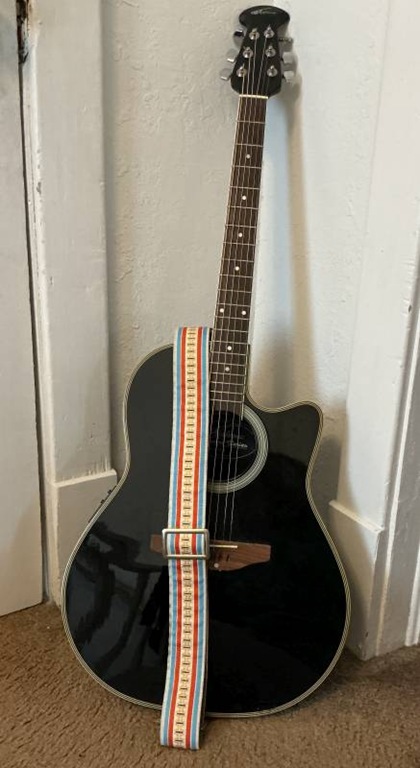
Ovation

It’s looks legitimate & peaceful sitting there, but what might it summon with its tinny horn?

.

And one night this month, I had an inconvenient time to record a realization of a fine poem by the famous Irish poet Yeats. Yeats got a Nobel literature prize. Yeats became a Senator when his country achieved independence. Yeats is so honored in Ireland, a poem of his is on their passports. Yet, I played my song version of Yeats on an old battered guitar, its cheapness designed in.

And you know, I appreciate a good sounding acoustic guitar. Those folks in thrall to the details aren’t imagining things. But then my singing voice isn’t a finely crafted instrument either, and I’m asserting I can express something of the essence of Yeats’ poem anyway. You can hear it with the audio player below. No player? Has that old wizard Yeats summoned the devil to fly from the shuttered Ovation Connecticut factory with Hartford’s Mark Twain and Wallace Stevens riding with his hoard to take that audio player from you? No, it’s likely just a matter of some ways of reading this blog choosing to not show the player gadget.  This highlighted link will open a new tab with its own audio player.


.


*The Ovation brand still exists, a shadow of itself, having been haunted through a series of owners. The plastic bowl-shaped back – though often paired with much better sounding other components than my low-end example – is still controversial. In its glory days, Ovation was well-known for pioneering under-saddle acoustic guitar pickups. They were so preeminent there, that in the last quarter of the 20th century if you were to see a popular guitarist in concert in any sort of larger venue playing acoustic guitar, you’d be more than likely to see them playing an Ovation guitar that looks remarkably like my more lowly example.

Eventually other manufacturers caught up with their own acoustic guitar pickup systems, eclipsing Ovation’s USP. Come the 21st century, the New Hartford Connecticut Ovation headquarters and factory, home to these innovations, was closed.

**At least some early Applause models used aluminum necks. I can’t say for sure what’s under the black paint of mine, but it sure isn’t wood.
Ethna McKiernan’s “The Day My Mother Gave Me Away to the Tinkers”

Here’s a poem that I’ve turned into a song for my second post honoring two Irish-American poets who led a St. Patrick’s Day poetry reading in Minnesota for several years before their death. Of the two, Ethna McKiernan had more direct ties to Ireland, having spent some time living in Dublin, and then in Minnesota running an Irish book and music arts store in the Twin Cities for many years.

For a part of those years I was acquainted with Ethna through the Lake Street Writer’s Group,* where a small group of poets shared works in progress and discussed on the side our lives and outlooks. When I look back on those years, I miss those writers, but I also fear I was inappropriate in critiquing their work, particularly Ethna. My style in that sort of thing tended to be highly detailed (picky might be a word), and even if I would lengthen my responses to their work in progress with “you could consider this or that alternative” because I believed in an honest “test reader” response without claiming to having some reliable recipe for a successful poem, or authority to ask them to change anything. That claim, that belief, should have opened me up to considering “so why then bother them (or myself) with these suggestions or reactions?” I have no academic training in poetry (Ethna did) and in my late twenties I gave up working at submitting for publication. Ethna did publish. She and Kevin each had several book-length collections as well as the usual small-press acceptances. All this would testify that whatever I thought about poetry’s workings, those ideas were unlikely to be commercially helpful.

Well, you can’t apologize to the dead. They either know better or not at all. I meant well, and I could be amazed by Ethna’s best poems. So, here’s to letting you know about their work here, which I hope is a pleasure for you. And if you would like more of that pleasure, Ethna’s last book, a new and selected collection finished as she was in her final illness, is available here from her Irish publisher.

I think I heard Ethna read today’s poem selection, “The Day My Mother Gave Me Away to the Tinkers,” more than once, including at one of those annual St. Patrick’s Day public readings, where it’s an apt choice, what with its Dublin setting. Before reading it, Ethna would instruct the listeners that, just as with many people of our shared generation,** her mother had issued the threat inside the poem’s title in jest, at worst during momentary frustration; and that the subject of her poem was but her teenage mind thinking in response “Well, I’ll take her up and that, and then she’ll be sorry.”

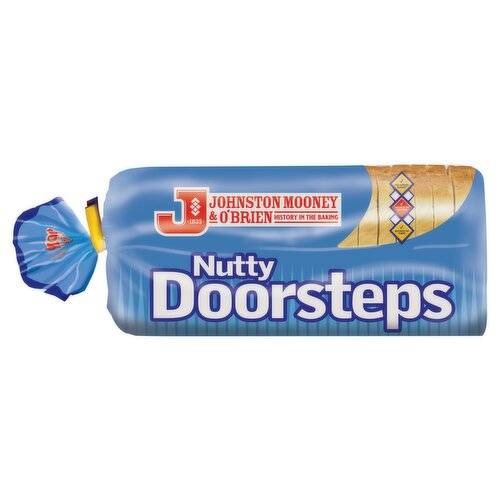
What else do I want you to know before you hear my song performance of this poem? First, for practicalities sake, there’s a man singing this mother-daughter poem. That might be a detriment. Otherwise? I made a mistake singing the name of a baker mentioned in the poem, Johnston Mooney and O’Brien. I dropped the “Johnston,” but at first figured no one would care, that it must be just some immaterial tiny particular bakery – but it turns out that firm is a famous and long-standing Irish baking concern, Oh well. I hope you enjoy the song anyway.

Johnston Mooney and O'Brien Nutty Doorsteps

Forgot the “Johnston?” Never darken (or spread jam on) my doorsteps again!

.

You can hear it with the audio player gadget below. Has any such audio player disappeared? No, the gadget’s mother hasn’t given it away, it’s just that some ways of viewing the blog must want the audio player to not be seen (or heard) – and so I offer this highlighted link that’ll open a new tab with its own audio player.


.


*Alternative voice here Dave Moore, and our other St. Patrick’s Day poet Kevin FitzPatrick, were principals of the Lake Street Writers Group.

**My own mid-century mother had her variation of this “give you away” phrase, and but seven kids to test her patience.

Kevin FitzPatrick’s tale of “Two Cities”

Two Minnesota-based Irish-American poets who Dave Moore and I knew and worked with (Kevin FitzPatrick and Ethna McKiernan) used to give an annual St. Patrick’s Day poetry reading in the Twin Cities, a tradition that was ended by their final illnesses and death a few years back. It’s occurred to me that I can carry on that tradition here, so, let’s do that. I’ll start with one of Kevin’s poems.

Kevin’s poems are often parables. He’ll tell a story, most often using simple, off-hand language, though that story may encounter unexpected jumps. A bit of dry humor will often stop by. From working on and talking about poetry with Kevin I learned about the craft and intent in his language. The poems rhythm, sequence, and word-choice were honed – what seemed casual was thought out, and being able to see many of his poems move from earlier drafts to final versions, I’d see Kevin’s poems ending up working like good, even more highly compressed short stories. Like Joyce in Dubliners,  the mundane and the particular are a setting in which to find an epiphany.

I’ll remind readers that Kevin FitzPatrick’s poetry is available through this web site: https://www.kevinfitzpatrickpoetry.com

Here’s a poem, “Two Cities,”  from one of his earlier collections, 1987’s On the Corner.  It’s set distinctly in Minnesota’s Twin Cities (Minneapolis and St. Paul). These are two, barely fraternal twins. Minneapolis: larger, traditionally more Protestant (its early civic leaders were often New England WASPs) including a strain of tony liberal Republicans that have all but disappeared. St. Paul, more Roman Catholic, smaller, less seated with secular high-culture institutions, a stronger union town. Though not identical twins, they are cojoined, their borders entirely coincident.

Kevin starts this poem with a tiny, vague head fake about an empty pole, and then drives right into one of the borders. Is it real, even if no one cares to maintain the sign? There are certainly different governments as he shows us in an efficient aside, different even to something as central as time zones. Some residents think the differences in the two town’s citizens are strong, shown in the dive bar anecdote that had me laughing again as I re-read the poem.

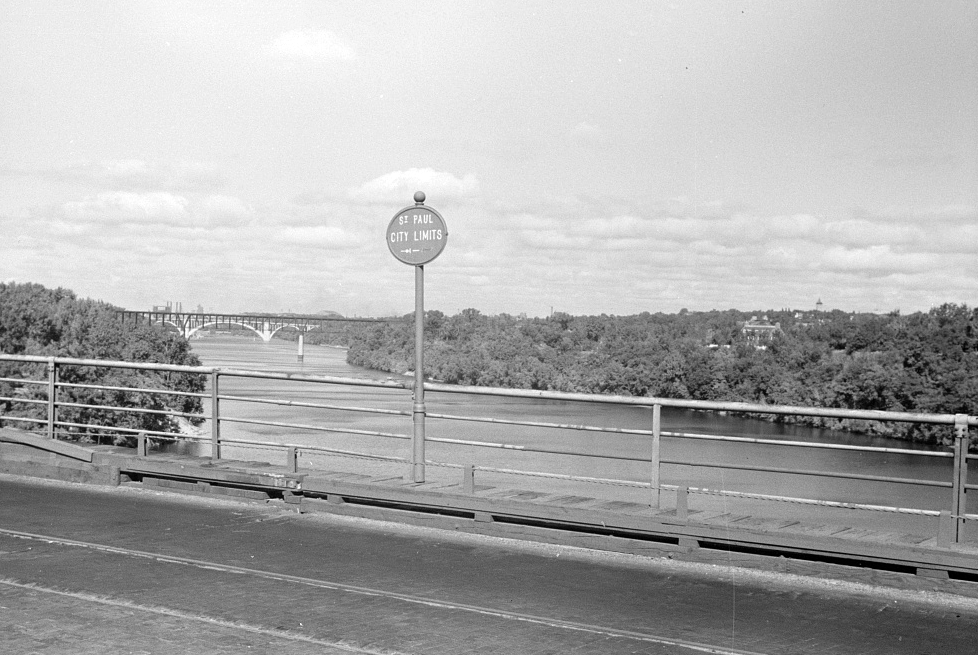
st paul border sign on bridge

The Lake Street Bridge in the mid-20th century at its St. Paul border. I can’t find a picture of the missing bi-directional sign FitzPatrick writes of in the poem

.

He wraps his poem up with another character – and Kevin’s poems are full of characters. Unlike the typically solipsistic modern poem, he casts voices that ask us to consider something/someone else. How quickly Kevin draws him! “Jim” is a military man’s son, not a stay-put native who thinks his birthplace tells who someone is. Perhaps too, from the nature of his family business, he knows the violence that maintains borders more than chipped signs. And “Jim” gets the last word, or rather a last hope: that we can rise above things like borders, see ourselves as ourselves, not as cliches of birth or origin, bound by imaginary map-kept lines.

Is Jim the fool for his hope, when even two neighboring cities in the same state can divide themselves up with rough and ready human pattern matching? The poem sits between those alternatives. By bringing it up, the poem, the poet, asks us to decide.

So, a parable. Yes, its detail is about two cities Kevin and I lived and worked in for several decades. Yes, I’m remembering Kevin for a national culture observance, and remain here, after him – honoring, as it happens, poets with an Irish background. But I write this winter in a time when immigrants are held in a bureaucracy with cruel penalties and moving/sign-less lines. And with wars now too, where the lines of governments are crossed by a mad emperor. Kevin FitzPatrick’s poem reminds us, we all make ourselves (people, towns, nations) what we are, and we might waste our time making someone else what we think they are.

I performed the poem, reading it, to the best of my ability, as I think Kevin might have. I did add one of my “inline epigraphs” to the poem’s text, a line from a song  that you’ll hear at the end. Musically I once more unleashed my company of electric guitars, though the Telecaster solo in the middle got caught out by someone’s arrival that meant that would be the last take. While I’m a guitar cosmopolitan, there is something special available from a Telecaster when it and an amp mesh up. You can hear this performance with an audio player you should see below. Has it disappeared like that border sign? No, it just that some ways to view this blog will 86 showing the player, and so this highlighted alternative link is your asylum, able to open a new tab with its own audio player.


Only Until This Cigarette Is Ended

Did I promise an upcoming, complicated, love poem from Edna St. Vincent Millay last time? Well, let me deliver that.

This poem is one that taunted me to sing it as I read through several dozen Millay poems early this month. Millay chooses rich yet strange images in it, the poem’s erotic mood includes complex uncommon elements within its lyrical account of two consciousnesses which have met and are about to separate, and that makes me think of other songs I admire. Its splendor in an alienated nighttime moment makes me think of “Visions of Johanna,”  while it’s notes of respect beside begone absence makes me think Dylan’s suite of songs within Blood On the Tracks.  And Millay’s choice of images here verge toward the surreal enough to think of Robyn Hitchcock as I worked out the music and performance you can hear below.

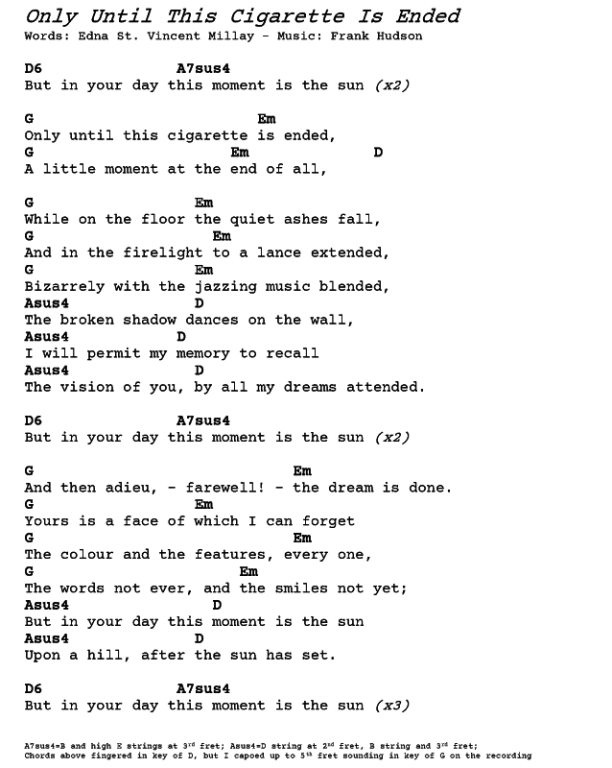
Until This Cigarette Is Ended

I chose to leave this chord sheet showing the chord forms I fretted on a standard-tuned guitar, even though the recording sounds in a different key due to my use of a capo. This is an easy song to play on guitar, even strummed rather than using my cross-picked arpeggio playing style, and I wish to encourage others to sing these Parlando Project songs.

.

I choose one lyrical change as I made the poem into a song: I decided to create a refrain out of one of its lines. I’m personally OK with songs that eschew choruses and refrains, and a great many poems taken down word-for-word as song lyrics will not have that element that’s increasingly prominent in popular songwriting. This choice brings forward that two-consciousnesses element. The poem has the poem’s voice (for simplicity, I’ll call that voice Millay’s) speaking what we’d call these days “her truth.” Though the poem is compressed into a lyric moment, that truth is that there’s been a pleasant enough erotic event between two people, but that Millay knew, or has decided, that that’s enough and this will not be an ongoing erotic bond. For a woman to publicly write this over a hundred years ago was striking – this poem’s honesty is precedent to those more contemporary expressions.

But the poem is more than precedent, let me linger on the images, starting with the titular cigarette, that quick and casual tube of tobacco. Rather than fade into Millay’s century ago, this reader (now singer) is drawn back half-that interval to when he, and most in his circle, were smokers. For Millay the cigarette would’ve been a somewhat modern signifier – and one without the more lingering girth of the cigar or the apparatus of pipe smoking – but for me, I was drawn back to what I tried to explain to my wife yesterday was my youthful erotic imprinting on cigarettes. My thoughts were not the trope of the post-prandial smoke after a buffet of lovemaking (something I never chose to do) but on the smell and taste of tobacco about the lover’s body. To younger moderns, disdainful of my evoking that, I’d try to explain that a common sharing of certain oils and ash on our skin and lips was kind of intimate comingled pyre. Millay doesn’t explicitly evoke that – I think the modern briefness and offhand casualness was her intent, but she portrays another image I think here that is specific to cigarettes in my memory” a well-packed, factory made, Modernist for Millay, cigarette can produce a lengthy ash as it’s smoked. I can still recall one college literature professor, one with a very John Berryman beard and manner, who would, while animated with some literary thought he was expressing, continue to puff on his cigarette as the distal ash grew to maybe half the length of the number in his mouth. This drooping ash would jiggle as his lips that held its cigarette continued to expound, and the suspense of its suspension would sometimes disconnect my attention to what he was saying with the other part of his mouth. All our thoughts, all our desires, all of us, will eventually fall to ash might be the image here, and I believe that’s the lance Millay evokes in her poem.*

There’s also fireplace, firelight in this shared post-lovemaking pyre, and Neanderthal meets Plato expressionist shadows make a visual Jazz noise with some off-screen radio or record player. For Millay a palpably Modernist mise-en-scène, but even for more modern moderns, there’s really nothing to turn off, it’s just lovers, so entwined, but these visions…

The final six lines make it so precise and so clear: something, a lasting erotic pairing, is not to be. Millay’s voice here is precise: this person momentarily beside her will not hence imprint with their body, hers – but that other’s words will stick with her? Something they said? Something they wrote? Since there’s no hint of rancor or lack of respect in the boundaries of this lyric poem, it may be the latter, a love of the poetry of the word not the poetry of the physical deed.

And in Millay’s final six lines comes that line I’ve chosen to refrain, a choice that brings her to an in passing but significant notice of that other consciousness inside this short poem’s fleeting embrace further to the fore: “But in your day this moment is the sun.”

What is that saying? That the other takes this as more overt than the covert firelight and briefly burning cigarette? Probably. That could easily be read as more than a bit egotistic, a trope in the more well-worn notched bedpost of the male “Babe, I gotta be moving on” road song. Or it could be, as I tried to make it my musical performance of Millay’s poem, a rueful acknowledgement that there’s a gulf between the two consciousnesses, even inside their closeness in the moment of the poem, now song.

So, complicated – a love song, or a song of something close to love.

That musical performance is available below with an audio player gadget. What? Is that side of the embed empty, the sheets now cold? Ah, the poem-now-song peddler now speaks, there’s jewels and binoculars – no, a link, a link, a highlighted link, that will open a new tab in your browser that will have its own audio player so you can hear it.


.


*Yes, yes, this obligates the sometimes “a cigar is just a cigar,” Freudian mention. That it’s a cigarette here – a genderless tobacco product rather than the male-coded cigar or pipe – is Millay’s choice.

Apostrophe to Man–Edna St. Vincent Millay declares war

Apologies to those who came to this post in expectations of a follow-up to my (however simplified) approach to Art Song last time. I’m looking forward to finding time to use my acoustic guitars and imperfect singing voice – really, I am –but sometimes you have to deal with the internal question “You’ve got a strategic stockpile of electric guitars, so why don’t you use them?”

A midcentury person, I grew up in a world with the fear of nations who for ideological supremacy or imperial colonialist designs, would bomb, invade, and make war on others. My country, the United States, was to be a bulwark against this – and so, might these other countries launch an attack, perhaps on a pretext that they were preempting our weapons and opposition to theirs? The scenarios were detailed in dream shadows: missiles across the arctic, a covert foreign army across our southern border, some manifesting murderous domestic fifth column.

And now I have those fears again – only it’s my own country that will be the attacker.  Manifest Destiny seems to have a new expansive definition: the whole world. The mad despot I fear now sits in my capitol. First, we got the flavor of what government round ups of our neighbors would feel like, and then our “warfighters” blitzkriegs across this-and-that border. The borders that are preeminent principles in the former are of no matter in the latter.

Perhaps I’m oversimplifying things – or you wish it was simplified in the way our leaders rule correct in their current mood Yet, perhaps, we haven’t simplified these things enough. I’m not writing this to be clever or to lord over you with some moral superiority, I’m just disgusted by warfare cast under shoddy precepts by callous and vainglorious men.

Millay across the sky

When Millay wrote “Man” in her title, did she mean a general, genderless, “mankind?”

.


So let me get on with it – we should have some poetry and some purported music. I recently read this Edna St. Vincent Millay poem. You might think of Millay as the writer of wistful poems on inconstant love and desire. Yup, she wrote those poems, and some of them are quite good. Desire and how we keep or loose it is a deep subject, worthy of verse, and metaphysics and theology elsewhere in poetry have less to testify about the times we are naked before the shroud.* But there’s an angry Millay that I’ve also featured here too, and this one suits my household’s current mood. When this poem of hers, “Apostrophe to Man”  was published  it was not some sort of detailed position paper in verse either. Here’s a link to the text of that poem. I suppose one could try to make it sound pretty in spite its spite, but there’s a Stratocaster not Stratofortress that wishes to launch ordinance on you there today. You can hear my assertion of something much like music around Edna St. Vincent Millay’s poem with the audio player below. No player to be seen? It’s not a stealth fighter or secret police thing, merely the inability of some ways you might read this blog to show a graphical audio player gadget. Use this highlighted link then, and a new tab with its own audio player will appear so that you may hear a screaming coming across the sky.


.


*No real footnotes this time, but I still hope to have other musical presentations that attempt beauty this spring.