Jazz and reading John Darnielle: Part Two, This Year 365 Songs Annotated

Here’s the final piece of this two-parter, and the place where I take off that hair shirt for a while and present a review of John Darnielle’s new book This Year, 365 Songs Annotated.

I largely owe my appreciation of singer-songwriter John Darnielle to my daughter, who found solace in his earlier recordings as she moved through adolescence. One 2005 song, the one that gives its title to a new book by Darnielle, features a 17-year-old speaker refraining: “I am gonna make it through this year if it kills me.” It resonated more than a decade later with another 17-year-old. What a good thing for a song to do.

I knew Darnielle’s work from a couple of songs recorded under his long-running project name “The Mountain Goats,” most notably the mysterious anthem “Jaipur.”   My daughter gifted me his All Hail West Texas  album one Bandcamp Friday a year or so ago. My immediate thoughts on Darnielle were that he was a good song lyricist. Like the late poet-associate of mine Kevin Fitzpatrick, his work is full of “other people,” and those people are often working class or lost-soul types who make themselves known as if in overheard declarations in his songs. Writing in Boomer classic-rock consumer-guide style “he’s like…” comparisons are misleading in Darnielle’s case. Saying he’s lyrically a mix of Randy Newman, Bruce Springsteen, Ray Davies, and John Prine is a bad assay, because he’s like all of them at once or in sequence, and he is his own man too. Still, the range of characters is an important strength. A lot of poetry, and a lot of indie songwriting too, is a singular solipsistic narrative, and Darnielle’s of the songwriting school that avoids this.

This Year cover

More than a collection of song lyrics (though they’re good lyrics)

.

Yet, This Year  is largely the story inside one person, a memoir in a different form: a book of days where he writes somewhat sequentially, but not by strict intent or always, about how 365 songs came about, what he thinks he was trying to express, and what his life was like as he wrote and recorded them. The entries can be quite short, a couple of hundred words typically, though a few extend for a few pages. The lyrics to each day’s song are included with each entry, which is helpful for any reader who’s not familiar with his work. I’m half-way through reading it straight through, but the book can also be read an entry at a time, as sort of daily thought-starter. I’m somewhere between a hardcore fan and someone that doesn’t know any of Darnielle’s work, and I’ve sought out some of the songs after reading of them in the book.

Things I’ve learned? It was not apparent to me beforehand, but he’s a poet who converted to songwriting, and many of his early songs had preexisted as page poems that he wasn’t planning to sing. Reading his lyrics silent on the page in this book demonstrates a literary poet’s craft in his writing, but my finding this out in memoir is a testimony to their lack of crusty poetese. Poets as well as songwriters would benefit from exposing themselves to Darnielle’s lyrical tactics, and he talks effectively about them in this book. I also learned that he spent formative years in his songwriting’s development living in a small town in Iowa, the kind of place I grew up in, in roughly the same part of the state, though I’m more than a generation older than him.

Another part of his story, which unreels through the day entries each devoted to a single song from his now large catalog of original songs, is that he began recording and making these songs public using meager equipment. He so far mentions almost nothing about the particulars of his instruments which are likely unremarkable and inexpensive, and a considerable part of his early career recordings – including the original versions of some of his best-loved songs – were recorded on a boom-box cassette tape machine at home. I resonated with that, having spent around 20 years using such cassette tape along with low-budget equipment. A late 20th century indie-music and fanzine samizdat network allowed Darnielle a slow-burn career doing that, around the time that my own nerve to share my work had faded. He recounts in the book, that royalties from the tapes sometimes paid part of the $170 a month rent,* but he had a day job in a lower-paid nursing field, again something I rhymed with in my cassette years.

The short entries in the book also tell a story of Darnielle’s religious journey, which began as a Catholic youth and has had elements of return, though I’m midjourney on that arc so far in the book.

These similarities paradoxically bring up the personal gap which makes reading his book so meaningful to me now. From what I’ve read so far, Darnielle apparently retained confidence in his own work through these long-beginnings, low-rent, lo-fi years, and even if there are dark nights of the soul in coming parts of his book, he displays that now as he discusses the work in retrospect. I had, and still have, substantial gaps in being able to carry that in public during my cassette years. Having days of private levels of self-confidence in some of my musical work is not an effective dose to properly present it to others, and my doing so “blind” without that confidence led me to some painful comedy of misreadings of likely interest. Those two things (managing self-doubt, being able to present one’s work effectively to others) interact. Darnielle may have been more personally engaging, or just more persistent in his networking. Elements of luck might have been significant (with me, they were in my “day job.”) Thinking of this difference as I read Darnielle’s book, it’s (too) easy for me to think, “Well, it must have been easier for him, his work was so darn good.” He’s a better vocalist and performer than I am (no-biggie, almost everybody is), and though I’m not sure how far apart we are in “on a good day” guitarist skills, his song lyrics are teaching me new tactics even after decades of my doing this on the page and with guitar.

In the first part of this pair of posts I sincerely worried about my work and hubris when I put it up against the skillset and history of Jazz. Despite those differences in how we’ve used our parable of the talents, I find reading Darnielle’s book heartening so far. You don’t have to be a songwriter, if you are any kind of writer – and likely if you are an artist of any kind – spending time with this book may be helpful.

Here’s an early song of mine, recorded on primitive equipment before the nearing 900 songs of the Parlando Project had started counting off, but consistent with its principles, a setting of John Keats’ “In the Drear Nighted December.”   Audio player gadget should be below, but if not, this highlighted link will open a new tab with its own audio player.


.

*For any younger folks reading this, the $170 a month rent (for a house!) must seem a dormouse fantasy. For younger musicians, the idea that royalties from indie recordings might contribute in any substantial way to making rent must seem equally fantastic.

Jazz and reading John Darnielle: Part One, when I make a Jazz noise here

I’m glad my face ID still recognized me today to write this, since I’m in an unhappy, grumpy mood, and I don’t much like the self I’m in. This mood may be because it’s winter and cold with dark early and late, or because I didn’t get a bike ride in, or because folks with guns and ones with governmental power are doing cruel things for the proximate reason that they’re cruel. Grumpy and unhappy? Perhaps a reasonable response for winter, but is that same mood commensurate to the mass shootings in the news or the treatment of our country and neighbors by the mad king and his gleeful courtiers? I don’t know. Whatever I do (little) or think (enough? too much?) about these things ties me up in this grumpy place. In addition, we have a world of similarly unsatisfied folks to me – but these folks are pointing out that we aren’t thinking or doing enough in various best ways to defeat these horrible acts.*

Since I put my efforts toward music and poetry, I’m not going to charge you with not doing the right things to counter those general evils here. It would feel hypocritical for me to do so. But this dissatisfaction with the world and myself is bleeding over to my work today as well.

Early this morning I posted something on BlueSky about Jazz that could be easily misunderstood. So, I’m taking my chance to get it off my chest here so that I can be misunderstood or make a fool of myself at a greater length. There’s a new documentary that you can rent-to-view for $3 on Amazon: The Best of the Best, Jazz from Detroit.  This is a good film, made for the best reasons. My reaction is not their fault, and you shouldn’t hold it against them. The insightful Ethan Iverson has it right in summing up its value: “not just…a must-watch for fans, but also a superb introduction to jazz for the uninitiated.” But reading an interview with its creators and spending a rewarding 90 minutes watching it today also activated a problem I’m increasingly having with my musical work here. Let me summarize it as quickly as I can.

I feel embarrassingly limited as a musician. That I have a few tricks that I can pull off some of the time on a few different instruments must be balanced against the absence of some foundational skills that should be there. This is the reason that I’ve often taken to calling myself a composer, since my tactic is to create pieces I might play passably well rather than to show my lack of skill in doing musician’s work.**  But “composer” sounds even more presumptuous. I call myself, I think accurately, a “naïve composer.” I know dribs and drabs of musical theory, but again I lack the musical foundation that most anyone who calls themselves a composer would have.

I feel this lack of foundational competence often among musicians, and I’d feel it even more if I was around folks who are composers often enough – and there’s no place I feel it more than when you put “Jazz” in front of musician or composer. Watching Jazz from Detroit,  this fine film, reminds me of that; first because it makes the point that one of Detroit’s strengths as a “punches above its weight” center of Jazz music is that there were teachers in the school system and elsewhere in the city, mentors who helped young players understand and master the fundamentals of that art. These mentors guided folks who made Jazz and music their life and honors them. And it makes another point beside that one: they did this as part of a specific Afro-American urban culture that is not mine.***

Jazz for Detroit Title Screen

The film’s title screen.

.

OK, so where does that leave me, particularly at my advanced age? I somehow can’t stop at simply recognizing and honoring that, I’m drawn to dipping into that musical language at times here, even if I can’t speak it fluently, and I’m not sure that is a good thing. Are my efforts, which wouldn’t fool a skilled Jazz musician for a minute, profaning their art? Does even my small audience subtract from the possible audience for more dedicated and skilled musicians? Is this intentionally non-revenue Project undercutting folks who need recompense? Or even: is this self-flagellation boring, and something only someone with my level of privilege would undertake? Am I thinking about any of this too much, or thinking about it not enough? I don’t know.

But here’s what I do know: what I can observe I do. I keep doing this, even if it may be wrong – or guilty of a lesser sin, missing the point.

Here’s a piece of mine from a few years ago about the dedication of an actual Jazz musician, Sonny Rollins. Audio player gadget below, or alternatively, this highlighted link that will open a new tab with its own audio player.

.

*Some of them could be right on what we should be doing – but since they differ, some are likely wrong. All of these voices can’t be Martin Luther King writing from the Birmingham Jail, and there are/were folks then and now that didn’t think he was doing it right either. In our modern age I can’t help but suspect the “everybody to the left of Donald Trump is complicit in this mess” voices as bots.

**Put me in a room of not particularly skilled folk or rock players with my guitar, and on a good day I might fool them for a while at being a musician.

***This isn’t shouted outright in the film, but some of the elders speaking in it are, I believe, trying to make the point that the specifics of their 20th century Jazz-creating Afro-American culture require additional efforts to be valued and maintained.

The Sunset stopped on Cottages

Here’s a poem by Emily Dickinson that I made into a little song. There’s an audio player below to hear it.*  I intended the music I made for this piece to be jaunty – not only because I worry that too many of the Parlando Project pieces are slow to mid-tempo, but because it fits the language of Dickinson’s poem. Just 8 lines, but its “what’s in the box” description includes: a sunset, a morning, cottages, and a USB C charging cable.

No – error – sorry. No charging cable. I looked at the catalog listing:

Emily Dickinson no longer includes a charger or charging cable as part of our environmental commitment, which we maintain as we continue to offer the finest in Cottage-Core products for the home poetry enthusiast. Folks who listen to ‘The Sunset Stops on Cottages’  often listen to I’ll Tell You How the Sun Rose’   and may also be interested in a delightfully antique Emily Dickinson tulle tippet nightgown or one of the delightful Tyrian purple moth-scented candles from our Susan Gilbert Dickinson collection.

OK. I’m funning with you. After living with the poem for awhile as I set it to music and recorded my performance of the result, I instead believe this poem is an example of the genre my wife calls “Cozy Gothic.” How come? I think the poem’s cottages are graves.

Here’s how I understand Dickinson’s poem. There’s a pretty sunset, an eternally repeated and universal, broad-sky-set thing. The sunset must appear where ED’s poem sees it, but after its moment it’ll be “Gone Westerly,” for today. Gone westerly is likely a similar idiom to “gone south,” a euphemism for death. The sun has not fled out of dereliction of duty –“treason” – but because a day, like a human life has its limits. The poem’s second stanza reminds us of the circadian day too: that morning and a sunrise was, and will be, there – but that’s no matter to the dwellers in the cottage/grave “swellings in the ground” who can’t see the “supercilious Sun.”

Sunset stopped on Cottages

Here a chords sheet, and what’d be more Cottage-Core than playing this Cozy Gothic song in your own cottage? That G chord form I played is just the B & E strings fretted at the effective 3rd fret along with the open D and G strings.

.

I asked my wife again this morning about “Cozy Gothic” as I prepared to write this. I reminded her that the young Emily Dickinson did not grow up in the grand house that’s now the Emily Dickinson Museum, but in another place where the Dickinson family lived in her youth after her grandfather got the family finances mired in debts until her generation extracted them from that and were able to move back to the grander house we associate with her poetry. The grand Dickinson manse was across the road from a crop field, and had room for gardens of fruit, food, and flowers; and it was beside a main road for travelers in and out of town. The place that her family had to relocate to was smaller, and across the street was a graveyard. Mix those two homes ED knew in her lifetime, and you have some pretty good poetic loam. I asked my wife, a known PK,** “Did you ever live next to a graveyard?”

Yes, when we lived in a parsonage. The town was taken aback when I sunbathed in the graveyard. I didn’t know what the big deal was about that – it just seemed like a nice, peaceful, place.”

That’s my wife. Nature nymph and likely a better writer than I am – and for all the mixture that made up her childhood, she got to live the spirit of this Dickinson poem directly – Cozy Gothic.

Here’s that audio player gadget. What, has any such audio player “Gone Westerly?” You can take hope in the resurrection, but it’s likely because some ways of viewing this blog suppress displaying the audio player gadget, just like they mute the angels that would write better, more concise blog posts. I make do by providing this highlighted link that will open a new tab with its own audio player though. Playing the bass track for this one – without making a point to think of it, but still thinking of it – I was thinking of the great British bassist, Danny Thompson, who died this autumn. Thompson’s playing could be quite free and capable of quick, large, leaps in register, but while doing that he could follow complicated or chaotic other players ad lib and help make musical sense out of them. I loved his playing, and of course mine is more a tribute than the work of a peer in skills or dedication to the instrument.

.

*I find it puzzling as this Project enters its 10th year that the number of people who take the time to listen to the (almost always) short musical pieces here remains essentially flat from 3 years in the Project on forward, while the number of readers of the blog posts continues to grow. Less than 10% of readers click the audio player or link, assuming that the stats I get are accurate.

I have guesses. My rough-hewn voice will never make me America’s sweetheart. My naïve compositional skills may fall between the sawhorses of pop ready-mades and art-song sophistication. The variety of my musical approaches may put a stop to continued listening, as I’m near certain to attempt a style someone doesn’t like (and so my failure or limited success in evoking those styles could be beside the point).

**”PK” = “Preacher’s Kid.” Not just my wife, then Dave Moore, my long-time musical partner sometimes heard here, is a PK too. I’m sort of one, though my father left the Protestant ministry, except for fill-in roles, in my childhood – but that history and those fill-in pulpit appearances likely helped shape me.

The sequela of being a PK vary. Some become rebel angels, some follow into the “family business,” some suffer from having had childhood expectations of goodness and polity, others take the close-hand connections with music, ethics, or philosophy and use that in some other field. For myself, I think the main thing I took from it (and my father deciding not to take to it) is the concept of “a calling.”

Adapting Michael Strange: “To Claude Debussy’s La Grotte”

I’ve long wanted to do a Parlando Project piece using the words of early 20th century American poet Michael Strange – but there was this one problem: her poetry wasn’t very good. Or perhaps I should restate that: her poetry doesn’t consistently work in the ways that I appreciate poetry. What about her poetry causes problems for me? It’s not just that it risks being ecstatic to a fault, or that it seems grandiose at times. I’ve forgiven other poets those excesses. It’s certainly not her overall poetic approach, as her verse seems to me to be highly influenced by Imagism, that early 20th century poetic movement that continues to inspire me. She also seems fond of Whitman and Nietzsche, but so were other writers of her era that I’ve presented here. So, if not those things, what? If I’d pick one term for what keeps me from enjoying her poetry it would be “over-writing.”

Here’s an example, an ekphrastic poem about an art song by composer Claude Debussy which used a text by François Tristan L’Hermite. I’m not sure if Strange is portraying L’Hermite’s French lyrics (which are quite good and bring in the myth of Narcissus) but she talks of sound and gives the musical composer the sole place in her title:

To Claude Debussy’s La Grotte

Your song
As the hale of mysterious exotic intention
Drifting in palpitating echoes
O’er the pallid oval
Of night-closed flowers -—

Your song
As the increasing shimmer
Of some exquisite nearness —
Clad in those steel-dark foils
Of sinister fancy —
And once more your song
As the moaning hush of a human soul
Receding — from the Divine Moment

.

The images here constantly suffer from the Donald Trump school of interior decorating. They’re not just curlicue ornamented, they’re coated in gold leaf. The “hale of…intention” image is a fine one, but adding both “mysterious” and “exotic” as modifiers cloaks its originality. Are “echoes” so unclear as a sound description that they need “palpitating” to clear up that they repeat at intervals? Why the somewhat archaic “O’er” when the modern “over” will chime nicely with “oval” and “flowers?” And that’s just the first stanza, first 21 words. This over-egging hurts not just the sharpness of the images, it hurts the word music too. As with Trumps White House confessions of gilde, this can be read as a lack of confidence in her own vision and place in poetry. I must include “poetic” words, I must show the specialness of each facet with modifiers and more modifiers, I must show that I’m writing.

Now I’m not writing this to dunk on Strange. I’ve committed every sin above, and more. What I write has enough faults to repel readership. Strange is not a particularly famous or widely-read poet, but more people have likely read her poem, and maybe even more people would like this poem of hers than any I’ve written. Still, I want a better poem than this one printed more than a century ago if I’m going to perform it. Yet what I did is risky ethically – that Strange is dead and her work fully in the public domain doesn’t erase the issues with what I chose to do this week with her poem. I rewrote it.

Your song,
the hale of exotic intention
drifts in echoes
Over the oval night-closed flowers.

Your song,
the shimmer comes nearer,
some steel-dark foils of sinister fancy —
And once more
your song,
the hush of a human soul
receding from the Divine Moment.

.

I tell my self-accusing self that I did this in service to what I think Strange was portraying in her original poem. Indeed, what I did there is similar to what I do when translating a poem from another language: find the images the poet was portraying and convey them in contemporary English with a word music that works in that destination language – though here I’m able to use more of her original words since she wrote in English. I’m opening myself up to a charge of patriarchal overreach, but in my defense, I’ll say I’ve done this to Robert Frost and Rupert Brooke. So, I may just be an asshole when I do this.

Before I move on to a few notes on the musical performance that prompted me to do this rewrite, let me just give the briefest outline of Strange’s fascinating life, a history that gave me such high expectations as I sought out her verse. Strange was born into a socially prominent East-Coast family, and was married (three times) to socially prominent men. Photographs and contemporary testimony portray her as exceptionally beautiful. Despite her background, she was a feminist, a left-wing social activist, and moved in bohemian circles. During the WWI years she published her first poetry collection and used the masculine pen name Michael Strange for this. Wikipedia’s summary says the name was used to shield her family from the poetry, which was claimed to be erotic and scandalous, and it’s also easy to suppose that she may have made (at least in part) a tactical choice to avoid sexist devaluation of the work. Whatever the initial reasons, she soon came to use the name generally, in subsequent writing, when she appeared on stage as an actress, on radio as a host* and, I gather, “in real life.” I’m not an expert on Strange’s life, but it appears she used feminine pronouns.

Michael Strange

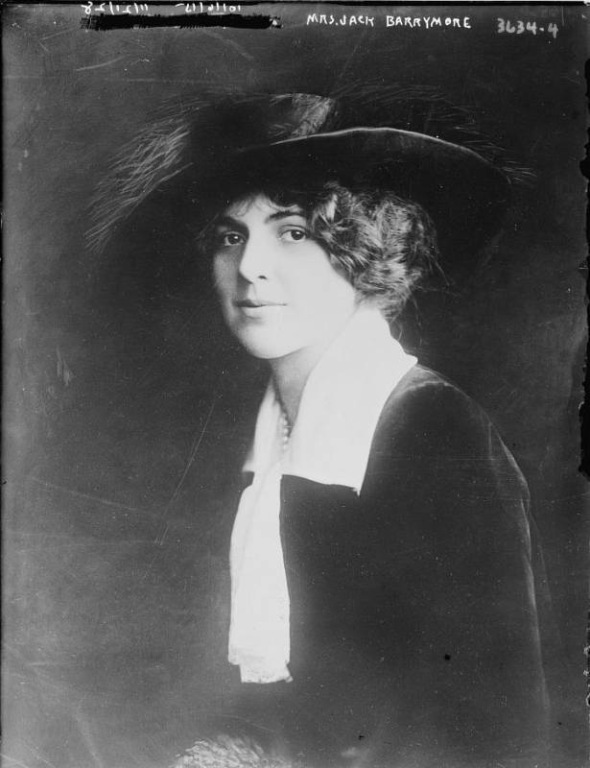
Pleased to meet you. Hope you guess my name. Born Blanche Oelrichs, became Michael Strange, was a member of the Lucy Stone League dedicated to married women keeping their own name – and this photo is labeled “Mrs, Jack Barrymore” (the name of her second husband, the famous actor).

.

It’s possible I would have run into Strange, on her own, at some time in this Project, since I enjoy examining lesser-known poets from her era here. Instead, I first encountered her because of her relationship with another author who produced popular Modernist work, Margaret Wise Brown. What? Yes, Margaret Wise Goodnight Moon  Brown. Early this century, in my fatherhood role with a then pre-literate child, I was the bard of such stories as Goodnight Moon  or The Color Kittens.  And it may not be only because this overlapped my adult reading that I heard them as part of the same world of early Modernism.** For the last decade of her life Strange lived in a committed relationship with Brown, and so it was in reading about Brown that I first read Strange’s name.

All right, on to this short musical piece using adapted words from Michael Strange. I was working on composing with the intent to use minimal motifs, ones that my minimal keyboard skills could play without using an arpeggiator or other automated extensions. I built the music using a variety of alt-techniques and “prepared” piano sounds. In the middle section there’s an organ part that does use an arpeggiator, and a percussion part that had me playing parts on some struck metal objects over a more conventional drum-set pattern. Not exactly Debussy,*** but perhaps evocative of other 20th century avant-garde musics. You can hear it with the audio player below. No audio player? It’s not gender panic, but some ways of viewing this blog suppress it, and so I offer this highlighted link that will also play the musical performance.

.

*Her radio program was titled Music and Poetry.  Just as with today’s poem – despite my problems with its prosody – Strange’s bio can’t stop being catnip to me.

**Another “could he really be serious” suggestion: if we might well include Robert Louis Stevenson and Lewis Carroll in studies of Victorian lit, should Brown be read next to H.D. and Pound as Imagist texts?

***Musically, while I’ve listened some to the Impressionist musical school of composers, I came to them largely from instrumental guitarists who were directly influenced by them. So, Dadaistically, today’s piece has no guitar whatsoever.

Before the Snow

Long time readers know that the Parlando Project is largely about our encounters with other people’s words – usually their literary poetry. Poetry, even impersonal or hermetic poetry, is a rich way to transfer experience between consciousnesses. Poetry’s strengths in this transference over memoir, blog post, or informal conversation are largely the strengths of focused beauty – that thing that attracts us even before knowledge, expressed as sound or by novel connections.

Still, these beautiful elements of poetry come with costs, which is why many, most of the time, prefer other modes. Yet, I think the shortness and the compressed incidents of lyric poetry offer a possible compromise. We’re asked to share a little burden, a few minutes of reading or listening, subconsciously absorbing the word-music and linkages, which may in leisure or with mood be extended by re-reading and re-thinking such a small number of lines.

One of the things that caused me to begin this Parlando Project was thinking that a short musical accompaniment might add pleasures to possible serial re-encounters with the words. Is this so? I’m not sure, though I persist in doing this.*

That preamble out of the way, I’m going to look like I’m violating the “Other People’s Stories” maxim that is a principle of this Project, because I’m presenting today words I wrote to go with the music I compose and record – but hold on, I’m going to tell you this is still about a poetic transference across a gap.

Here’s why: once again I’ve been running into things from decades ago as I do my “death cleaning” reduction in things stored away or unlikely to be of foreseeable use. Just last week I moved aside a drum set that had been played by Dean Seal when he was in the LYL Band,** and found under the bass drum a plastic carryall tub with things hurriedly packed up after some gig: a Radio Shack battery-powered mixer, cables, a guitar strap, a cassette recorder, and a few tambourines we’d hand out for audience participation. And more spiral, college-ruled notebooks have come to light. Glancing through one I found a page with 9, untitled, lines – the start of a poem. From the style of the poetry in the fragment I think it’s from the 1990s, but it might be earlier or later. It caught my attention because it seemed to be talking about November in Minnesota in that interval right before the first snows come.

I remember nothing about writing this poem, or what prompted it, but it had some nice word-music and was roughly pentameter. That pentameter made me think I was writing a sonnet, and for some reason left off at this incomplete draft. That night, before bed, with my aching muscles and joints from twisting, bending, and hauling I decided to complete a full 14-line draft.

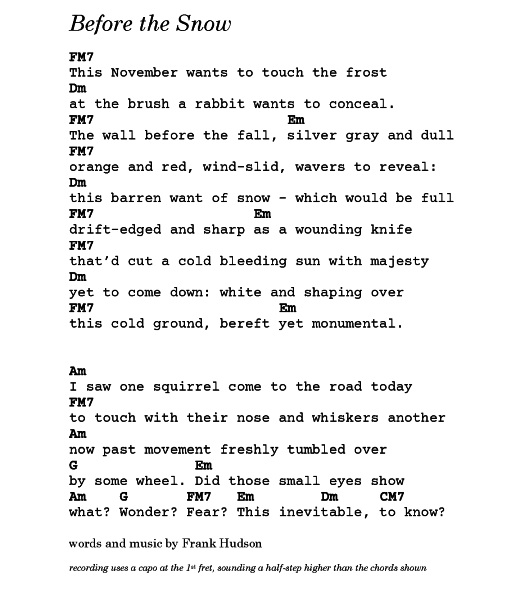
Before the Snow

More musical perversity: the difficulty in finding times to record acoustic guitar with sensitive mics in the past year or so has increased the number pieces I’ve done with that instrument.

.

For the final 5 lines I used an incident from a recent bike ride. Rolling down to a favorite breakfast destination at the borders of my wooded city I’m usually met with a rewarding bit of wildlife (outside of deep winter): constant squirrels, rabbits, small rodents, birds, including waterfowl by a pond and creek I pass, insistent crows, and so forth. If Keats wrote his “Ode to Autumn”  on Hampstead Heath in the Highgate section of the city of London, these near-daily rides of mine with this contrasting nature in the midst of modest single-family houses and parkland is my equivalent. What I saw this day was a little epiphany – a squirrel had been quite recently struck down crossing the road. Not smack dab run over, for it was not squashed, and there was only a little blood – yet it was clearly not moving or breathing, and even from the height of my bicycle its eyes could be seen fixed and dead. And then, as I was approaching, carelessly another squirrel scampered out onto the road and up to the corpse. Though I was riding onward, and only slowed a bit moving to the side, this squirrel bent down right to the head of the dead one, close enough to touch it barely with whiskers, clearly looking closely at it, for a moment regardless of my vehicular approach.

And then, just as I was beside them, it scattered off, missing by accident or close design, my slowed, but rolling, bike wheels. What was that squirrel after, what was it thinking in those few seconds with the dead one? This  was the matter to finish the poem that had started years ago with a rabbit finding scarcely-leaved autumn bush and brush to hide in. And I too had had my customary Parlando encounter without firm context, working with the part of the poem written by someone I hadn’t seen for decades: though in this case, it was my younger self. Not really that different from the usual encounters here with Frost, Dickinson, Sandburg, Millay, Stevens, Hardy, et al.

I originally gave the resulting sonnet the title “Before the Rapture of Snow,”  because I thought that tied-in the rabbit’s anxious waiting and the dead squirrel. I drew back from that thinking it too grand a reach, and because the theological implications of “rapture” would repel, puzzle, or draw in too-determinant reactions.

I was lucky enough to have a Monday to record this, finishing what felt like a good take of the vocals and acoustic guitar just before I had to leave my studio space. I added piano yesterday and mixed the tracks. As a non-pianist I’ve fallen into using that instrument simplistically as I do here, and I’ve grown fond of how these pounded single notes mesh with the timbre of acoustic guitar. You can hear “Before the Snow”  with the audio player below. Has the player been raptured up to heaven? No, it’s just that some ways of reading this blog suppress displaying such a thing, so I provide this highlighted link that will open a new tab with its own audio player.

.

*Besides my lack of talents for promotion, I sometimes feel what I do with this Project presents a number of detriments to gathering an Internet-scale audience. Poetry, as I write above, is not something sought out by modern Americans in great numbers. And then the music I make suffers from these things that reduce audience interest: I’m not a singer with a beautiful voice, nor do I think of myself as a performer with charisma or erotic appeal, and the music I make despite that is both too varied and too limited.

Many potential listeners or readers, presented with an infinite library of options in our modern age, will avoid things that have but one of those strikes against it – and to add another one or two against the Parlando work wouldn’t be rare either.

All this isn’t breast-beating or humble-brag, and I’m even hesitant to waste your time writing this. I am proud of much of the work I’ve done over the last decade here. While my audience is Internet-small, I believe it’s not all that small by poetry standards, and increasingly, not completely outsized by the audience for much non-Pop Indie music. Thanks to my hardy listeners!

**Dean was working elsewhere in comedy, and with at least one other partner in music, when he played in the LYL Band in the 1980s. He was talented and creative, we were looking for a drummer or bass player, and we perversely came upon him as both – unconcerned with the challenges of one person filling both roles! He may have grown to think of us as less professional or ambitious than he was, I don’t know, or events of his life may have intervened, but for reasons unknown to me we just stopped playing together – but this happened without him picking up the small drum set he played with us, and stored at my place. While working on my cleanout this fall I briefly tried to find contact info for Dean to see about the drums, but the trail ran cold after finding articles about him being part of the pastoral lineup at a church that no longer listed him on staff.