Last time I was musically blasting your ears with twin electric guitars, bass, drums, and keyboards as I commemorated the snark of the early Internet’s “flame wars.” Today’s piece combines – just in time for American Thanksgiving – a quiet nylon string “classical” guitar, and a 19th century poetic ode to pumpkin pie.
The words I sang were written by John Greenleaf Whittier, one of a circle of New England worthies who were grouped as the Fireside Poets. Back in my parents or grandparent’s time the Fireside Poets were as celebrated as pumpkin pie. As a group they took on the job of creating an American poetry written by Americans with American subjects.* Alas, that’s a job that once done, doesn’t inherently demand continued interest, particularly in a country like America that has become a cultural superpower. American poems written by Americans about American subjects are a commonplace thing now.
But to do this was a piece of work in the first part of the 19th century – and in furtherance of this Whittier chose an indigenous American plant for his poem. The pumpkin represents American autumn is so many ways, starteing with jack-o-lanterns in October, as a decorative harvest tote, and for its curtain call, the fruit for pumpkin pie at Thanksgiving. Whittier wrote his ode mentioning all these things, and here’s a link to his entire poem. I read Whittier’s tone as “mock heroic” in his poem, but I chose to make a small song using only his ending, the pumpkin pie part, since I was racing to complete it before American Thanksgiving. Friends of our officially young-adult kid are gathering downstairs tonight to do whatever they will, as I hole up under the slanting roof typing this.
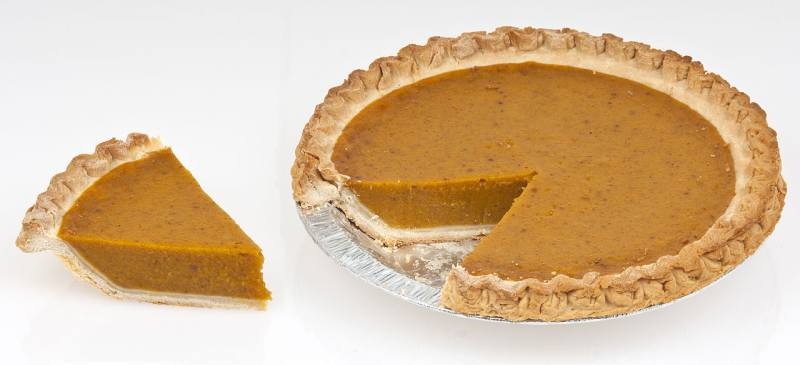
“Fairer hands never wrought at a pastry more fine.” Pumpkin pie picture by Evan-Amos
.
Is it just me, or is there a touch of what my wife calls “comfy gothic” in this passage at the end of Whittier’s poem? The poem starts out addressing the pumpkin plant itself, but as it continues we see it speak to the humans associated with it from childhood to grey-hair-dom. When I have Thanksgiving tomorrow with my little family I’ll have thoughts of everyone distant or dead that made or attended Thanksgiving meals over my life. In the poems final stanza Whittier speaks of, praises, the hands that make the wonderful pumpkin pie, and then as the poem ends, he sings them away with a wish that their final sunset is as orange and lovely as a pumpkin.
There’s an audio player gadget, or should be, below that will let you hear me sing that last stanza of Whittier’s poem. I focused on the simplest and most modest of musical settings for this one, purposeful contrast to the previous musical piece here. If you don’t see the audio player that’s likely because some ways of reading blogs suppress it, so I provide this highlighted link that will open a new tab with its own audio player. Consider that the apple or blueberry pie option to hear this song about pumpkin pie.
.
*Earlier this year when I asked AI to create some protest songs, it defaulted to a musical style stuck somewhere between Bro-Country and Indie Americana. When I needed to make up names for the faux acts I chose Fireside Poets’ names like “Greenleaf Whittier” for them – because though writing for the page, those Fireside poets were the poetic roots of Americana.
Around a decade ago I was looking at how to launch this Project, trying to figure out what service to carry the audio and where to host this blog. I knew I had some things I’d already recorded that fit my design of combining various words (mostly other people’s literary poetry) with original music in differing styles, and so I created a computer folder with those pre-existing Parlando candidates along with a spreadsheet to catalog them. There were 30-50 pieces in there, and if you go back to the first year of the Parlando Project in our archives here, you can hear about half of them. One piece, “Forum,” was in that pre-launch list. “Forum” had been recorded in 2007 live in my studio space by the LYL Band on a 4-track cassette Portastudio.
Why didn’t it make the cut? Two things. First, while I didn’t want the Parlando pieces to always use literary poetry, I planned to focus on that, but the words of “Forum” were a compilation of phrases used on turn-of-the-century interest group forums and Usenet “newsgroups”* when users would get into a dispute loop and a “flame war” would erupt. So, not conventional literary poetry – though I suppose I could have appealed my case citing “found poems” or Catullus’ invective. The other issue: though a step up from my older mono or stereo cassette performances I’ve featured occasionally this year, the recording quality had issues. After that initial year, I stopped considering it for Parlando use.
It’s impossible to picture the massive number of interests and sub-interests that Usenet Newsgroup served around the turn of the century. There were hundreds of thousands of separate topics that could be subscribed to and argued about.
.
This month I read someone (online) writing that elements of our current public culture include the historical novelty that nearly everyone can (and many will) try to communicate their opinions and thoughts in writing to a wide range of strangers. Communicating has difficulties. Communicating in writing has further difficulties. Communicating with strangers? More so. Socratic dialog assumes good faith and a certain rigor, and even then it can be exhausting. Now that we have an immense quantity of stranger-to-stranger debate, base human nature is often showing itself bare-assed in the forum.
I thought once again of “Forum” as I read that, this performed snapshot of early Internet culture. The phrases I selected and performed in it were the G-rated ones, skipped the racism and homophobia, and included little to none in the way of political specifics. That curation made the resulting text almost quaint when I relistened to the recording. This 2007 composition was now old enough to vote, and the text seemed like a folk song now, archaic as a sea shanty or hawker’s cries. After 18 years, is it time to share that piece now?
Well, there were still the considerations of its music and its realization on the old recording I had. Should I do a new performance? It might be difficult for me to rise to the level of intensity that version of the LYL Band had back then. The 2007 performance is what the MC5 would have called “High Energy Music,” and if you listen to it – like it or not – that’s how I wanted to present it.
But we had used a drum machine that day, and the energy in the room as we played this in one take/one-pass-through overwhelmed its timid tick toc.
Then I remembered: along with ubiquitous dispute loops, our modern computer age also provides wonderful tools. I can put this old recording digitized from cassette tape into a computer program, and in a few minutes of hard thinking signified by the CPU fan wheezing up, it can remove the drums from the old recording, even though they are buried in a mix full of furious other sounds. I did this, and then spent some time this Sunday putting in a new sequenced drum part with an energy that more appropriately matches the rest of the piece.
You can hear the result with the audio player gadget below. No, this is not like the gentler pieces I’ve been doing lately – that too is part of the design of this Project, and the next one may be gentle acoustic guitar or something – but what, you’re all ready and willing to blow out your speakers with this and you don’t see any audio player? Some ways of viewing this blog won’t include it. No flames, I offer this alternative, a highlighted link that will open a new tab with its own audio player.
*”Newsgroups” makes these sound like it was the AP or something, but Usenet newsgroups were started and were made up of those who’d figured out how to use the Internet in the 20th century, so more male and more STEM/academic/nerdy than the modern Internet. Usenet provided a large hierarchy of interests their own categorized newsgroups on which to share their knowledge – or their opinions about the validity of someone else’s knowledge. I’d suppose Reddit is the most similar common modern equivalent, but that’s more centrally architected and moderated.
I’m going to write about 20th century poet Langston Hughes’ pioneering Jazz poetry. I’m hoping to condense a lot, trying to make this short – but we’ll see. Like someone commencing a Jazz improvisation, I’ve got an idea – and maybe have some sight of where that idea goes – but what happens after that? That spirit, going there with maybe a first idea to see what you can develop from it, is what makes Jazz improvisation possible. Some skilled musicians, able to translate written scores into music straight off the page are terrified of that leap. Perhaps it’s because they know how to play those set-down compositions right that they’re frightened – if I must improvise, they may think, how will I know what’s right?
Langston Hughes published the words I’ll be using today in 1926 – but I must be in a hurry telling today’s story, because I’ll start in 1835, or thereabouts. Wikipedia puts “circa” next to that date, so there aren’t any attested records, but one Mary Sampson Patterson was born a free woman of color at about that date in North Carolina.
At around age 20 her Wikipedia entry says she fled for Ohio due to an attempted enslavement.* Records again are sketchy, but in Ohio she in some way studied at Oberlin College – as an Afro-American woman, this a double rarity in the first part of the 19th century. Her education trailed off in 1858 when she married Lewis Leary, a fugitive slave also from North Carolina. Leary was not just a fugitive slave, he became part of the Harper’s Ferry Raid, John Brown’s attempt to start a mass slave rebellion by attacking a military armory in Virginia. Brown attempted this with only 22 men, including Leary. Under the element of surprise, Brown’s men took over the lightly guarded armory, but a little over a day later a full military detachment under the command of Robert E. Lee easily defeated the small band. Nearly half of Brown’s raiders died in the subsequent battle – Leary being one of those – and seven more were executed afterward. Lee didn’t need to be any kind of military genius to win this battle, and whatever Brown’s beliefs, he wasn’t a great tactician either. Were they both improvising? I suppose they were.
The widow Mary married another abolitionist, Charles Langston, and they moved to Lawrence Kansas to raise a family. One of their children was Carolina “Carrie” Langston. That Carrie Langston married a James Hughes. The marriage was short-lived, though it produced a son given the first name from the mother’s family and the last name of the father’s: Langston Hughes. That was 1901 or maybe 1902 – accounts differ. Anyway, we’ve reached the 20th century.
Carrie needed to find work, and so the young Langston Hughes was largely raised by his grandmother Mary. So here you go: a Black woman, born around 1835, in the age of slavery, flees slavery’s grasp, gets at least a smattering of higher education, gives that up for a husband, then in turn gives up that husband in the fight against slavery, and in the end gets a chance to nurture a literary innovator. No one composes such a life and scores it out ahead of time.
I believe this is a photograph of the woman born Mary Sampson Patterson. The place I found it credits Yale’s Beinecke Library. Oddly enough I found two other photos claiming to be the Mary Patterson I write of above. Image search says one is another abolitionist woman from the same era. The other, of an older woman, may be Mary Jane Patterson, who was the first Afro-American woman to get a BA, coincidentally in more than the name, from Oberlin.
.
Hughes started writing poetry as a child. His first publication was as a teenage contributor to W.E.B. DuBois’s short-lived kids magazine. In the 1920’s he’s a young member of what gets called “The Harlem Renaissance.” Like his grandmother, he starts to get some higher education, but that effort is thwarted.** In 1923 he takes a job crewing on an Atlantic ocean merchant steamer.
How far is he planning ahead? Like many an improvisor, Hughes might have an idea in his head, he goes there, and he sees what happens to fit next. In 1924 he jumps ship while it’s in Rotterdam, and makes his way to Paris. One of the things he finds there: other Black folks, some of them playing Jazz, which in Paris has an added layer of exoticism. Here’s a link to a good short account of some of what Langston Hughes found there.
Hughes is an Afro-American. Jazz isn’t exotic to him, but furthermore he’s part of a smaller group (even among Afro-Americans) who are developing a deeper understanding and appreciation of that music.
Given what Jazz is in our current century – a largely select-audience concert art – I feel I have to go on another expository aside now, filled with what I have absorbed from history. In the early 1920s Jazz is viewed as fast-tempo music, suitable for dancing, drinking, and carousing. Intellectually, it’s considered thoughtless, or perhaps comic, a burlesque of real musical structure, timbres, and practice. It’s associated with criminality, intoxication, and sexual promiscuity to the degree that it isn’t just guilty of being an accomplice to vice but the cause of it: just taking in that hopped-up primitive music might drive its listeners to excess and ruin. Believing that I have a wide generational and geographic range within the readers of this Project, rough analogies to the initial cultural assessments of Rock’n’Roll and Hip Hop may be made – but I have no sure metaphor for those of you who grew up in our present century, for whom those later musical movements are history too.
Just like Rock’n’Roll and Hip Hop, Blues and Jazz are Afro-American musical forms, though both soon-enough have non-Black practitioners, and this points out something that the intelligent 1920s Afro-American young man in his 20s, Langston Hughes, is facing when he writes about his experience of Jazz. In a class or vocational level, is he going to be the college-degree middle-class artist or is he going to be a crewman on a steamer or a servant-job worker? Could he be something else beyond that dialectic? Hughes must have thought of all of this even before he took off from that freighter job, and every poem he writes may be notes and directions to himself in these matters.
I don’t know when Hughes first started to write poetry about Blues and Jazz, but some things I’ve read say that his poems about them go back to his high-school poetry – and I also don’t know when he first performed his poetry with Jazz accompaniment, though I think that music is present anyway in the word-music implied in much of his early poetry – but this was unsure ground to stand on in the 1920s.*** The novelty of a genteel high art like literary poetry speaking with appreciation about Jazz had some controversial power, but cultural gatekeepers, including some of the nascent Black critics, considered the music embarrassing and detrimental. Concert music, particularly Afro-American Spirituals, overtly concerned with the Abrahamic Godhead and Biblical stories (even if metaphor for temporal, earthly liberty and respect) were a competing, easily praiseworthy art that elevated the race. Meanwhile, Jazz, including the way it was adopted by some white listeners and practitioners in the 1920s, reeked of black-face minstrel shows, with white folks playing Black folks playing the fool.
So, once more I’ve taken the long way around, but here’s the 22-year-old Langston Hughes, an Afro-American poet and college dropout, so-recently raised by a Black woman who intimately knew the serious costs of seeking freedom and respect, with $9 in capital equity in pocket, who’s jumped ship from his job, and is in Paris, a capital of European Culture – and he finds, of all things, a Jazz band. Here’s a link to the text of his resulting “Jazz Band in a Parisian Cabaret” if you’d like to read along.
There’d be a temptation in this for a long poem of internal monolog, or some mighty external manifesto. A great poem might be written thusly, stuffed with much of what I’ve taken your time to discuss today. Instead, Hughes wrote this sly, shorter poem, one that assumes you know this history, assumes you know it in the same way that some other poet assumes you know Ovid or the Trojan War – and goddammit, if you are an American you should know it! Hughes little poem is made up of contrasting voices, a floating democracy of understandings and misunderstandings, breathing together as Jazz plays. The diverse audience calls out, wants this music. Hughes’ voice inside this colloquy, needs it – not just to remind him of home, but to let he see that home and his culture in perspective – and so he joins the chorus of “Play that thing, Jazz band!” European high culture and wealth enjoys it – and it’s a testimony, not a detriment, to its powers that the demi-monde likes it too. Are the American millionaires (perhaps as culturally stunted as modern techbros) slumming for idle amusement, or covert in foreign secrecy allowing a forbidden release? No matter, schoolteachers, the most modest keepers of culture, find it worthwhile. And oh, this statement, summing up something that Hughes can see in this moment: “You know that tune/That laughs and cries at the same time.” Hughes reports a little babel of European languages is going on around this recognition on his part that the Jazz band knows inherently what he knows. Then Hughes’ voice speaks again in his poem, another remarkable realization about Jazz music, “You’ve got seven languages to speak in/and then some.”
This epiphany then: Afro-American art: Jazz, Blues, Hughes’ own poetry, can go over the heads of the domestic gatekeepers or the reactions of racism.
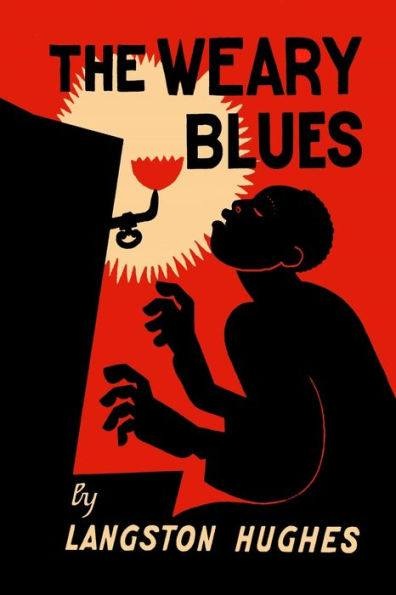
Hughes chooses to close his poem with a three-line final scene, one which a further dramatic program note might illuminate. Someone is picking up someone else for the night. No gender is lined out, and while it could be Hughes, it may also not be, or it may be Hughes constructing a metaphor.**** The person they’re attracted to is said to be from Georgia. I think that’s an important detail, because the poem’s dialog has it “Even if you do come from Georgia.” Hughes, Northern-raised, recipient of a white-privilege-level high school education and some Ivy League University is portraying this amour as an uneducated rural person. Metaphorically then, Hughes’ concludes that Jazz and Blues folk-music ancestry isn’t important compared to what it does – and by writing Jazz poetry, eventually performing Jazz poetry, that’s the choice the young Langston Hughes makes. When this poem appears in his first poetry collection, that book is going to be titled The Weary Blues – right on the cover he’s making a point of his decision on what’s worthwhile art.
.
Now that I’ve written all that, I’m left with handing off to my musical performance of Langston Hughes’ poem. I felt compelled to “make a Jazz noise here,” as one of my models once titled an album. As a composer I don’t have the theoretical training that most modern Jazz composers do, but I put something together using a characteristic Jazz harmonic cadence. Then the composer called on the inconsistent musician me to realize it and improvise the top line melody. I’ve been practicing my poor chord-comping skills a little bit lately, so I was able to portray the set of written chord changes passably. Spontaneously creating while playing the melodic guitar line was easier for me, as I’ve always been open to improvising that sort of thing. When I start something like that, when I don’t know how to play it exactly – I may have an idea, go there, and see what would fit next. You can hear the result with the audio player gadget below. Is there no visible audio player? No, your ship didn’t leave port without you, it’s just that some ways of reading this blog will suppress showing the gadget, so I offer this highlighted link that will open a new tab with its own audio player.
**Hughes and his mother were estranged from his father, who had become a company man with the Pullman Company working out of Mexico City. Langston’s father agreed to support his education as long as it was aimed at practical matters such as engineering, not the arts. Langston Hughes agreed to make a go of that, but found he couldn’t leave his literary interests. The train trip to work out this ultimately-to-fail detente produced one of the greatest poems ever written by a teenager.
***Unintendedly, I seem to have stumbled into a theme this fall: literary poetry which has absorbed folk-music forms. Folk revival acoustic-guitar-based music and electric Rock are in my page poetry just as they are more explicitly in my Parlando Project pieces using other people’s words.
****Hughes sexuality is, best as I can determine, hard to determine. Some say he was gay, others assume bi. Some who knew him well paint a somewhat asexual person, or they just say, as I do, that they don’t know.
I wanted to get another musical piece up this week as I was somewhat dissatisfied with my performance in my last one here for Armistice Day/Veterans Day. I looked a pieces I had near ready, and selected this one, by Anglo-Welsh poet Edward Thomas. Thomas is lesser-known in the United States, but is more recognized in Britain where he often gets grouped as a “War Poet.” The main reason for that: he volunteered and was killed in WWI, and some of his poetry speaks about his thoughts as he considered volunteering for overseas front-line service.
Sitting in America, which hasn’t regarded Thomas enough, I’d like to expand him a bit from behind that label. First off, like Wilfred Owen (another British poet filed under war poets, and another WWI casualty) Thomas was something of a beginning poet,* but like Owen his poetic voice is so strong it doesn’t need to apologize for being early days. As powerful as Owen’s poems about trench warfare are, I’m just as impressed by his home-front poem “Shadwell Stair.”And Thomas, this other “war poet,” seems not to have finished any poetry about his short front-lines experience before his death in that service. As we celebrate Veterans Day it would be good to remember that each person who served is not just their service.
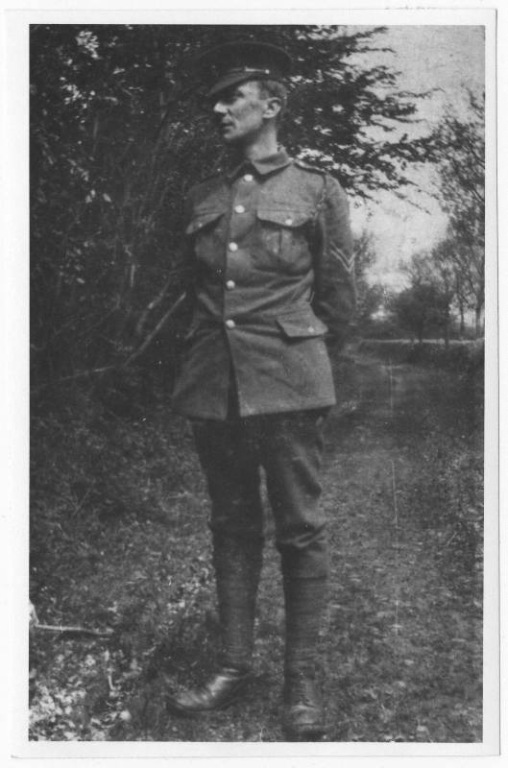
Edward Thomas in his uniform. He was married and past the age of most soldiers, but still volunteered.
.
So, here’s a poem that I think has nothing to do with the war directly – perhaps not indirectly either. “Like the Touch of Rain” seems to me to be a love (or rather a loss of love) poem, though the nature of the relationship is not spelled out.** It uses as its central symbol rainfall, and I suspect it’s speaking of erotic love because of the sensuous opening where the rain, however wild, is caressing the poem’s speaker and he sings and laughs here. The poem ends by telling us he’s now closed in, out of the rain, not by his choice but by some her’s “Go Now.” It’s a turn-about from the typical “Who’ll Stop the Rain” or “Shelter from the Storm” depiction of rain vs. shelter. Here’s a link to the text of the poem that I’ve now turned into a short song.
“Like a Touch of Rain” is not the most complex or virtuosic poem, but it also doesn’t detract from its depiction with any overreaching or stilted poetic diction. There’s a power in that. Reading Thomas’ contemporaries’ poetry in search of material for this Project I’ve read a great deal of published poetry that doesn’t escape those faults. My wife gave me a copy of Thomas’ collected poems a few years back – it’s not a thick volume, and I believe that most of the poems in it were first published in this collection posthumously through efforts of Thomas’ friends.***
After overreaching with my Padraic Colum poem setting earlier this week, and having to settle for an incomplete recording, it may behoove me to leave today’s piece as just voice and acoustic guitar accompaniment – and as rough-hewn as my voice is on this performance, I think it’s better too.
You can hear my performance of Edward Thomas’ “Like a Touch of Rain” with the audio player below. What, has the door to any such player gadget been shut? Well, this highlighted link will open a new tab with its own audio player.
**I have not read a full biography of Thomas, but before the war he seems to have had a complicated set of affections as well as bouts of depression and drug use. Those two things might cause one to suspect a ne’er-do-well life, but through-out that he wrote voluminous freelance reviews and essays to pay the bills for a young family.
Today’s piece was created from a poem written by the Irish poet Padraic Colum. Colum was born in the 19th century, then traveled through the world of 20th Century Modernism, and lived on long enough to overlap my lifetime. Looking at the outlines of his life I am pleased to report that Colum connects a favorite of this Project, the undercelebrated Irish poet Joseph Campbell* and the American mythological theorist of the “Heroes’ Journey” also named Joseph Campbell. With the American Campbell, Colum connected because he was a folklorist as well as a poet, and he wrote several young adult and children’s collections of folk tales and retold myths which I’ve not yet read. With the former Campbell, besides being Irish literary revival contemporaries, he collected folk-songs.** Like that Irish Campbell, Colum’s best-known work today is arguably a folk song.
Long-time readers here may recall that the poet Campbell is likely responsible for the song “Reynardine” being sung in a version featuring a supernatural, shape-shifting lover. At around the same time, and for the same publisher of Irish folk songs, Colum collected/wrote the lyrics to the song “She Moved Through the Fair.” Why the slash notation on the authorship? There’s some controversy if Colum closely adapted a traditional set of lyrics, or largely wrote original lyrics to an existing tune. Colum claimed he wrote the lyrics, making use of only a few floating lines that are folk song ready-mades. The challenge to Colum’s authorship strikes me as highly suspect: it’s based on another collector writing in 1970 that he came across an old man who told him he’d learned it as a traditional song before Colum’s version was published in 1909.
I suspect there’s someone out there who can do a better job singing this song I created from Colum’s poem.
.
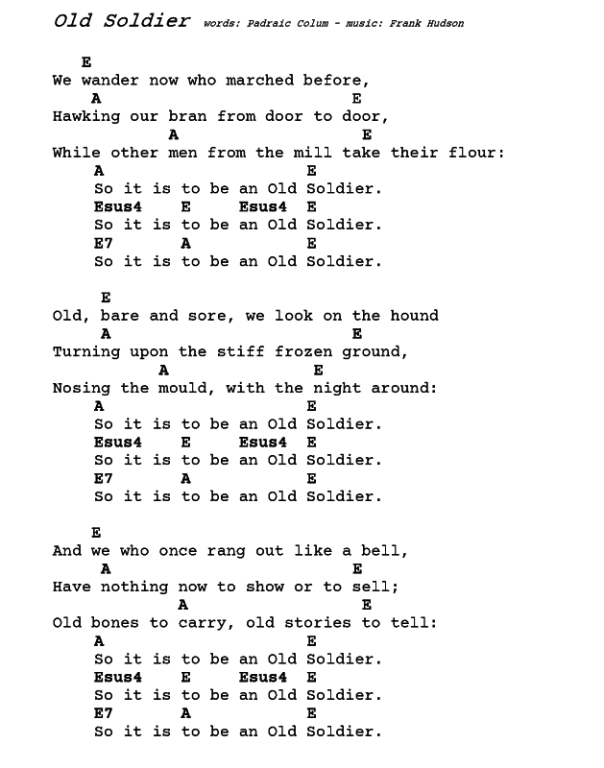
“She Moved Through the Fair” was included as a poem in Colum’s first poetry collection “The Wild Earth”*** which also includes today’s poem. I note that “Old Soldier” has some similarities with the lyrical methods of SMTtF: both use spare details and leave out a great deal. Some of what is implied in the two lyrics may have become more obscure to modern listeners. SMTtF very early on speaks of the singer’s “lack of kind” which uses a now archaic meaning of “kind,” meaning family. “Old Soldier” opens with the titular old soldier going door to door. Since “hawking” (a hawker is a street-seller) is used as a verb in the second line I thought at first he was peddling, but from what I can find, no one sold flour that way. I think he’s begging for bran, which was then the discarded part of the milling of flour. That waste part after the wheat was milled or boulted, was thrown out or used as animal feed, though apparently the poor sometimes made use of it for human consumption.**** In the second stanza we meet the old soldier’s only companion, a dog, and the bran the soldier has garnered may have gathered mold.
I don’t know if “Old Soldier” has been set to music before this, but it seems every bit as singable as “She Moved Through the Fair,” and as soon as I read it, I wanted to sing it. I decided to use an arrangement soaked in South Asian musical influences, perhaps due to the wonderous extended version of the SMTtF tune played by Davy Graham. That link above includes one of Graham’s recordings of it, as well as Anne Briggs wonderous acapella version. Oh, hell, here’s that link again, click it indeed if you haven’t heard the song Colum made. Last week I recorded the basic tracks singing and playing a tune I created for Colum’s poem using my guitar in an alternate tuning driving a sitar virtual instrument though a MIDI pickup. To this first pass, I added harmonium, tanpura, tabla drums, acoustic guitar, and a final vocal.
Every one of those overdubbed passes felt good as I played them (save for my vocals, I’m never happy with my vocals) but the result was a whole bunch of tracks that would require careful mixing so that the instruments blended well. I set about doing that, working until midnight when I figured I might have a piece to present and saved a complete mix down. Awaking the next morning, I listened again, and the result wasn’t just flawed, it was a mess. A useful question for one mixing a piece of music with various instruments in an ensemble like this is “What track is the focus of the piece?” My putative mix had no good answer for that. The voicings of the chords on the sitar and the guitar didn’t mesh well. The harmonium and the tanpura were fighting over the same part of the sonic spectrum despite my efforts to give them their own sonic space. The tablas didn’t mesh with the acoustic guitar’s rhythm.
The wise solution would be to just re-track the piece. Maybe I should have more particularly considered that Davy Graham had made his impressive version of a Colum poem/song with only a solo acoustic guitar. But I would not have another opportunity to record with a sensitive open mic until this week, too late for Veteran’s Day. So last night I went to work stripping back the crud of my failed mix, leaving mostly the acoustic guitar and the vocal, with the tanpura and then the harmonium coming in for later parts of the song in turn. It’s not an ideal recording, but it’s my hope it lets one consider “Old Soldier” as song today.
The more palatable version can be heard with the audio player below. The song itself is simple, and the remixed arrangement that builds a bit as the song continues serves it better. You don’t see any audio player gadget? No, I didn’t remove that, it’s a side-effect of some ways of viewing this blog. I have a plan B for that too: this highlighted link that will open a new tab with its own audio player.
.
*Joseph Campbell, who also wrote under the name Seosamh MacCathmhaoil, was acquainted with the original London Imagist circle, and wrote what I think is some excellent short verse in the form. His life and literary career were brought low by siding with the losing side in the Irish Civil War.
**Given that I’ve been doing this project for a decade, the folklorest/singer/collector and poet is a combination near to my heart. Besides Colum and Campbell, two American poets from the same era, Carl Sandburg and Edwin Ford Piper did both things, and I’ve tried to briefly make the case that Sandburg should be more often cited as instrumental in connecting folk song with progressive politics and literary poetry in the United States, which eventually leads to the case of a Nobel laureate in Bob Dylan. Around the same time as all these others, elements of the “Harlem Renaissance” in Afro-American literature were open to melding folk song with high literature too (Fenton Johnson, Langston Hughes, Jean Toomer, Waring Cuney, Zora Neale Hurston).
I’m going to jump far afield before leaving this footnote: I’m writing this on the 50th anniversary of the release of the Patti Smith Group’s glorious debut LP Horses. The Patti Smith Group started because Smith, a poet personally immersed in colloquial music, a paramour of Fugs-adjacent musician/actor/playwright Sam Shepard, joined up with a guitarist/rock critic/crucial anthologist of garage bands Lenny Kaye, wanting to make unexpected poetry combined with electric guitar.
***Just when Colum’s The Wild Earth was published is unclear to me. My copy has a 1927 American printing of a 1922 edition. Wikipedia says “She Moved Through the Fair” was in a 1916 edition of the book, and then in their entry for Padraic Colum gives a 1907 date for the book.
****What, that’s the healthy part! Whole wheat! At the time the milled pure white flower was prized from making lighter baked goods and for a longer shelf life. The city I live in was growing rapidly at the time of this poem by finely milling the “Best” and the “Gold Medal” flour that had absolutely no bran or wheat germ at all.
I’ve mentioned this Fall that I’m on a project to clean out the accumulations of my long life. There are various battlefronts in this effort, but last month I worked on emptying my stuff from a small storeroom in my house, which was filled with boxes, some of which hadn’t been unpacked since I moved 40 years ago. One box was completely stuffed full of spiral bound notebooks.
I had once saved the notebooks I used in my high school years and then throughout my twenties. This meant a slowly growing cache of them had traveled from a tiny hometown in Iowa, to a dorm in a small college in that state, and then to the locations I lived at in New York for six years, and onward the four places I’ve lived in Minnesota.
I had a typewriter, which I used for some more formal things and finalized school assignments, and then in the ‘80s I got a personal computer,* but for 20 years or so, my creative work began and was recorded with handwriting in these college-ruled notebooks. Early, when there were only a handful of them, I mentally cataloged them by the color of their covers. Even after all these years I recall a couple of the earliest ones as “The Orange Book” and “The Green Book.” Like Emily Dickinson I didn’t always save working drafts, written on whatever was handy, but when I felt I had finished a poem I’d make a good copy in my most legible hand inside one of the notebooks to be saved.
I’ve written briefly at least once about starting to write poems as a teenager, and I won’t go on much more about that today, but I was surprised at the urge – it was not planned. I felt compelled to do this for reasons I couldn’t tell you then, or now. Living in my tiny town I had no idea how many people were writing poems, but I presumed it a small number, as the literature anthologies I had in school made me think the number at any one time was a select few. This misapprehension led to a grandiose feeling that I was writing poetry! – this grand art-form of literary geniuses.
Clearly there was a lot I didn’t know, but in my case this helped me, giving me a sense of accomplishment. Did writing poetry give me an unearned, unrealistic, sense of self-worth? Yes, I think it did – but we all need a minimum deposit in that bank, and that was the source I had. And after all I was a teenager, and few of that age have any substantial achievements.
In that process of pulling aside these old notebooks I came upon “The Green Book” that I recalled when there were only a couple of these, and I set it aside to look through first. In it I saw my good copy of a poem I remember quite well from my early work, one I had thought was one of my better ones then. Looking at it as an old man who’s read much more, written much more, lived much more, I think enough of it to present it here in performance today.
I didn’t have many poetic models to draw on, but this one certainly came from reading John Keats “Ode on a Grecian Urn” in my high-school literature class. I’ve performed Keats’ poem here, and I think I was already impressed at the ambiguity in the poem’s famous ending back then. My “Ode to a 1953 Automobile Ad” was on the surface a free-verse parody, burlesquing Keats classical art object – but I was at least partly conscious of wanting to make some solemn points too, though I don’t recall thinking out all the themes the poem includes, so my best recollection is composing the poem without knowing all I was including in the text under my pen.
I think there was a 1953 automobile ad in my memory, though I haven’t found the one described in the poem.** Sometime in my early teenage years, a man in my little town – no doubt doing the same “death cleaning” I am doing in 2025 – gave me several dozen 10-15-year-old Popular Mechanics/Popular Science/Mechanix Illustrated magazines. I devoured them, first because I adored the hyperbolic writing of the self-styled dean of journalistic automobile test drivers Tom MaCahill who wrote for Mechanix Illustrated – but this was a strange genre of magazine. Part reviews of new models of cars and novel ideas in consumer goods, part pre-Whole Earth Catalog handyman tips and project plans, and part more general writing about science and technology including predictions for the future.
The soft golden car in front of a Greek colonnade, or a peaceful ride in a Paris that 8 years earlier would have been in the midst of a World War.
.
I enjoyed the time-travel aspect of reading these magazines, visiting as an abstract thinking teenager the world of early childhood. The too fantastic flying car future has since become a meme – but the junior historian in me would think: the Korean Conflict was being fought as some of these old pages went to press (little mentioned in these mags, little remembered now too), the new age of atomic war fear was beginning, and in the sixties as I wrote this poem, Vietnam was echoing the Korea situation. So, as the poem was being written, there was then too the feeling of a glorious and blest domestic United States – yet with a “conflict” acting as a far-off minotaur ready to take sacrificial children.
So, I wrote this in the 1960s linking those times in the 1950s, and sublimation of killing young men is the topic. Inexperienced as I was, I tip my hat to the images the young person that would become me put in there: the camera and/or coffin dark box capturing the bright sunlight of the ad, the rust-holes in the teenaged car as the wound in the son. The use of Whitmanesque (or Sandburg or Ginsberg in their Whitman mode) extra-long lines is not something I do much now, but as I performed them this week, they seemed to work well enough.
This old poem is now published with a musical performance in the lead up to the holiday that was once known as Armistice Day – the very day that World War I ended at a moment when it was just “The Great War” and didn’t need a number, and didn’t expect to gain one – but now our wars don’t get the roman numerals, though fantasy film franchises and Super Bowls do. We didn’t get flying cars. We got armed drones.
You can hear me performing my “Ode to a 1953 Automobile Ad” with the audio player gadget below. Has the audio player gone with Studebakers and saving old magazines? This highlighted link is supplied as an alternative which will open a new tab with its own audio player.
.
*My penmanship was erratic and not consistently easy to read, so a typewriter was essential for things of any length destined for others. But I didn’t do creative writing on a typewriter – something about the mechanical nature seemed an authorship firewall: the machine made the letters, keys and levers away from the writer, and one couldn’t easily cross-out and add little marginal changes as one wrote.
One of the things found in the storeroom with the notebooks was a postcard about requirements for receiving a rebate on what would be officially my first personal computer: A Timex-Sinclair bought in 1982 – but that tiny $85 plastic wedge wasn’t able to take over from a pen or typewriter since it had a small membrane keypad that was only useful to learn to write computer programs with. In 1984 I got a Commodore 64 which could do limited word-processing, but I couldn’t afford the software that did that. In 1987 I got an Amiga 500 which came with a copy of Word Perfect – the then leading word-processing software product – and I began a slow and inconstant transition to using computers to do initial drafts over a decade or so.
**The 1953 year of the car in the ad makes me sure it was a Studebaker ad, for a remarkably beautiful new 2-door coupe was introduced for that model year. When I look for examples of the ad campaign, I see many of the Studebakers are depicted in yellow, but never in a family tableau described in the poem in the ones I could find. And there’s the chrome bird hood ornament. Was I thinking of the Packard swan? Looking at pictures of the 1953 Studebaker I see there’s a 3-bladed chrome insignia on the peak of the hood – meant to be a propeller, or bird, or abstract shape? I appeal to Brancusi on the bird.
Today’s piece is rare for the Parlando Project: a presentation of a contemporary poem by American poet Henry Gould.
Contemporary? How contemporary? “Searoads” was written only a few days ago. I read it on Halloween when the poet shared it on Blue Sky shortly after it had been written. Since I follow Gould on Blue Sky, I had read several of his poems before. He’s posted poems and poem drafts written serially as he works on a book-length opus dedicated to a topic. In recent Gould poem-series, historical time seems to take place simultaneously, and wide references to history and literary works weave through stanzas (or even within lines) of individual poems, this weave sometimes worked with the warp of wordplay.
That makes for a challenging density. Since my youth I’ve taken self-pride in being a history buff, and working on this Project has extended the poetry I’ve had contact with to a level that tests the working set of my old-guy memory. When I’ve got the energy to exercise those parts of my personality, digging into one of Gould’s poems can match up with those receptors. Gould’s work is ambitious and deals with earnest subjects, but I suspect it’s also playful. When you can catch, and hopscotch through the pattern of one of his sideways leaps to connection, there’s a pleasure in discovery – and this is so even though honest history and literature contains a great deal of conflict and pain.
I have a term I use for an effect I find in poetry – the polyphony layers of perceptions invoked with images, the melody of tracking from one thing to another like unto it, the intervals of sames separated by time – The Music of Thought. I assume this isn’t a new idea, but while study of the prosody of sound is commonplace, a prosody of the patterns when the images and what they present, composed in that order and layering, seems rarer to me. That I take any pride in writing about this is likely secondary to my ignorance of how thoroughly others have already written about this. I’m the kind of solitary, stubborn cuss that has to discover it myself to be able to integrate it into my enjoyment of poetry.
There can be a problem with the Music of Thought. While tastes in the word-sound-music may vary among readers and listeners to poetry, the effect requires nothing special in terms of shared knowledge. Children can enjoy Dr. Suess before they have much of a corpus of knowledge at all.* Poems of Yeats, Eliot, Frost, or Emily Dickinson can charm us by their sound even when – if we were tested by some exacting taskmaster to do so – we couldn’t write an internally consistent and plausible essay on what they were on about exactly. Fear of that looming taskmaster kills poetry readership, but the lure of the pleasures of sound draws us back in. The Music of Thought may still be sensuous, but it’s more abstract, it requires more knowledge and attention from a reader.
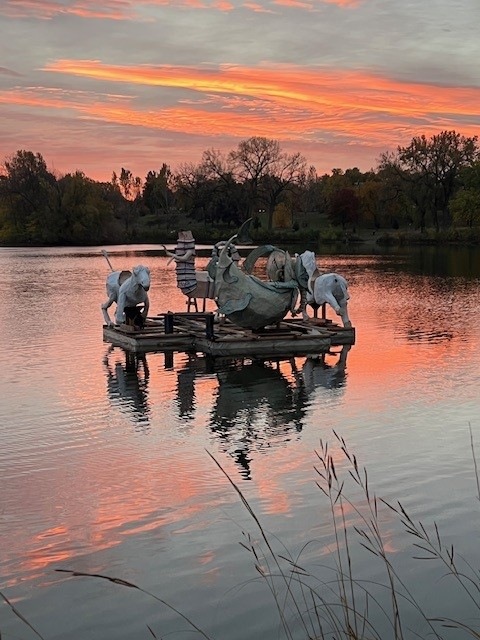
My wife shot this mysterious assemblage in Powderhorn Park at the dawn of All Souls Day 2025
.
When I came upon Gould’s “Searoads” it was late in the day. I was in the context of the short-attention-span-theater that is a modern social media feed. Tough court for the poem?
The sound caught me first and last, and I also easily fell into this poem’s Music of Thought. In both musics, “Searoads” drives forward attractively, and I was gathering meaning even on the first time through.**
How does it work? I’m bad at scansion (when creating music I’m habitually playing with offbeats and syncopations, sporting with measures, which probably demonstrates that I don’t understand the basic pattern well enough). Could “Searoads” be intended pentameter with predominant iambic stresses? I read the stresses as having variation (which good verse should have) but I scanned the lines as having a goodly amount of iambs, while I hear them as predominantly four-feet lines.***
The use of rhyme here is excellent. I heard rhymes the first time through, but not the scheme – so I didn’t know when they were coming. My own ear or taste loves off/near rhyme, and that too helps the sound work without some regular clock-coocoo chime effect. If I take apart the mechanism, it’s ABABCABCA. And there’s a lovely moment in the poem when an extra C rhyme comes strongly in the middle of the last line of the first stanza with “infants.”
The poem has a few unusual words. I knew “sarabande” was a dance form that survives in European classical music, and I even knew that there is some dispute about its origin, including a theory that it includes American musical ideas adapted by Spanish colonialists in the 16th century from native central American music. I didn’t know the word “Argive” (of the Greek city-state of Argos) – but two things referenced in the poem were part of my attraction. On Halloween I was intending to work on a piece for All Saint’s Day (November 1st) or All Souls Day (November 2nd), but despite some effort earlier in the week I hadn’t found a suitable text. As I read Gould’s poem, he may be invoking circular reincarnated or pre-existing souls in the second stanza – so in celebrating all who have died and the unity of that human experience, we may celebrate all unborn as well. What a lovely autumnal thought! And the same stanza even needle-drops a line from one of the All Souls’ texts that I wasn’t progressing on making music for: the “full-fathom five (my father lies)” speech from Shakespeare’s The Tempest.
But one word (well, hyphenated, but…) is most responsible for the piece you can hear today: “Ark-Dove.”**** I suspected the dove sent out from Noah’s Ark to confirm the time afloat in the great flood was ebbing. When I asked Gould, he confirmed to me he was thinking of that too, at least in part, as he wrote his poem. In our troubled times, a great flood of destructions, on a boat stinking of animal effluents, I think we are waiting for the dove to return with a green twig – but I had another specific thing going off in my mind too.
There’s a folk song, collected in 1906 in Texas at a temporary work camp along the Brazos river. A woman there, washing clothes on that riverbank sang this song about being abandoned; but imagining Noah’s dove anyway, singing “If I had wings, like Noah’s dove, I’d fly down the river to the one I love.” Beside the song, the folk-song collector only got the name “Dink” for the singer. He wrote that he tried to find out more later, but when he returned to ask about her, she was gone from the camp and no one knew where. We cannot know if she found wings to carry her above the river or if the river carried her, submerged, down its current.
So, as I returned to the top to read Henry Gould’s poem for a second time on Halloween, I was already humming that folk song, known as “Dink’s Song,” to myself as I read the words. The next morning, I had no Dink to ask for, but on All Saints Day I decided to work out some music to sing Gould’s poem. I did this with no expectation that anyone besides myself (and probably Gould, who I figured I’d just send it to, unbidden) would hear it.
I’ve been composing a lot in October on acoustic guitar, this meant I had some musical ideas to try with the words. I loosely based my music on the chord cadence from the verse of “Dink’s Song,” (D G5 D / Bm G5 D) with an even looser variation from the song’s chorus on the last line of each stanza (D G5 D Asus2 D). I’m not a very melodic singer, and unless one knows “Dinks Song” and reads this, one won’t hear the connection. I recorded this using my usual cross-picking technique on acoustic guitar while singing, and picked the best out of about five passes I quickly recorded that afternoon. I added a low-pitched piano part that emulates the way a tanpura is used in South Asian music and a bass part as I thought the piece needed a little more low-end activity.
Henry Gould received the recording and has graciously allowed me to share this musical performance of his fine poem “Searoads” here. You can hear it with the audio player below. Has the audio player flown down river? No, it’s just that some ways of reading this blog suppress showing an audio player gadget. This highlighted link will open a new tab with its own audio player so you can hear it.
.
*Adults could enjoy challenging Modernist poetry more if they allowed themselves to initially listen to it (even silently) as a toddler listens to board books. For that matter, I assume Dr. Suess/Theo Geisel had Lewis Carroll and Ogden Nash in his ear when he wrote, but his poetry makes me think he was reading Gertrude Stein or Marianne Moore too.
**I don’t rate myself highly in understanding poems, but a short poem that draws me in usually gets a repeated reading where often my understanding changes. One of the pleasures of doing this Project is that that the poem I start with can change to a poem I understand differently by the time I’m done with the recording.
***Today’s short discussion of prosody demonstrates why I do that sort of thing rarely here. I suspect a combination of being bad at it (not getting the correct answers in my scansion) and distrusting the classic accentual/syllabic theory that may need to be followed more loosely to produce a sophisticated effect.
****”Searoads’” unusual “Ark-Dove” with hyphen and capitalization made me think Gould must have had something else specific in mind, beyond my folk song and the Bible story. I did a quick search and found that two ships, the Arc and the Dove brought the first English settlers to Maryland – the Arc and the Dove are sort of the Catholic U.S. version of the Pilgrims and the Mayflower. What a rich reference! I asked Gould. Nope, he wasn’t thinking of that. Ah, but the muses Henry – they must have whispered in your ear.
And the poem’s title gave me thoughts too. Isn’t “Searoads” the way medieval English poetry might refer to a ships’ path?



 Frank Hudson