As Halloween approaches, here’s a song that focuses on the playfully frightful aspects of the holiday. Wait a minute – I debated typing “playfully” there with “frightful.” I went with that combination as it’s my best guess at the intent of the Vachel Lindsay poem that I converted into a song, though I can’t be sure.
Playing with fear and horror is clearly a part of Halloween. We expect children to celebrate the holiday, and the adults participating in Halloween celebrations plan them to be happy occasions, even though the decorations will be full of spiders and their webs, and monsters, and skeletons, and those dream-flickering pumpkin skulls.
But if you take the poem (now a song) at face value, this is about a woman who is personified as a predator, the femme fatale trope and her victim fly. Had poet Lindsay felt himself wronged by some lover to come up with this piece? I don’t have biographical evidence to point to with an emphatic gesture,* and the internal evidence within the poem speaks to me of a playful mode to the condensed tale of horror it tells. There seems to be a paradoxical agreement on the part of the singer: they’ve been done wrong, but they’re going to speak lightly about this, and while the song’s fly doesn’t say it out-loud, they might be open to just a little more peril.**
A poem that literally describes tearing the wings off flies, yet I’m still holding it as playful.
.
Earlier this month I wrote about the mid-20th century “folk scare” in passing, and as someone who has some grasp of the songs revived by that movement, I couldn’t help but think that Lindsay referenced a floating verse that appears in some American folk songs. Did anyone else catch it from listening or reading the text above?
The spider takes her prey with the line: “She drove me to her parlor/above the winding stair.” Reading this, I immediately heard a specific tune – cementing the idea that this poem would get the Parlando Project treatment. What tune? One widely sung song that features the verse about a woman taking a lover to her parlor goes by the title “Cindy, Cindy.” Besides the parlor destination – sometimes sung in the folk song as “She took me to her parlor and she cooled me with her fan” – most “Cindy, Cindy” versions have devouring women in them too, with verses like “I wish I was an apple a-hanging on a tree and every time my Cindy passed she’d take a bite out of me”*** or even “My Cindy is a pretty girl. My Cindy is a peach; she throws her arms around my neck and hangs on like a leech.”
Quick research says that “Cindy, Cindy” was sung in America in the early 20th century when Vachel Lindsay wrote his poem. I’m going to suspect Lindsay knew one of the variations of it – and he might have thought some of his audience would too.
So, I’m calling it: playful. Likely erotically playful.
I also suspect my music for today’s performance of “The Spider and the Ghost of the Fly” had “Cindy, Cindy’s” tune in its ear a little bit too. You might be able to hear that performance with the audio gadget below – but like the devouring and dangerous love between the spider and the fly, some of you may find the audio gadget hidden and suppressed. Aha! I have this highlighted link, a veritable grail-shaped beacon, that will open a new tab with its own audio player so you can hear the song.
Today’s piece, continuing our series as we consider the variousness of Halloween including the surrounding Days of the Dead and associated horror/fantasy elements, has odd origins. It starts, since it’s useful to mark a starting point, with the death of my late wife decades ago, something that led to an unusual instrument.
Shortly after my wife died, and I was left alone in the house we once shared, I decided I’d take to playing more music in the silence. I went looking for new instruments to inspire me. This intimate death, as it happened, was followed by another kind of ending. To tell you about that, I won’t get too deep into the weeds of the musical instrument business, but one of America’s largest musical instrument makers, Fender, had in the late 1990s quixotically decided to introduce an entirely new guitar brand, DeArmond. In short order they created an entire line of electric guitars and basses, around two dozen models, priced between their budget Squier line that featured inexpensive renditions of traditional Fender instruments and their more expensive American line that the Squier guitars copied – but the DeArmond guitars weren’t copies of the highly popular Fender designs at all. Instead, they were versions of electric guitars and basses once produced by another company, Guild, which had around the same time been absorbed into Fender. I expect few who read this Project will know anything about Guild guitars, and that explains why they ceased to exist as a separate company. But those who do hear the name “Guild” and have a light bulb illuminate, are most likely to think of Guild acoustic guitars.* Guild produced a successful line of acoustics. The Guild line of 12-string guitars were highly thought of: John Denver, Tim Buckley, and Ralph Towner constantly played jumbo-bodied Guild 12-strings, and other folk artists played acoustic Guild guitars in this era: Richie Havens, Paul Simon, and Bonnie Raitt.
So, this was a strange business idea: create a new brand, but make it closely reference past electric instruments many players had never heard of. So how did this turn out?
To quickly answer, I step back in marketing time and type: “Edsel.”**
OK, where are we getting to Halloween? This started with one death – trust me, we’ll get there – and now there’s the pseudo-death of guitar line. Fender pulled the plug abruptly just as our current century was getting underway. They had lots of unsold DeArmond electric guitar stock. I mean lots. They gave some away to schools and music programs. They sold the rest at fire-sale prices. Guitars made to be sold for around $600 ($1200 in 2025 dollars) were being blown out at $200. I quickly bought three of their guitars: a large hollow-body archtop, a 12-string electric solid body, and a 6-string electric with a Bigsby vibrato bridge – not at BOGO pricing, but at those BOG2 prices. I’m writing about a lot of things today, but not those – instead, it’s another DeArmond.
One of the weirdest Guild designs that that Fender/DeArmond revived only to kill – indeed one of the oddest guitar designs of all time – was the Ashbory bass. Guitarist readers are now visualizing an electric bass: bodies at least as big as an electric guitar, but with longer necks. Old guys like me that play electric bass also are thinking weight – heavy, too often more than 10 pounds.
Nope. This is my Ashbory bass:
White lines, don’t do it. The Ashbory is a fretless instrument, the fretboard lines are just markers. Exact intonation with the thick strings and very short scale is a challenge.
.
Weighs less than a Stephen King novel. Less than half the length of a regular electric bass. Body just a little bigger than a CD case. The original strings, specially designed for it, were translucent rubber bands. The current strings on mine are smooth white opaque nylon, essentially extra thick versions of a modern classical guitar string. Unlike a normal fretless electric bass, which is a beast to play, you need to be almost delicate when playing these extraordinarily low-tension strings.
Other than the tiny size, a goal here was to approximate the plucked sounds of the even more unwieldy upright bass, but neither the original 1980’s Guild Ashbory or the late ‘90s DeArmond copy sold well. I used mine when I wanted upright and fretless bass sounds for a while, but in the last few years I’ve moved over to using other methods to get that sound on Parlando recordings. This week someone mentioned they’d just purchased a used Ashbory, reviving memories of that time and leading me to revisit the instrument musically. In my studio space I got the tiny bass out and plugged it in to record. To get the upright bass sound from it you want to use bare fingers, but for some reason (habit?) I decided to use a thick rubbery pick – which is one way I play regular electric bass. This gave me a slightly more aggressive sound than I recall getting out of it and I then programmed in a drum pattern to match where that result was leading me. Building from the groove, I played some electric guitar and added a piano part, producing a short two-minute piece as my studio time ran out yesterday.
Listening to the result this morning I felt the music had a sense of longing or leaving. That may have leaked from my connection between the DeArmond Ashbory and the time after my wife’s death, which was followed by my mother’s, and then after an interval, my father’s death. Could I find some words to go with this music? Nothing I had in my files of poems for Halloween seemed to fit, so I did a web search for “poem about a ghost leaving or disappearing.” Bam, this lesser-known Sylvia Plath poem came up, right on point!
Plath’s “A Ghost’s Leavetaking” is an 8-stanza/40-line poem, not all that long, but longer than my just-over-2-minute music could cover. The poem describes a somewhat distressed awaking in a morning where the speaker is mixing dreams and remembrance of the dead with an ongoing adjustment to mundane household tasks.*** Just as in Phil Dacey’s “Frost Warnings” poem from earlier this month, Plath sets up tired laundry and bed sheets that “signify our origin and end” while they play the role of ghosts of the departed.
A good poem, but now I had two problems: an apt text too long for my music and a poem not in the public domain.**** “A Ghost’s Leavetaking” was written in the 1950s and has not yet reached PD status in the U.S.*****
I made a quick decision. I would use only some lines from Plath’s poem. Artistically I thought that worked. It made a shorter set of text to fit the music I had finished. I was able to zoom in on the Day of the Dead and ghost elements of the poem, shortening the examination of how we sometime wake still recovering mundane reality from our dreams. If you would like to read the entire poem, as Plath published it, here’s a link. As to the PD situation, my solution is at best mixed. “Fair use” is not a firm concept, and my Project’s entirely non-revenue and educational purposes are no guaranteed Kings X. Using only a few lines would bolster my case, but as I used about a third of the poem, that’s not clearly kosher. Even forgetting laws, if Plath were a living author, she’d be well in her rights, regardless of the law, to take issue with someone cutting her poem up, making it less than she intended it to be.
So, from that decision, we’re left with this musical piece where I quickly sketched out today in my little home office “Studio B” how one might sing some lines from Plath’s poem with the music I finished yesterday. I’m aware of the limitations of my voice, and in an ideal world the melodies could be better worked out and ornamented by a better singer. None-the-less, I found it personally rewarding to inhabit Plath’s words and do the best I can today to convey the emotions and images she put in them, and some listeners may gain something from that performance. You can hear my sketch using lines taken from “A Ghost’s Leavetaking” with the audio gadget below. Has the audio gadget gone to Plath’s “lost otherworld?” I offer this alternative as a keeper of the “profane grail,” a highlighted link that will open a new tab with its own audio player.
.
*Fender had never been able to make itself a factor in the upper end of the acoustic guitar market, so it was assumed that’s why they snapped up the distressed Guild company: for the well-thought-of acoustic guitars.
** There are car folks who will tell you that the Edsel was a perfectly fine late 1950’s American car, but that doesn’t change what the brand name invokes.
The Guild electrics were pretty good guitars, if not answering what the market wanted back in their day. Some of the DeArmond sort-of copies were arguably better instruments than the originals, but they were just as out of sorts with what the market wanted. In 1998 the electric guitarist customer wanted a Stratocaster or a Les Paul, with a Fender or Gibson name on it, or one of the slightly hot-rodded extensions of those Fender or Gibson models. The sort of funky, oddball looks of the DeArmond guitars would have stood a better chance a decade later after Indie rock stars started to come forward making a point of playing anything but a Les Paul or a Strat.
***I had the vivid experience of my late wife seeming to return to my bedroom in the liminal hours. From things I’ve heard from others, this is not uncommon for those who’ve lost intimates.
****I’m not all that troubled by asking for forgiveness from a ghost, but one of Plath’s children is still alive, and may hold the IP rights to Plath’s work. Her web site lists the Faber and Faber UK offices as the contact for Sylvia Plath rights permissions, but I got no reply early in this project when I asked that very organization about my small-time, non-revenue use of another Faber and Faber author. I would remove this piece on any objection.
*****If I did a little day trip up Highway 61, to say Thunder Bay Ontario, Plath’s poem would be PD there. And thanks readers for following me on this post’s road trip.
Halloween is a multi-valent holiday. There’s the cluster of religious and spiritual holidays of prayer and remembrance for the dead, the holiday of horror and monsters, the children’s festival of costumes and small candy-bars, and so on. I went looking for some supernatural poems that might be fun to present this week, and I came upon this short poem by British Romantic-era figure Leigh Hunt that was begging to be sung – after all, the full title of his poem was written down as “Song of the Fairies Robbing an Orchard.” It’s light fantasy, but then the news has stolen all the horrors.
Was I thinking of a particular orchard as I worked on this piece? There were two apple trees just to the side of the house I grew up in, but they were past their prime by my time. I remember they bore small and not very appetizing fruit, and sometime around when I left home they were cut down. I recall my sisters and I climbing in the low and scraggly branches when barely more than toddlers – but it wasn’t exactly that pair of trees. I was probably thinking more of an orchard I have never seen: the apple trees that are part of the homestead “kitchen garden” that blogger Paul Deaton often writes about. I also probably visualized Deaton’s apple trees and his stories of work with them when I performed Robert Frost’s great harvest-time poem “After Apple Picking” a few years back. Deaton’s a regular reader of this Project’s blog – so Paul, if you read this, and when you next check you are missing some of your apples, you’ll know who tipped off the fay. Well, the more they take, the fewer you need to harvest and put up.
An engraved drawing of Leigh Hunt by J. Hayter
.
Leigh Hunt is one of those Zelig or Forrest Gump like characters of the 19th century British Romantic-era. He knew and worked with all the big three Romantics: Byron, Shelley, and Keats. Hunt was key in launching Keats poetic career, was there for Shelley’s death by drowning, and had a tempestuous relationship (I suspect the most common kind) with Byron. As a poet himself, he’s decidedly minor, but this opus’ mischievous whimsy charmed me. I love the characterization tidbits in it: the fairies peeping in at pious humans worshiping in chapels, and their admission that they don’t even care that much for apples, but are in it more for the challenge of stealing them.
Come to think of it, Julius Lester probably has as least as high a Zelig/Forest Gump score as Leigh Hunt
.
For music to sing Hunt’s poem, I used a 12-string acoustic guitar. Last week while commenting on a poem I’d read online, its author asked if I’d read Julius Lester. An old man, my steel-trap memory has corrosion problems, but the name rang a rusty bell. I remember seeing Lester’s byline in the Village Voice back in the Seventies, and I had some vague recall of him working on radio. But poetry? No, I had no idea he wrote any poetry. I hit a quick web search, and Julius Lester as it turns out was a multi-hyphenate: author of many books in several fields, social activist, college professor, photographer, critic, broadcasting host, and folk-scare-era folk singer. Reading about him I realized that I had owned one of his books: the early Sixties instruction manual “The 12-String Guitar as played by Leadbelly.” I’ve long been interested in this 12-string variation of the great folk instrument of my country: the steel-string, flattop acoustic guitar. Leadbelly was a pioneering performer on that instrument.* I can’t say that today’s piece is fully in his style, but it’s the work of someone who’s heard Leadbelly and some of his more apt descendants. You can hear the short song I call “Robbing an Orchard” with the audio player gadget below. What, have the fairies run off with the audio player too? Naughty fairies! I give you this alternative enchantment then: a highlighted link that will open a new tab with its own audio player.
.
*I heard a counselor at a kids summer camp play a 12-string in the early part of The Sixties around the time that the 12-string-featuring song “Walk Right In” made it to #1 on the Billboard Hot 100. I note in the linked wiki article on that song, that in 1962 12-string guitars were so scarce that when they decided to use two 12-strings playing together for an even more powerful sound, they had to wait for a second one to be made by the Gibson guitar company. Lester’s book, co-authored with no-less-than Pete Seeger, was a rare publication on how to play this instrument.
Minnesota’s Twin Cities was something of a hotbed of 12-string players in the 20th century, and shortly after I moved there, I bought my first 12-string, a cheap one sold as a sideline in a Musicland record store.
I mentioned earlier this month that my late wife took creative writing classes with poet Phillip Dacey in the mid-1970s. Later, through her, I met Phil and was able to talk to him a bit about poetry. Phil was generous about this, and I’ve never forgotten that.
It’s always hard to accurately, objectively, analyze where one is in in their writing craft. I knew I was only partway in craft, but I self-judged myself as better than average in the imagination aspect. Looking back at that young man I was then, I’d re-set my judgement now to say I was even less far along in craft than I thought, but I still think my imagination was as good or better than many. Those models that I looked to back then: Blake, Keats, Sandburg, Stevens, and the Surrealists were good enough for starters.
Of course, old men can be wrong when looking at themselves too – presently or retrospectively. I’ve come to consider self-judgment as so unreliable that I treat it as a traveler’s tale: something to listen to, but with a duty of skepticism. If I get time, I might extend this informal series engendered by finding old 1970’s manuscripts packed away in boxes with a few of my youthful poems. If I do, I’ll try to make it worthwhile for you rather than self-indulgence.
This Project takes author’s rights into strong consideration, and you may notice that we almost always perform works in the Public Domain.* As the Parlando Project was starting I learned that Phil Dacey had died. I hadn’t seen him in over a decade at that point, but I contacted his website on hearing the news, and got permission from one of his sons to perform a couple of his poems here. This autumn, while in a dusty boxes clean-out, I came upon a letter from Phil to my late wife dated November 1977, and within the handwritten letter was a typed copy of a poem of his about this time of year.** I felt I had to perform it for you. Phil’s personal site is no more, and I retain no contact info for the family, but this not just a non-profit – non-revenue – Project would propose that the promotional/educational aspect far outweighs any abrogation of the rights holders. If one wants to seek out and read any of Phillip Dacey’s poetry collections, you’d be following my recommendation. I don’t know if today’s poem made it into a collection (I only have some of Dacey’s many books), but you will find poems like this in them.
The subject matter of Dacey’s poetry when I met him was spread out between memories of his childhood in St. Louis (a city that punches above its weight in modern American poetry), a Roman Catholic upbringing, erotic desire and its complications, and family and marriage. He came into a long-term teaching gig at a rural Minnesota college, and stayed in the state during his retirement; and as a result, the setting for many of his poems is distinctly Midwestern. In my early posts here where I wrote about Phil’s poetry, I stressed the humor in it and the unusually engaging way he presented his work to audiences. Both of those things might endear him to listeners and readers, but I fear they might blind the completely earnest (or the envious) to other strengths in his poetry.*** I don’t know how he taught the craft professorially, but he models for young writers a subtle kind of poetry, and the piece I perform today is an example of that strength.
“Frost Warnings” begins – and with only casual attention might remain – an occasional poem about the present point in an Upper Midwest autumn. Afternoons remain warm, yet the hours before dawn drop lower and lower until they eventually sink below 0 degrees Centigrade – frost and freezing time for plants. Food gardeners must make their household harvests, flower gardeners, preserve their late bloomers. The poem’s bed sheets with rips and out-worn baby blankets start as reportorial items in a task to stave off frost-burn, but are, if we think again, stealthy deep images of desire and parenthood, the kisses from which we make mankind as Éluard had it our last post.
Then a third of the way in we meet the bedding again, cast as shabby Halloween ghosts. Dacey’s unshowy poetic compression of the worn-life of young parents “too much revelry and worry” is masterful, but might you overlook it on first reading? The modesty of how Dacey uses his craft pleases me – and then he playfully indulges himself by breaking into Wallace-Stevens-voice for the word-a-day-calendar delight of writing down the ridiculous sounding “tatterdemalion.”
On the page it’s also easy to miss the use of rhyme and near-rhyme in this poem: that “revelry” with “worry,” “find” and “vine,” and the comic “jalopy” and “credulity.” Finally, the poem sticks the ending with a rhyme: “Fall” and “mortal.” For at least a while, I think Dacey was associated with “New Formalism” in poetry. “Frost Warnings” is Formalism unfettered.
I wish I’d spent more time on the music I made for this one. It’s been a busy week or so for me, getting vaccinations, some banking business, attending a large gathering against cruel and capricious authoritarianism, getting my own “garden” of bicycles and composing/recording equipment ready for the upcoming winter. As a result, the music I performed with Phil Dacey’s poem is quite short, and is just a trio. I wanted to add a melody instrument, and strip back or deemphasize the piano part for a guitar, or even a horn or wind instrument part, but that would delay things, and I have a half-a-dozen other pieces in WIP state that also want completion.
Phil was a great performer of his own work. He’d have done a great job presenting this, so I tried to use my memories of him to guide me. I attempted to memorize the poem for the performance (Phil often did poetry readings without “reading”) and I hope I brought out some of the elements in my recording that a quick reader of the page poem might miss. So, it’s done, and you can hear Phillip Dacey’s “Frost Warnings” with the audio player below. Worried that someone’s taken the audio player away and spread it over last roses in the garden? Don’t wilt, I’ll provide this alternative: a highlighted link that will open a new tab with its own audio player.
.
*Yes, I have bent the rules a few times – and as the Project was beginning, I thought I’d get permission to use more recent poems by sending simple requests, only to find that would too often require prodigious effort and persistence.
**Here my late wife and Dacey were operating like 19th century Emily Dickinson and Thomas Wentworth Higginson well into the 1970s. By the end of the 20th century it’d be emails, and by now, social media or chat software. My dusty boxes and my late wife’s metal box held things for near 50 years, but who knows at what interval current inter-author correspondence-in-effect goes all Library of Alexandria.
***Often humor has a shorter shelf-life and lower canonical trajectory in literature. Using humor, or other approaches which seem to attract a wider audience, can attract a distrust of “mere entertainment.” The argument here, to be fair to detractors, is that such an audience is shallower even if broader, and that “fan-service” audience-pleasers keep an artist from growing and dealing with difficult subjects. My personal belief? Those most difficult subjects are absurd, incongruous, impossible mysteries and dichotomies to solve, and that humor can portray them as well as any other mode.
Phil read a few times with musical backing, as I present him today. One performance I attended was with his sons’ alt-rock band. His “readings,” even if acapella, could have performance elements. He’d weave well-told stories into the poems in such a way that you didn’t always know when the poem had started and explanatory introductory material had ended. He sometimes sang lines when he quoted a song inside a poem. Again, let me concede this sort of thing can be cloying. I’ve heard poetry readers down-rated for an “AmDram (amateur drama) style of presentation, and the “You are hereby sentenced to attend my one-man-show” jokes are easy to make – and that’s sometimes justified. My summary? This can be done badly. Just about all ways of presenting poetry can be done badly. I thought Phil did it well. Other than talent and attention to his craft (including presentation) one reason it may have worked for Phil was the modest and subtle nature of his poetry that awaited and welcomed being presented more expressively than on the silent page. Still, and unlike some performance-oriented poets, Dacey’s poetry does stand up on the silent page – I just have had the pleasure of seeing it in that other framing.
This poem by the French Surrealist poet Paul Éluard wandered into my view earlier this month, and it seems like it, and my work translating it into English, slots right in between my late wife’s poem I performed last time and this Saturday’s planned #NoKings protests planned around America.
I’ve mentioned earlier this year that in my youth I became interested in the French Modernists because I had gotten the impression that they were a key force in English-language Modernism. Later, from my work for the Parlando Project, I came to learn that this is only partially so. I wasn’t far into the Project when I realized that there was in London before WWI (at that time still the center of English-language literature) a “reverse British Invasion” going on as crucial as the 1960’s British Invasion that helped revitalized rock’n’roll music. Americans: Pound, Eliot, H.D., Frost, and even the important British Imagist theorist T. E. Hulme who had spent some expanded-sky time in Canada, were all there shaping up a make-it-new freshness. Now it’s also true that Eliot and Pound were fond of some French poets,* but as I later traced those French poets with the greater resources I could obtain this century, I found that some of those French writers were taken with Whitman and Poe.
Still, the French Symbolists, and the more internationally-sourced but eventually Paris-centered Dada and Surrealist poets were important. Having only High School French it was hard for me to absorb a great deal of French Modernist poetry, but what I was able to find in translation, or painstakingly translate myself in the 1970s was an important influence on me.
It was soon enough that I came upon Paul Éluard then, who as far as the French were concerned, was a big deal, often rated as the greatest Surrealist poet. Well, ratings are silly – ought to remain so – but his poetry had striking imagery and was often concerned with some combination of erotic love and anti-fascist politics. In the 1970s, the first attracted me primarily, while the latter seemed a noble history lesson.
Ha ha! History, it seems, has jumped out of the past, and the anti-fascist Éluard is due for a revival – and so I welcomed seeing his poem “Bonne Justice” appear on BlueSky in its original French. I could make out enough of it (my French is even more scant than it was in my 20s) to want to do a translation and possible performance.
I don’t know why his handwritten manuscript uses a circular format. Éluard may be trying to convey the eternal in natural law. Cynics might read “circling the drain.” Young moderns seeing this would need to start with the translation task of reading cursive.
.
Translation moved quickly. Vocabulary issues are easily handled by computer these days, and online sources help to drill down on a word’s flavors.** Éluard’s language here is not fancy, there are no obscure or archaic words, and he seems to me to be speaking to a general audience, not artistic theorists or avant-garde cadres. I proceeded as I normally do when translating from a literal gloss: first finding the images and what word choices will most clearly illuminate them, while giving care in preserving the “music of thought” in how the poem introduces the images and sets them off in the context of each other – though then I will take a hand at using a modern English word order and sentence structure that has some new music of sound in its new language. I rarely try to make rhyming translations. This poem’s word-music retains Éluard’s original repetitions, which I think are sufficient.
A chord sheet presented so that others can sing this fresh song created in English from Éluard’s poem.
.
So, my “Beautiful Justice” keeps all of Éluard’s parallels, though I made one set of considered changes, both for the benefit of myself as the performer of the result, and from my reading of Éluard’s intent. This poem seems to be speaking of qualities and situations of mankind as a whole, but he uses “hommes” (men) for this, and in another case a masculine noun for brothers (“frères”) which I rendered as “family.” I decided these gendered words were outdated conventions that would benefit from translation. Yes, I was thinking too of my late wife’s poem, “In Another Language,” performed here last time, who in those same 1970’s was dreaming a genderless language.
It’s just a single acoustic guitar and my rough-hewn voice for this performance. If one wanted to remember this poem, now song, when marching on October 18th, it could be portable that way, though I don’t think my own performance is a stirring march – it’s more a reminiscent prayer. Prayer is focused speech. Song adds intensity of breath and music to speech. Marching and standing together, as simple as that is, adds action from our bodies (even this old man’s body). There may be more going forward that we will be called to do – who can tell with accuracy – but I think it’s not a bad start to be praying in song for those laws old/yet new, those always perfecting laws that protect us, the laws that aren’t capricious decrees to persecute and sever us.
You can hear my song in English made from Paul Éluard’s French poem with the graphical audio player below. No player? This law says you’re permitted to click on the highlighted link and it will open a new tab that will have its own audio player.
.
*Core Imagist F. S. Flint, working-class-born, but a native Londoner, worked hard to promote modern French poetry in this pre-WWI era for one.
**Though an online French dictionary I use for that had a service outage while I was working, and I began to dismay that I’d given away to charity my large old French-English dictionary volume.
I mentioned last time that I’m cleaning out things I can no longer reasonably expect to use, and found a box which included poems by my late wife. Perhaps such things are past the use test, but I asked what use can I make of them?
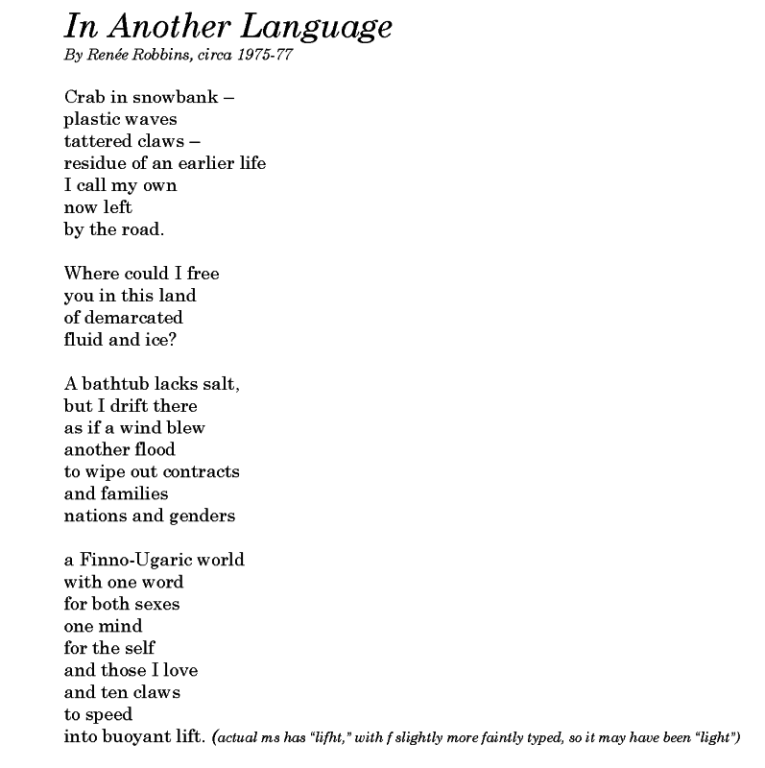
After paging through the papers, I transcribed the handful of poems I found, typing them into documents on my computer, a now ordinary device which would have been a SciFi marvel to her back when she wrote these poems in the 1970s. Could I perform some of them, here, as part of the Parlando Project? Could that seem like special pleading, an enforced overlay of widower husband wants you to shed a tear for his dead wife? Let me try to move you past that. Decades after a death, and when one is old enough to reasonably consider one’s own death to be a nearish interval, shorter than the one from that loss, loss begins to take on a universal and obligatory aura. These aren’t sentimental poems – my late wife, Renée Robbins, was funny and was wearing the full costume of life when she wrote them. Those costumes of life go back into storage, kept for use in later productions. Perhaps her poem “In Another Language” can be worn by someone still treading the boards?
Yes, these poems are little pieces of someone I loved deeply, written early in her too-short life, and bringing them on to you extends a tiny bit of what she was. Yes, it was particularly nice to feel I was working with and playing this part of her when I performed this poem this month – but yes too, it’s October: everyone’s wearing costumes and pretending they can see ghosts.
I can hear her responding to this situation. How? I’ll explain it with a quote from Woody Allen* that has been reverberating through my mind:
I don’t want to achieve immortality through my work; I want to achieve immortality through not dying. I don’t want to live on in the hearts of my countrymen; I want to live on in my apartment.”
So here you have it, a poem likely written while she was still in college, studying writing under Howard Mohr and Phillip Dacey. I’m fond of the obscure strangeness in the framing image. I can’t be sure what she, the author, was seeing. My best guess is a whole crab or lobster on ice in a seafood display, a mundane piece of unintended Surrealism – and being in a world of frozen water is also an accustomed strangeness to Minnesotans. I like the poem’s leaps, like the dream of the crab escaping to her bathtub, and the totally unexpected leap into the genderless cross-shifting-borders of “Finno-Ugaric.”**
Besides the crab image, I see Noah’s flood in the third stanza. I chose “lift” from the alternatives for that last line because it’s more sensual.
.
I performed Renée’s poem in a style that still hadn’t gone-out-of in the Seventies, as spoken word with an approaching-Jazzy musical backing: drums, bass, and two electric guitars. I believe the music, taken by itself, might shows the subliminal influence of a current band, Khruangbin. It’s subliminal because I don’t use as much reverb.
So, there you go. Looped through with the footnotes, we’ve got Khruangbin, Krasznahorkai, Woody Allen, my late wife Renée Robbins, Phil Dacey, The 1970s, and a fifty-year-old poem by a twenty-something. There’s a lot of intervals and strange harmonies there, but I’ll end with another quote from an artist (actually, from his less famous brother). I read this one in a recent interview answer given by Ken Burns when asked how he makes those famous “Ken Burns Effect” intelligence flights over photos as he edits his work:
It’s all music—my brother, Ric, said that all art forms, when they die and go to heaven, want to be music.”
So, there you go Renée, not immortal from non-dying – but you get music.
As you can see today, we stay narrowly focused on the topic here at the Parlando Project, and we will return with poems by more famous literary poets soon – but to hear Renée’s poem “In Another Language” as I performed it with music, use the player gadget below. No graphical audio playing gadget? I offer this heavenly highlighted link that will open a new tab with its own music player.
.
*I know a fair number of possible readers of this have strong opinions when they hear his name. I’ve got at least half of those myself. There’s a second, artistic, set of subjects regarding his work that would overwhelm the focus of this piece. To stay on topic, let me just say that my late wife was a comedy fan who could recite from memory the entire 30-minute Firesign Theater Nick Danger radio drama parody, and that Woody Allen movies were a constant date night thread in our relationship. Renée had opinions too, consistently caring ones, but she would have laughed at that quote, and I’m laughing now too, but with a deeper resonance to that laugh.
**My memory of seeing Woody Allen movies with my late wife was intensified by the recent death of Diane Keaton, but there was even more coincidence as I worked on this: the Nobel Prize for Literature went to László Krasznahorkai, who writes in a Finno-Ugaric language. And yes, that language group is non-gendered, even the pronouns – at least from what I find when I checked on Renée’s reference in her poem. And if I may risk one more Woody Allen reference, in my life back then I was (roughly speaking) playing more the Annie Hall role.
I’ve already mentioned that I’ve been dispensing with a lot of stuff, the kind of winnowing that I like to refer to as “Death Cleaning.”* This has included going through a series of stored-away boxes and plastic bins which dated back to moving into my present house in the 1980s. While somewhat illogical, this isn’t, I think, unusual. When we move, we’re moving forward, and there’s a tendency to liberally bundle and box up those things we think we might still want – and then in the new place, present time takes over and one never gets to unboxing things one doesn’t need right away.
Things of mine I found in these dusty bins? Music tutorial books, and books on French poetry and language. The former because this was the height of the LYL Band’s live performance era and I was hoping to increase my skills and knowledge, the latter because I was interested in translating Symbolist and Modernist French poetry.** More than 40 years have passed. I now know that I know just a bit more about music: mostly what I’ve found out about in order to create the over 850 Parlando Project pieces composed this century. That’s what became my tutorial: doing. I never got around to translating as much French poetry as I planned, though you will still see that interest playing out here sometimes. Back then, I thought French poetry was the key to English-language Modernism, and while that’s not entirely untrue, I now know the American influences some of the French poets took note of.
One night in this clean-out task, working in a small room with shelving that I think had once been the coal or oil bin for our Edwardian house’s early furnace, I pulled open one of the stacked boxes there.
It was likely the contents of a desk or file cabinet drawer packed away by my late wife in the 1980s. Inside the larger cardboard one, there was a metal box, the kind one might keep important papers in – but this one was filled mostly with things she had written. Looking through the pages, there were a few things that might have dated back to high school, and a selection of poems and short-stories, some for college classwork,*** some for her just post-college time when she submitted and had published poetry. A couple looked like work for articles she had published in Seventeen, then a glossy magazine for the teenage girl market. Also in the cardboard box were the contents of many a desk in that era: sheets of typing paper, the chalky white strips that one could carefully pinch just above the belettered hammer of a typewriter to blank out a mistyped character, and a few miscellaneous things from a job she’d had with Control Data.
I was steeled for the job of getting rid of things that had an adjudged expiration date of meaning or usefulness. I could easily chuck the general detritus of this typewriter wielding ghost, but I couldn’t throw out the manuscripts. How many poems were in the stack? Might I be able to perform some of them here? Maybe. “Death cleaning” sternly says you won’t get around to it. The Parlando Project whispers otherwise.
In this case, Public Image Ltd was not involved: Renee’s metal box and folder of youthful creative writing work.
.
So, the metal box went into the to be saved pile – but of course there is no real keeping. I’ve survived my late wife for 24 years, and I’ve been with my living wife for almost exactly as long as I was with my wife who died all too young at 43 years old. Actuary tables say I will die before any more such multidecade interval. Death cleaning has its solid argument: the writings of a young woman, or those of myself, the young man she partnered up with, will not have any enduring memorial. It’s a near certainty that is so too of all the poets I’ve known. We write words like the immortals do, with the same goals, to the best of our craft – but there are only so many niches in the pantheon.
Today’s musical piece is a poem I wrote condensing that experience. I can imagine the readers I used to have in my small group of poets wondering at an imperfection of the poem’s ending. “Why end this personal poem with such a mundane little observation about – what? – a business you don’t even name? Needs another draft.”
And I confess to you here, that’s the thing I’m trying to say. The most practical and commercial things we do in life come to an end, are forgotten – all that stuff we’re told we should be doing instead of writing poems, making music, or creating art. So then, forgive us our arts.
You can hear my musical performance of the poem I call “Exhumation” with the audio player below. I wanted this to have rough edges, and so the guitar recording tries to capture and leave in pick and fretboard noises that you’d usually not hear by intent. What if the intended audio player gadget is not where I say it will be? No worries, some ways of reading this blog toss it out, but I supplythis highlighted link that will open a new tab with its own audio player.
.
*I think when I first heard the term it was “Swedish Death Cleaning” and the process was imbued with practical Scandinavian modesty. The florid sentimentalist of objects within me has to listen to the memento mori enlightened elder in me: these are simply artifacts of one person’s life that are meaningless once that life ends. Somewhere in the corner, there’s a Modernist, smoking unfiltered cigarettes, in an Existentialist infested coffee shop, who exhales in blue and says to no one in particular, “Well, it’s all meaningless, save for what you compose it to be.”
**Mixed in were some faded to brown music papers from the Seventies and Eighties: Punk, New York Rocker, Sounds. I had them in the to-the-trash pile, but my kid wondered if they could digitize them and upload the scans to the Internet Archive. I doubt they will ever get around to that, but they’re young and should enjoy those provisional ideas.
***The little college she attended allowed her classes with Howard Mohr and Phillip Dacey.






 Frank Hudson