Dorothy Parker’s “Portrait of the Artist”

Is Dorothy Parker a humorist or a poet? If choosing one, do we diminish the other? Wikipedia leads with the latter – which surprises me a little, because if you’d asked me in the midst of my literary engagements decades ago, I’d have replied the former. The poetic literary cannon doesn’t mind wit, but it downrates those suspected of making humor the main point of their work. And there’s the matter of how it was presented: Parker published in general periodicals (though at a time when they were still engaged more than now with literary poetry). Her collections are filled with short verses sharply focused on catching the busy glossy page-turner a century ago. Are they the poetry equivalent of a New Yorker cartoon – some insidery cultural memeability, yes – but not meant to be judged alongside fine art with substantial complexity?

What if we were to read her in translation, and she was a writer from a culture and times we were substantially distanced from? Imagine a poem like the one I’ll perform today not as a 1920’s American work by a writer whose lifetime overlapped my own, but as a fragment of Sappho or a poem taken from the pen-work of Li Po? Might we see something else?*

Here are some things I see looking at today’s poem this way as I worked to set it to music and perform it. The first is some awkward syntax, some of which could be “poetese,” that mangling of normal word order that is reaching for a sense that this is “special” speech cast in some archaic or fancified manner. In humorous verse this is often used as part of the joke: you were expecting some grand edifice of beauty and truth – dressed in this artificial, inflated manner – and instead you get a pratfall? Ha ha! This still works as a humor tactic, though its sharpness is dulled by the relative absence of literary poetry in our culture. Needing to reach the rhyme is part of the humorous charm of light verse – forced or outlandish rhymes are laugh points. Parker doesn’t go Ogden-Nash-hard on this here, but I smiled when the “rankles” and “ankles” chime goes off in the first verse.

An allied tactic is the use of some unusual words, another high-falutin stance that aims to make the pratfall funnier. I actually had to fix my recording of this. Having recently worked on Yeats famous apocalypse “The Second Coming,”  I actually sang “And gyre my wrists and ankles.” “Gyve” is to bind or tie, “gyre” is to move in a circle or spiral. I don’t know, maybe I was visualizing RFK Jr’s falcons besetting the poem’s speaker with fetters in their beaks and claws.**
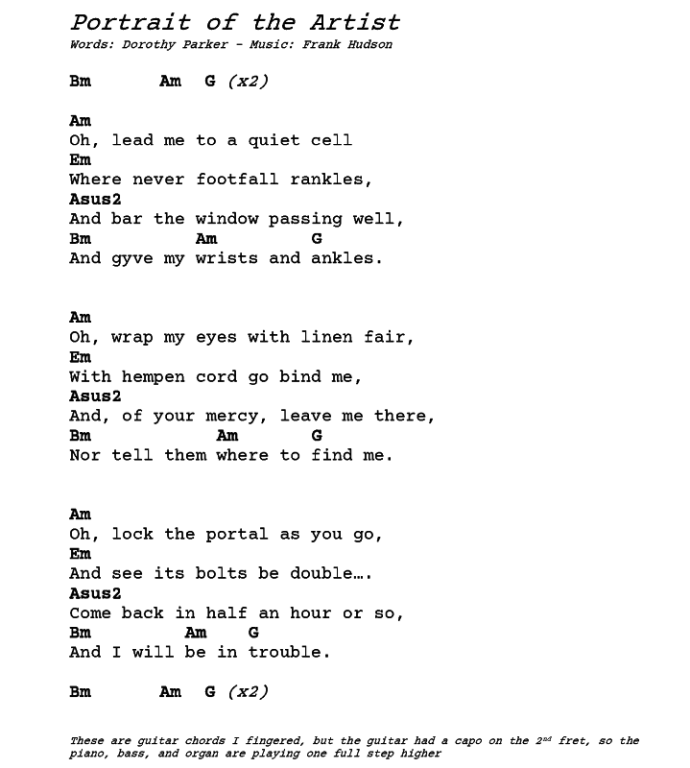
Portrait of the Artist

Here’s a chord sheet for the song I made of Parker’s poem

.

Also noted when dealing with this poem: the situation set out in the poem is extreme, and taken literally it’s a portrait of bondage, exile, or imprisonment. If parts of this survived as a Sappho fragment, I can see this being decoded erotically. Scholarship and kink cross-over more often these days – and the poem’s imagery is specifically sensual – but don’t put that in your scholarly paper until you do further research.

And here’s the last, most important thing I noticed: I’ve been living this poem recently. First off, a sidelight on the manner in which I found Parker’s poem: I have been going through books and disposing of most of them. My wife is distressed by the number of books and recordings I’ve accumulated over my life. Little difference most sit shelved at the edges of rooms, they are clutter,  and she believes that the space could be used otherwise. At this point in my life, I can see this issue another way: I’m of an age that there’s no world enough and time to imagine going back and rereading or reading the majority of them. Books that I once treasured as reference materials are likely obsoleted by the Internet. For example, I’m torn about keeping my thick hardbound French to English dictionary which was a companion when I started translating French poetry years ago. I’m keeping most of my books of poetry, and some on music, as I intend to keep doing this Project. Novels and general non-fiction? To be carried away.***  Is it clutter? Among my small segment of humanity, I’m not alone in being comforted by books and music surrounding me, and the irrationality of there being more than I can consume in whatever time I have left as an aged person doesn’t change this, but having accumulated an overwhelming amount submerges some books. Going through my books I was surprised to find a 1930’s printing of Parker’s collected poems. I don’t remember buying it, though I did spend time and a dollar or two in any used bookstore that had a hardbound poetry section during my youth.

Last week I read through the first segment of Parker’s book, work that is now in the public domain, and it’s there I found “Portrait of the Artist.”  I’ve mentioned recently that my opportunities to create new work here has become constrained. I’ll spare you the logistical details, but in the early years of this Project I had the five workdays of the workweek to research, compose, and record. The hundreds of pieces I produced in the first half of the Parlando Project’s run say I used that time productively – but if I was to be honest, I’d report that there were days I just blew off, knowing that the next day would be just as good to start or complete some Parlando work.

Now? I can’t tell for certain when I can record, I just know there will be fewer hours available. My energy level as I age is lower, and my old body no longer finds itself able to sit in an upright office chair for hours at a time. I do more of my research and reading on a tablet, which however marvelous, is a poorer environment for complex work with its constrained single smaller screen. I’m still able to play my instruments when I can use my studio space, though I need more time there practicing or simply blowing off the stress of life with a plugged-in electric guitar moving air around me. There are some mornings when my wife, being helpful, will tell me I’ll be able to work on recording for a few hours that day. I’ll think: I don’t have any new poem-texts selected, or the basis of a musical setting ready to be realized, and my energy is low. What can I do (anything?) with that time? And if I can’t do anything, when will the next chance come?

Whine. Whine. What else is the Internet for – complaint and its opposite, the carefully curated presentation of one’s perfectly actualized life to be envied. In Apollonian distance I can clearly see that to have the opportunity and the wonderous technology to do creative work, is a historical exception of the first order.

But then artists, many of whom are toward the introverted side, are often like the one in Parker’s poem: always swearing they wish they had the solitude and freedom from the distractions of life. And then the poet faces the blank page, the composer the silence in the room, their muse taunts them “What’ya got?” and the artist mumbles “That’s your job,” knowing that there’s really no one else in the room, just as they wanted.

There are lots of things in life that are temptations for self-pity or abuse. Sometimes the de profundis answer is “Ha ha.” That doesn’t mean it isn’t serious. The consequences for this troubled encounter with the chance to be creative, and perhaps to come up dry, have killed and crippled.

Simeon the Stylite 600

Simeon the Stylite has figured out how to get some work done without Robert Benchley, FPA, George S. Kaufman, Alexander Woollcott, et al.

.

All this feeds into the choices I made in the musical performance of Parker’s poem. I treated it no differently than I would have a “serious” literary poem by Parker’s contemporaries Elinor Wylie or Sara Teasdale, though I believe there are a couple of times I’m subtly winking as the singer seeks the situation of a desert-steeple mendicant. The fool is funny – still is when the situation is serious. This is often the lonely place of business for creativity: weighted on commercial and logical scales, it’s absurd that we do it – even, or especially, alone in that room with silences and tabla rasa.

You can hear this performance of Dorothy Parker’s “Portrait of the Artist”  with the audio player gadget below. What, is any such gadget gyved up somewhere? Well then, I provide this highlighted link that will open a new tab with its own audio player.

.

*We can prosecute mootings on more recent American authors too. I’ve recently written here on the difficulties in deciding how often Emily Dickinson means to make a humorous/satiric point in her poems vs. how often she’s an earnest transported romantic. A mixture? Likely, but what are the proportions? What are we missing if we miss the joke?

**Ah, the powers of overdubbing. I fixed that word-mistake ex-post-facto.

***I’m fond of the term “Death Cleaning” for this process. Time’s winged chariot is heading for Goodwill. While I’m blessed to be healthy for my age, I can no longer fool myself into thinking that someday I’ll get around to this, and that…and that, and that.

Michaelmas Day, and a new short video

I’ve got things to do today, but I awoke, thought of this piece from the early days of the Parlando Project, and figured I could make a quick “lyric video” for it. I don’t know how many get introduced to the things the Parlando Project does via videos, but I’m always looking to find new listeners to these musical combinations with various words (mostly other people’s literary poetry).

This one is unusual in that I use one of my own poems for the text. Long time readers here will know that one of our mottos is “Other People’s Stories.” It pleases me to generally make these pieces with other poets’ words.

Tis whiter than an Indian Pipe

Emily Dickinson poems are easy to set to music, but they can be more difficult for the performer. Having absorbed Protestant hymn books and folk songs in my youth, the common meter/ballad meter stanza Dickinson easily falls into makes it especially easy for me to find music for them. But then the composer me turns things over to the necessary performer me – and in that role I’m left with the question: what is she on about in this poem? What’s the attitude to the material she’s presenting: is she playful, joking, earnestly existential, or some hard to assay mixture of those approaches?

Here’s an example of how this dichotomy works out. In August I completed a setting and performance of a Dickinson poem, “Tis whiter than an Indian Pipe,”  inspired, as I was with the recent D. H. Lawrence “Bavarian Gentians”  poem, by a flower that my wife had seen and photographed on one of her nature walks. Working rapidly on that song setting I went with a casual judgement that this is a playful poem, a little portrait or riddle around the entirely pale white Indian Pipe plant. It has no green chlorophyll at all – doesn’t need it, it doesn’t use photosynthesis to get its nutrition, instead feeding parasitically off deep soil fungi. Dickinson may have been especially drawn to the plant (she had an avid horticultural interest throughout her life) because it’s, well, so weird. As the poem proceeds, my quick understanding was Dickinson commenting on its oddities. That would be consistent with other short nature portraits-in-verse that she wrote.

Ghost Pipe flowers photo by Heidi Randen 1080

If they are symbol of the afterlife, they aren’t immortal. The Indian Pipe/Ghost Pipe flowers are short-lived, and this one, near the end of its life, has lost its pipe-bowl shape.

.

Now in September, I looked again at the poem, and I can see the primary mistake I made leading me to understand this poem too soon. The poem begins “Tis whiter than an Indian Pipe.” Duh! While the things she writes in the rest of the poem could  be characteristics of an impressionistic plant description, she’s declaring right off that the poem isn’t about this unusual plant, though it will make use of the comparable flower as a symbol. Here’s a link to see the text of the poem and a scan of the handwritten manuscript including alternative words Dickenson considered.

What is the thing she’s sort of riddling us to guess is her subject? Some kind of immortal soul, some extension of being or consciousness past death. Oblivious to this at first, in this new understanding Dickinson’s poem is a good pairing with Lawrence’s “Bavarian Gentians” – each poem is examining the prospects of that “undiscovered country” past death, illuminated by a late-summer/autumn flower. This poem’s speaker (likely Dickinson herself) is unsure of such a thing: it’s colorless in the shade, makes no sound, is not something all can see. Belief in it might well be romantically exaggerated, “hyperbole.” This pale uncertainty continues, an ongoing “drama” about the possibility of an ongoing plot for our souls, instead of a tragedy’s concluding act.*

The original music and performance I created was lighthearted. In this new understanding, Dickinson is still playing, balancing thoughts about immortality, riddling with mysteries without solution. My new music would have a stronger “drone” center to depict on the necessarily faith or grounding in the unanswered question here. The core instrument in this recorded performance is my old Seagull Folk acoustic guitar, a smaller-bodied cedar-topped instrument, brown and worn as the leaf-beds the Indian Pipe might sprout from. For the drone grounds I played a tanpura, an Indian of a more correct than Columbian geography instrument. For drums, I stayed with the emerging South Asian sounds and played tablas with only the simplified technique I have for them.**

I liked how the new version came out. You can hear it with the audio player below. No player to be seen? Well, “not any voice denotes it here” – some ways of viewing the blog suppress the audio player gadget – but it be not tragedy, I supply this highlighted link that will open a new tab with its own audio player.

.

*Oddly, for all her oft-expressed gothic touches, she doesn’t use one of the symbolic plant’s other common names which include “Ghost Pipe,” and “Corpse Flower.” Perhaps the name she used was entirely predominate in her time and place? A supposition is that the plant’s long stem topped with a bowl-shaped flower is reminiscent of a ceremonial native American smoking pipe. By 1879, First Nations people were largely absent from Amherst (see also this extraordinarily brutal Robert Frost poem) – and to call this haunting plant “Indian” may have had a cultural or specific undercurrent for Dickinson.

1879 – I note this is a late Dickinson poem. Dickinson was very prolific in the early 1860s, but by this time in her life the number of poems we have of hers tails off. She’d gone through the death of her father, and her mother’s crippling stroke, and all the national casualties of the American Civil War – all occasions for considering if death was really the end. She wouldn’t have known this, but the 49-year-old poet would be dead herself in 7 years, but with the ghostly flowers we have within her poetry I can make customs of the air by singing them.

**Just to be clear – my studio space is cluttered enough – I used virtual instruments (computer databases of all the sampled notes and articulations of the actual instruments) to allow my MIDI guitar and little plastic piano keyboard to play those sounds.

I Should Turn to Be – Jimi Hendrix Tribute 2025

Thinking of the late Nineties, I think of the Sixties, 1970, and then the end of the 19th century. When you’re an old man, that’s the kind of swift mobility you retain.

It’s difficult to comprehend how short the careers of some musical figures from The Sixties™ were. This month I watched a documentary on Jeff Buckley, the charismatic late 20th century singer. One of the challenges of his foreshortened life was to deal with the artistic inheritance and distraction of being the son of another singer, one of those Sixties™ artists, Tim Buckley.*

Here’s something I think remarkable, comparing those two. Jeff Buckley was two years older than Tim when he died at age 30. Jeff left one full-length recording, his extraordinary, eclectic debut album Grace.** Tim, beginning in the onrushing Sixties, and continuing through its continuance in the early Seventies when rock performers were increasingly hobbled by drugs of dependence, released nine LPs! Nine,  moving between three  distinct personal stylistic eras in eight years.

Neither Buckley ever made it to the toppermost of the poppermost, but obscured by their creative and commercial hegemony, posthumous fame, and trailing post-group recordings, consider that even the Beatles band was a living presence for only seven years in America.

Back to the Buckleys – there’s a sharp line ending in their careers: Tim died of an overdose of drugs stronger than he expected, Jeff drowned in river currents during an unwise spontaneous swim. We may expect our artists to be audacious – risks come with that.

Which brings me to today’s annual duty, where I mourn the death on September 18th 1970 of my patron saint of The Sixties™ music martyrs, Jimi Hendrix.***  Time and again in these observances here I’ve tried to make the case that Hendrix – the rightfully proclaimed pioneer in expanding the electric guitar’s vocabulary – is underrated as a songwriter, and particularly as a lyricist. I say this, even if I believe such things shouldn’t be reduced to a rating, because his strengths there are just so under-considered. In the pursuance of this goal, I’ve done things like make the lyrics of “Third Stone from the Sun”  audible, and illustrated in a video the scenario of “Up from the Skies,”  but today I’m going to link the lyrics of one of Hendrix’s greatest compositions to a trope not of the 20th century, but more the 19th.

Are you ready for:

Mermaids.

In his song “1983 A Merman I Should Turn to Be”  Hendrix skillfully unravels a Science-Fantasy story without much wasted exposition: in a troubled world beset by wars and violence, a couple of lovers enter the ocean, find they can breathe underwater, and return to the salty brine from which we all have emerged through birth or evolution. Hendrix’s first-order inspiration for this tale is likely mid-century SF writing which he had been reading from childhood – but his imagination made this material his own and he should be remembered as an early Afro-Futurist – but let’s trace those SF stories he read back: the SF pulp writers were still following on from the Verne/Gernsback/H. G. Wells/William Morris late 19th century genesis of their genre.****

This week I went looking for literary mermaid/merman poems, thinking that a possible route into my Hendrix memorial this year. Surprise, there’s a lot of them!   I don’t have a theory as to why this would be, but a great many British Isles poets had a mermaid poem somewhere in their collected works from around the turn of their centuries. In some of the poems the sea maidens are depicted as sirens, luring men to danger or soggy death in their arms, and this kind of naughty sex/death double feature might be a good fit with Victorian decadence. Then there was the highly successful Little Mermaid  story of Hans Christian Anderson, but that’s an opposite plot from most of the poems: Anderson’s heroine wants to flee from the sea to the land, not from the land to the sea, and the mermaid is the story’s protagonist, not the landlubber male poets hearing sea maidens. Baring the example of Hendrix’s song, mermaids in my lifetime more likely follow Anderson fairy tale path onto dry land.

What turned the tide with this poetic trope? It might be T. S. Eliot’s famous use of sea-girl sirens in “The Love Song of J. Alfred Prufrock,”  his first prominent poem. The satiric uncommitted romanticism of the poem’s Prufrock concludes with human voices awakening us from the sea girl romantic/decadent dream. We’ve largely followed suit ever since.

So, for a text for today’s piece I decided to weave together sections of five mermaid poems from that earlier era,***** but I am putting them in the context of a memorial to Hendrix, on the anniversary of Hendrix’s death, which came to him slept-under from unfamiliar pills, drunk on wine – when and where the man who dreamed a tender escape into the sea died on dry land in the middle of London. He was 27, yes too young, only four years in the general public’s eye, yet he had created his revolution for the guitar, and four albums of songs, songs I maintain that are good enough to be remembered alongside the guitar playing. What mighty things to have done in such a short time.

I Should Turn to Be

Selections from mermaid/siren poems by Tennyson, Beckett, De la Mare, Symonds, Eliot, and Yeats were woven together to make the lyrics to today’s musical piece.

.

My song “I Should Turn to Be”  had to be created in a small amount of studio-space time, but I’m reasonably happy how it turned out. I was aiming for some dynamic range in this tale of doomed fantasies underwater, and I was able to get there. I haven’t been able to play electric guitar much for simple enjoyment this month, but even the focused playing to realize this composition felt good, so forgive the indulgence in two guitar solos – The Sixties™ would forgive me. You can hear the performance with the audio player below? Has any such player slipped beneath the waves? It’s just that some ways of reading this blog suppress showing the player gadget, so I provide this highlighted link that will open a new tab with its own audio player.

.

*I recommend that film, It’s Never Over, Jeff Buckley.  For a music documentary about a male artist, it’s remarkable that it relies largely on testimony from women. Yes, like most music documentaries it avoids talking in detail about music – and the musical examples are short clips, which may not convey enough of the man’s art for the uninitiated – but the emotional narrative is richer for this uncommon choice by the makers.

Tim abandoned Jeff’s mother to focus on making his first record and subsequent touring. Jeff broke up with his partner in the midst of trying to launch his own career, though without a child being involved in his case. Questions about his father bedeviled Jeff, understandably – more so in that both père and fils were taken with a strong ethos of living in the moment. Still, it’s hard not to note the similarities in the two singer’s unbounded singing, and the two even sounded a likeness when describing their dedicated artistic drives.

**In Jeff’s defense, his career as a recording artist was only 4 years, having not made his first recordings until his mid-20s. And the range of musical approaches he assayed over fewer recordings is comparable to his father’s.

***The tight cluster of the Jimi, Jim, Janis deaths in 1970 gave rise to that gothic “27 Club” thing. I’d be risking a lot of “who’s that?” shrugs if I’d say that I myself am probably more like Al Wilson, the singer/guitarist/folklorist who died on September 3, 1970, also at age 27. But Hendrix is my choice because he was as much a poet as Jim Morrison, and doubly an artist when he played his guitar.

****Reviving 19th century Victorian fashions and art was a significant part of the English psychedelic era. This undercurrent too might have led Hendrix to compose his merman/mermaid song.

*****One couplet introduces the piece that isn’t from a late 19th-early 20th century poem. Those two lines are from the most-covered Tim Buckley song, lyrics written by his high school friend and collaborator Larry Becket for “Song for a Siren” – another late contribution to the mermaid genre Tim Buckley released in 1970. It’s a haunted song, and it takes only a little dose of gothic romanticism to wonder if Jeff Buckley heard the sirens beckoning from out across that fatal river in Memphis. See, I wasn’t wasting your time with that Buckley stuff at the beginning, it’s a plan.

Bavarian Gentians

One of the things I’ve loved about doing this Project is the varied ways that poems come into consideration for performance within it. I’m not even sure after reaching 850 of them today, that I could catalog all the ways the words have come forward. Here’s an example: last week my wife was visiting a wildflower area — something she does often enough that I kid her that she’s a nature nymph with all the powers and duties thereof. She’d taken some pictures. One she showed me was of gentian flowers.

“Do you know D. H. Lawrence has a poem about blue gentians?” I asked

“The flower or the dye?”

“Mostly the flower as I recall.”

In actuality, I couldn’t recall much about Lawrence’s poem, only that it had once impressed me around the age of 19 or 20 when I had started to read poetry more widely. Now the old man-me did a quick web search before going to sleep that night and found Lawrence’s “Bavarian Gentians,”  likely the Gentian poem I’d barely remembered. I copied it and saved it for further exploration around a Parlando Project performance.

This week I began to work on that. The first thing I noted was the poem’s odd word-music. There is enormous use of repetition: words “blue,” “black”, “dark” and “darkness” reoccur constantly, and the flow of the poem seems less that of normal prose or poetry and more like a stuck-record ostinato.*  In performance I couldn’t see how to treat this as an elegant set of refrains, so I based my eventual performance on my first impression of obsession.

But there are twin narratives inside the poem’s babbling: observation of the gentian flower itself in the Imagist manner, and a retelling of the Persephone in Hades myth. What I feel links them (other than the obsessive refraining about the dark blue color of the flower and the coincident darkness of Hades’ underworld domain) is that flowers are the reproductive organs of plants, and the Hades and Persephone, daughter of Demeter, myth is about a male/female couple in the context of Demeter’s goddess of fertility.

bottle gentians by Heidi Randen

The bottle gentians that led to today’s piece. Like the Bavarian gentians in Lawrence’s poem, dark blue and autumn-blooming. This genus’ flowers stay in this closed budded shape, which hampers pollination, while the Bavarian gentians open into the vase or torch shape described in the poem.

.

And then, as I was fairly far along in my work with the musical performance you can hear below of “Bavarian Gentians,”  I made a discovery. There are two candidates for the official, presumed final text of this poem. It just so happens, the one I found in my quick bedtime search was the lesser-known one. The version that instead will be found in most cites and collections treats the Hades/Persephone/Demeter material at a more abstract level, while the one I’d been working with is much more raw and troubling. Note: I’m not a strict adherent to content warnings, but the account in the version I was performing likely deserves one: it’s an incident of sexual violence. Here are links to the two versions of the poem: the smoother one, and the rawer one I used. Keith Sagar and some other scholars question the predominance given to the smooth version and argue that the more explicit take was Lawrence’s final revision.

I can see how the more often reprinted version of this poem was chosen. It’s more graceful I think, and one could read that kind of change as the path of an author’s revision where later, more-removed, artistic judgement polishes the rough-hewn inspirations — but it could also be the kind of revision made to make something more marketable. Now knowing of the other version, I briefly thought I should redo my performance using it — it might communicate better to a listener who might only hear it once —  and another reason I considered a redo: the sexual violence depicted in the version I had first found presented problems.

I’ll briefly outline that problem. Let me summarize the Hades/Persephone/Demeter myth. Hades, the god of death and the underworld, abducts the young Persephone to be his bride against her will and she is unable to escape from this situation. Her mother, Demeter, a more senior and powerful goddess, intercedes and a compromise is reached. Persephone will be able to rejoin the above-ground world of the living, but she must return every winter back to Hades and his underworld of the dead. The myth here is transparently an explanation of the growing season in non-tropical regions. Told at an abstract PG level, and particularly in the expectations and context of classical non-equalitarian and clearly patriarchal society, it’s a “just-so-story.” We are not to experience horror with it.

But in Lawrence’s lesser-known version, this scene is portrayed: the poet’s speaker, using the gentian flower as if it could be a lamp, follows an abducted Persephone and Demeter, this child’s mother pursuing in rescue. They enter Hades, a place of complete darkness, Persephone and everything else for that matter cannot be seen, but sound remains — and this is heard: Hades (called by his Roman name, Pluto*) is raping Persephone.

Did Laurence mean for this account to make us recoil in horror, as I did when I needed to confront the text for performance? Shouldn’t the text call for that? Or was it intended as just some ancient fantastic myth given a bit of specific detail for which the author had and expected no overwhelming empathetic reaction? There are readings of this poem’ that see a metaphoric synthesis which is only on some surface level horrible, and something else on a metaphysical level.

I don’t know enough to say for sure, if there’s a “sure” in this case. Like the sexual violence and exploitation that was woven into Eliot’s “The Waste Land”  without drawing significant emotional weight from most (and mostly male-oriented) readers for decades, it could go either way in authorial intent — but I’m not the author, I have to perform this, I feel that horror, and I expect some listeners will feel the same. Frankly, this makes me a little dissatisfied with my performance of this piece, though I tried not to shirk its implications, however imperfect the result.

What could have driven Lawrence to use this myth in such a way, and in this version, to keep in the horror? He was working on this poem knowing he was facing a mortal illness. Like poets John Keats and Adelaide Crapsey, he was dying of tuberculosis. I have no knowledge of his experience of sexual violence, but Lawrence was undergoing viscerally an abduction against his will into the underworld of the dead. He might have felt that his poem, starting and ending on the consideration of the (by natural fact) bisexual flower justifies that element of considering Demeter and Persephone, and his anima will be taken away to die along with the rest of him by the disease. Make your own judgements on these issues; they may be wiser than mine.

The final line of this version has a contrasting power to what precedes it. The erect yet open gentian flower — which despite its shape was after all useless as a torch in Hades’ dark —  spreads in dark welcome at the draught of the light of a day.

If you’ve progressed this far past the trigger warning, you can hear my performance of one version of D. H. Lawrence’s “Bavarian Gentians”  with the audio player below. No audio player to be seen? Some ways of viewing this blog suppress showing it, so I offer this highlighted link that will open a new tab with its own audio player for those situations.

.

*I figure much of my audience is old enough to grasp that metaphor, but a footnote for the rest: the vinyl record with a deleterious wound to its groove which won’t let the needle progress beyond one stuttering spiral revolution.

**Lawrence’s use in the poem of the Anglicized Greek names for Persephone and Demeter, but the Roman name for Hades, Pluto, puzzles some readers. I suppose it could just be a Cortez-on-a-peak-in-Darien kind of poetic error, but I wondered if this poem, written in 1929 might have been recently soaked in the Pluto name from the discovery of the then considered 9th planet. Close, but no cigar: Pluto was discovered in February 1930 at an observatory created by the poet-related astronomer Percival Lowell in the American Southwest region that had recently been Lawrence’s home.

My remaining theory on why Pluto? Having the underworld and its god-king both using the same name Hades makes it harder to distinguish between the two.

The Cherry Blossom Wand

Here’s a poem by a poet you may not know of. I certainly didn’t until early this year when I saw a note about the later life of Anna Wickham on Bluesky, read the linked article (which I recommend), and made a note to look into her poetry.

Well, there’s life and my disorderly path – it wasn’t until this month that I did so. As a page poet Wickham may not capture you easily, depending on your expectations. I read a 1921 American collection that combined two books of hers published earlier in England: 1915’s The Contemplative Quarry  and 1916’s The Man with a Hammer.*   She wrote almost entirely in short formats, there are quite a few 8-or-fewer line poems that can remind one of Emily Dickinson poems of similar length. Short formats can be favored by those who dash off poems in an otherwise occupied life, and this may be the case here – but at least on first read through, there’s a different general attitude from the American genius. Dickinson to my reading is often playful in her poem’s argument, and even when writing of subjugation or from inside a gothic fantasia, she generally seems in control – and she was after all a member of a family that had achieved local prominence and financial stability. Wickham’s background seems less secure and more bohemian, and from 1906-1929 she was married to a man who is reported to have viewed her poetry as a sequalae of mental illness.** This horrid situation is reflected in the poetry – there’s ample counter-punching wit and protest deployed against the patriarchy in these two collections – but that also presents a certain closed-in feeling. Some of these poems take on the manner of quickly-whispered-where-he-can’t-overhear asides to friends from a woman in an abusive relationship. From extant drafts we know Dickinson had, and took, time to revise her verse, and she often strikes me as a talented structured improviser. Wickham (so far) seems to me to be more a jotter of quick poems from the first-thought-best-thought practice – biographical scraps I’ve read reinforce that conclusion*** – and some (most?) of her papers that might show more about work in progress do not survive.

older Anna Wickham in her kitchen

Anna Wickham in 1946. She made her living by turning her Hampstead home into a rooming house. Still asserting herself, she famously took umbrage with someone declaring: “You’d better retract, my good man. I may be a minor poet, but I’m a major woman.”

.

There’s a good chance my appreciation of her work will increase, but I also didn’t get a sense of compelling word-music on first reading, and that’s a quality that can attract me to a poem even before I understand it – which makes the first poem of hers that I’ll present today a bit of an anomaly. “The Cherry Blossom Wand” is  musical, and she even put a notation beside its title on the published page “To be sung.” I have no knowledge if she wrote music for it, or sang it,**** but that sort of thing is taunting the Parlando Project!

I see the poem as being a multifaceted account of beauty or love of beauty (and if we extend that, to love itself). The poem starts with its refrain stanza, telling us a branch of cherry blossoms is a “wand” that can do some kind of merciless bewitching magic. I like the refrain’s final line “a beautiful thing that can never grow wise.” Ambiguously: either we never wise up to the thrall of beauty, or that experience, time and wising up removes the beauty.

Blossoms are of course famously temporary, as the first non-refrained verse reminds us. On the page, Wickham only puts the refrain first and last, but since songs favor repetition, I put an extra refrain between the two verses.

The final verse before the ending refrain contrasts the merciless enchantment of the blossom wand with the “kind” removal of the bewitching beauty, and the verse then ends with its own internal refrain saying that the transience of beauty and time is eternal. There’s no change that can change that change, and the mercy is that we are not taunted long with its brevity.

As a whole then: bittersweet.

Cherry Blossom Wand

Chord sheet for the song I took as commanded by Wickham’s note on the page

.

Musically I got to play my nylon string guitar for the first time in a while. Every time I play that variety of guitar, I’m reminded of the cheap J C Penny nylon string guitar that I bought off the after-Christmas sale table in late 1974 to begin to learn how to play. Classical guitar players may be appalled, but I currently play my nylon string with a pick, which is wrong – but it’s how Willie Nelson does it.

You can hear my performance of Anna Wickham’s “The Cherry Blossom Wand”  with the audio player gadget below. Has some merciless hand removed any such player?  This highlighted link will bud a new tab with its own audio player then.

.

*Some accounts say Anna Wickham is more read and studied in the U.S., which would be the reverse of some poets I present here, most notably Welsh poet Edward Thomas who has some best-loved poems in Britain, and is hardly known in America. Influential 20th century American anthologist Louis Untermeyer thought enough of Wickham’s work to praise and include it. The Feminist-Modernist angle probably occasioned some interest too, and you can read her as a predecessor to Sylvia Plath in some of Wickham’s themes. Before she had a career as a best-selling novelist, American poet Erica Jong wrote a couple of poems dedicated in part to Wickham: this one, and this one.

**Wickham was eccentric. The linked article that sparked my interest has accounts that make that eccentricity seem charming, but depression seems to have figured in her life too. The complexities of our mental wiring and biochemicals mixed in with the stress of her life makes remote historical diagnosis chancy of course. The close publication of the two books of poetry that I read as a combined collection coincided with her husband going off to WWI, giving her some increased autonomy. Give a moment to imagine Edwin Starr singing a revised song: “War!! Uhh! What is it good for? Giving Anna Wickham a chance to see her poetry in print. Good God! Say it again!”

***The account of her reading one of her poems in public and presenting it with ““Rubbish, but there it is”” indicates this approach.

****After a childhood family sojourn to Australia, Wickham returned to England to take study in performing arts, particularly a singing career, though that doesn’t mean she composed music. The Cherry Blossom Wand”  has been set to music as Art Song before, at least this once 25 years ago.

She mentioned abandoning any search for musicality in her poetry in one of the poems I recall reading this month. This could be part of Modernist distain for frippery, or a practical act of triage for a poet without enough time. She’s a contrast to her American contemporaries Sara Teasdale, Elinor Wylie and Edna St. Vincent Millay who wrote very musical verse even as they wrote about Modernist concerns.

Sedition. A poem which isn’t, and that’s a point it’s making

Edmund Vance Cooke was a Canadian poet. At least I think he was. There’s not much on his life I can find, and sometimes his last name is rendered as “Cook.” His sparce Wikipedia entry says he was born in what was then known as West Canada in 1866, and back around the beginning of the 20th century he wrote a type of popular published poetry in a style that has largely died out. Wikipedia calls his genre “inspirational verse,” and some of it I’ve found is that: paeans to earnest striving and social virtues that now-a-days would be reduced to short easily-sharable quotes or the captions on “hang in there” motivational/affirmation posters. But there are indications that social criticism was also part of his repertoire, and this poem I perform today has some bite to it. Though written in 1917, I felt I should work up some music and sing it as a freshly-made song in 2025.

One of the things that irks me most this year is the outrageous lying by my country’s mad despot and his fawning courtiers. I can’t say for sure what drives all these fabulations and alibies across his administration. For some personalities a lie is a demented reflex, a neurological tic. Others spout the lies as a cold tactical choice of propaganda, with a sense that it will gain them some rewards. A more generous assumed motivation: that by saying this or that is so, when it’s not, may help manifest the thing not yet in existence – and this is akin to what affirmations invoke for personal improvement. Alas, most of the things not yet in existence that our current regime members are manifesting by statement are ugly, cruel things. We shudder – while considering the exaggerations, we fear they might not stay lies for long.

Today’s Cooke poem “Sedition”  is a statement of the countervailing powers of truth. It reminds me of an anonymous poem about truth that was widely printed in the same era as Cooke was writing, “Truth Never Dies.”   Five years ago in this Project, I presented that poem and wrote about what I found about who had republished it. This link will be of interest if you wonder about that. Though it’s a statement without evidence, it’s not impossible that Cooke was the author of the much reprinted “Truth Never Dies”  poem – but “Truth Never Dies”  is a more religious and spiritual poem than “Sedition.”   I composed music for the former with acoustic guitar and strings presenting it as a firm, but gentle prayer. The latter, Cooke’s poem, is more sardonic, defiant, even militant – and so I decided to crank up some electric guitars for it.

Sedition

Here’s a chord sheet for my version of Cooke’s poem. I won’t take responsibility if you decide to play and sing it yourself, –  that might make you part of a conspiracy.

.

I played three guitars in the recording via multitracking. For the electric guitar nerds, the center channel has a Gretsch hollow-body playing the chords, the right channel’s a Jazzmaster solid-body with a pitch-shimmering wiggle stick, and the left side a Telecaster whose wide vibrato here was created by having enough personal frustration to expiate that my fingers directly wrung the strings sideways to way above their fretted pitch.* I associate this kind of guitar solo with Canadian Neil Young’s credo that sometimes your intent is to not sound like a “professional guitarist,” some master of tasteful licks and precise intonation.

You can hear the performance with the graphical audio player gadget below. No gadget? I’m not lying – some ways of viewing this blog suppress the player, so I offer this highlighted link that’ll open its own tab with an audio player.

.

*”Hey, posh-guy, you’ve got a lot of guitars there.” I accumulated cheap imported versions of these guitars over 30 years, using trades, hunting up second-hand examples, and waiting for sales. Coincidently, the current regime’s tariffs are threatening what has been a golden age of reasonable quality, good sounding instruments for musicians with limited funds.