Does the summer feel like it’s gone by like a dream, one of those dreams where the ungainly night-plot finds its own winding path? I started this summer with a May Day suggestion to remember to write of our workday labors, and then too, I presented back then a cover song marking my teenager’s last childhood summer. And now it’s Labor Day weekend, and I’m going to present a poem that is the antithesis of paid labor, another poem from the 1894 Songs of Vagabondia book by Bliss Carman and Richard Hovey. We’ve already heard from Carman this month, now let’s sample some Hovey.
Richard Hovey is another of those pre-Modernist era poets who wrote in the final years of the 19th century. Because his work falls before the Modernist revolution and the ascension of American poets to a preeminent place in English language literature there’s lesser interest in it, but with a figure like him I think of a bright young man living in an age that felt stirrings of desire to form its own poetic styles.
His Songs of Vagabondia struck a carefree chord in its time. Tennyson, Longfellow, or Robert Browning would have presented a very serious life that should be attended to. The Vagabondia poems, with intent, fail the Sandburg Test I’ve proposed to assay poetry collections. If my beginning-of-Summer cover song asked the listener to indulge in “That Summer Feeling,” these poems concur. There’s no Winter and barely an Autumn there. No work or studies either. Instead, we have flirtations and libations, the comradeship of likeminded friends, and here the open road and heart are spent without anything much in one’s purse or paycheck.
For this Hovey poem from Songs From Vagabondia I chose to create a denser piece of music, a presumptuous rock band ensemble with two drumsets, electric bass, piano, two electric guitars, along with string synth and wind instrument parts. For a Labor Day holiday song about an aimless trip down a Maine river, I spent quite a few hours working to form this into shape. I’m not sure I produced the perfect arrangement after all that, but I enjoyed the process.
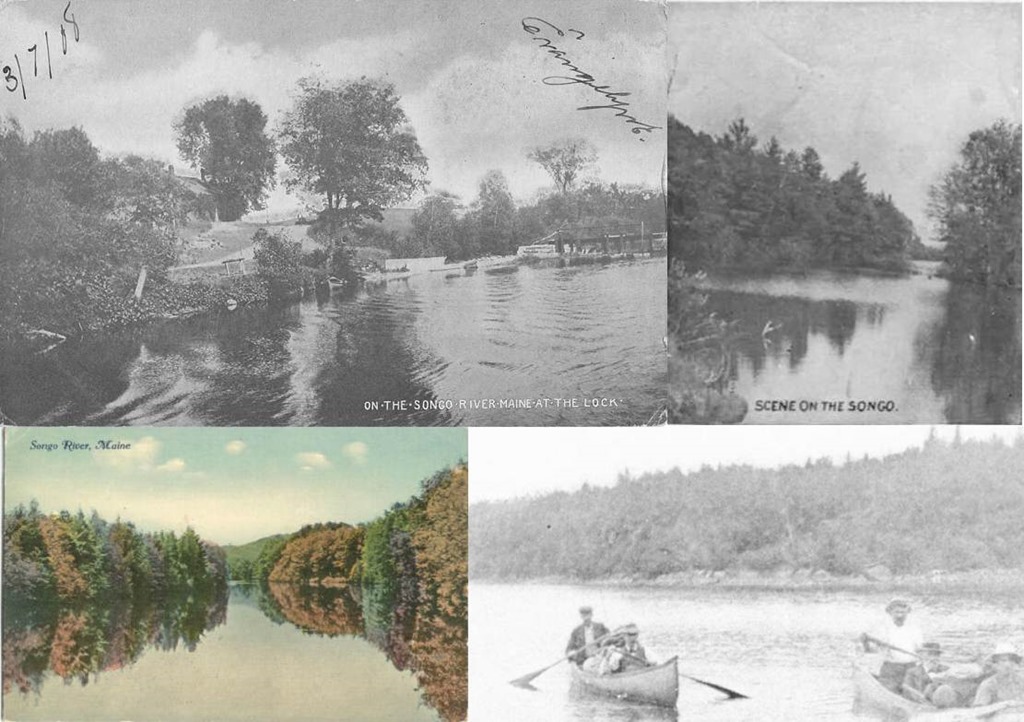
These Songo river photos look like they could have been taken within a decade or so of Hovey’s poem. Looks bucolic in these, but others show passenger steamboats (one named for Maine’s poet Longfellow) plied the river too.
.
The Songo in Hovey’s poem is a short river in Maine, but the Songo connects a large lake and some other bodies of water — and though I don’t think the poem mentions it, it had then (and still has!) a hand operated set of locks and a swing-away draw bridge constructed in 1830.* Hovey’s poem makes this river sound rural and solitary, but having never been to Maine, much less the Maine of the late 19th century, I can’t say how busy it actually would be. The poem’s voice says someone is using oars for propulsion, so even if this is an aimless pleasure trip, there’s work involved just as there was in my recording the song I made of the poem. At the end of the poem there appears to be someone else in the boat, as the poem’s voice cries out “Kiss me” unexpectedly. Who is the other there? Could this be a Hendrixian excused kiss of the sky-blue-water-sky? Maybe, but a lover would be the likely (if unprepared for) guess. The unprepared suddenness of this ask seems dream-plot strange to me.
In my performance I turned the poem’s remarks about the experience being dreamlike into something of a refrain to further emphasize that element for someone who might hear this once as I perform it. I also removed one short stanza from the poem’s original text in the interest of shorter performance length. You can hear the full band performance of “Down the Songo” with the graphical audio player you should see below. No player? This highlighted link is an alternative that will open a new tab with its own audio player.
.
*This short modern video shows the continued remarkable operation of the manual lock and drawbridge. Yes, these are hand-cranked mechanisms! So, Sandburg Test met with this post, there are necessary folks working a job on this river, even if unmentioned in Hovey’s poem.



 Frank Hudson