Reading Carl Sandburg’s American Songbag

I spent much of today reading through Carl Sandburg’s landmark 1927 folk song collection American Songbag,  all 500-plus-pages of it. It’s not the first time I’ve looked into the book, and indeed I’ve paged through it or jumped to songs I was interested in before. But next month I’m planning a trip to Sandburg’s boyhood home in Illinois and to Iowa City where I will be taking a look at some papers relating to early 20th century poet and professor Edwin Ford Piper who was one of the sources of folk song material used in Sanburg’s anthology.*  So, looking at the book in full seemed a good grounding for this trip.

I’ve made the case before here, such as this post from a year ago, that besides being a somewhat deemphasized Modernist poet these days, Sandburg is a primary model for the American Folk Music Revival, which eventually produced in the second half of the 20th century several genres of popular and semi-popular music.**  Here’s the matrix that Sandburg built in the 1920s, a hundred years ago:

  • American folk music can be appreciated like art music
  • It will be associated with literary poetry
  • It expresses, or can be adapted to express or accompany, progressive/left-wing causes
  • It’s multi-ethnic, and the contribution of Afro-Americans will be substantially acknowledged
  • Humor and funny stories will be part of its presentation

Sandburg was including segments of folk music performance as part of poetry readings before American Songbag.  AFAIK we don’t have any transcripts or recordings from that era, but all these things are demonstrated for the record in the 1927 book. Sandburg is not the only American doing any of these things a hundred years ago, but he’s doing all of them at once,  and he’s doing it with a degree of fame and cultural acclaim that was significant.

I was aided in my rapid march through American Songbag  by already knowing many of the songs it contains, and as I encountered them I remembered hearing them in my half of the 20th century performed by Woody Guthrie, Pete Seeger, Bob Dylan and many of those other “folk singers” that surrounded them.***  The Sing Out magazine and Jerry Silverman folk songbooks of the Sixties that are my foundation, are successors to Sandburg’s work, right down to the touch of  using vintage B&W line drawings as interspersed decorations.

Sandburg often includes little stories about the collector (Piper was one of a group who collected the songs “in the field” for Songbag)  and for those he collected himself he says a few words about how, where, and with whom he first heard the song. Here’s one of the most engaging of those stories I came upon today in the book:

Once when the night was wild without and the wintry winds piled snowdrifts around the traffic signals on Cottage Grove Avenue, Chicago, we sat with Robert Frost and Padraic Colum. The Gael had favored with Irish ballads of murder, robbery, passion. And Frost offered a sailorman song he learned as a boy on the wharves of San Francisco.

The song Frost sang for Colum and Sandburg? A subtle wry ballad of farming? A nuanced lyric of nature cooly observed? No, it was this one. Some will know it from its latter association with the Assassin’s Creed video game franchise:

.

*Besides the folks songs Piper contributes, Sandburg even quotes a part of a poem from his contemporary Piper’s Barb Wire  poetry collection in Songbag.

**Besides the Folk Scare of the 50s and 60s, the American “Rock Music” that extended Rock’n’Roll to FM radio, college campuses, and rock critics was generally formed from folks who had connections with the just preceding folk revival. Modern Americana and roots music links to the same strains and connections that Sandburg was personifying 100 years ago.

***Guthrie composed music for Sanburg poems later. Ruth Crawford Seeger (Pete’s step-mom, Mike and Peggy Seeger’s birth mother) was one of the composers who created harmonized music for the folk songs in Songbag,  and she also set Sandburg’s page poems to music. When the young Bob Dylan started to expand the poeticism of his song lyrics, he decided to pay a visit to Sandburg, briefly meeting him unannounced in North Carolina at Sandburg’s farm. Other folk luminaries connected? At least a couple songs collected from Leadbelly by John Lomax are included in Songbag.  Lomax is credited, but Leadbelly isn’t, though Leadbelly’s more general public career hadn’t yet started. Let me just say that Lomax’s relationship with Leadbelly is complicated. Just this month I was reading a recollection of a performance by Spider John Koerner (who first performed in the mid-century Minneapolis folk music scene along with Dylan) where he told a humorous story about a farmer who fed his pig by lifting him up to the branches of an apple tree. That’s a story Sandburg also told. I’ll also note that when I came upon several songs in Songbag,  the rendition I recalled from the Folk Scare of the mid-century was by Dave Van Ronk, a wonderful performer and a mentor to Dylan when he arrived in New York.

William Carlos Williams “The Birds” and what nature sounds

Something about the Spring I noticed this year — oddly, this year as an old man who has had a full lifetime of Springs — is the intensity of natural sounds in my city. There’s a tendency, demonstrated in many poetic tropes, to make nature a portrait or a silent movie, putting nature in contrast to the noise of our civilization’s hum and bark.

I ride my bicycle nearly every day off to a café to have a breakfast, sometimes early enough to feel like the single soul on the street, but by the return trip certainly part of the city waking and doing: kids on their school bus stops, sometimes with a parent, sometimes waiting with their own cohort only, folks holding coffee flasks unlocking their car doors to go to work, a few other bicyclists, including those on big front basket bakfiets or long-tail rear-seat-shelf bikes holding small kids, this observant cargo watching whatever in the morning beneath their pastel helmets. The human noise is slight and clicking. In such mornings we are more like crickets rubbing their wings.

But the birds! When most of those humans are making only accidental noise this early, and the kids waiting for the yellow bus aren’t always talking, perhaps practicing quiet for the ordered schoolroom, the birds are singing at the tops of their voices in the morning. Like miniature feathered fiddles, their song cuts through larger sounds, it insists on being heard. “Ladies, I got your genetic material here!” “This is my and my kind’s tree!” “Whatever this is, this Spring, I am here, and I’ll use my breath to say it!”

Like us bipeds lacking much fur, other mammals aren’t sounding much. Yard bunnies are suspicious and quiet. The squirrels don’t chirp, and their little feet make quiet footfalls. The dogs on leashes: all nose-leading in an alternate sensory dimension. But the frogs and toads are singing out too — whole amazing choirs of them, all wanting to contest Emily Dickinson’s Nobody with a harrumph and high whistle of who they are.

So, it is this Project’s nature to add sound to page poetry. Today’s audio piece is just me alone with a Telecaster electric guitar during a hurried session early this Spring to put down some musical ideas. In the poem that I’m combining with my music, “The Birds,”  William Carlos Williams follows Imagist principles, melding a moment into concrete images. Given that we’ve just had a set of rainy days throughout the long holiday weekend in my city, I resonate as Williams poetically paints the bird-morning wet as undried paint.

Is the world not “wholly insufflated” as he says at the start? The bird song is breathing into our world — nature is not silence, but poetry aloud.

Strange Powers Magnetic Fields photo by Heidi Randen 600

My wife found these* stapled to poles around our neighborhood on Sunday.

.

You can hear my performance of Williams’ “The Birds”  with the player gadget below. No gadget to be seen? This highlighted link is an alternative that will open a new tab with its own audio player. Want to follow along with the text of the poem? Here’s a link to that.

.

*This bird couple’s heads are superimposed over a human pair of heads from the cover of The Magnetic Fields Holiday  album. The quatrain quoted below is from a song found there “Strange Powers.”   Despite being a substantial Magnetic Fields admirer myself, I had never seen this album cover.

That Summer Feeling

I could, maybe should, write about a number of things this weekend. The end of May brings Memorial Day, one of the United States’ two holidays celebrating those who served in the armed forces, the spring version being more focused on those who died in wartime duty. It also brings to mind the anniversary of the drawn-out, agonizing death of George Floyd a few blocks from where I’m writing this. I think of that little group of South Minneapolis people, ordinary citizens of my neighborhood, who witnessed it, who pleaded with the police officers to cease their officiousness. I think of the new policemen in that squad, earnestly following the lead of their trainer who’d arrived, the man with his knee on Floyd’s neck. Duty.

Duty is a small word, but one that we have two holidays to honor. We generally respect it, and in small and large ways we carry duties through our days. My wife does in her workdays what I did for a couple of decades, taking on the duty of helping the sick. In between workdays she takes on the obligations to her mother suffering from increasing Alzheimer’s in a care home.

I’ve written about all those things here. I could write at length about them here tonight. In doing so I could say I am following my obligations to humanity, to those who suffer, to those who’ve lost. We use poetry often to decorate those tasks, more often perhaps than we use the more capricious song to do so. Thus I could write, and you might view it as your duty to read that.

Instead, I’ve been filled this month with the realization that this is my teenager’s last summer as a teenager. They’ve concluded an indifferent year of post-secondary education, and now have taken their first job. As to next Fall plans: they are thinking of stopping with school, saving money from the job, and moving out. Studying seems like a duty — their work-a-day job does too, but maybe it’s a more novel duty, or at least one that has a biweekly award of a paycheck.

Music is a key to memory, particularly emotional memory to me. During these feelings this May, I came upon a performance of a song by Jonathan Richman. Richman has an utterly strange career. He’s one of those you might see called a cult artist, which means those who “get” him sometimes puzzle those who don’t, but also it means that many who read this won’t know his work at all. As a teenager Richman became something of a Velvet Underground* superfan, and his early work shows direct influence of Lou Reed’s songwriting. In the early 70s he and his band The Modern Lovers recorded more than a dozen tunes that prefigured a lot of what was to come in Punk and Indie rock a few years later, but the recordings were not issued when they were made. Then in 1976, when the first stirrings of Punk were drawing attention, they came out along with newer recordings.

Here’s complexity to that odd: the old, early 70s songs and recordings were unvarnished, and they followed Reed’s model of being emotionally honest, but their timbres and approach would be in tune with some of the vanguard of what was called Punk at that time. The newer songs were even more childlike, though no longer being written by a teenager or recent teenage time-emigrant, and the sonics were quieter, even more stripped back. As his career continued, Richman generally proceeded down that path, writing ever more childlike songs focused on everyday wonderment. If his early singing called on some of Lou Reed’s snarl and assertion, the later work took on elements of 50s Do-Wop teenage innocent sweetness.**  Richman in a sense started out before his time, had a recording career launch when his early work seemed of the moment, and then continued until the present day as a singer-songwriter presenting the impression of coming from a place that was younger and younger.

The song I heard while thinking of my teenager at the borderline, “That Summer Feeling,”  was sung by a 40 something Richman a couple of decades into that career. On Richman’s record the Do-Wop influence is apparent, backing harmonies and call and response from additional voices. Compared to the version you can hear below, there are more verses, more detail of youthful specifics. Blind to the career history I’ve summed up above, you might easily think someone about 19 or 20 recorded it, fresh with passing through that borderland.

Here’s the intuitive choice I made when I decided to quickly work up a cover of “That Summer Feeling:”  to record it more in the style of the early 70s The Modern Lovers recordings than the “mature” Jonathan Richman. If I had more time, I would have overdubbed a garage rock guitar solo at the end or maybe some combo rock’n’roll organ as those records sometimes had. Following my taste, I preferred the songs less specific but most summer-set verses.***  This musical change and the way I sang the lyrics also brings out more of the undercurrent in this song, a complexity that a casual listen to a more smoothly produced recording might let one overlook. The singer isn’t just doing a let’s remember our youth story here. He warns in slightly mutating refrains that that youth will haunt you, and then he pleads with the (presumably teenage) listener to not wait until they’re older to, what — it’s not entirely clear — somehow integrate that duty-free time’s outlook fully into oneself or it won’t just haunt you, it’ll taunt  you, and finally it will hurt  you “the rest of your life.”

Would any kid ever listen to that message? Doubtful. My fatherhood duty knows limits, even counterproductive effects, of advice. Still, I wanted to sing it anyway.

After the jumps of this Memorial Day post, I won’t make the proforma Memorial Day holiday wishes. Some will be decorating graves. Some will be thinking of how life was disregarded. Some are caring for the sick and infirm. Some will be having cookouts or taking a little vacation trip away from work. Black joy, worker’s rest, flopping down in the grass without any duty, playing or listening to music. We honor duty. Let us also honor some respite from it.


Here’s my performance of Richman’s song.

.

*As many writers do, I must reiterate the Eno quote about how only a few thousand bought the first Velvet Underground record — but that everyone who did went out and started a band. Historians have determined that the record actually had decent sales, but Richman is one of the early examples of direct VU influence. The early Modern Lovers band included folks who would go on to being in The Talking Heads and The Cars.

**The small vocal ensemble 1950 style of urban teenage music that got called Do-Wop was often written by teenagers or near teenagers — and like the Punk, Rap or Indie music that followed later, it was inexpensive and approachable to create for the kids who made it. Arch cultural critics and satirists-in-song Lou Reed and Frank Zappa both appreciated it, thought it honest in its innocence. Punk founders Patti Smith and Lenny Kaye met because Smith loved an appreciation of Do-Wop that Kaye had published. I on the other hand have vocal limitations that keep me from indulging in the style.

***I am struck by the specific the song takes in one verse where it goes from singing swimming ponds and cool lawns to a traffic stop. I don’t think Richman meant to make that an existential moment, even if our modern gun-soaked life might make it seem so now.

A little Madness in the Spring

Today’s musical piece uses another very short Spring poem by Emily Dickinson “A little Madness in the Spring.”   I was reminded of this poem when I attended the May Midstream Poetry Reading Series this month where Thomas R. Smith opened a set of his own poems by reading this one of Dickinson’s. If you’d like to follow along, here’s a link to the text of that poem. Spring madness is not an unique poetic subject, but there’s an odd character we meet in this 6-line poem: a clown. Smith told us that “Clown” in his mind is best illuminated by understanding that the word emerged from a character that would have been understood as a country bumpkin. Checking on this, I confirmed that. The silent, white-makeup, big-shoed, red-nosed presentation that likely arises in your mind when you read “Clown” has not yet come into its full form when Dickinson wrote her poem, but the rural clod stock character reached back through commedia dell’arte to the works of Latin and Greek comedic playwrights.

I can’t say how Dickinson visualized clowns in her mid-19th century. I don’t know her access to whatever comic drama or the opera bouffe, but she might have run into clown characters in books or periodical reviews too. One thing that occurs to me: an American form that uses stock buffoons that was popular in Dickinson’s time and place was the minstrel show. Minstrelsy is infamous for using largely white actors playing black slaves acting foolishly, a context which cannot be disengaged from the larger social evils of slavery and white supremacy. It’s not to excuse our parochial evils to note that these character tropes existed outside of the peculiarities of America and white blackface.

When I had seen “A little Madness in the Spring”  with its “Madness,” “King” and “Clown” before I heard Smith read it, I casually thought the poem referenced Shakespeare’s King Lear.  Looking at that today, I can’t find evidence for it. The Fool in Lear  is always The Fool, the word clown is never used. Nor is Springtime evoked in the play.

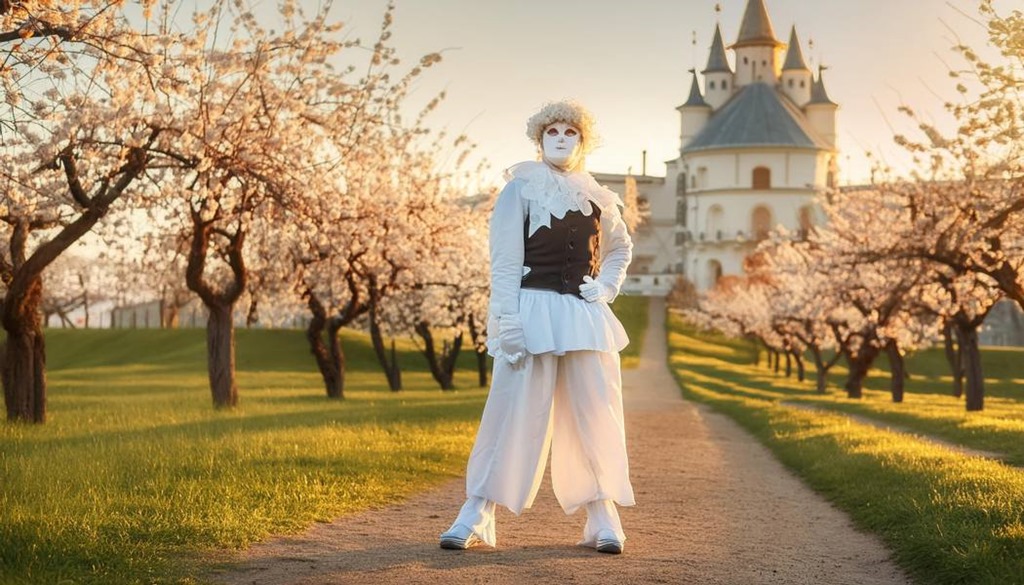
A little Madness in the Spring clown 600

“As if it were his own…”

.

So, I think Dickinson may have a generic King and Clown in her little poem. The meaning I’d extract is: It’s fine to be irrational in Spring, even if one has powerful responsibilities, but even more so we should note the foolish notion of the innocent peasant or farmer clown who observes all this new growth of spring, the “whole Experiment of Green” and believes it is their property.  One fine point I’ll put onto that last part: even an unschooled farmer — and avid gardener Dickinson too — would know the work and craft that goes into starting a garden, crop field, or orchard. A King might puff himself up and portray that husbandry as “his own,” but the man or woman dealing with the exact logistics and labor knows well their part, regardless of who owns the crop or the field.

Is Dickinson winking at that difference in her comparison of the King and Clown? But neither labor nor legal papers and titles make the Earth and Springtime fully our own. We sing it, but the music comes from elsewhere.

You can hear my musical performance of Dickinson’s “A little Madness in the Spring”  with the audio player gadget below. No gadget?  This highlighted link will open a new tab with its own audio player.

.

Sexton!

For a cluster of reasons, it’s been increasingly difficult to create new audio pieces for this Project. For one thing, having done over 750 of these pieces during the past 8 years, a lot of musical ideas, poets, and poems have been explored already. For another, my increasing age and high-mileage body have decreased my stores of reliable energy and dexterity. But one other reason is that I no longer have a predictable and luxurious access to times when I can record something that involves a microphone. Oh, I still get such time — but I don’t always know when it’s coming — and so an opportunity may arise, and I’m committed to something else, or it comes about and I’m weary and spend it napping or resting my aching old frame, or it opens up, and I have nothing prepared to record.

This frustrates me even as I realize that what I do have to bring to the Parlando Project in terms of resources and time is something to be grateful for.

Yesterday I had foreknowledge of one of those recording times coming. I collected two things I wanted to do something with: a well-known poem by Emily Dickinson and another musical piece that I wanted to record just for my own personal enjoyment. As I sat down in my studio space to record my musical performance of the better-known Dickinson poem, I noticed on my music stand a chord sheet for a lesser-known Dickinson poem I had done the music for early this spring: “Sexton! My Master’s sleeping here. ” “Sexton!”  hadn’t been recorded, even though it was ready — I didn’t have the time in early Spring as I rushed to do all the pieces on the children’s verse theme I had chosen for National Poetry Month.

Dickinson’s “Sexton!”  is an early Spring poem, a season that arrives at different times in different climes, but I figured that I needed to record it right away if I was going to keep it at all timely. I grabbed a dreadnaught guitar (a larger, more powerful sounding guitar than my usual instrument) and quickly refreshed myself on how I had intended to perform “Sexton!”

I was so eager to record on this occasion when the restrictions to making a sound had fallen away that I ripped into the piece at a reckless tempo. A choice or a mood? Moot point, I had to get on with it. Thinking about that tempo today I also wondered if my teenager’s hardcore punk listening had seeped into my mental metronome. But then “Sexton!”  does start with an exclamation point, and the whole poem is that: an exclamation of Spring.

Of course this is Goth Emily — so even if her poem and performance are as short as a cut by the so-rapid punk bards of San Pedro The Minutemen, there’s context crammed into 90 seconds. Here’s a link to Dickinson’s poem if you want to follow along. What do we find in those words?

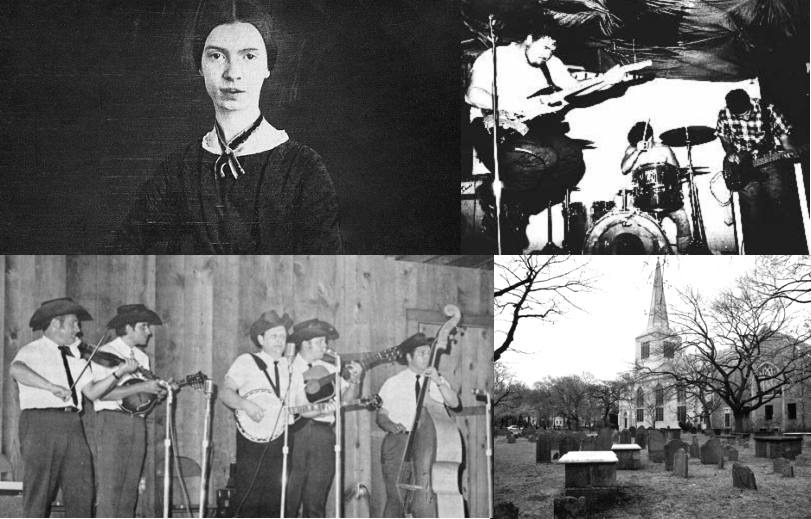
Dickinson-The Minutemen-Ralph Stanley and the Clinch Mountain Boys-graveyard

This is what you come to the Parlando Project for: stuff that’s stuck on each other like cockleburs.

.

A sexton* takes care of church grounds, typically including a graveyard. The sleeping Master’s bed chamber is therefore likely a grave. Spring has come with flowers and birds expecting new life.**

Spring isn’t stopping to reflect on this, like the tempo of the song it’s got work to do. Dickinson is in a churchyard, but it’s full of death departed and life arriving, not dogma. What replaces that dogma, sermon, homily? Bird-troubadours, secular Spring-song: its shortness, its insistence. You can hear my performance of Emily Dickinson’s “Sexton!”  with the graphical audio gadget you should see below. No gadget?  This highlighted link is a backup that will open a new tab with its own audio player.

.

*By anachronistic coincidence, the poem’s sexton made me think of Anne Sexton, a 20th century American poet. Poetry is like a cocklebur: its tropes and metaphors will stick to anything.

**More coincidental connections: in considering Dickinson’s poem in the context of a song I thought of this Earl Sykes song, best-known from a Ralph Stanley bluegrass version, called “A Robin Built a Nest on Daddy’s Grave.”   I wonder if Sykes knew Dickinson’s poem, or if there’s some third source that both the poet and the songwriter tapped for this springtime combination. My Dickinson poem-now-song would make a good medley with Sykes’ song —and good bluegrass high vocals and harmony would certainly spruce up my rough-hewn singing performance.

Pea Brush

There are more things than well-made that a poem can be — but as someone who’s worked to make their own poems work, I can use that experience to admire what Robert Frost does in today’s piece.

“Pea Brush”  is a rhymed iambic poem, based on four-foot lines, but it throws in enough variation that it never seems like it’s limping along in its gait. The rhymes aren’t fancy, and at least for me, they quietly chime along in the background without calling attention to themselves. This is prosody that isn’t bragging or showing off. It was easy to sing in my rough-hewn manner for the most part,*  but if I was to reformat it into blocks as if it was prose, it wouldn’t seem all that strange either. Indeed, as I performed it, I wanted to stress its conversational quality.

If you’d like to follow along, here’s a link to the text of Frost’s poem used for my performance.

I myself haven’t had a garden in decades, but one friend of the blog Paul Deaton covers their kitchen garden regularly at his blog, and alternative Parlando voice and keyboardist Dave Moore has a garden that we talk about sometimes. I could imagine reading the first-layer plot of this poem as a post Paul might make. “I’ve arranged with a neighbor to use the small limbs from some birch trees he’s clearing as poles for some of my climbing garden plants. When I went to pick them up on Sunday, I noticed bent-over wildflowers** blooming under the brush pile. My reuse of the felled branches will help my pea vines and give the wildflowers room to grow.”

Besides this clear plot line, there are fine clear images in the poem’s story: the smell of sap still in the air from the just-cut trees, the pause in the frog’s song, the near-like to a baby’s grip of an adult’s finger to the tendrils of a climbing plant on garden stakes.

Pea Vine Tendril!

 Wishing good luck to all the gardeners reading this.

.

Below this surface, what is the poem trying to convey? The poem’s speaker (as a character perhaps a more prosaic farmer than the poet and indifferent farmer that Frost was) just notes the practicality of the arrangement — free garden stakes — while letting us in on the blooming of May flowers and the promise of harvest aided by this arrangement. Frost the poet has written this well-made play, painted this scenery, blocked and directed its performance. The play portrays the give and take of humankind in nature. We’ll grow (and consume) the peas with their infant tendrils. Neighbor John has amputated the treescape for his own agricultural designs. These are planned acts of life and death. The episode of the frogs has them portraying those things outside our plans, their Sunday-service silence to hide from a two-footed demigod that might come to capture them to a final silence.

I’ll note too the poem’s ending “had to come” interjection breaking the meter to make a final statement of the budding wildflowers that couldn’t wait for humans to make their plans.

I had to make do with a single hour to get this musical performance down today, and I chose to grab an acoustic guitar to get this accomplished. The results felt right enough to produce this new piece that you can hear with the graphical audio player below. No player?  This highlighted link is an alternative that will open a new tab with its own audio player.

.

*The line “The same as you seize cat’s-cradle strings” is a bit of a tongue-twister. And while I get Frost’s image clearly in that line’s stanza, the syntax is a little disordered I think.

**Frost names his wildflowers as trillium. I don’t know if Frost was the exact botanist that his friend Edward Thomas or his great New England predecessor Emily Dickinson were. Neither am I, but I’m often open to researching specifics like this in poems. I find that one of the species of trillium that grows in Frost’s New England is the Nodding Trillium, a variation that grows crooked stems naturally, not because a brush pile has altered its growth.

Happy May Day to the workers in song

It was quite the April for me, and I’m resting up today before getting on with a bunch of tasks I’ve put off while working on the accelerated posting schedule for National Poetry Month. Readership was up substantially, busiest month ever for visitors at this blog, and page views blew past the old record by over a thousand. I should be better at replying to your comments and encouragement, but besides being focused on the work I have a mental Catch 22 where I often can’t decide the best way to respond, and in that indecision put off responding.

Car Sandburg - The Sandburg Test

.

I didn’t put anything new for International Workers Day today, but I’ll repost this piece with Carl Sandburg’s words from his longer poem “The Windy City”  that I created for last autumn’s U. S. Labor Day. In posting it last year I suggested something I had bounced off my old compatriots in The Lake Street Writer’s Group, something I call “The Sandburg Test.”

Let me suggest a rough analog of the Bechtel Test.  Let me call it The Sandburg Test. To be clear, it’s not my suggestion that every poem has to be about work, about the things we do for our daily bread. But, if we are viewing an anthology or substantial poetry collection from a poet, to pass The Sandburg Test it has to have poems that deal with work in some substantial way. How does the speaker or characters in the poem relate to work? What are they doing that work for? What is it in presenting them that portrays something about life? What are the mysteries, sensations, and systems of that work?

Here’s that musical performance of Sandburg’s words from “The Windy City” accessible with the graphical audio player you should see below. No player to been seen?  This highlighted link is an alternative.

.