When I said Halloween series, did you assume that that would mean the sidelines and backbenchers rather than the serious literary poetry we sometimes take out for a musical spin here? Let me break through that expectation quickly with today’s selection from seven years of the Parlando Project — it’s a part of a literary poetic landmark, T. S. Eliot’s“The Waste Land.”
When it comes to dread, I’m not a fan of jump scares — I rather prefer the slow build — but did I frighten some casual readers who are reaching to click to the next web site already? I hear you muttering.* “The Waste Land’ — isn’t that long, boring, indecipherable, so full of stuff you need footnotes for?”
OK, so you believe you have a fresher aesthetic than some old Modernist war-horse — but I do wonder if there isn’t a chill as sudden as a just unconcealed weapon or bared fangs, a suppressed shuddering beneath the contempt. “Is there going to be a test? Do I have to write an essay on what it means — pretending it means anything to me?”
Schoolwork. Many learn to love and to hate poetry in that single place.
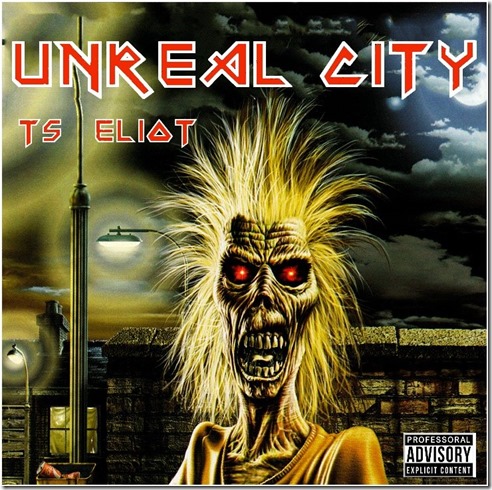
Done over several Aprils here on this Project, I used music and performance in my serialized presentation of the whole poem to remind us of the abstract ways that music makes us feel through non-literal modes, without explications and decoder rings. The unreal city section of “The Waste Land,” sliding for now over the specifics of place names and time-jumping references, is just a nightmare of the possessed and undead, of a speaker so PTSD’d by a world decimated by violence, epidemic, and careless oppression that the masks have fallen off the faces of his city. The dark humor of friendly small talk is of dogs digging up corpses.
Additional advisories: wear sunscreen, and don’t look directly at the sun without the proper filter.
.
You can hear the performance of the unreal city section of “The Waste Land” with the audio player many will see below. No player visible? This highlighted link will open a new tab with a player that will let you hear it.
.
*Sure, you have that over-tape or closed shutter on your web cam, but rather than composing, recording, or researching new pieces, I instead have been listening to the microphones on your devices. I actually don’t care what you say about parents, children, partners, bosses, or coworkers. I’m listening with dread to what you say about my making the best of my voice and somewhat restricted musical skills. Dogs digging corpses out of the garden aren’t scary compared to those fears.
And of those infamous footnotes in “The Waste Land?” Have you considered this: are they a frightened nerd being asked to show what he means?
What’s coming up? Halloween! And I’ve decided to dedicate the rest of this month to accelerated posting of some of the Parlando Project’s favorite pieces of fright, fantasy, and the uncanny. There will be ghosts a-plenty, curses, creatures, spells, and graveyards. The Project has done over 700 combinations of various words (mostly literary poetry) and original music over the past 7 years or so. The poetry is of different styles and eras, and the music differs to, at least as much as I can make it do so.
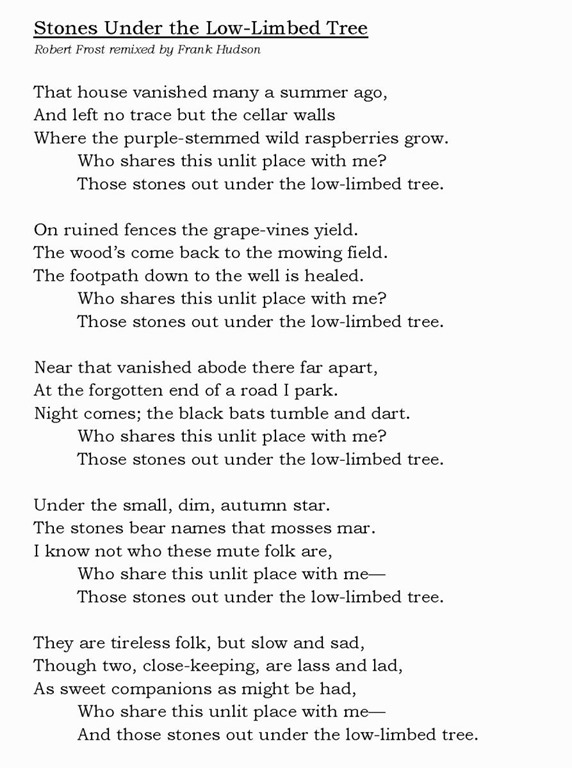
Here to kick things off is a poem by one of America’s favorite poets, Robert Frost, that I adapted and recast in making it into a song. Can Frost do eerie clothed in nature’s homespun? I think so. Frost called his poem “Ghost House.” I revised it enough that I decided to use a different title when I presented it in 2020 as “Stones Under the Low-Limbed Tree.”
If you compare my lyric to the original poem hyperlinked above, you can see I refrained things more than Frost did in his page poem
.
You can hear the resulting song with the audio player below. No player to be seen? This highlighted link is an alternate way to hear it. It’ll open a new tab with its own audio player.
Does any poet know if their work is any good? Some perhaps have that conviction, but at least during substantial moments I think the majority of poets have doubts. This drives some poets to ever tinker with and improve their writing, and causes others to abandon the idea of poetic writing as a useless pretention. Some even numb themselves to the question — yet anything that numbs doubts can overshoot and numb creativity too.
Do bus drivers and child-care workers have these doubts about their work? Do politicians or generals? Is a poet’s lack of confidence in their work generally less than other artists? Let me only take the last question. I do think more poets have more doubt, because their audience is usually small, and that audiences’ response is so muted. Actors, musicians, or other performers can expect immediate audience response, it’s in the nature of their work that it exists only in front of others. Poets, even successful ones, read publicly much less often than they write. The attempts at bringing performance to poetry, with slam and other spoken word variations are seen by many literary poets as corrupting the complex and more contemplative aspects of their art. Novelists, screenwriters, the authors of non-fiction and memoir, can lucidly dream of paydays that would be fantastical for poets, and it’s not unusual for poets to step aside from their poetry to those other writing fields seeking something they can touch and deposit on account from their work. Visual artists are as abstracted from their audiences while doing their work as poets, but we have no auctions of living artists poetry that bring bidders to the alexandrine numbers.
So, in such solitude, such silence, or even within the quiet, diffuse reverence of award-winning poets, there is most often doubt. What would it be like if poetry was on most everyone’s mind, if living poets were giants in our culture?
Since I started this project I’ve sometimes thought of Longfellow, an American poet who reached that level of achievement. The American culture of Longfellow’s era wasn’t more educated or entitled to access to high culture that we are today. Yet, I grew up in a town, and live in a city now, which from that time created streets and spots, and named them for him like we would for Presidents or Generals. My father and his father would know, would memorize his work. We do not need to travel back to Classical Greece or the Confucian Odes to imagine that level of poetry in our culture.
And yet. Longfellow has disappeared, and as far as those that do care about poetry this is regarded as neither mistake nor injustice. This isn’t due to scandal. AFAIK, Longfellow lived a praiseworthy life. He must have said or written some things we could condemn, but on the big issue of his age, slavery, he was on the side of the angels. He was a nationalist, but an internationalist too. He may have appropriated First Nations names and legends with insufficient grounding, but he did it to ennoble not dehumanize them. No, the main reason we have dumped Longfellow off the bookshelves of our culture is that he doesn’t excite or move us in the least. His poetry seems like old civic statuary covered in pigeon dung, not worth noticing, and not worth any effort to replace.
American poetry is a different country now, and Longfellow is exiled from it.
Inside poetry, in its provinces, and within old classics where we might still retain interest, there’s current discussion about Emily Wilson and her fresh translation of Homer’s Iliad. Wilson has been clear in discussing her practice of translation. She assumes or assays that there must be something there in the archaic Greek. Her task, she writes, isn’t to make a work that sounds like the original text, or to bring us its most exacting word-for-word translation, but to make a new poem that works like the original must have worked for it to have had the impact it had — a version which we can by extension expect to be something like the authors best intentions. We believe this is what Homer deserves, regardless of if our tactics vary from or agree with Wilson’s.
We do this for Dante. We do this for Du Fu. We even do this to some degree with Shakespeare’s plays. We don’t do it with Longfellow. Why not?
We may think there’s nothing much there. We may think that Longfellow’s English is close enough to our modern English that to do so would be presumptuous or dishonest to the work. This last objection is a funny combination with the first. If there’s nothing worthwhile there, who cares what we do with it?
For a recent live in the studio LYL Band recording I decided to “translate” — or more exactly, extract and arrange for greater direct effect to the modern ear, a portion of a lesser-known Longfellow poem, one he titled “Epimetheus, or the Poet’s Afterthought.” Epimetheus, for those not up on your Greek mythology is Prometheus’s contrasting brother. If Prometheus is a hero, however tragic his fate, Epimetheus is the “Oops! I did that?” guy, a total fool. Prometheus is the I’ll give humans fire and suffer the eagle eating my liver forever hero. Epimetheus is the ”What’s in that cool box, Pandora. Let me have a look” disaster.
In my version I left Epimetheus out of it. Pandora too. Longfellow’s poem is a Friday-the-13th thirteen stanzas long and would require more melody and virtuosity than I can muster to capture a modern listener’s attention. I cut it to three stanzas, modified a couple of pieces of archaic word-order, killed one perfect rhyme for a near one. I did this because I think there’s a core in the piece that might speak to me or you without delay or overly baroque elaboration — and that’s the intent I found in Longfellow’s subtitle. If you write, particularly if you write poetry, you likely know the feeling: that joy and initial appreciation of the inspiration that carries you into the first draft, only to be followed by the problems of realizing the best poem that escapes us. And the completed poem? It travels out to a place where there are only wanderers like us.
Here’s my much shorter adaptation of Longfellow. The full poem as originally published is linked here.
.
You can find that performance of my revised version of Longfellow with the audio player many will see below. Don’t see any audio player? This highlighted link will open a new browser tab that will have such a player.
I have trouble at poetry readings. Oh, I enjoy them, but they tend to spark off ideas and associations* in my mind. When I come back from those jumps in my consciousness the poet reading in front of me may have gone off to the next poem — and I feel like I have been delinquent in my duty as an audience.
A couple of months ago at the poetry reading series I try to attend regularly,** a poet was introducing a poem, and somewhere in between that poem’s introductory material and the poem itself this connection, this metaphor, occurred strongly to me. I don’t now recall what it was the poet reading said. Was it something about an acoustic guitar? Possibly. Something about a church? Maybe. That I can’t remember says something about the utter rapidity and completeness of my leaving that room and into the germ of this poem.
Here’s the poem presented as a chord-sheet with the guitar chords I used to accompany it.
.
I saw immediately the churches of my parents’ and grandparents’ generation, small Midwestern US churches. Usually wooden and white with a steeple’s neck outside, and inside largely one room, the sanctuary within the single story, filled with dark brown wooden pew benches. A basement below, small children’s bible class spaces and a kitchen that smelled of brewing coffee, the sanctum of wives, mothers, and grandmothers of the congregation after weddings, funerals, baptisms.
The particular church most in my memory is decades gone, but this nearby one will serve as an example.
.
When one thinks of churches, I suppose some think of grand spaces, cathedrals or those more modern large urban churches built to approach that scale and presumption. Weighty stone buildings, as unresonate as tombstones, intricate carvings and décor. Grand halls, chambers, perhaps a pipe organ, for they are the pipe organs of buildings, elaborate and encyclopedic, overwhelming anything human that would manipulate it.
The modesty of those small-town Midwest churches, the woodiness of them, has its own glory. And so it seemed natural to connect them to a instrument that is somewhat of a point of origin to me musically, the acoustic guitar.
I don’t know how well this little poem will communicate that to those who do not share my experiences with those buildings. I accept that a poem can’t be everything. There’s one detail in my poem that might not make sense or image to some readers: the attendance list. In my recall, it was common for these churches to have a board that toted up the attendance for the last service. I’m not sure that sign’s entire purpose. To remind those in the sanctuary that they were part of a continuance? Could be. The small continuances are what these churches contained.
You can hear my musical performance of “Quiet Sanctuary” with the audio player gadget you might see below. No player to be seen? I offer this highlighted link as fall-back then. The link will open a new tab with its own audio player.
.
*It occurs to me that I rarely have ideas as such so much as I have associations, things that seem to recall other things or suggest other things yet to be connected. It’s possible to write poetry without the poems containing metaphor, that kind of association, but most poets don’t. That trait may be why I’m drawn to poetry.
**That reading series, held the second Thursday of the month in St. Paul Minnesota, is the Midstream Reading Series. I know some of my readers are from the Twin Cities area. I find this event worthwhile, and you might too. Though I’m often inarticulate in person, I would try to say hello if you were to greet me there. Next reading is this coming Thursday, October 12th.


 Frank Hudson